In today’s fast-paced digital landscape, businesses constantly seek ways to enhance efficiency and effectiveness. One powerful solution that has emerged is marketing automation. This innovative approach allows enterprises to streamline their marketing efforts, improve customer engagement, and drive growth.
This blog explores marketing automation, its benefits, and how Vtiger marketing automation can increase your productivity.
What is Marketing Automation?
Marketing automation is the use of software to plan, execute, track, and optimize marketing activities without relying on manual effort at every step. It helps businesses manage campaigns, capture and nurture leads, personalize communication, and measure performance from a single system. Instead of isolated actions, marketing automation connects data, workflows, and channels into a repeatable process that scales.
Why Your Business Needs Marketing Automation?
Marketing teams often face execution gaps as volume increases. Manual follow-ups, fragmented data, and delayed responses reduce control over campaigns. Marketing automation addresses this by structuring how activities run, how data moves, and how decisions are triggered, bringing consistency and operational clarity to marketing execution.
Operational Efficiency
Routine activities such as follow-ups, audience segmentation, and campaign scheduling run through predefined workflows. This reduces manual dependency and execution delays. Teams operate within a repeatable system, allowing more time to focus on planning, optimization, and coordination with sales.
Lead Management Control
Every lead interaction is tracked and evaluated within the system. Behavior-based scoring highlights intent levels, while automated routing ensures timely assignment. This prevents lead leakage and creates a clearer transition between marketing and sales without relying on manual intervention.
Measurable Marketing Impact
Campaign activity is recorded in a centralized view. Engagement, conversions, and contribution to revenue can be traced back to specific efforts. This enables performance reviews based on actual outcomes, making marketing decisions data-led rather than assumption-driven.
How Marketing Automation Works?
Marketing automation functions through connected workflows driven by data and user behavior.
Data Capture and Segmentation
Customer data is collected from web forms, emails, social channels, and campaigns. Contacts are segmented based on attributes, behavior, and engagement patterns.
Workflow Execution
Predefined rules trigger actions such as sending emails, assigning leads, or updating records. These workflows run automatically once conditions are met.
Monitoring and Optimization
Dashboards track opens, clicks, conversions, and drop-offs. Marketers refine campaigns continuously using real performance data instead of assumptions.
The benefits of Marketing Automation in a CRM
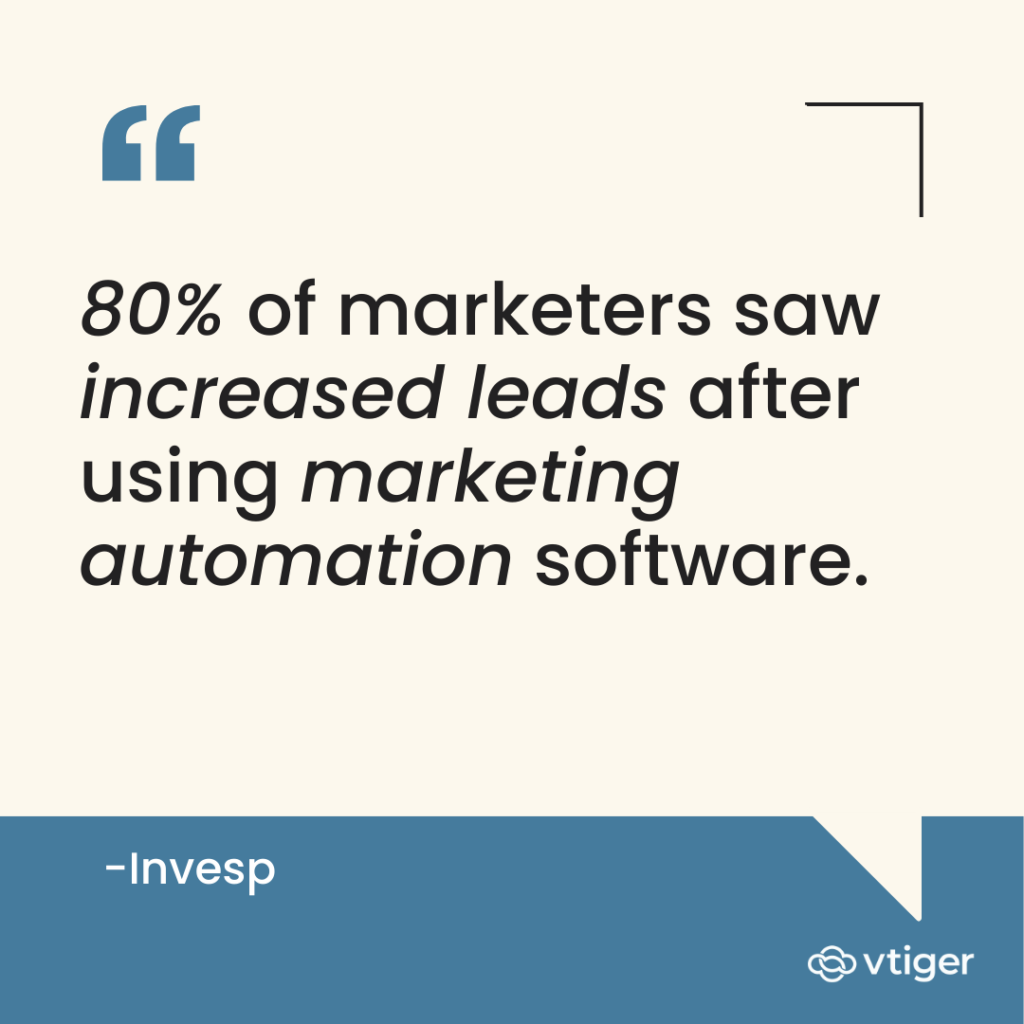
Over one-third of marketers use marketing automation, says Forbes1, and for a good reason. Here are a few ways marketing automation will benefit your business:
- Saves time and makes your processes efficient
Automating repetitive tasks like email campaigns, social media posts, and ad management allows marketing teams to focus on more strategic activities. This increases productivity and reduces the need for manual intervention.
- Content Personalization
Marketing automation enables you to deliver personalized content to a large audience. By segmenting customers based on behavior, preferences, and demographics, you can tailor your messages to resonate more effectively with each segment.
- Lead Generation and Nurturing
Automating the marketing and sales process allows our team to focus on nurturing high-quality leads while gaining insights into customer behavior. By tracking user activities—like website visits and social media engagement, you can understand their interests and position in the purchasing journey, enabling automatic lead scoring.
Marketing automation delivers timely, relevant content to nurture leads through the sales funnel, increasing conversion chances. This is crucial for small businesses, as not all leads convert. Marketing automation streamlines this by setting up workflows that send targeted messages based on predefined triggers, enhancing engagement and efficiency.
- Data-Driven Decision Making
Automated systems can collect and analyze vast amounts of data, providing insights into customer behavior, campaign performance, and ROI. This data can be used to refine marketing strategies and make more informed decisions.
- Consistent Customer Experience Automation ensures that customers receive consistent messaging across all channels. This helps build brand loyalty and trust, as customers have a seamless experience interacting with the business. It automates responses to specific customer actions, such as sending abandoned cart reminders or personalized product recommendations, fostering a sense of individualized attention.
- Scalability
As a business grows, marketing automation allows it to scale its efforts without a proportional resource increase. Automated processes can handle growing leads, customers, and campaigns without requiring a significantly larger marketing team.
Marketing Automation in Vtiger CRM
Vtiger CRM’s marketing automation capabilities are designed to generate leads and execute marketing campaigns efficiently. Here are some key features:
- Webforms
Vtiger webforms are customizable forms that collect visitor data on your website. With a drag-and-drop interface, you can easily rearrange fields. Leads are automatically assigned to sales reps, streamlining management. Vtiger also handles duplicate entries, allowing you to keep, update, or append data, ensuring your CRM remains organized and facilitating efficient lead connections.
- Email Campaigns
Email marketing is a cost-effective way for businesses to engage a large audience and connect with interested customers. By delivering targeted, personalized messages, companies can enhance engagement and conversion rates while fostering ongoing communication to strengthen customer relationships. This approach keeps the brand top-of-mind throughout the buyer’s journey.
- SMS Campaigns
SMS campaigns enable bulk messages to be sent to your contacts’ phones. Vtiger’s feature allows you to craft compelling SMS, schedule optimal send times, and set up reply actions that automatically respond to incoming messages based on predefined conditions, ensuring timely and relevant responses.
- Social module
Vtiger’s Social module lets you manage your social media accounts optimally, minus the hiccups and complex challenges via the CRM.
- Landing Pages
The Landing Pages module is a powerful tool designed to empower users to create professional and effective landing pages without needing a web developer or IT assistance. This user-friendly feature is perfect for businesses of all sizes, enabling them to establish a solid online presence quickly.
- Email Templates
With Vtigeer Email templates, you can reduce the time spent crafting professional emails and documents. By customizing the templates, you can also send personalized email campaigns.
- Short URL
Vtiger Short URL is a powerful feature that is built to reduce the length of website links by reducing unwanted parameters. Short URLs are short website links widely used in social posts, emails, and SMS campaigns that limit your message.
- Surveys
Surveys are a powerful tool for gathering insights from various groups, including customers, employees, and target audiences. With Vtiger Surveys, you can easily assess the majority opinion and identify key focus areas through multiple question types for both internal and external surveys, such as customer satisfaction, employee engagement, and market research. Additionally, Vtiger allows you to keep external respondents anonymous if they prefer not to disclose their identity, ensuring a comfortable feedback process.

Common Challenges of Marketing Automation
Automation exposes weak marketing processes faster than it fixes them. When strategy, data, and execution are loosely connected, automated campaigns move quickly in the wrong direction. The issue is rarely the software. It is usually the absence of discipline in how campaigns are designed, triggered, and governed.
Misaligned Campaign Logic
Many automation programs begin at the execution layer instead of the planning layer. Messages are automated before funnel stages are clearly defined. As a result, workflows push content without understanding intent, readiness, or context. Activity increases, but movement through the funnel does not.
Fragmented and Unreliable Data
Automation relies on signals, not assumptions. When contact data flows in from forms, ads, CRM updates, and integrations without standard rules, segmentation becomes unstable. Inconsistent fields and duplicate records trigger the wrong campaigns at the wrong time, weakening both relevance and timing.
Workflow Saturation
More automation often leads to more noise. Parallel workflows compete for attention, firing emails and messages without coordination. Without frequency controls and suppression logic, contacts experience overload. Engagement drops, unsubscribes rise, and campaign performance slowly erodes.
How to Choose the Right Marketing Automation Tool
Marketing automation fails when it is selected as a software upgrade instead of an operating system for campaigns. The right tool must fit how audiences are built, how channels behave, how performance is reviewed, and how downstream systems consume marketing signals.
Fit With Channel Execution
Each channel produces different data and moves at a different pace. Email generates intent slowly. Paid media produces spikes. Web behavior changes session by session. The platform should handle these differences without normalizing everything into one score. Channel-level triggers, timing rules, and attribution matter more than surface-level multichannel support.
Audience Construction Logic
A usable system allows audiences to be built from behavior, stage, and recency, not just static fields. Segments should update automatically as contacts engage, drop off, or convert. If segmentation requires constant manual list rebuilding, campaign relevance will decay quickly.
Measurement and Reporting Depth
Automation should make performance review easier, not louder. The platform must show which campaigns move contacts forward, where engagement stalls, and how long progression takes. Reporting should connect campaigns to pipeline stages, not stop at clicks or opens.
Software Interoperability
Automation does not operate independently. It must exchange data with CRM, ad platforms, analytics tools, and content systems. Integration should support two-way updates so campaign activity influences lead scoring, routing, and follow-ups without manual syncing.
Control at Scale
As campaigns increase, governance becomes critical. The right tool enforces frequency limits, suppression rules, and approval flows. Without this control, automation creates message overlap, audience fatigue, and inconsistent execution that reporting cannot fix.
Use Case: Tara Suns
Tara Suns is a boutique hotel located in Gujarat, India. Its primary focus is banquets and restaurant business. Before implementing Vtiger, they needed help regularly following up with customers, which led to lost time and probable leads.
By implementing Vtiger, Tara Suns could:
- Easily handle their tasks and efficiently look into customer inquiries.
- Automatically capture customer details and create Contact records.
- Notify agents about lead follow-ups leading to more lead conversions.
- Schedule emails and generate reports regularly, leading to higher sales visibility.
Vtiger helped Tara Suns provide better service and improved customer satisfaction.
Marketing automation has become essential for businesses that streamline processes and elevate customer engagement. A study by Annuitas Group2 reveals that companies leveraging marketing automation to nurture prospects experience a staggering 451% increase in qualified leads. Moreover, those nurtured leads tend to make purchases that are 47% larger than their non-nurtured counterparts.
Effective marketing automation has a profound impact on lead generation and revenue. In conclusion, embracing marketing automation can significantly enhance your marketing strategy by streamlining processes, improving lead nurturing, and providing valuable insights into customer behavior.
Vtiger’s Marketing Automation feature can give you the above benefits.
FAQ’S About benefits of Marketing Automation
What is marketing automation and why is it important for businesses?
Marketing automation is the use of software to manage, execute, and measure marketing activities across channels using defined rules and data signals. It matters because it brings consistency to campaign execution, reduces manual effort, and creates a repeatable system for engaging audiences. Businesses gain better control over timing, targeting, and performance tracking as marketing scale increases.
How does marketing automation help improve lead generation?
Marketing automation improves lead generation by capturing signals from multiple touchpoints and responding with timely, relevant actions. It supports lead scoring, behavioral segmentation, and automated follow-ups based on engagement patterns. This ensures prospects receive appropriate content as interest builds, while teams focus attention on leads that show clear intent instead of treating all inquiries equally.
Can small businesses benefit from marketing automation?
Small businesses benefit by replacing manual coordination with structured workflows. Automation helps manage limited resources by handling follow-ups, basic segmentation, and campaign scheduling without increasing headcount. It also provides visibility into which channels and messages drive results, allowing small teams to prioritize spend and effort based on performance rather than assumptions.
Does marketing automation replace human marketers?
Marketing automation does not replace marketers. It replaces repetitive execution. Strategy, audience planning, creative development, and performance interpretation still require human judgment. Automation handles timing, delivery, and rule-based actions, allowing marketers to spend more time refining campaigns, improving targeting logic, and adjusting strategy based on data instead of managing tasks manually.
What are the main benefits of using marketing automation tools?
The main list of benefits include process consistency, faster campaign execution, improved audience targeting, and clearer performance measurement. Automation reduces errors caused by manual handling, supports cross-channel coordination, and creates a single system to manage campaigns. Over time, this leads to better use of data, more predictable outcomes, and improved alignment with sales and revenue goals.
How does marketing automation improve customer engagement?
Marketing automation improves engagement by responding to behavior instead of fixed schedules. Messages trigger based on actions such as visits, downloads, or inactivity. This keeps communication relevant and timely. Consistent pacing, channel coordination, and lifecycle-based messaging reduce fatigue while maintaining ongoing interaction across the customer journey.
References
- https://www.forbes.com/advisor/business/software/email-marketing-statistics/
- https://www.business2community.com/infographics/marketing-automation-by-the-numbers-infographic-0342287#%21rFqTU
- https://mailchimp.com/marketing-glossary/marketing-automation/
- https://www.invespcro.com/blog/marketing-automation/