Driving traffic is no longer the hard part. Most B2B and SaaS teams today can generate visitors through paid ads, SEO, partnerships, or outbound campaigns. The real challenge starts after the click. Visitors arrive, browse, hesitate, and leave without converting. This is where conversion rate optimization (CRO) becomes a growth lever, not as a set of isolated tactics, but as a decision system.
CRO focuses on improving how effectively your existing traffic turns into leads, opportunities, and customers. Instead of spending more to acquire visitors, CRO helps you extract more value from the traffic you already have. When done right, it improves revenue efficiency, aligns sales and marketing, and creates compounding gains over time.
Read this blog to learn about the inner nuances of the CRO definition, calculation formula, structured process, real-world CRO examples, and modern best practices; framed around what to optimize, when, and why.
What Is Conversion Rate Optimization?
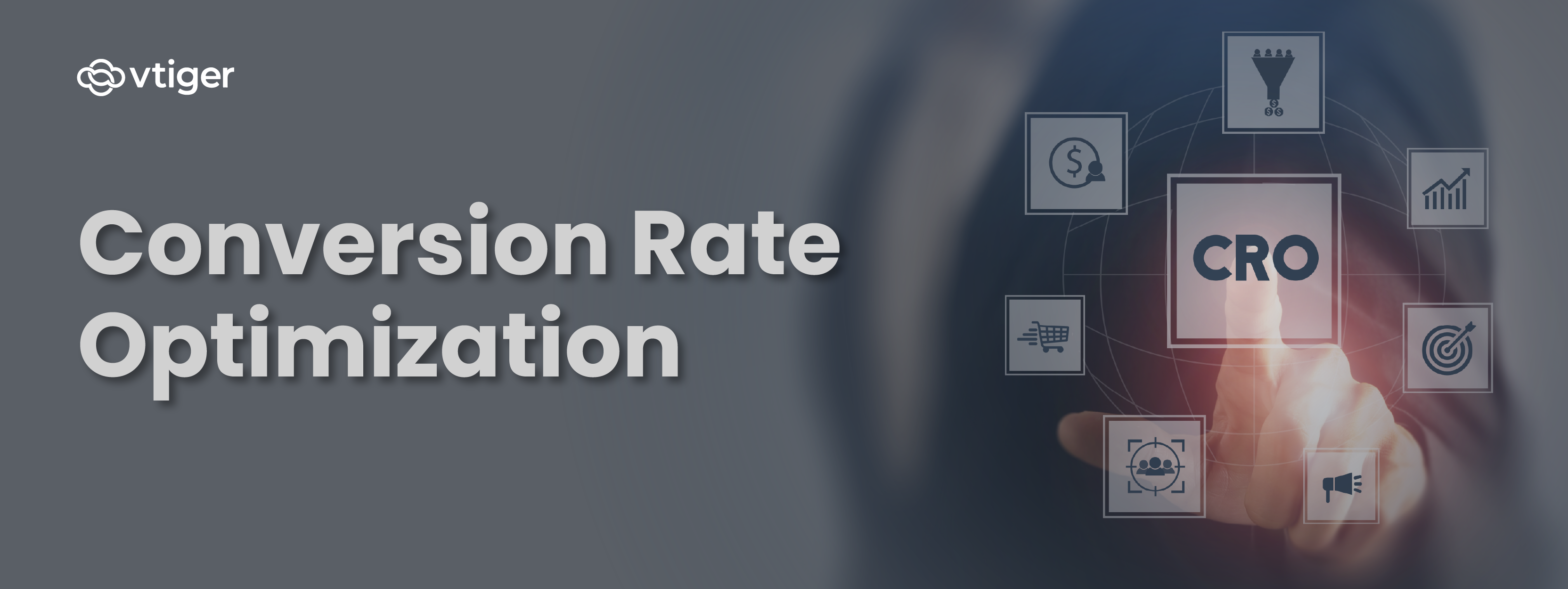
Conversion rate optimization is the practice of improving how users progress through your digital journey; right from first visit to final conversion and then identify friction, validate assumptions with data, and implement improvements that compound over time.
Visitor Behavior Analysis
CRO begins by understanding how visitors actually behave:
- Where do they come from
- Which pages they visit
- Where they hesitate or abandon
When connected to a CRM, this behavioral data gains context. Lead source tracking, engagement history, and decision-stage mapping reveal not just what users do, but who they are and how close they are to buying.
This is especially important for lead generation and qualification, where volume alone is misleading without intent and readiness.
Optimization of the User Journey
Effective CRO maps the full path from awareness to conversion. This includes:
- Website interactions
- Email engagement
- Sales conversations
- Follow-ups and re-engagement
Customer journey mapping across these touchpoints ensures optimization decisions are sequence-aware. Improving a CTA won’t help if trust hasn’t been established earlier in the journey. CRO works best when aligned with customer experience, not isolated page tweaks.
Continuous Experimentation
CRO relies on controlled experimentation like A/B testing, multivariate testing, and iterative refinement. The goal is not to “win” every test, but to learn systematically.
CRM-based lead scoring adds a critical layer here. High-intent prospects behave differently from early-stage visitors. Segment-specific testing respects this reality and prevents misleading averages.
Revenue Efficiency
At its core, conversion rate optimization exists to improve revenue efficiency, not traffic volume. CRO focuses on extracting more value from the visitors you already have by removing friction and improving decision clarity across the funnel.
- Generate more revenue from the same level of traffic
- Lower customer acquisition costs by reducing wasted spend
- Increase ROI from every marketing dollar invested
Rather than pushing more leads into a leaky funnel, CRO strengthens each stage of the journey, so a higher percentage of existing visitors move forward, convert, and generate revenue.
According to Gartner, poor data quality costs organizations an average of $12.9 million annually. CRM systems reduce this risk by centralizing visitor and lead data into a single source of truth, making CRO experiments more reliable and decisions more defensible.
How to Calculate Conversion Rate
Most teams look at conversion rate only when something feels off. Leads slow down. Sales complains about quality. Traffic looks healthy but revenue does not follow.
But if you use this formula, things will become clearer and you can set a benchmark appropriate to your use case.
Conversion Rate (%) = (Number of Conversions ÷ Total Visitors) × 100
So if 10,000 people visit your website in a month and 500 of them take a meaningful action such as signing up, requesting a demo, or completing a purchase, the outcome is straightforward.
500 divided by 10,000, multiplied by 100, gives you a 5 percent conversion rate.
Useful. But incomplete.
Because this single number tells you the outcome without revealing the sequence of decisions that led there.
CRM Enhancement
A CRM changes the way this calculation is interpreted by spreading it across time, intent, and progression.
Conversion is no longer treated as a single event. It becomes a series of transitions.
- A visitor shows interest and becomes a lead.
- A lead shows intent and becomes an opportunity.
- An opportunity proves readiness and becomes a customer.
Each step behaves differently. Each step fails for different reasons.
When these stages are measured independently, clarity replaces guesswork. A strong visitor to lead rate combined with weak qualification, usually points to messaging that attracts attention without intent. A healthy pipeline that struggles to close often reflects follow-up gaps, timing issues, or missing trust rather than poor website performance.
Instead of asking why conversions are low, teams can see where momentum breaks. A CRM dashboard makes this visible by connecting behavior, engagement, and outcomes into one continuous view. Optimization efforts then focus on the stage that limits revenue growth, not the metric that happens to look smallest.
At that point, conversion rate stops being a number you report and starts becoming a signal you understand.
Why Conversion Rate Optimization Is Important?
Conversion rate optimization is important because it brings discipline to growth decisions. Rather than relying on assumptions, opinions, or isolated metrics, CRO establishes a structured way to evaluate what actually influences user action at each stage of the funnel. It replaces reactive changes with evidence-backed prioritization.
When implemented correctly, CRO helps teams focus on outcomes that directly impact revenue and efficiency:
- Increases revenue without increasing traffic: CRO improves how effectively existing visitors convert, allowing growth without additional acquisition spend.
- Improves marketing ROI: Optimization ensures campaigns, pages, and funnels perform closer to their potential, extracting more value from current investments.
- Reduces customer acquisition costs: Higher conversion efficiency lowers the effective cost per lead and per customer across channels.
- Enhances user experience: CRO identifies where users struggle or hesitate, enabling targeted improvements that reduce friction and uncertainty.
- Reveals precise friction points: Instead of treating conversion as a single metric, CRO exposes where momentum breaks, whether at lead capture, qualification, or decision stages.
- Enables data-led growth decisions: Structured testing builds institutional knowledge, helping teams repeat what works and avoid random experimentation.
Gartner reports that AI-powered CRO tools reduce testing time by 35%, accelerating insight-to-action cycles. Vtiger’s Calculus AI applies this by recommending high-impact experiments based on real conversion and intent data, not surface-level trends.
Key Elements Optimized in CRO
Conversion rate optimization works by improving the specific elements that influence how users perceive value, reduce hesitation, and decide to move forward. These elements sit at critical decision points across the funnel. Optimizing them in isolation rarely works; CRO is most effective when these elements are evaluated together, in sequence, and with intent context.
Calls to Action
Calls-to-action determine whether users take the next step or stall. CRO optimizes CTA placement, visibility, copy, and urgency so the action feels both clear and appropriate to the stage of intent. A well-optimized CTA answers three questions instantly: what will happen, why it matters now, and what the user should do next.
Landing Page Structure
Landing pages are optimized to eliminate distractions and reinforce relevance. CRO focuses on aligning messaging with visitor intent, simplifying layouts, and placing trust signals close to decision points. The goal is to ensure visitors understand the value proposition without scrolling, searching, or second-guessing.
Forms and Checkout
Forms and checkout flows are common points of friction. CRO reduces unnecessary fields, improves validation feedback, and clarifies what happens after submission. Each field added increases cognitive effort, so optimization prioritizes only the information required to move the user forward.
Navigation and Findability
Navigation influences how easily users locate information. CRO improves menu labels, hierarchy, and internal linking so visitors can progress without confusion. Poor navigation often causes drop-offs that are mistakenly blamed on content or design.
Page Load Speed
Speed directly affects momentum and trust. CRO prioritizes fast load times across devices, as delays disrupt intent and increase abandonment. Even minor performance improvements can produce measurable gains in conversion rates.
Mobile Experience
Mobile optimization focuses on usability, not compression. CRO ensures layouts are readable, buttons are touch-friendly, and interactions require minimal effort. Mobile visitors often have less patience and less screen space, making clarity essential.
Trust Signals
Trust signals reduce perceived risk at decision moments. CRO evaluates the placement and relevance of testimonials, reviews, certifications, and guarantees. These elements work best when they support a specific concern rather than acting as generic reassurance.
Content Clarity
CRO improves how information is communicated, not just what is said. Headlines, body copy, and visual hierarchy are refined so users can grasp value quickly. Clear content reduces hesitation and prevents users from abandoning due to uncertainty.
Journey Flow Logic
User journey flow ensures each step prepares the user for the next. CRO identifies breaks in logic, such as asking for commitment too early or shifting messaging abruptly and restores continuity. A smooth progression builds confidence over time.
Lead Capture Workflows
Lead capture is a decision moment, not a data request. CRM-native lead capture forms automatically create lead records and trigger follow-up workflows based on submission behavior. CRO optimizes form fields and messaging by lead source and segment, recognizing that different audiences require different levels of commitment. Segment-aware lead capture improves both conversion rates and downstream lead quality.
The Conversion Rate Optimization (Step-by-Step)
An effective CRO process follows a clear sequence. Skipping steps or changing them out of order leads to misleading results and wasted effort. The goal is not to run more tests, but to make better optimization decisions by grounding every change in data, intent, and outcomes.
Step 1 – Measure Current Performance
Before optimizing anything, establish a reliable baseline. CRO starts by tracking existing conversion performance so improvements can be measured accurately rather than assumed.
Using a CRM, baseline metrics are captured across the entire sales funnel:
- Website visitor → Lead (awareness-to-lead rate)
- Lead → Opportunity (qualification rate)
- Opportunity → Customer (deal closure rate)
This creates a 360-degree view of where leaks occur. Are visitors failing to submit forms? Are leads entering the funnel but never qualifying? Are opportunities stalling late in the sales cycle? A CRM dashboard makes these breakpoints visible, allowing teams to focus on the stage that actually limits revenue growth rather than guessing.
Step 2 – Analyze User Behavior
Once baselines are established, the next step is identifying where and why users disengage. CRO examines both behavior and intent to understand drop-offs across the journey.
CRM lead scoring and engagement tracking reveal:
- Which lead sources generate the highest-quality prospects
- Which pages or emails drive sustained engagement versus early disengagement
- At which stage prospects most commonly stall or exit
When CRM data is paired with heatmaps and session replays, teams can see where users struggle on a page and who those users are in terms of readiness and intent. This combination prevents surface-level fixes and highlights the true source of friction.
Step 3 – Formulate Hypotheses
Optimization without a hypothesis leads to random experimentation. Each test should be grounded in a clear, testable assumption derived from observed behavior.
Forrester research shows that organizations with a highly structured CRO process outperform teams that rely on ad-hoc testing. A hypothesis-driven approach brings discipline to experimentation and creates a repeatable roadmap.
Example hypothesis:
Reducing form fields from seven to four will increase lead capture by 20% because friction during form completion is the primary abandonment reason identified in behavioral analysis.
Strong hypotheses clearly define what will change, why it should work, and how success will be measured.
Step 4 – Run Experiments
With a hypothesis in place, teams test variations using controlled experiments such as A/B testing or multivariate testing. The goal is to isolate variables so results can be attributed to specific changes.
CRM segmentation adds an important advantage at this stage:
- Test different CTAs for high-intent versus nurture-stage leads
- Adjust landing page messaging by industry, company size, or acquisition source
- A/B test email follow-ups based on lead score or engagement level
What converts for SMB buyers may not resonate with enterprise prospects. A CRM-driven testing approach respects these differences and improves relevance across segments.
Step 5 – Analyze Results
Not every uplift indicates success. CRO requires validating that results are statistically meaningful rather than the product of chance.
Tests should reach statistical significance, typically a 95% or higher confidence level, before a variation is declared a winner. Experiments must also run long enough to account for daily and seasonal behavior patterns, usually a minimum of two to four weeks.
This discipline prevents false positives from shaping the optimization roadmap and ensures learnings are reliable.
Step 6 – Implement and Iterate
Winning variations are rolled out and monitored, but the process does not end there. CRO is continuous by nature.
Customer behavior changes, competitors adjust, and market conditions evolve. High-performing organizations schedule regular CRO reviews—monthly or quarterly—to evaluate results, archive learnings, and identify the next high-impact opportunity.
The most successful teams treat conversion rate optimization as an ongoing discipline, not a one-time project. Each iteration builds on the last, turning data into long-term growth leverage.
Common Conversion Rate Optimization Techniques
Once problem areas are identified and hypotheses are defined, CRO moves into execution. These techniques are used to test changes, validate assumptions, and apply improvements in a controlled, measurable way. Each technique serves a specific purpose depending on traffic volume, funnel stage, and user intent.
A/B Testing
A/B testing compares a single variation against a control to measure the impact of one change at a time. It is best suited for validating focused improvements such as CTA copy, button placement, headline clarity, or form length, where isolating cause and effect is critical.
Multivariate Testing
Multivariate testing evaluates multiple elements simultaneously to understand how combinations of changes perform together. This technique is effective on high-traffic pages where interactions between layout, copy, and visuals influence outcomes. Without sufficient traffic, results can become inconclusive.
UX Simplification
UX simplification removes friction that slows or confuses users. CRO prioritizes reducing unnecessary steps, visual noise, and cognitive load so visitors can complete actions without hesitation. Simplification often produces stronger gains than adding new features.
Copy Optimization
Copy optimization focuses on improving how value is communicated. Headlines, value propositions, and calls-to-action are refined to reduce ambiguity and align with user intent. Strong copy clarifies relevance quickly and prevents drop-offs caused by uncertainty.
Visual Hierarchy
Visual hierarchy directs attention toward the most important elements on a page. CRO adjusts spacing, contrast, layout, and element size so users naturally notice key messages and actions first, shortening decision time.
Personalization
Personalization tailors experiences based on attributes such as behavior, source, industry, or stage of intent. CRO uses segmentation to avoid showing the same message to every visitor, improving relevance and response rates.
Trust Optimization
Trust optimization addresses perceived risk at decision points. CRO evaluates where testimonials, security indicators, certifications, and guarantees are most effective. These elements work best when placed close to moments of commitment, not scattered indiscriminately.
Mobile Optimization
Mobile optimization ensures experiences are designed for touch, speed, and limited screen space. CRO prioritizes responsive layouts, readable content, and simplified interactions, recognizing that mobile users abandon faster when friction appears.
AI-Powered Personalization
Modern CRO increasingly uses machine learning to personalize experiences at scale. Machine learning enables dynamic landing pages, adaptive messaging, and email personalization based on real-time behavior and lead score, allowing optimization to evolve continuously rather than relying on static rules.
Examples of Conversion Rate Optimization
Conversion rate optimization often shows up in small, practical changes rather than dramatic redesigns. The impact comes from where the change is made and who it is made for. Below are common CRO examples seen across SaaS, ecommerce, services, and content-led businesses, each illustrating how intent and context shape results.
Improving CTA placement: Moving a call-to-action closer to moments of clarity consistently improves response rates. A SaaS product page that places a “Book a Demo” CTA immediately after explaining a specific use case tends to see more sign-ups than one that waits until the footer. In ecommerce, surfacing the “Add to Cart” action earlier helps capture buyers who already know what they want, without forcing them to scroll or search.
Reducing form fields: Friction often hides inside forms. Service businesses that shorten enquiry forms from seven or eight fields to four see higher submission rates because visitors feel less commitment pressure. In B2B software, fewer initial fields increase demo requests, while deeper qualification can happen later through sales conversations or marketing automation.
Improving page speed: Performance changes rarely alter design, yet they directly affect behavior. Content-heavy sites benefit when faster load times reduce early exits, especially for first-time visitors arriving from search. Ecommerce brands see lower bounce rates and higher mobile conversions when pages load in under three seconds, particularly during high-intent browsing sessions.
Clarifying pricing and offers: Unclear pricing creates hesitation. Subscription businesses that explain what each pricing tier is best suited for help buyers self-select instead of overthinking. Retail and DTC brands reduce checkout abandonment when total cost, shipping, and return policies are visible upfront, removing uncertainty at the payment stage.
Improving navigation and discovery: When users struggle to find relevant information, conversions suffer silently. Marketplaces that simplify category structures improve product discovery without changing inventory. B2B websites that reorganize navigation around buyer needs, rather than internal product lines, help visitors reach decision pages faster and with more confidence.
These CRO examples highlight an important pattern: optimization works best when changes respect user intent, business context, and buying behavior. The same technique can deliver very different results depending on how well it aligns with the way people actually make decisions.
Best Practices of Conversion Rate Optimization in 2026
By 2026, conversion rate optimization has matured into a structured, data-led discipline. The focus has shifted from running isolated tests to building reliable systems that improve conversion efficiency over time. The following practices reflect how high-performing teams approach CRO today.
Focus on User Intent
CRO decisions should be driven by user intent rather than assumptions. Understanding why visitors arrive, what they are trying to achieve, and how ready they are to convert leads to more accurate optimization decisions. Zero-party data collected through preference centers and web forms helps capture intent directly, making CRO insights more reliable than inferred behavior alone.
Prioritize High-Impact Pages
Optimization efforts should focus on pages that directly influence conversions and revenue. These typically include landing pages, pricing pages, demo or inquiry forms, checkout flows, and high-traffic product pages. Concentrating on high-impact areas produces faster and more measurable results.
Test One Change at a Time
Testing a single variable per experiment ensures clarity in results. Isolating changes makes it easier to attribute performance shifts to a specific action, reducing false positives and improving confidence in CRO decisions.
Validate with Data
Every optimization idea should be validated using data before implementation. Behavioral analytics, CRM performance metrics, and historical conversion trends help teams avoid relying on intuition or isolated opinions when prioritizing tests.
Combine Quantitative and Qualitative Data
Quantitative data explains what users are doing, while qualitative inputs explain why. CRO programs should combine analytics with user interviews, feedback forms, and sales insights. Zero-party data strengthens this approach by adding explicit user preferences into the decision-making process.
Optimize for Mobile First
With more than 60% of traffic originating from mobile devices, CRO must prioritize mobile usability. This includes responsive layouts, readable content, touch-friendly interactions, and simplified navigation for smaller screens.
Maintain Fast Page Speed
Page performance remains a critical conversion factor. CRO best practices recommend maintaining page load times under three seconds to reduce abandonment and preserve user momentum, especially on mobile devices.
Document and Reuse Learnings
Sustainable CRO depends on retaining knowledge. Teams should document test hypotheses, results, and outcomes to avoid repeating ineffective experiments and to build long-term optimization intelligence.
Align Sales and Marketing Data
CRO outcomes improve when sales and marketing teams share a common CRM and work toward shared conversion goals. Sales feedback on lead quality and deal progression should directly influence CRO priorities. Strong sales and marketing alignment ensures optimization efforts are tied to revenue outcomes rather than surface-level metrics.FAQs
What is conversion rate optimization in simple terms?
Conversion rate optimization is the practice of improving how effectively your website or digital channels turn visitors into leads or customers. Instead of focusing on getting more traffic, CRO focuses on removing friction, improving clarity, and helping a higher percentage of existing visitors take meaningful actions.
How do you calculate conversion rate?
Conversion rate is calculated by dividing the number of conversions by the total number of visitors, then multiplying by 100. For example, if 500 people convert out of 10,000 visitors, the conversion rate is 5%. This formula applies across websites, landing pages, and funnel stages.
What is a good conversion rate?
A good conversion rate depends on industry, business model, and intent. E-commerce sites often see 2–3%, B2B lead generation averages 2–5%, and high-performing pages can exceed 10%. The most important benchmark is improving your own baseline consistently over time.
Why is CRO important for businesses?
CRO improves revenue efficiency by increasing conversions without increasing marketing spend. It helps businesses get more value from existing traffic, lower acquisition costs, improve user experience, and make growth decisions based on data rather than assumptions or opinions.
What elements can be optimized in CRO?
CRO can optimize calls-to-action, landing pages, forms, navigation, page speed, mobile experience, content clarity, trust signals, and user journey flow. In CRM-driven setups, lead capture forms and follow-up workflows are also optimized to improve both conversion rates and lead quality.
How long does CRO take to show results?
Simple CRO changes, such as CTA or form optimizations, can show results within 2–4 weeks. Medium-impact tests may take 4–8 weeks, while structural changes often require 8–12 weeks. Results depend on traffic volume, test complexity, and statistical significance.
What are common CRO techniques?
Common CRO techniques include A/B testing, multivariate testing, UX simplification, copy optimization, visual hierarchy improvements, personalization, trust optimization, mobile optimization, and performance improvements. Advanced programs also use AI-driven personalization to adapt experiences based on user behavior and intent.
Can CRO increase revenue without more traffic?
Yes. CRO’s primary value is increasing revenue from existing traffic. Even a small improvement in conversion rate compounds over time. For example, improving a 5% conversion rate to 6% can generate significant additional revenue without spending more on ads or acquisition channels.
How often should CRO testing be done?
CRO testing should be continuous for mature teams. Most high-performing organizations run multiple tests each month, prioritizing high-impact areas. Regular monthly or quarterly reviews help analyze results, document learnings, and refine the optimization roadmap based on what drives revenue.
INTERNAL LINKING STRATEGY
Add contextual internal links to:
- What is sales
- Sales funnel
- Lead generation
- Customer experience
- Marketing automation
- Customer journey
- Website optimization
- Conversion tracking
- CRM basics