Sales teams are entering a phase where decisions are shaped less by instinct and more by continuously evolving data. Lead management sits at the center of this change. Traditional systems rely on linear logic. A lead clicks an email, gets a fixed score. A form is filled, a task is assigned. The process is structured but rigid. AI introduces a different model. It works on probability, not certainty. Every interaction updates the likelihood of conversion. The system adapts in real time, recalculating priorities, suggesting actions, and guiding the next move based on data
What Is Lead Management with AI?
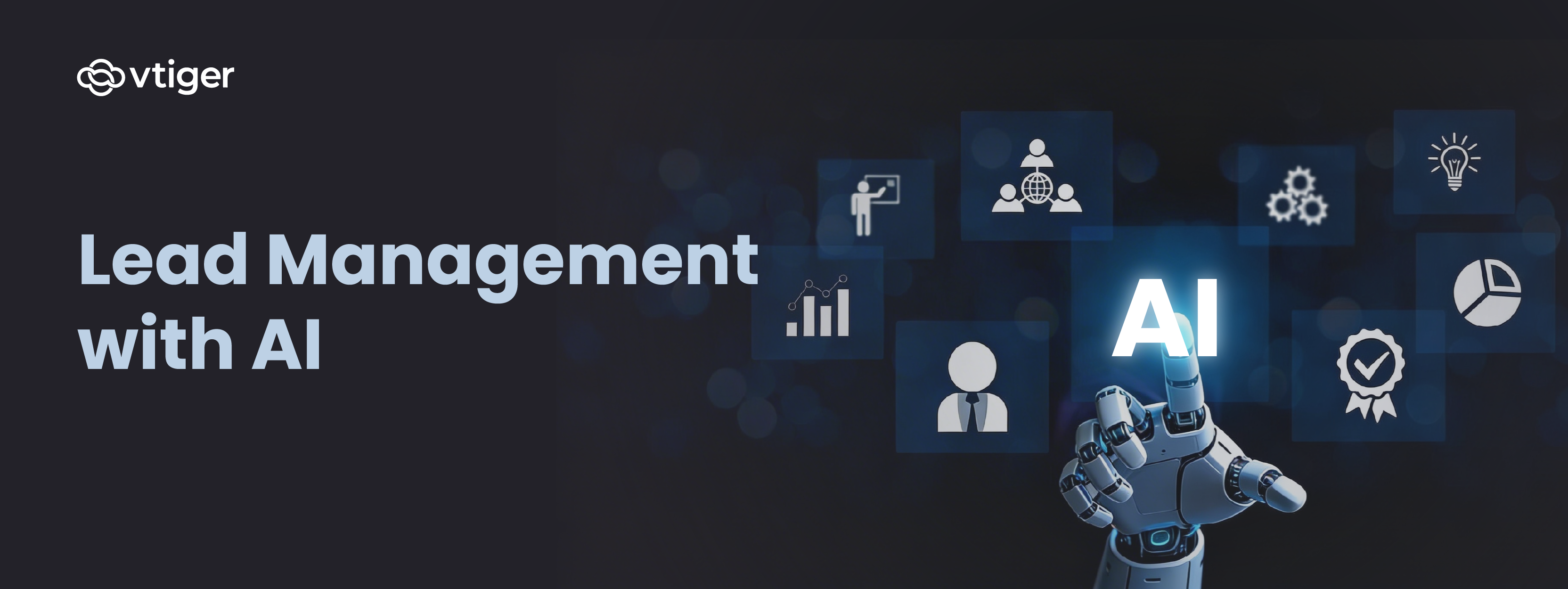
AI lead management refers to the use of artificial intelligence technologies such as predictive analytics, generative AI, and machine learning to identify, qualify, score, nurture, and convert leads with minimal manual effort.
The concept is grounded in how humans process information. Sales reps have limited attention. Traditional systems force them to search across dashboards, spreadsheets, and notes. AI removes that burden. It surfaces the most relevant leads, enriched with context, at the exact moment action is required.
Traditional vs AI Powered Lead Management
Traditional Lead Management
- Manual data entry across systems
- Static scoring models based on predefined rules
- Delayed follow ups due to dependency on human action
AI-Powered Lead Management
- Predictive scoring based on historical and behavioral data
- Real time qualification using live interactions
- Automated nurturing through intelligent workflows
- Intelligent routing based on deal context and rep performance
A simple example makes this clear. Traditional scoring may assign points for an email click. AI evaluates who clicked, how often, what content was consumed, and whether the interaction signals real intent or casual browsing.
How AI Transforms Lead Management?
The transformation of lead management workflows, assisted by AI, will witness innovations beyond descriptive analytics. Traditional systems explain what already happened. AI models estimate what is likely to happen next. Every new interaction updates the conversion probability. This is rooted in Bayesian thinking where each data point refines the outcome.
1. AI Based Lead Identification
AI expands how leads are discovered. It does not depend only on form submissions.
- Scans CRM records to identify patterns in past deals
- Tracks website behavior such as time spent, repeat visits, and content depth
- Analyzes social signals and engagement patterns
- Detects intent signals that indicate buying readiness
Modern systems also identify hidden stakeholders by analyzing email threads and communication patterns, helping reps engage decision makers early.
2. Predictive Lead Scoring and Segmentation
AI scoring models learn from historical conversions and continuously refine themselves.
P(Conversion∣ Behaviour)
Instead of assigning fixed points, the system calculates the probability of conversion based on multiple variables.
| Traditional Scoring | AI Predictive Scoring |
| Manual rule based | Machine learning models |
| Static criteria | Behavioral and intent signals |
| Periodic updates | Real time optimization |
Industry direction supports this evolution. Gartner states that by 2026, 65 percent of B2B sales organizations will rely on data driven decision making supported by unified workflows and analytics.
What stands out today is customization. Scoring models are trained on a company’s own deal history. That means the system learns what actually drives revenue in that specific business, not a generic benchmark.
3. Automated Lead Qualification
Qualification becomes continuous rather than event based.
- AI chat systems capture BANT inputs during conversations
- Prospects engage at any time without waiting for a sales rep
- CRM fields are updated instantly based on responses
- Leads are routed only when they meet readiness criteria
The discovery phase is handled with consistency. Every lead is asked the right questions. Every response is recorded without gaps.
4. AI-Driven Nurturing & Personalization
Nurturing becomes context aware instead of sequence driven.
- Email journeys adapt based on behavior and engagement
- Content changes depending on industry, role, and intent signals
- Systems recommend the next best action for each lead
- Triggers activate based on micro interactions such as link clicks or revisit patterns
Generative AI also plays a role here. A growing portion of outbound communication is being created dynamically, allowing reps to focus on strategy rather than drafting messages.
Key Benefits of AI in Lead Management
AI changes how lead data behaves as an asset. It stops being static information and starts acting like a system that improves itself with every interaction. This connects directly to the Resource Based View of a firm. For a resource to create sustained competitive advantage, it must be valuable, rare, inimitable, and organized.
Most companies already have lead data, so it is not rare. The difference comes from how that data is interpreted. AI models trained on your own deal history, win patterns, response behavior, and pipeline movement make your data inimitable. Another company cannot replicate that learning, even if they use the same CRM.
Efficiency & Productivity
Sales inefficiency rarely comes from lack of effort. It comes from unclear prioritization. Reps spend a large part of their day deciding whom to contact, revisiting notes, and manually interpreting signals. AI removes this layer by ranking leads based on real time probability to convert. The outcome is not just time saved. It is a cleaner execution. Reps move from deciding to acting.
Precision Targeting
Traditional systems treat activity as intent. Email opens, page visits, and downloads often inflate lead quality. AI evaluates intent depth. A pricing page revisit, repeated product interaction, or a direct reply carries more weight than passive engagement. This reduces pipeline noise. Teams stop chasing leads that look active but are unlikely to convert.
Scalability
Most personalization today is surface level. Name, company, maybe industry. AI works at a behavioral layer. It adapts communication based on buying stage, urgency signals, and interaction history. This is where the performance impact becomes measurable. Forrester reports that AI powered sales and marketing automation can improve conversion rates by 10 to 30 percent. That improvement is driven by timing and relevance working together, not just automation.
Hyper-Personalization
Speed matters most when intent is highest. That window is often short and easy to miss. AI driven systems assign leads instantly based on context. Not just availability, but which rep has historically performed best with that type of deal, industry, or company size. This reduces response time from hours to seconds. More importantly, it increases the likelihood that the first interaction is meaningful.
Faster Conversion Cycles
Growth usually brings operational strain. More leads lead to slower responses, weaker follow ups, and inconsistent qualification. AI absorbs this complexity. It maintains prioritization, enrichment, and follow up consistency even as lead volume increases. The team does not just handle more leads. It handles them with the same level of sharpness.
Generating and Managing Leads with AI (Practical Use Cases)
AI driven lead generation and management works on influence rather than pressure. This is where Nudge Theory becomes practical. Instead of pushing leads through a funnel, AI guides them through small, well timed interactions through various channels and parameters that reduce friction in decision making.
Chatbots for Real-Time Engagement
One of the biggest gaps in traditional sales systems is the inability to interpret tone. AI models now analyze written and spoken communication to detect sentiment. A lead expressing hesitation, confusion, or urgency is identified immediately. This creates a new layer of visibility. Managers can step in when a deal shows signs of friction. Reps can adjust tone before the conversation breaks down. It introduces emotional intelligence at scale, something that was previously dependent on individual skill.
Predictive Lead Scoring
Predictive scoring is where AI moves from organizing data to actively influencing revenue. Traditional scoring assigns value based on predefined rules. It assumes that certain actions always mean the same thing. The problem is that behavior does not carry uniform meaning across industries, deal sizes, or customer types.
AI replaces this with probability modelling . Every interaction contributes to a likelihood score that reflects how similar this lead is to previously converted customers.
A key shift here is that scoring becomes fluid. It is not a number assigned once, but a value that evolves continuously. A lead that was inactive can become high priority within minutes if new signals indicate intent. Similarly, a previously active lead can decline in priority if engagement weakens. What makes this powerful is that the model is trained on your own data. It learns which combinations of behavior, profile, and timing actually resulted in closed deals.
Automated Email Campaigns
Most email automation fails because it is structured around time. Fixed sequences assume that all leads move through the same journey at the same pace. In reality, buying journeys are uneven. Some leads accelerate quickly, others pause, some revisit earlier stages.
AI driven email systems respond to this variability. They trigger communication based on behavior, not schedule. A lead revisiting a pricing page receives a different message than one exploring product documentation. A drop in engagement triggers reactivation logic rather than continued push messaging.
Social Media Listening
A large portion of buying intent develops outside direct touchpoints.
Traditional systems capture leads only after they enter the funnel. By that time, intent may already be shaped by external influences such as peer discussions, competitor content, or community engagement.
AI expands visibility into these early signals. It tracks patterns across social platforms, identifying when individuals or organizations begin engaging with relevant topics, competitors, or solution categories. This does two things. First, it allows earlier entry into the buying journey. Second, it provides context about what triggered the interest in the first place.
Engagement then becomes informed rather than generic. Outreach reflects the lead’s current context instead of introducing a conversation from scratch.
Data Enrichment & CRM Sync
Lead management breaks down when context is incomplete. AI addresses this by continuously enriching lead profiles with structured and unstructured data. This includes company attributes, role information, engagement history, and interaction patterns across channels.
The important shift here is not just enrichment, but synchronization. Every interaction feeds into a unified system in real time. Marketing activity, sales conversations, and behavioral signals are connected into a single view. This eliminates fragmentation. Sales teams do not need to search across tools to understand a lead. The context is already assembled and updated.
Key Features in AI Lead Management Tools
Features in isolation do not create value. Their impact depends on how well they contribute to a connected decision system. The underlying principle here is interoperability. Every data point must be captured, connected, and made actionable.
Automation Capabilities
Automation at this level is not about reducing manual effort. It is about ensuring consistency in execution. Workflow triggers are tied to behavioral signals rather than static conditions. Lead routing considers deal type, engagement level, and historical conversion patterns instead of simple availability. Follow ups are not scheduled blindly. They are triggered when the probability of engagement is highest. This creates a system where execution aligns with intent.
Data Enrichment & Intelligent Segmentation
Segmentation evolves from classification to prediction. Instead of grouping leads based on basic attributes such as industry or geography, AI builds segments based on conversion likelihood, engagement depth, and similarity to past successful deals.
These segments are dynamic. They update as new data enters the system, ensuring that targeting remains relevant over time. The practical impact is sharper prioritization and more effective messaging.
CRM Integration
Disconnected systems create incomplete narratives. AI driven lead management requires continuous data flow between marketing platforms, sales tools, and communication channels. Every interaction must contribute to a unified pipeline view.
This alignment reduces friction between teams. Marketing generates context, sales acts on it, and both operate from the same understanding of the lead. The result is continuity across the buyer journey rather than fragmented engagement.
Predictive Analytics & Forecasting
Forecasting becomes grounded in probability rather than assumption. Each lead and deal is evaluated based on real time signals. Conversion likelihood is recalculated as new interactions occur. Risks are identified early through patterns such as declining engagement or delayed responses.
This changes how pipelines are managed. Instead of reviewing performance after outcomes, teams can intervene while deals are still active. Another layer emerging here is embedded pipeline guidance. Systems highlight which leads require attention, which deals are stagnating, and where effort should be concentrated.
The Future of AI in Lead Management
Lead management is moving toward systems that take ownership of early stage execution with minimal human input.
Agentic AI
AI systems are beginning to operate as independent units within the pipeline. They can initiate first contact, qualify leads through multi step conversations, update CRM fields, and route opportunities based on predefined business logic combined with learned patterns. The key change here is continuity. Actions are not triggered one by one. The system carries context across steps and progresses the lead without waiting for manual intervention.
Autonomous Lead Routing
Routing decisions are becoming more context aware. Instead of assigning leads based on availability or geography, systems evaluate factors such as deal type, industry, historical win rates of reps, and current pipeline load. This improves match quality between lead and rep, which has a direct impact on conversion probability, especially in complex or high value deals.
Conversational Sales Agents
AI driven conversations are moving beyond scripted responses. These systems handle multi turn interactions, ask follow up questions based on previous answers, and adjust direction depending on lead intent. They can manage qualification, schedule meetings, and provide relevant information without breaking flow. The practical impact is consistency. Every lead receives the same level of structured engagement regardless of timing or volume.
AI Generated Sales Messaging
A growing portion of outbound communication is being generated by AI. Current estimates suggest that around 30 percent of outbound messages in large organizations will be AI generated.
The shift here is operational. Sales teams are less involved in writing individual messages and more focused on defining positioning, sequencing logic, and intent behind communication. Message quality becomes a function of input strategy rather than individual effort.
Predictive Pipeline Intelligence
Pipeline visibility is becoming forward looking. AI systems evaluate each deal based on real time engagement, response patterns, and progression signals. They identify which deals are likely to close, which are slowing down, and where intervention is required. This allows managers to act throughout the deal lifecycle rather than review outcomes after the fact.
Frequently Asked Questions (FAQs)
Q1. How does AI improve lead qualification?
AI improves qualification by analyzing behavioral intent alongside declared information. It evaluates how leads interact across emails, chats, and website activity, using Natural Language Processing to detect nuance in responses. Qualification becomes continuous, with each interaction refining readiness, ensuring sales teams engage leads who show real intent, not just surface-level interest.
Q2. What is predictive lead scoring?
Predictive lead scoring uses machine learning to estimate conversion likelihood based on historical and real-time data. Instead of fixed rules, it identifies patterns across past deals such as engagement timing, response behavior, and interaction sequences. Scores update dynamically, allowing teams to prioritize leads based on evolving intent rather than static activity.
Q3. Can AI replace manual lead management?
AI replaces repetitive, structured tasks like data entry, lead routing, and follow-up scheduling. It handles predictable workflows efficiently, reducing operational load. However, human involvement remains essential for negotiation, relationship building, and complex decision-making. AI supports execution, while humans focus on judgment, context, and strategic conversations within the sales process.
Q4. How does AI personalize lead nurturing?
AI personalizes nurturing by adapting communication based on behavior, engagement patterns, and inferred intent. Instead of broad segments, it treats each lead individually, adjusting messaging, timing, and content. Interactions reflect what the lead has explored or responded to, ensuring communication stays relevant and aligned with their decision stage.
Q5. Is AI lead management suitable for small businesses?
AI acts as a force multiplier for small teams by automating lead capture, qualification, and follow-ups. It ensures consistent engagement without requiring additional headcount. Small businesses benefit from faster response times and better prioritization, allowing them to compete with larger teams while maintaining focus on high-value interactions and conversions.
Q6. What tools are used for AI lead management?
AI lead management typically involves CRM platforms, machine learning models, and automation engines working together. CRM systems collect and organize data, AI models analyze patterns and predict outcomes, and automation tools execute workflows. Increasingly, these capabilities are integrated into unified platforms to reduce fragmentation and improve decision consistency.
Q7. How does AI integrate with CRM systems?
AI integrates directly into CRM systems, using stored data to generate insights and trigger actions. The CRM acts as the central data source, while AI analyzes interactions, updates fields, and recommends next steps. This creates a continuous feedback loop in which every interaction improves future decisions and keeps the pipeline contextually up to date.