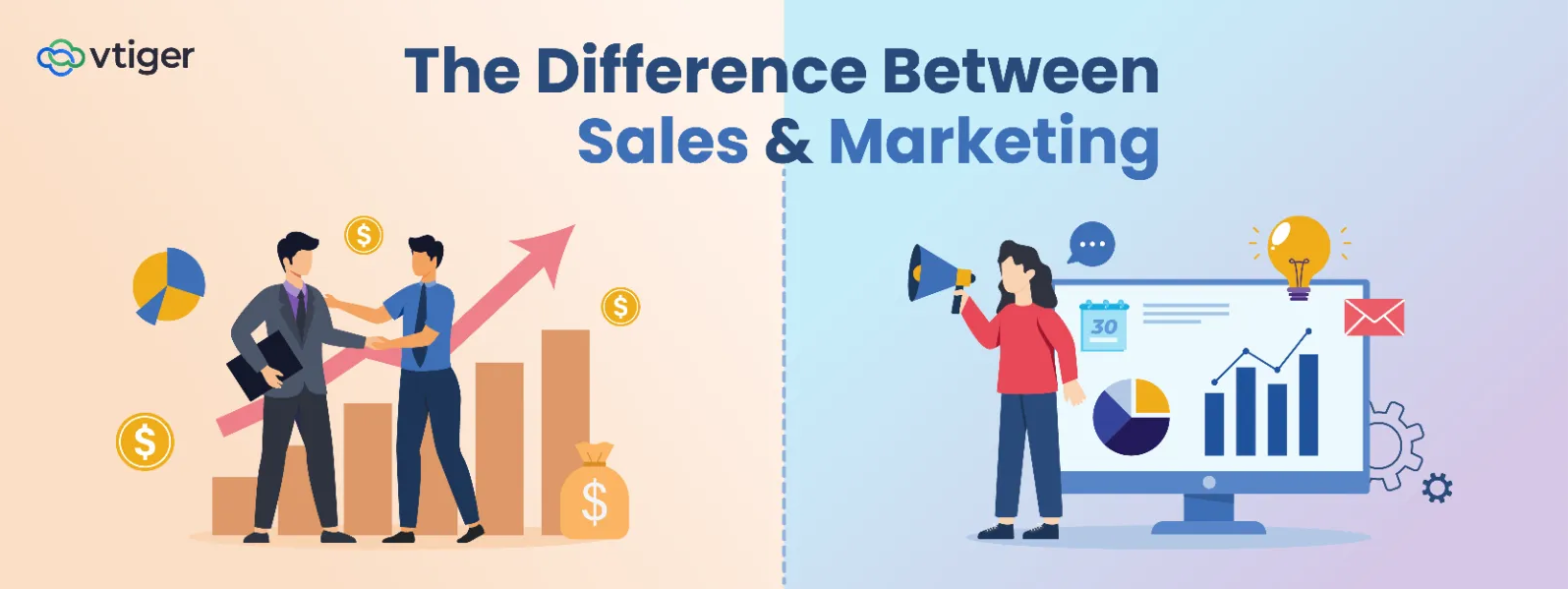
Sales and marketing are grouped because both influence revenue, but they solve different problems at different moments. Marketing deals with how a market becomes aware of a problem and a solution, while sales deals with how a specific buyer decides to act on that awareness.
Confusion can happen when outcomes are compared without understanding responsibilities. Marketing does not close deals. Sales don’t create market demand. Both contribute to revenue, but through separate workflows, timelines, and measures of success.
Read this blog to understand the difference between sales and marketing, how both verticals can be optimized in a way to help businesses assign ownership correctly, avoid duplicated effort, and measure performance without overlap.
What Is the Difference Between Sales and Marketing?
The difference between sales and marketing appears when a customer interaction begins. Marketing works before a buyer is ready to talk. It creates demand by shaping how a problem is understood, how a category is perceived, and why a solution should matter at all. Awareness, interest, and pipeline readiness are its core outputs.
Sales enters once a prospect shows buying intent. Sales qualifies requirements, validates budget and authority, manages objections, and negotiates commercial terms. Revenue is generated only when these steps conclude in a confirmed transaction.
This sales and marketing difference is about sequence, not importance. Marketing operates across markets and segments. Sales operates one-to-one. Most sales vs marketing examples follow this path. Demand is created first. It is converted later. Both sales and marketing functions exist within the same revenue system, but each owns a different stage, which is why they complement each other rather than compete.
Sales vs Marketing – Key Differences
The sales vs marketing distinction becomes clearer when responsibilities are compared side by side. Both functions contribute to revenue, but they do so through different goals, timelines, and execution models.
The table below outlines the core sales and marketing differences across focus, approach, audience, and day-to-day activities. Viewed together, these contrasts explain why confusion often arises and why alignment depends on respecting functional boundaries rather than blending them.
| Aspect | Marketing | Sales |
| Goal | Create sustained demand by shaping market awareness and buying interest | Convert qualified demand into confirmed revenue |
| Focus | Long-term influence on how the market perceives the problem and solution | Short-term execution to move specific opportunities to closure |
| Approach | Scales demand through research-led, data-driven campaigns across channels | Advances deals through direct conversations and negotiated decisions |
| Audience | Defined segments and personas evaluated at an aggregate level | Individual prospects are evaluated on a case-by-case basis |
| Example activities | Content creation, SEO, advertising, and audience nurturing | Discovery calls, demos, proposal |
What Does Marketing Do?
Marketing sits at the top and middle of the revenue system, where markets are defined, interest is shaped, and readiness is built over time. The difference between sales and marketing becomes clear here. Marketing works at scale across audiences, while sales engages later at the level of individual opportunities.
Market research and audience understanding
Marketing begins with analysis, not promotion. Teams study customer needs, buying triggers, and segment behavior to understand why demand emerges and how it evolves. This research informs targeting decisions and prevents sales from engaging unqualified or misaligned prospects. Strong segmentation improves pipeline quality, not just volume.
Brand positioning and messaging
Marketing defines how a solution is perceived before direct interaction occurs. Positioning clarifies the problem space, competitive context, and value narrative. Consistent messaging across channels ensures that when sales teams engage, prospects already understand what the offering stands for and why it is relevant.
Lead generation and nurturing
One of the core sales and marketing functions is pipeline creation. Marketing attracts interest through content, advertising, and search visibility, then nurtures that interest until intent becomes measurable. Tools such as marketing automation support this process by managing email campaigns, webforms, and landing pages at scale.
Content, advertising, and awareness campaigns
Marketing executes campaigns that educate markets and sustain attention over time. Data-driven strategies improve segmentation and pipeline growth, a point reinforced by Forrester research showing measurable gains from structured demand programs. These efforts ensure sales enter conversations with informed and prepared prospects rather than cold demand.
What Does Sales Do?
The role of sales begins after demand is qualified and continues through decision making, closure, and account continuity. The difference between sales and marketing is visible at this stage. Marketing prepares the opportunity. Sales executes it through direct customer interaction and commercial judgment.
Engage qualified leads
Sales works with prospects who have displayed intent and fit. These leads enter structured workflows where readiness, authority, and timing are evaluated. Movement through the sales pipeline is not automatic. Each stage requires validation, prioritization, and action based on probability and value.
Understand customer needs
Sales conversations are diagnostic. Requirements, constraints, budget expectations, and risk concerns surface through structured discovery. This step prevents misaligned deals and protects long-term revenue quality. Unlike marketing, which works at the segment level, sales evaluates each opportunity independently.
Present solutions and handle objections
Solutions are positioned against specific needs, not general use cases. Objections related to pricing, scope, or feasibility are addressed through clarification and negotiation. This is where the sales and marketing difference becomes operational rather than theoretical.
Close deals and manage relationships
Sales converts approved opportunities into confirmed revenue. Closure includes contract finalization and handoff for delivery. Relationship management continues post-sale through renewals, expansions, and retention. A defined sales process ensures consistency across these stages.
Together, these sales and marketing functions form a single revenue system, with sales responsible for execution, where outcomes are measured in closed business rather than projected demand.
Sales vs Marketing Goals and KPIs
Goals and measurement frameworks reveal the real difference between sales and marketing. Both functions contribute to revenue, but they track progress using different indicators because they influence different stages of the revenue system. Marketing KPIs reflect demand creation and readiness. Sales KPIs reflect conversion efficiency and realized outcomes.
| Function | Primary goals | Key KPIs |
| Marketing | Build demand and prepare pipeline | Website traffic, leads generated, engagement rates, Marketing Qualified Leads (MQLs) |
| Sales | Convert pipeline into revenue | Conversion rates, revenue achieved, average deal value, Sales Qualified Leads (SQLs) |
Marketing KPIs focus on volume, quality, and momentum at the top and middle of the funnel. Traffic and engagement show reach and relevance. Leads and MQLs indicate whether demand is progressing toward sales readiness. These metrics help evaluate how effectively markets are being shaped.
Sales KPIs operate closer to financial outcomes. Conversion rates and deal values measure execution strength. Revenue reflects closure effectiveness. SQLs signal pipeline health from a qualification standpoint.
How Sales and Marketing Work Together
The sales and marketing difference becomes functional when responsibility moves in sequence rather than overlaps. Marketing works upstream, shaping demand and preparing leads for evaluation. Sales works downstream, converting qualified intent into revenue through direct engagement. Coordination matters because both sales and marketing functions act on the same buyer at different stages. How alignment shows up in execution:
Marketing prepares and educates leads
- Buying problems and use cases are clearly defined before sales engagement
- Content and campaigns establish category context and solution expectations
- Lead qualification reflects intent, not just activity
- Sales receives prospects who understand why they are evaluating
Sales converts intent into revenue
- Discovery focuses on fit and constraints, not basic education
- Conversations progress through evaluation, pricing, and negotiation without resets
- Objections are specific and actionable rather than exploratory
- Opportunities move forward based on readiness rather than volume
Alignment shortens cycles and builds trust
- Messaging remains consistent from first touch to final decision
- Buyers experience continuity instead of repetition
- Decision timelines compress due to reduced friction
- Confidence increases because expectations match execution
Real-World Examples of Sales vs Marketing
Real execution makes the sales vs marketing difference easier to see than theory. Marketing actions create interest and readiness across groups. Sales actions take that readiness and move it toward a commercial decision. The examples below exhibit how sales and marketing functions operate in sequence, not in parallel.
- Marketing runs a content campaign → Sales follows up with demos
Marketing publishes SEO driven articles and social content to reach buyers who are researching a specific problem. These assets attract visitors and signal early interest. When engagement indicates intent, sales initiates direct conversations. Demos/commercial content pieces are then used to address specific requirements and validate solution fit, allowing the opportunity to move forward.
- Marketing drives event registrations → Sales converts attendees
Marketing promotes events through email and digital campaigns to increase attendance from relevant audiences. Registrations create a pool of prospects with shared context. Sales engages attendees during and after the event to qualify intent, discuss requirements, and negotiate terms. This progression turns participation into pipeline opportunities.
- Marketing nurtures leads → Sales closes opportunities
Marketing uses structured drip campaigns to maintain visibility and educate prospects over time. Engagement data reveals when interest becomes actionable. Sales acts on those signals by starting direct discussions focused on evaluation and decision-making. Deals are closed without repeating earlier education, which improves efficiency and conversion.
Common Myths About Sales and Marketing
Many misconceptions about the difference between sales and marketing originate from observing only one stage of the revenue process at a time. When functions are viewed in isolation, partial truths start to look like complete explanations. The myths below usually emerge from real situations, but they fail once the full operating cycle is taken into account.
Myth: Marketing ends after lead generation
This belief often appears in organizations where marketing success is measured only by lead volume. Once leads are handed off, marketing activity becomes less visible, creating the impression that its role is complete. In reality, buyer perception continues to evolve. Marketing continues to shape understanding through follow-up content, education, and reinforcement, which directly influences how prepared those leads are when sales engage.
Myth: Sales is only about closing
This assumption tends to form in short-cycle or transactional environments where the close is the most obvious milestone. What gets overlooked is the work that happens before and after. Sales qualifies fit, manages risk, navigates objections, and maintains relationships that drive renewals and expansions. Closing is one outcome, not the entire function.
Myth: Sales and marketing do not need alignment
This scenario occurs when teams operate against separate targets without shared visibility. Marketing optimizes for activity, sales optimizes for select deals, and friction follows. In practice, sales and marketing functions rely on shared context. Alignment reduces duplication, improves efficiency, and ensures a buyer’s experience continuity rather than disconnect as they move through evaluation.
Why Alignment Between Sales and Marketing Matters
Misalignment between sales and marketing shows up during handoffs. Leads reach sales without enough context. Prospects repeat information they have already shared. Sales conversations start before buyers are ready. Each of these issues slows down decisions and weakens conversion. Alignment prevents these breakdowns by keeping demand creation and deal execution in sync. The following are the business outcomes of alignment between the sales and marketing functions:
- Consistent customer experience: Marketing communicates value and expectations that match the conversations led by sales. Prospects move from marketing interactions into sales discussions without confusion or repetition.
- Higher conversion rates: Sales engages leads that reflect verified interest and readiness. Fewer opportunities fail due to misalignment between buyer needs and sales positioning.
- Shorter sales cycles: Discovery conversations focus on confirming requirements rather than reintroducing the problem. Objections are narrower, which allows decisions to progress more quickly.
- Better revenue growth: Pipeline quality improves because opportunities are better qualified. Revenue forecasts become more accurate. Gartner reports that organizations with aligned sales and marketing teams are nearly three times more likely to exceed customer acquisition targets.
Alignment becomes sustainable when teams operate with shared visibility into the pipeline and demand activity. Connected systems such as sales CRM and marketing automation support this visibility by linking lead context with opportunity progression.
FAQs
Q1. What is the main difference between sales and marketing?
The difference between sales and marketing lies in where decisions are influenced versus where they are finalized. Marketing operates before direct engagement, shaping demand through positioning, content, and segmentation. Sales operates after interest becomes explicit, managing evaluation, negotiation, and commercial closure through direct customer interaction.
Q2. Is sales more important than marketing?
Sales activity appears more visible because revenue is booked at closure, but it cannot function without demand readiness. Marketing creates the conditions that make sales possible at scale. In early growth stages, marketing often drives momentum. In later stages, sales execution becomes critical. Neither function replaces the other.
Q3. How do sales and marketing work together?
Marketing qualifies interest into structured demand using segmentation, scoring, and nurturing. Sales then engages prospects who are ready to evaluate and decide. When handoffs are clear, sales teams spend less time re-educating and more time converting. Coordination ensures effort moves forward instead of resetting at each stage.
Q4. What activities belong to marketing vs sales?
Marketing handles demand creation activities such as audience research, SEO, content distribution, paid campaigns, and lead nurturing. Sales handles execution activities such as discovery calls, demos, requirement validation, pricing discussions, negotiations, and contract closure.
Q5. How do sales and marketing goals differ?
Marketing goals focus on demand health, including lead quality, engagement, and pipeline readiness. Sales goals focus on execution outcomes such as conversion rates, deal value, and revenue. Marketing optimizes what enters the pipeline. Sales optimizes what leaves it. Measuring both the same way distorts accountability.
Q6. Can a business succeed without marketing or sales?
A business without marketing struggles to sustain demand and depends heavily on outbound effort. A business without sales struggles to convert interest into revenue efficiently. Short-term success may occur through referrals or inbound spikes, but long-term growth requires both sales and marketing functions operating together.
Q7. What skills are required in sales vs marketing?
Marketing requires analytical skills for segmentation and performance tracking, along with the ability to translate insights into positioning and messaging. Sales requires strong discovery, negotiation, and decision management skills. Both roles demand discipline, but they apply it at different stages of the revenue process.
Q8. How does marketing support the sales process?
Marketing supports sales by defining the problem space before engagement begins. It provides context through content, messaging, and lead qualification signals. This reduces time spent on basic education during sales conversations and allows sales to focus on fit, constraints, and decision criteria.
Q9. Why is alignment between sales and marketing important?
Without alignment, leads arrive without context, and sales conversations restart from the beginning. Alignment ensures that expectations set by marketing match what sales discusses. This reduces friction, shortens evaluation time, and improves conversion reliability across the pipeline.
Q10. Are sales and marketing part of the same revenue function?
Yes. Sales and marketing operate within the same revenue system but at different stages. Marketing prepares demand and pipeline readiness. Sales converts that readiness into revenue. Treating them as separate functions breaks continuity and weakens predictability across the revenue lifecycle.