The rapid growth of data, digital channels, and customer expectations has accelerated the adoption of AI in marketing across industries. Marketers today manage more touchpoints and campaigns than ever before, making it difficult to rely solely on manual processes. Artificial intelligence provides the ability to analyze large datasets, identify patterns, and automate decision-making at a speed that traditional approaches cannot match.
This shift represents a move from rule-based execution toward intelligent systems that continuously learn and improve. Rather than replacing marketers, AI marketing acts as a decision-support and execution layer, helping teams focus on strategy, creativity, and customer relationships.
What is AI in Marketing?
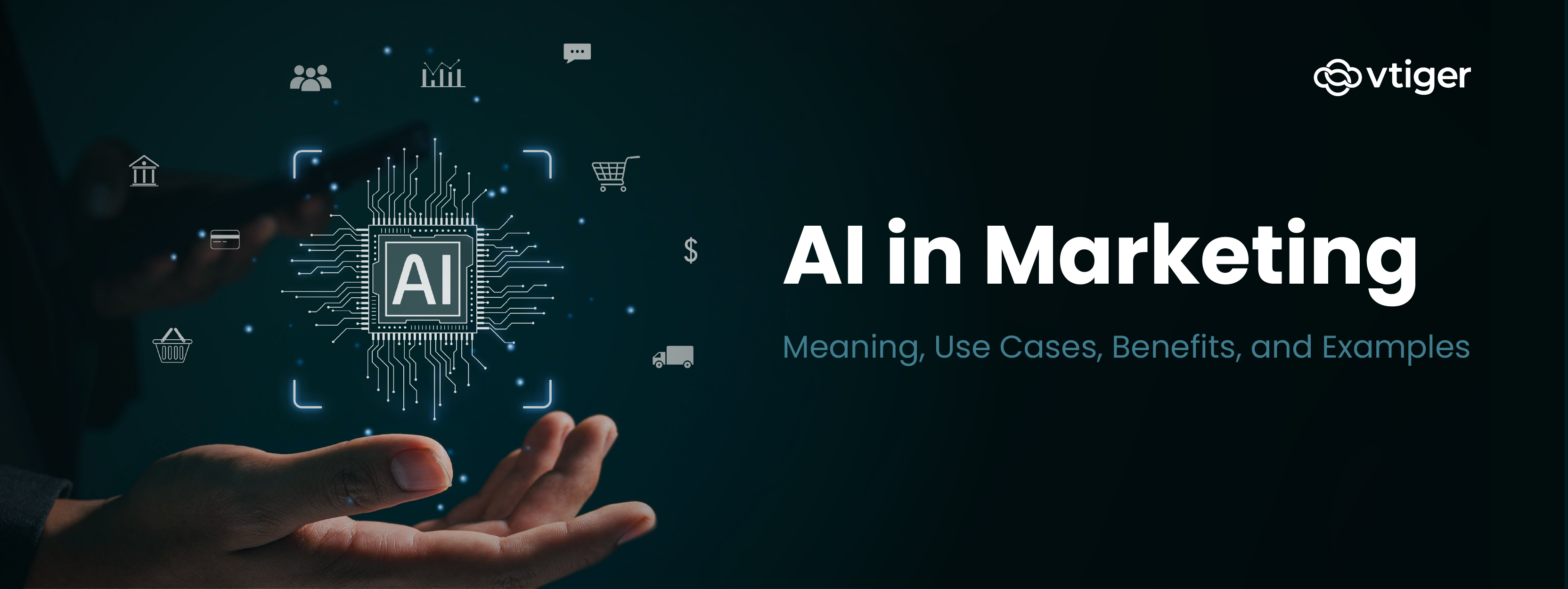
AI in marketing refers to the use of machine learning, predictive analytics, and natural language technologies to enhance marketing processes and decision-making. Unlike traditional automation, which relies on predefined rules, AI systems learn from data patterns and adapt over time. This ability to continuously improve makes AI marketing automation more dynamic and context-aware than conventional tools.
A key differentiator is how AI uses data to generate insights and predictions. For example, it can identify which customers are most likely to convert, recommend content based on behavior, or optimize campaign timing. Common applications include content generation, dynamic personalization, and performance optimization.
Rather than replacing human judgment, artificial intelligence in marketing functions as an assistive intelligence layer. It scales decision-making, surfaces insights faster, and enables teams to execute complex strategies with greater precision while maintaining human oversight.
How AI is Used in Marketing Today
Today, businesses apply AI across the entire customer lifecycle, from audience discovery and content creation to engagement, conversion, and retention. These applications show how AI in marketing acts as both an execution engine and an intelligence layer that supports faster, more informed decision-making.
As data volumes grow and customer journeys become more complex, marketers rely on AI marketing capabilities to manage campaigns across multiple channels while maintaining personalization and consistency. The following areas highlight the most common and impactful ways artificial intelligence in marketing is used today.
AI for Content Marketing
AI tools help marketing teams generate blog drafts, email sequences, product descriptions, and ad copy while maintaining tone and contextual relevance. This reduces the time spent on repetitive tasks and allows marketers to focus on creative direction, storytelling, and strategy.
Other than content creation, AI enables dynamic personalization. By analyzing engagement patterns and user preferences, systems can recommend relevant content for each audience segment. This ensures messaging remains timely and relevant, making content marketing one of the most widely adopted AI marketing use cases.
AI for Customer Personalization
Personalization is now an expected part of the customer experience, and AI in marketing enables businesses to deliver tailored interactions at scale. Behavioral tracking tools collect insights about browsing patterns, engagement frequency, and product interests, allowing AI models to recommend relevant content or offers.
AI CRM also maps individual journeys by identifying key moments of intent, such as repeat visits or high engagement signals. This helps marketers trigger contextual communication at the right time, improving both customer satisfaction and conversion outcomes.
AI for Marketing Automation
Traditional automation relies on fixed workflows, but AI marketing automation introduces adaptability. Campaigns can adjust in real time based on user behavior, engagement signals, and predictive insights. For example, email campaigns can adjust timing, frequency, or content based on recipients’ interactions .
When combined with platforms such as CRM systems, especially in CRM for Marketing and workflow tools, AI helps coordinate cross-channel campaigns and enhances lead prioritization through predictive scoring. This ensures marketing efforts remain efficient while improving the quality of engagement.
AI for Campaign Optimization
Campaign optimization is one of the most measurable applications of Artificial Intelligence in marketing. Machine learning models analyze historical performance, audience behavior, and channel effectiveness to predict which strategies will deliver the best results.
These insights allow marketers to adjust targeting, messaging, and budget allocation proactively. By continuously learning from performance data, AI ensures campaigns become more efficient over time, improving ROI and reducing wasted spend.
AI for Customer Insights
AI enables marketers to derive deeper insights from complex datasets through techniques such as sentiment analysis, intent prediction, and micro-segmentation. These insights help businesses understand not just what customers do, but why they behave in certain ways.
By uncovering hidden patterns and trends, artificial intelligence in marketing supports more strategic planning and enables teams to design campaigns that closely align with customer expectations and needs.
Benefits of AI in Marketing
The impact of AI isn’t limited to efficiency gains, transforming how marketers plan, execute, and evaluate campaigns. Key benefits of AI in marketing include:
• Higher ROI through precision targeting
AI evaluates conversion probability, engagement history, and channel response to continuously refine audience segments and adjust media spend.
• Improved productivity and speed
Campaign performance data is analyzed in real time, allowing marketers to modify targeting, creatives, or channel allocation without waiting for end-of-campaign reports.
• Reduced manual effort and errors
AI automates attribution analysis, performance tracking, and anomaly detection, allowing teams to focus on strategy instead of manual reporting and spreadsheet-based evaluation.
• Better customer insights
AI identifies patterns across browsing activity, engagement signals, and purchase sequences, helping teams understand what influences customer decisions.
• Consistent personalization across channels
Content, recommendations, and offers are dynamically adjusted based on user behavior, improving relevance throughout ongoing interactions rather than after campaign completion.
• Scalable campaign execution
AI handles segmentation, targeting, testing, and optimization across large audiences, allowing teams to manage more campaigns without increasing operational overhead.
Together, these advantages demonstrate how AI marketing enhances both operational performance and customer engagement.
Real-World Examples of AI in Marketing
AI marketing use cases appear across targeting, content delivery, customer interaction, and pricing decisions. These systems process behavioral data, engagement signals, and transaction history to improve how campaigns perform and adapt.
Recommendation and Personalization Systems
Recommendation engines analyze browsing sequences, purchase frequency, dwell time, and product affinity. Based on these signals, the system ranks and serves products, content, or offers most relevant to each user. This logic drives ecommerce suggestions, streaming recommendations, and personalized homepage experiences, increasing conversion probability and average order value.
Predictive Targeting and Ad Optimization
Advertising platforms apply predictive models to evaluate click probability, conversion likelihood, and audience intent. The system automatically adjusts targeting parameters, bidding levels, and audience selection. . This improves campaign efficiency by directing spend toward segments with higher expected performance rather than distributing budgets uniformly.
Conversational AI and Customer Interaction
Chatbots and virtual assistants interpret user queries, identify intent, and respond using trained language models. These systems answer product questions, qualify leads, assist navigation, and support transactions. This reduces response time and ensures customer engagement continues without depending entirely on human agents.
Social Listening and Sentiment Analysis
Social listening tools process public conversations, reviews, and comments using natural language processing. The system classifies sentiment, detects recurring themes, and tracks opinion shifts over time. Marketing teams use this information to understand brand perception, identify emerging concerns, and adjust communication strategies accordingly.
Dynamic Pricing and Demand Response
Pricing systems analyze demand trends, competitor pricing, inventory levels, and purchase velocity. Based on these inputs, prices adjust automatically to match market conditions. This approach helps maintain competitiveness, manage inventory movement, and improve revenue performance without manual intervention.
How Businesses Can Get Started With AI in Marketing
Adopting AI in marketing does not require an immediate, large-scale transformation. Most successful implementations begin with a focused, phased approach that allows teams to experiment, learn, and scale gradually. The following steps provide a practical framework for introducing AI into marketing strategies effectively.
• Identify high-impact use cases
Begin by pinpointing areas where AI can deliver measurable improvements quickly. This might include personalization, lead scoring, campaign optimization, or predictive analytics. Starting with targeted use cases allows teams to demonstrate value early and build momentum for broader adoption.
• Leverage first-party customer data
Quality data is the foundation of any successful AI initiative. Using first-party data such as customer interactions, behavioral signals, and purchase history helps AI models generate more accurate insights. Investing in data hygiene and governance ensures reliable outputs and better decision-making.
• Integrate with existing systems
AI tools deliver the greatest value when connected to existing platforms such as CRM, analytics, and marketing workflows. Integration enables a unified view of customer data, streamlines processes, and ensures insights can be applied directly to campaigns.
• Train teams on AI-assisted workflows
Technology adoption is as much about people as it is about tools. Providing training helps marketers understand how to interpret AI recommendations, validate outputs, and collaborate effectively with intelligent systems. This builds trust and encourages adoption across teams.
• Maintain human oversight
While AI can automate analysis and execution, human judgment remains essential. Marketers should review outputs to ensure they align with brand voice, ethical considerations, and customer expectations. This balance ensures AI enhances decision-making rather than replacing it.
• Track performance and refine continuously
Measuring results is critical for long-term success. Monitoring metrics such as engagement, conversion rates, and ROI helps teams evaluate the effectiveness of AI initiatives. Continuous refinement ensures models improve over time and remain aligned with business objectives.
Future of AI in Marketing
The next phase of AI in marketing will focus on deeper intelligence, automation, and collaboration. Micro-audience segmentation will enable brands to tailor messaging to extremely specific customer groups, increasing relevance and engagement.
Agentic workflows will automate complex marketing processes with minimal manual input, while predictive revenue models will guide strategic planning and budget allocation. AI copilots will assist marketers by generating insights, recommendations, and creative ideas in real time.
As these technologies mature, marketing will increasingly operate as a partnership between humans and intelligent systems. AI will handle analysis and execution at scale, while marketers focus on creativity, strategy, and relationship building, making human-AI collaboration the new standard, along with lead management.
Frequently Asked Questions (FAQs)
1. What is AI in marketing?
AI in marketing refers to the use of artificial intelligence technologies such as machine learning and predictive analytics to analyze customer data, automate tasks, and improve campaign performance. It helps marketers make data-driven decisions, personalize customer experiences, and optimize messaging across channels while reducing manual effort and improving overall marketing efficiency.
2. How is AI used in marketing today?
Businesses use AI in marketing for content creation, audience segmentation, predictive analytics, campaign optimization, and workflow automation. It powers recommendation engines, chatbots, email personalization, and performance forecasting. These applications help marketers understand customer behavior, deliver relevant messages at scale, and improve engagement and conversion outcomes across multiple marketing channels.
3. What are the benefits of AI in marketing?
The benefits of AI in marketing include improved targeting accuracy, faster campaign execution, deeper customer insights, and consistent personalization. AI reduces repetitive manual work and helps teams make smarter decisions using predictive analytics. This leads to better customer experiences, higher engagement, and improved return on investment for marketing activities.
4. Is AI marketing expensive?
The cost of AI marketing depends on the tools and scale of implementation, but many solutions are now accessible to businesses of all sizes. Cloud-based platforms and built-in AI features reduce upfront investment while delivering measurable efficiency gains, making AI marketing a cost-effective option when aligned with clear business goals.
5. Does AI replace human marketers?
AI does not replace marketers; it enhances their capabilities. By automating repetitive tasks and analyzing large datasets, AI frees marketers to focus on strategy, creativity, and relationship building. Human judgment remains essential for interpreting insights, maintaining brand voice, and ensuring campaigns align with customer expectations and business objectives.
6. What is generative AI in marketing?
Generative AI in marketing refers to tools that create content such as copy, images, videos, or product descriptions based on prompts or data inputs. It helps marketers produce creative assets faster, experiment with variations, and scale content production while maintaining consistency, making it a valuable tool for modern marketing teams.
7. How does AI improve personalization?
AI improves personalization by analyzing customer behavior, preferences, and engagement patterns to deliver tailored messages, recommendations, and experiences. It enables real-time adjustments across channels, ensuring customers receive relevant content at the right moment, thereby increasing satisfaction, engagement, and the likelihood of conversion.
8. What data is needed for AI marketing?
AI marketing relies on customer interaction data, behavioral signals, transaction history, demographic information, and campaign performance metrics. High-quality, well-organized data helps AI models generate accurate predictions, enabling marketers to understand audience needs, segment customers effectively, and deliver more relevant communication.
9. What are the risks of AI in marketing?
Risks of AI in marketing include data privacy concerns, algorithmic bias, lack of transparency, and over-reliance on automation. Without proper oversight, AI decisions may not align with brand values or customer expectations. Strong governance, ethical guidelines, and human review processes help mitigate these risks effectively.
10. How can small businesses use AI in marketing?
Small businesses can adopt AI through tools for email automation, customer segmentation, chatbots, and analytics. Starting with simple use cases helps improve efficiency and targeting without large investments. As familiarity grows, businesses can expand AI adoption to enhance personalization, optimize campaigns, and scale marketing efforts.