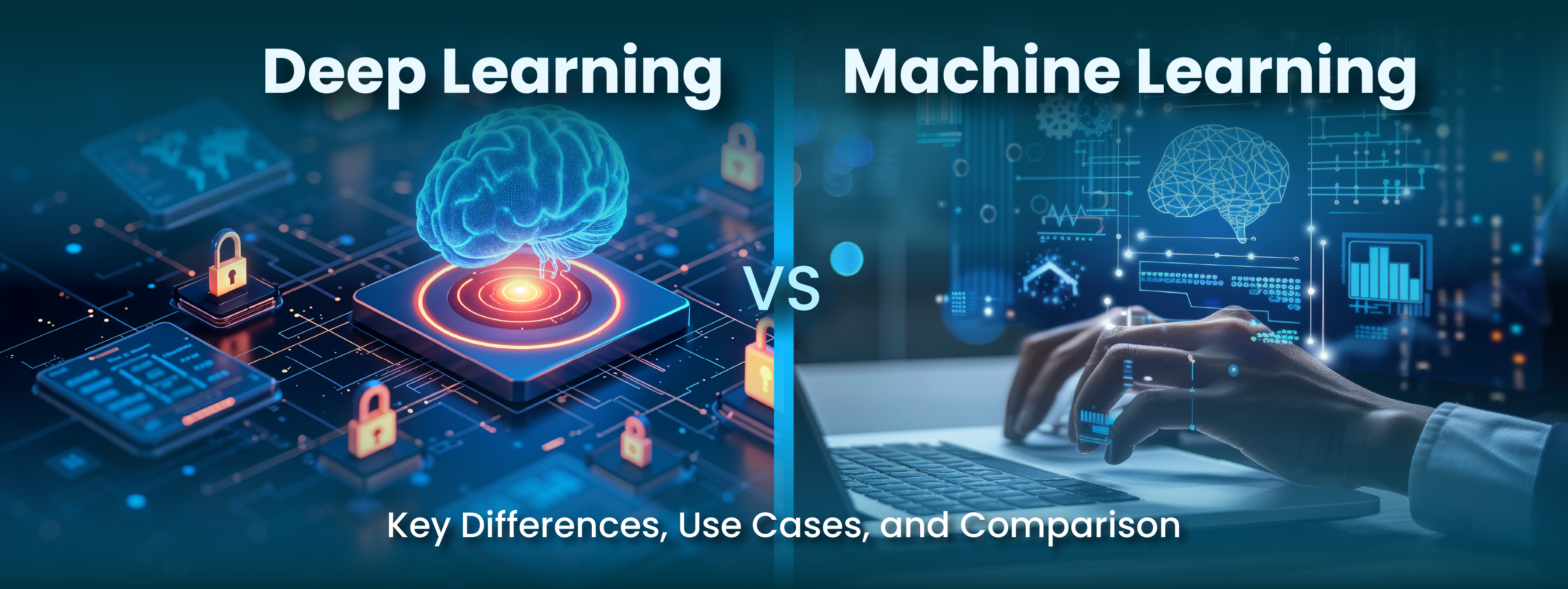
Deep learning is a subset of machine learning that uses multi layered neural networks to automatically learn patterns from large amounts of unstructured data such as images and text. Machine learning encompasses broader algorithms such as regression and decision trees that require manual feature engineering and work well with structured data.
In any modern day discussion, the real difference between deep learning and machine learning comes down to data scale, model complexity, and operational requirements. Broadly speaking, deep learning is an ideal alternative for perception problems, while machine learning is best suited for structured predictive tasks that power everyday business systems.
Read this blog to get a nuanced rundown on where these tech capabilities can be best used.
What Is Machine Learning?
Machine learning is a branch of artificial intelligence where algorithms learn patterns from historical structured data and generate predictions without explicit programming rules. . It works best with tabular datasets such as CRM records, financial reports, and transactional logs.
Machine learning models typically require manual feature engineering where domain experts define relevant variables before training. These systems are trained on labeled datasets and run efficiently on CPUs, making them practical for production environments.
Common algorithms include linear regression, decision trees, random forests, and support vector machines.
Business examples include fraud detection, sales forecasting, lead scoring, and recommendation systems. In many AI in Business deployments, machine learning serves as the analytical backbone that supports operational decisions without requiring heavy compute infrastructure.
What Is Deep Learning?
Deep learning is a specialized subset of machine learning that uses artificial neural networks with multiple hidden layers. These architectures automatically extract features from raw data instead of relying on manually engineered inputs.
Deep learning models are particularly effective with unstructured data such as images, speech, and free form text. Neural networks process inputs through layered mathematical transformations, enabling them to detect complex nonlinear relationships.
Convolutional neural networks are commonly used for image recognition tasks. Recurrent neural networks and Transformers are applied to text and speech processing.
Business use cases include image recognition systems, voice assistants, autonomous vehicle perception systems, medical image diagnostics, and advanced NLP engines used in AI Automation initiatives.
When comparing machine learning vs deep learning comparison scenarios, deep learning becomes dominant when the problem involves perception or language understanding.
Deep Learning vs Machine Learning – Key Differences
The Deep Learning vs Machine Learning debate is often simplified, but businesses can witness the real distinctions of its application in terms of data requirements, infrastructure needs, and interpretability. Have a look at this comparison aligned with common clusters of interests/features:
| Feature | Machine Learning | Deep Learning |
| Data Requirement | Small to medium datasets | Large scale Big Data |
| Feature Engineering | Manual | Automatic |
| Training Time | Faster minutes or hours | Longer days or weeks |
| Hardware | CPU | GPU or TPU |
| Best For | Structured data | Unstructured data such as images text audio |
| Interpretability | Higher | Lower |
| Model Complexity | Moderate | Very high |
In most machine learning vs deep learning comparison evaluations, ML offers faster experimentation and clearer audit trails. DL offers higher ceiling performance for complex tasks but demands more computational investment.
When to Choose Machine Learning vs Deep Learning
Choosing between ML and DL is rarely binary. It is not about which model class is more advanced. It is about statistical efficiency, data topology, compute constraints, and governance tolerance.
The Deep Learning vs Machine Learning decision should be driven by signal structure, feature availability, training budget, inference latency requirements, and explainability thresholds.
Choose Machine Learning When:
Machine learning is often the better option when your dataset is structured, tabular, and limited in volume. Algorithms such as gradient boosted trees, random forests, logistic regression, or support vector machines are statistically efficient. They perform well even when sample sizes are moderate.
If your problem space allows explicit feature engineering, ML models can extract high predictive power without deep architectures. For example, in credit risk modeling or churn prediction, engineered features such as recency, frequency, monetary value, and behavioral aggregates often capture most of the signal.
ML is also preferable when:
• Interpretability is mandatory due to regulatory oversight
• Feature importance, SHAP values, or coefficient analysis are required
• Latency constraints demand lightweight inference
• Training cycles must be short for rapid experimentation
• Infrastructure is CPU bound and GPU clusters are unavailable
In operational systems such as sales forecasting pipelines, structured historical revenue data can be modeled effectively using regression ensembles or time series algorithms without introducing deep neural networks.
In short, if the signal is largely linear or moderately nonlinear and can be expressed through engineered predictors, traditional machine learning often provides a better bias variance tradeoff. You gain faster convergence, lower infrastructure cost, simpler deployment pipelines, and stronger auditability.
There is also an organizational reality here. Many business systems such as CRM Automation or financial reporting platforms rely on deterministic logic combined with probabilistic scoring layers. Machine learning integrates cleanly into these environments because it supports feature lineage tracking, model monitoring, and drift detection without extreme operational overhead.
Deep architectures are not automatically superior if 80 percent of the predictive signal already exists in structured aggregates.
Choose Deep Learning When:
Deep learning becomes appropriate when the feature space is high dimensional, raw, and difficult to manually engineer. If the underlying signal is hierarchical or compositional, neural networks can learn representations that classical models cannot easily approximate.
For example:
• Pixel level image classification
• Sequence modeling in speech recognition
• Context aware language modeling
• Multimodal data fusion
In these cases, handcrafted features are either insufficient or prohibitively expensive to design. Convolutional layers can learn spatial hierarchies in images. Transformers can model long-range dependencies in text through self-attention mechanisms. Recurrent architectures capture temporal dependencies in time series and speech.
Deep learning is also justified when:
• The dataset contains millions of samples
• Nonlinear decision boundaries are complex
• Transfer learning from pretrained models is available
• Representation learning adds competitive advantage
• You have access to GPU acceleration and distributed training
In modern AI Automation systems such as intelligent chat interfaces, language models rely on embeddings, attention layers, and large parameter matrices. Classical ML models cannot replicate this contextual depth.
However, there is nuance. Deep learning introduces tradeoffs:
• Longer training cycles
• Higher energy consumption
• More difficult hyperparameter tuning
• Reduced interpretability
• Greater MLOps complexity
Backpropagation across deep architectures requires careful optimization strategy, learning rate scheduling, regularization techniques, and often gradient clipping to prevent instability. Model monitoring becomes more complex because representation drift can be subtle.
If your problem can be expressed as feature engineered tabular prediction with manageable dimensionality, machine learning is usually more efficient.
If your problem involves representation learning from raw perceptual input, deep learning is often unavoidable.
Real-World Business Applications
Definitions are useful, but decision makers rarely evaluate models in isolation. They evaluate impact. The real test of any Deep Learning vs Machine Learning decision is not architectural elegance but measurable business outcome.
Once models leave the experimentation phase, they must integrate with revenue workflows, customer systems, pricing engines, forecasting dashboards, and marketing pipelines. That is where theoretical differences translate into operational consequences.
Instead of asking which approach is more advanced, the better question is this: where does each create the most leverage inside actual business systems? Let us examine how both machine learning and deep learning operate when tied directly to revenue and growth outcomes.
Machine Learning in Business
Machine learning is built for extracting patterns from structured datasets and turning them into accurate predictions. Most enterprise revenue systems rely on ML long before they consider deep neural networks.
Here is where ML delivers measurable business value.
1. Predictive Lead Scoring with Behavioral Depth
Basic lead scoring uses demographics. Modern machine learning goes much deeper.
Instead of simply asking whether a prospect fits an industry or company size, ML models evaluate behavioral signals such as:
• Frequency of website visits
• Velocity of engagement across pages
• Type of content consumed
• Email response timing
• Form completion patterns
Downloading a pricing guide carries more intent than browsing a blog. Repeated visits to comparison pages signal stronger buying readiness than a single homepage visit.
This shifts scoring from surface interest to behavioral fit.
Inside structured CRM environments, systems like Calculus AI evaluate how closely a lead profile matches historically closed deals. Rather than guessing, the model compares each new prospect against the ideal customer profile derived from past wins.
That is machine learning applied directly to Lead Management optimization.
2. Customer Churn Prediction as an Early Warning System
Churn rarely announces itself. Customers do not always complain before leaving. Often they simply reduce activity quietly. Machine learning models use anomaly detection to identify silent churn patterns such as:
• Drop in login frequency
• Reduced feature usage
• Decreased transaction volume
• Lower response rates to outreach
Instead of reacting to cancellations, teams can intervene weeks earlier. Retention campaigns become proactive rather than reactive.
3. Dynamic Pricing and Revenue Optimization
Pricing is no longer static in many industries. Machine learning models adjust pricing based on:
• Competitor movements
• Inventory levels
• Historical demand curves
• Seasonal trends
• Real time purchase velocity
Airlines and ecommerce platforms use structured regression and ensemble models to continuously optimize margins. These systems do not require deep neural networks. They require structured data modeling and strong feature engineering.
4. Revenue and Sales Forecasting Using Pipeline Velocity
Basic forecasting looks at calendar timelines. Advanced ML forecasting evaluates pipeline velocity. Pipeline velocity measures:
• How long deals stay in each stage
• Conversion probability between stages
• Historical close rates
• Rep level performance patterns
Instead of guessing closing dates, models estimate the actual probability adjusted closing window.
Managers can build customized projection models using CRM level data points rather than relying on flat percentage assumptions. This improves forecast confidence and resource planning.
5. Intelligent Marketing Attribution
Attribution is one of the most misunderstood problems in growth. Which channel actually influenced the conversion? Machine learning models analyze touchpoint sequences across:
• Email campaigns
• Social engagement
• Paid ads
• Webinars
• Direct visits
Instead of last click logic, probabilistic models estimate weighted contribution of each interaction.
This helps marketing leaders allocate budget rationally rather than emotionally. Modern Marketing Automation systems rely heavily on structured machine learning for this kind of analysis.
Deep Learning in Business
Deep learning enters the picture when data stops looking like rows and columns and starts looking like images, voice, or language. If the business problem involves perception or contextual understanding, neural networks become necessary. Here is where deep learning becomes operationally meaningful.
1. Conversational Chat Systems
Customer service chatbots powered by transformer based models understand intent, sentiment, and context across long conversations. Unlike rule based bots, these systems:
• Interpret natural language variations
• Maintain conversational memory
• Generate context aware responses
• Detect escalation signals
This is where deep learning handles language representation in a way classical ML cannot.
2. Sentiment and Emotion Analysis
Deep neural networks analyze large volumes of text from reviews, support tickets, and social conversations. Instead of keyword counting, these systems evaluate semantic context.
For example, the phrase “not bad” carries different sentiment than “bad.” Deep learning models capture such nuance through embeddings and attention mechanisms. This level of contextual intelligence improves customer experience strategy.
3. Voice Enabled Systems
Speech recognition systems rely on sequence modeling and acoustic feature extraction. Deep architectures process raw audio signals and convert them into structured text. This enables:
• Voice search
• Call center transcription
• Voice based automation
• Accessibility solutions
These systems require GPU accelerated training and large labeled audio datasets.
4. Image Based Automation
In industries such as logistics, insurance, and healthcare, deep learning models analyze images for classification and detection.
Examples include:
• Document scanning and data extraction
• Damage detection in claims processing
• Medical image diagnostics
• Quality inspection in manufacturing
Convolutional neural networks learn spatial hierarchies directly from pixel data. Manual feature engineering would not scale here.
Is Deep Learning Better Than Machine Learning?
The short answer is no. The longer answer is it depends on what you are optimizing for.
The Deep Learning vs Machine Learning debate often assumes progress is linear, as if deeper architectures automatically mean better outcomes. In practice, model performance is bounded by signal quality, data consistency, deployment constraints, and business tolerance for complexity.
Deep learning can outperform classical models when the decision boundary is highly nonlinear and when representation learning materially improves signal extraction. This is common in vision systems, speech processing, and large scale language modeling. In those domains, shallow models simply do not capture hierarchical structure effectively.
But outside those environments, the story changes.
If the underlying signal is already well captured through engineered variables, adding a deep architecture may increase variance without increasing usable accuracy. Overparameterized models can introduce instability, require aggressive regularization, and demand ongoing retraining cycles that may not justify marginal lift.
There are also operational realities:
• Deep networks require extensive hyperparameter tuning
• Training pipelines become more sensitive to distribution shift
• Inference latency may increase depending on model size
• Debugging errors becomes significantly harder
• Governance teams often struggle with explainability requirements
For structured business analytics such as churn modeling, risk scoring, or revenue projections, tree ensembles and regularized regression models often achieve strong performance with lower operational overhead. In these scenarios, machine learning offers statistical efficiency with clearer attribution of impact.
Deep learning dominates when feature discovery itself is the hard problem. Machine learning dominates when decision optimization is the hard problem.
In mature enterprise environments, the question is rarely which one is better. The real question is which layer of the system requires representation learning and which layer requires controlled, auditable decision logic.
Many high performing systems use deep learning to generate embeddings and machine learning models to rank, score, or allocate resources on top of those embeddings.
So is deep learning better than machine learning?
It is better when representation complexity is the bottleneck. It is unnecessary when structured signal already explains most of the outcome. Better is contextual. And in production environments, contextual decisions win over architectural trends every time.