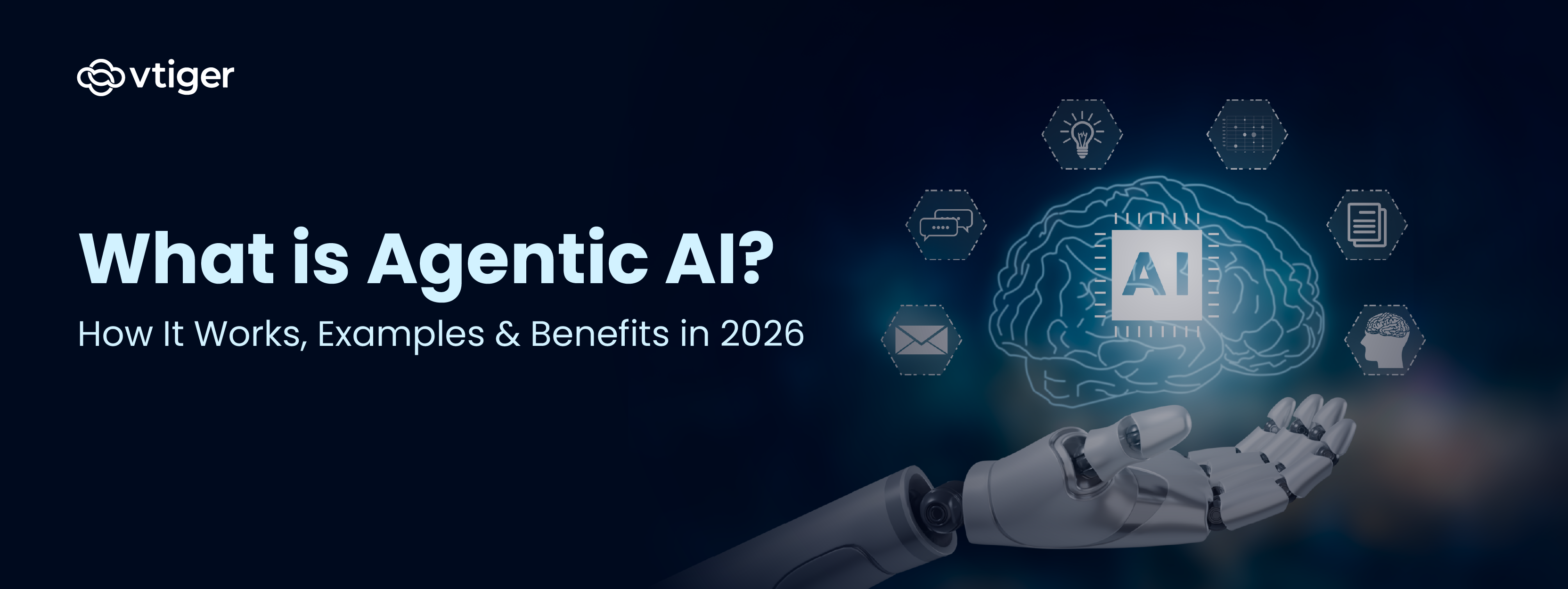
Agentic AI refers to systems that pursue defined goals, plan multi-step actions, and execute those actions using tools, with minimal human prompting between steps. Unlike traditional automation that follows fixed rules, or generative AI that produces content on request, agentic AI combines reasoning, memory, and tool use to complete tasks end to end. Adoption focuses on business workflows where decisions can be scoped, validated, and audited within defined boundaries.
Agentic AI is moving out of the research lab faster than enterprise software categories usually absorb new capabilities. The shift is being driven by three concurrent maturity steps:
- Large language models reaching a reasoning quality that holds up across multi-step task.
- Tool-use frameworks becoming reliable enough to expose APIs and databases to model-driven workflows, and orchestration layers that allow agents to plan, retry
- Recover from errors without resetting the conversation.
The economic implications are visible in the analyst projections. Gartner identified agentic AI as one of the top strategic technology trends, projecting that by 2028, at least 33% of enterprise software applications will include agentic AI capabilities, up from less than 1% in 2024.
Software workflows that previously required human intervention are moving toward agent-led execution with human oversight at defined decision points.
What Is Agentic AI
Agentic AI is the class of AI systems designed to pursue defined goals through multi-step planning and action, rather than responding to single prompts with single outputs. The defining capability is autonomy within constraints. The agent receives a goal, breaks it into smaller steps, executes those steps using available tools and data, evaluates the outcome at each step, and adapts the plan when reality does not match expectations. Human input frames the goal and validates critical decisions, but the agent handles the operational sequence between those points without constant prompting.
The contrast with rule-based CRM automation is meaningful. Rule-based automation follows deterministic logic. If a customer support ticket has a particular tag, route it to a particular queue. If a deal stage updates, send a particular email. The rules execute reliably but cannot handle situations the rules did not anticipate.
Agentic AI handles unscripted situations by reasoning about the goal and the available actions, then deciding what to do next. The same agent can handle a support ticket whose shape was never anticipated in the original rule set, because the decision logic comes from the model rather than from pre-specified rules.
The contrast with assistive AI is equally important. Assistive AI surfaces recommendations for a human to act on. Recommend the next email to send, suggest the next deal action, draft a response for review. The human stays in the execution loop. Agentic AI takes over more of the execution between human checkpoints, with the human’s role shifting from doing the steps to defining the goal and reviewing the outcome.
Agentic AI vs Generative AI
Agentic AI and generative AI are often discussed together, but they operate differently. Generative AI is built to create content from prompts, while agentic AI is designed to complete tasks across systems using reasoning, planning, and execution capabilities.
What Generative AI Does
Generative AI produces outputs such as text, code, images, audio, or video based on user instructions. The interaction stays prompt-driven, with the user providing context for each request.
Common use cases include:
- Writing emails, articles, and summaries
- Generating code snippets
- Translating languages
- Answering knowledge based queries
- Creating visual or audio content
Its strength lies in content fluency and fast content generation.
What Agentic AI Adds
Agentic AI uses generative AI as part of its reasoning layer but extends beyond content generation. It can maintain goals across multiple steps, interact with external tools, and execute actions within connected systems.
Common capabilities include:
- Managing multi step workflows
- Using APIs and enterprise tools
- Updating CRM systems
- Scheduling actions and follow ups
- Coordinating tasks across platforms
Its strength lies in task execution rather than content creation alone.
Core Difference Between Both Agentic AI vs Generative AI
The difference is mainly visible in how each system operates and what outcome it produces.
| Parameter | Generative AI | Agentic AI |
| Primary output | Content generation | Task completion |
| Interaction model | Prompt and response | Goal and execution |
| Context handling | Limited to active interaction | Maintains multi step objectives |
| Workflow capability | Single task focused | End to end workflow execution |
| Tool usage | Usually manual or user triggered | Autonomous tool and API interaction |
| Decision making | Reactive to prompts | Plans and adapts actions dynamically |
| Human involvement | High supervision required | Reduced intervention after setup |
| System connectivity | Mostly isolated generation | Integrated across enterprise systems |
| Operational scope | Creative and productivity tasks | Process automation and orchestration |
| Enterprise deployment | Writing and assistant tools | CRM, operations, and workflow systems |
Core Components of Agentic AI Systems
Agentic AI systems are built from modular components that together produce goal-directed behaviour. The architecture is consistent across most production deployments, even when the specific implementations differ.
The Reasoning Engine
The reasoning engine, typically a large language model or a combination of models, interprets the goal and decides what action to take next based on the current state. This is where the agent’s general intelligence lives, and the choice of model affects both the quality of decisions and the operational cost of running the agent.
Most production deployments use a foundation model for reasoning, with specialized models for tasks like classification or extraction, where they outperform the general model.
- The reasoning engine processes goals into actionable steps.
- It decides between available tools based on the current context.
- It interprets results from tool calls and decides whether to continue.
- The choice of model affects accuracy, latency, and per-run cost.
Goals and Instructions
Goals are the structured statements of what the agent is trying to accomplish, and instructions are the constraints on how it can accomplish them. Together, they define the operating envelope. Without clear goals, the agent’s actions become unpredictable.
Without clear instructions, the agent may take actions that achieve the goal but violate organizational requirements.
- Goals specify the desired outcome in observable terms.
- Instructions define the constraints, including what actions are permitted.
- Both need to be specific enough to constrain the agent meaningfully.
- Production systems require version-controlled goal definitions.
Tools and Integrations
Tools are the agent’s ability to act in the world. They include API calls to external systems, database queries, function execution, file manipulation, and any other action the agent can take outside its own reasoning. The breadth of tool integration determines what categories of work the agent can complete, and the security model around tool access determines what it cannot break.
- API integrations connect the agent to external systems such as CRM, billing, and communication tools.
- Database access lets the agent retrieve and update structured records.
- Function calls enable specific business logic to be invoked.
- Scope-limited credentials prevent the agent from accessing systems beyond its mandate.
Memory
Memory is what allows the agent to maintain context across steps within a task, and across tasks over longer windows. Short-term memory holds the working context for the current task. Long-term memory accumulates patterns, preferences, and prior outcomes that inform future decisions.
- Short-term memory tracks the current task’s context and intermediate results.
- Long-term memory persists across sessions and tasks.
- The memory model affects personalization depth and decision quality.
- Production systems require explicit memory policies for compliance.
The Planning Module
The planning module breaks the goal into ordered steps, monitors progress, and adjusts the plan when steps fail or produce unexpected results. This is where the agent’s resilience comes from. A simple agent without a planning module fails on the first unexpected condition. An agent with a planning module reroutes and continues.
- The planner decomposes goals into sequential actions.
- It handles error recovery and step retries.
- It adapts the plan based on intermediate results.
- It identifies when human intervention is needed.
How Agentic AI Works in Practice
The operating loop of an agentic AI system follows a recognizable pattern, even across different platforms and use cases. Each step contributes to the overall task completion, and gaps in any step weaken the whole.
- The agent receives a goal from a user or another system, with the goal stated in observable terms and the constraints defined explicitly.
- The agent analyses the current context, retrieving relevant data from connected systems and reviewing any prior interactions tied to the goal.
- The planning module decomposes the goal into a sequence of steps that, executed correctly, should produce the desired outcome.
- The agent executes the first step using the appropriate tool or function, capturing the result for evaluation against the expected outcome.
- The reasoning engine evaluates whether the step succeeded, adjusting the plan if it failed or producing the next step if it succeeded.
- The agent continues through the planned steps, with memory accumulating context across each step to inform later decisions.
- When the goal is reached or the agent identifies a point requiring human input, it produces a result for review, including a summary of actions taken and any pending decisions.
- The outcome feeds back into the agent’s memory and into the system’s training data, gradually improving performance across future similar tasks.
This loop runs inside the workflow automation function in CRM deployments, where Vtiger’s Calculus AI applies the pattern to specific business workflows. The human user defines the goal and reviews the result, with the agent handling the steps in between within defined boundaries.
Benefits of Agentic AI for Business Operations
The operational returns from agentic AI deployments depend heavily on use case selection and implementation quality. The benefits below are visible across production deployments, with the magnitude varying by workflow complexity and the maturity of the underlying CRM data.
End-to-End Automation of Multi-Step Tasks
Tasks that previously required a human to coordinate steps across multiple systems can now be completed by an agent operating within defined boundaries. The lift is largest on tasks that involve sequential steps across multiple applications, because that coordination is where most of the human time is being absorbed.
- Lead qualification workflows that previously required cross-system data lookup.
- Customer support escalations that involved checking billing, usage, and product status.
- Onboarding flows that span CRM, email, contract, and project management systems.
- Renewal and expansion workflows that required account history and product usage context.
Faster Decision-Making With Real-Time Context
Agentic AI shortens decision latency by pulling relevant data together, evaluating it, and producing a recommendation in seconds rather than the hours or days that manual processes consume. The benefit is largest on time-sensitive decisions where the value of speed outweighs the marginal cost of agent operation. PwC‘s Sizing the Prize research projected that AI could contribute up to $15.7 trillion to the global economy by 2030, with the largest gains coming from productivity improvements in tasks where time-to-decision is a binding constraint.
- Sales response prioritization based on real-time engagement signals.
- Support case routing that integrates customer history with case context.
- Marketing triggers detection from behavioural and product data.
- Operations decisions on inventory, scheduling, or resource allocation.
Scalable Operations Without Proportional Headcount Growth
The scaling math of agentic AI is structurally different from human-only operations. Adding capacity does not require proportional headcount growth, because the agent can handle additional volume within the same operational envelope. The implication is that businesses with significant routine workflow volume can absorb growth without the staffing cost that previously came with it.
- Customer support scaling without proportional agent hiring.
- Sales development scaling without proportional rep hiring.
- Operations workflows scaling without a proportional increase in admin headcount.
- Marketing personalization scaling beyond what manual segmentation could handle.
Real-World Use Cases of Agentic AI
The deployment patterns landing first in 2025 and 2026 cluster around workflows where the goal is well-defined, the steps are bounded, and the failure modes are recoverable. The use cases below show where the returns have been most visible.
Sales Automation Through Agent-Driven Workflows
Sales agentic AI handles lead qualification, follow-up sequencing, and deal-stage progression based on engagement signals. The agent monitors prospect behaviour, decides when to send a follow-up, drafts the message, and updates the CRM record, with the rep reviewing the drafted outreach before send for high-value prospects and auto-sending for routine follow-ups. Vtiger’s Calculus AI operates within this pattern, with the rep retaining final approval for customer-facing actions involving high-stakes prospects.
Customer Support Resolution and Triage
Support agentic AI handles ticket triage, knowledge base retrieval, response drafting, and escalation decisions across the support function. The agent reads the inbound case, checks the customer’s history, retrieves relevant resolution patterns, and drafts a response for agent review or for direct send on routine cases. The deployment surface here is significant, and the AI automation tooling handles the end-to-end orchestration without requiring agents to manage each tool individually.
Marketing Workflow Execution
Marketing agentic AI handles campaign execution across channels, including segmentation decisions, content selection, send timing, and performance monitoring. The agent runs the campaign within defined parameters, monitors response data, and adjusts targeting or timing within constraints. The marketing team sets the goal and reviews the performance, with the agent handling the operational sequencing in between.
Operations and Workflow Optimization
Operations agentic AI coordinates cross-system workflows that previously required human orchestration. Order processing, exception handling, vendor coordination, and internal approval workflows all fit this pattern, where the goal is to keep operations moving while flagging exceptions for human review.
Finance and HR Process Automation
Finance and HR agentic AI handles structured workflows such as invoice processing, expense approval, employee onboarding, and compliance documentation. The processes are well-suited to agent deployment because the rules are codifiable, the audit trail requirements favour structured agent execution, and the human review can focus on exceptions rather than routine items.
Best Practices for Implementing Agentic AI
The implementation patterns that produce durable returns follow a consistent shape. The principles below apply across industries and use cases.
- Start with use cases that have well-defined goals, bounded action spaces, and recoverable failure modes. Open-ended goals on unbounded action spaces produce unpredictable outcomes.
- Define the agent’s instructions and constraints explicitly, including which tools it can use, which decisions require human approval, and what the boundaries of its scope are.
- Build modular agent architectures with clear separation between the reasoning layer, the planning layer, the tool layer, and the memory layer. Monolithic agents are harder to maintain and debug.
- Implement guardrails at every decision point that touches external systems, with validation logic that catches errors before they affect customers or financial records.
- Keep humans in the loop for decisions that are high-stakes, customer-facing, or hard to reverse. The agent handles the steps in between, but the strategic checkpoints stay with a person.
- Monitor agent performance continuously through structured logging, decision audit trails, and outcome measurement. Agents that operate without monitoring drift away from their original behaviour over time.
- Ensure data security and compliance through scope-limited credentials, audit logging of all agent actions, and explicit data handling policies that match regulatory requirements.
- Integrate the agent with the underlying AI CRM so that customer history, business context, and product usage data inform every decision the agent makes.
- Tie agentic AI deployment to the broader AI in business strategy rather than treating it as an isolated technology project.
The Future of Agentic AI
Agentic AI is expected to become a major part of enterprise operations over the next few years as businesses move beyond experimentation and begin integrating AI agents into core systems and workflows. Advancements in reasoning, automation, and system connectivity are expanding the practical use cases of these autonomous systems across industries.
Improvements in AI Reasoning
AI models are becoming better at handling complex tasks, contextual understanding, and multi step decision making. This improvement is allowing agentic AI systems to operate with greater reliability across business functions.
Expansion of Tool Integrations
The growth of integration ecosystems is increasing the number of tools and platforms AI agents can interact with. CRM systems, workflow software, analytics platforms, and customer support tools are becoming part of the operational environment for agentic AI.
Enterprise Adoption and Market Growth
According to Precedence Research, the global agentic AI market is projected to grow from $5.1 billion in 2024 to nearly $196.6 billion by 2034. Organizations are increasingly embedding agentic AI into existing infrastructure while regulatory frameworks continue evolving for large-scale deployment.
The deployments most likely to compound value are the ones that integrate agentic capability into the customer data and process infrastructure already in place, with what are AI agents emerging as a question that procurement teams now ask alongside their CRM and workflow tool evaluations.
Frequently Asked Questions (FAQs)
Q1. What is agentic AI?
Agentic AI is the class of AI systems that pursue defined goals through multi-step planning and action, executing tasks across multiple tools and data sources with minimal human prompting between steps. Unlike chatbots or content generators, an agent maintains a goal across a sequence, decides what to do next based on current state, and adapts when steps do not produce the expected outcome.
Q2. How is agentic AI different from generative AI?
Generative AI produces content in response to a prompt. Agentic AI completes tasks across multiple steps and tools, using generative AI as one component of its reasoning. The interaction model is different. Generative AI is prompt-and-output. Agentic AI is goal-and-result, with the agent handling the intermediate steps. Agentic systems use generative models internally but also add planning, memory, and tool use.
Q3. Can agentic AI work without human input?
Agentic AI operates within defined boundaries that include when and how to seek human input. For routine well-bounded tasks, the agent can complete work end to end without active human prompting. For high-stakes or ambiguous decisions, production agent systems include human-in-the-loop checkpoints. Full autonomy without any human involvement is rarely the right design for enterprise deployments.
Q4. What industries are deploying agentic AI most heavily?
SaaS, financial services, healthcare administration, e-commerce, and professional services lead current adoption, with deployments concentrated in customer support, sales development, operations workflow, and finance process automation. The pattern is broadly consistent: industries with high routine workflow volume and structured data systems adopt fastest, while regulated industries adopt more selectively with strong audit and approval controls.
Q5. Is agentic AI safe for production deployment?
Agentic AI is safe for production when implemented with appropriate guardrails, including scope-limited tool access, audit logging, human-in-the-loop checkpoints for high-stakes decisions, and structured monitoring of agent behaviour. Production safety comes from system design discipline, not from the model itself. Agents deployed without these controls produce unpredictable outcomes regardless of underlying model quality.
Q6. Does building agentic AI require custom coding?
Building production-grade agentic AI traditionally required custom engineering, but the platform ecosystem has matured to the point where many use cases can be deployed through low-code tools and platform-native agent builders. CRM systems that natively include agent capabilities reduce integration work, since the customer data, business logic, and workflow infrastructure are already in place.
Q7. What returns can businesses expect from agentic AI?
Returns depend heavily on the use case. Routine multi-step workflows that previously required cross-system coordination tend to see the largest returns, often 30% to 50% reduction in operational time on the targeted workflow. Customer-facing applications see returns through response speed and consistency rather than headcount reduction. The pattern most likely to produce durable returns is to integrate agentic AI into existing workflow systems rather than run it as a standalone tool.