AI is best suited for business cases involving large volumes of data, repetitive tasks, pattern recognition, forecasting, personalization, and decision support. Common examples include customer service automation, lead scoring, sales forecasting, content generation, fraud detection, customer segmentation, and workflow automation. Businesses achieve the greatest value when AI augments human expertise rather than completely replacing it.
The right AI use case for your business has less to do with what AI can do and more to do with what your business is set up to deploy. Most AI projects stall not because the technology fails. They stall because the organization never had the data, infrastructure, or operational discipline to scale the deployment past a demo.
What Makes a Business Case Suitable for AI?
The best business processes for AI are those that are highly repetitive, data-heavy, or require rapid, rule-based responses at scale. The clearest signal is the combination of pattern density and decision volume. Where both are high, AI compounds; where either is missing, AI struggles to produce returns.
According to Forrester’s 2025 research, 91% of global technology decision-makers plan to increase IT spending driven by AI investment. The capital is flowing, but use case selection still separates productive deployments from expensive demos. The gap between deployment and measurable return is widest in organizations that skipped the suitability check.
| “If a typical person can do a mental task with less than one second of thought, we can probably automate it using AI either now or in the near future.” – Andrew Ng, founder of DeepLearning.AI |
Characteristics of Good AI Use Cases
The strongest AI candidates share four traits. Each one shows up well before the pilot stage and predicts whether the deployment will scale. Treat them as a filter, not a wish list:
- Data availability in clean, structured, accessible form across the workflow.
- Repeatable processes where the same decision recurs with predictable variation.
- Measurable outcomes with clear baseline metrics for cycle time, accuracy, or cost.
- Scalability potential so that early wins compound rather than plateau at the pilot stage.
Which Business Cases Are Better Solved by AI?
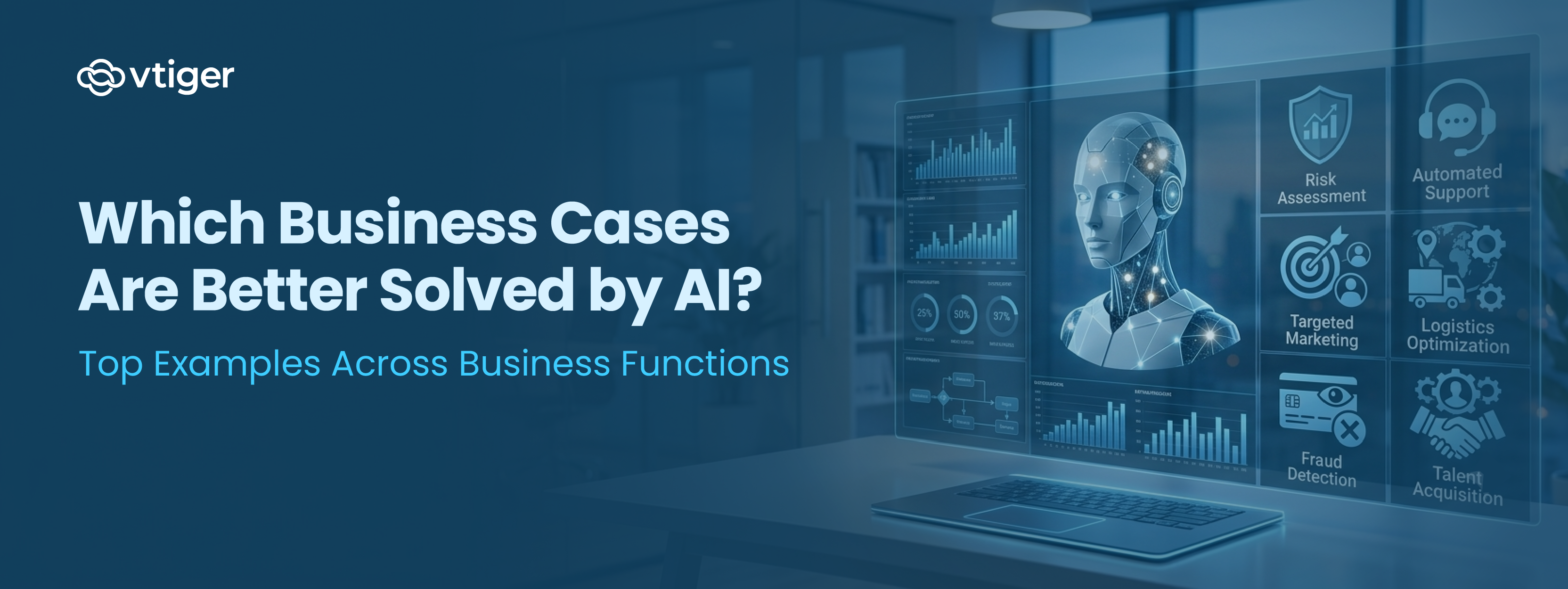
AI delivers the most value when it automates tasks, uncovers insights, or assists decision-making at scale. The ten use cases below recur across companies of different sizes and industries. Each one starts as a productivity gain and grows into a workflow change when integrated with the system of record:
- Customer service automation uses AI-powered chatbots and virtual assistants for tier-one query handling, ticket routing, and knowledge retrieval; a capable AI agent builder makes the deployment configurable rather than custom-coded.
- Lead scoring and qualification rank prospects against historical close patterns, surface buyer intent signals, and prioritize opportunities for sales follow-up.
- Sales forecasting leverages pipeline data to predict revenue, flag deal risks, and improve accuracy beyond traditional rep-by-rep gut feel.
- Customer segmentation groups audiences by behaviour, value, and engagement; disciplined customer segmentation is the foundation for any personalization program.
- Marketing campaign optimization recommends audiences, drafts variants, and personalizes content based on individual customer history rather than segment averages.
- Content creation drafts emails, blog outlines, product descriptions, and sales communications that humans then refine and approve.
- Workflow automation handles task assignment, approval routing, and process orchestration; mature business process automation deployments combine AI with rule-based logic.
- Fraud detection and risk assessment identify financial anomalies, monitor security signals, and support compliance review across high-volume transactions.
- Demand forecasting predicts inventory needs and supply chain demand; tools like the Predictive AI Designer ground forecasts in CRM data rather than open prompts.
- Knowledge management runs enterprise search, internal assistants, and document summarization through retrieval-augmented generation.
Did you know?
The most common reason AI pilots fail to scale is not technical complexity. It is the absence of clean, structured data in the systems where the work actually happens. Data quality outranks model selection in determining outcomes more often than any other factor in enterprise AI deployments.
Business Cases Where Humans Should Remain Involved
Not every business decision benefits from AI involvement. The cases below depend on judgment, relationship context, or ethical reasoning that AI cannot reliably reproduce. Recognizing these boundaries is what separates sustainable AI programs from those that overreach:
- Strategic planning depends on synthesizing signals AI cannot quantify, including competitive intuition and market timing.
- Complex negotiations require reading the other side’s incentives in real time and adjusting position dynamically.
- Relationship management with major accounts runs on trust built over years of human contact, not algorithmic scoring.
- Ethical decision-making in employment, lending, and customer escalations carries legal and reputational risk that needs human accountability.
- Leadership and change management depend on persuading people, not predicting them, especially during organizational transitions.
Stanford economist Erik Brynjolfsson observes that the greatest economic value from AI comes from augmenting human capabilities, not replacing them. AI should sit alongside decision-makers, not in place of them, especially where stakes are reputational or regulatory. The most damaging deployments are those that remove humans from decisions the team should still own.
AI Use Cases by Department
The business functions improved by AI span every part of the organization. The department lens matters because adoption decisions are made by function leads rather than by activity owners. Each function below has a distinct entry point.
Sales
Sales teams use AI for lead scoring, opportunity insights, and forecast accuracy. Mature AI in sales deployments surfaces next-best-action recommendations from CRM history rather than running as separate scoring tools. The productivity gain frees time for the relationship work AI cannot do.
Marketing
Marketing teams use AI for personalization, content generation, and campaign optimization. Disciplined marketing automation treats AI outputs as starting drafts. The productive teams measure lift on conversion rather than volume produced.
Customer Support
Customer support teams use AI for self-service deflection, ticket triage, and response suggestion. The CRM stores customer history, grounding AI responses in the actual account context. Without that grounding, the AI guesses rather than answers.
HR and Recruitment
HR teams use AI for resume screening, candidate matching, and interview scheduling. The risk surface is high because employment decisions are regulated in most jurisdictions. Strong oversight at the decision layer is non-negotiable.
Finance
Finance teams use AI for forecasting, fraud detection, and expense analysis. The pattern density in transaction data makes finance one of the highest-yield functions for AI deployment. Compliance review still needs to be scoped before scale-up.
Operations
Operations teams use AI for workflow automation, predictive maintenance, and resource planning. The deployments that compound encode operating “taste” into automated rules. The AI then produces work consistent with how the team already operates, rather than introducing a parallel decision-making logic that operations leaders must manually reconcile.
AI vs Traditional Automation
AI and traditional automation solve different problems and produce different outputs. The 2 approaches are complementary in most enterprise deployments. Knowing which to use for a given process is part of the suitability assessment.
| Factor | AI | Traditional Automation |
| Decision Making | Dynamic | Rule-Based |
| Learning Ability | Yes | No |
| Data Analysis | Advanced | Limited |
| Adaptability | High | Low |
| Personalization | High | Minimal |
Strong deployments use both AI and traditional automation together. Traditional automation handles deterministic, high-volume, rule-based work efficiently. AI handles ambiguous inputs, pattern recognition, and decisions where rules cannot anticipate every case.
How to Identify the Right AI Opportunities
Knowing where to use AI in business comes down to a short readiness assessment. The five steps below filter the long list of theoretical opportunities into the few that will actually compound. Skipping any of them produces pilots that look good in demos but stall in production.
Evaluate Repetitive Processes
Start with processes where the same decision recurs many times per week. High-frequency, low-complexity decisions produce the fastest measurable wins. Strategic, one-off decisions rarely justify the deployment cost.
Analyze Data Availability
Confirm that the data feeding the AI is clean, structured, and accessible through the workflow. Data preparation is the most common bottleneck and the most underestimated cost. Without it, the model has nothing reliable to retrieve.
Calculate Business Impact
Quantify the baseline and the realistic improvement before committing to deployment. Set clear KPIs for time saved, expense reduction, and revenue generation. Unfocused goals lead to wasted capital and unproven returns.
Assess Technical Feasibility
Evaluate whether your existing infrastructure can support the deployment at scale. The hyperscaler your data sits on, the integration layer, and the level of expertise in building AI agents on the team all shape what is realistic. Mismatched infrastructure is where most enterprise AI programs get stuck.
Start with Pilot Projects
Run small-scale pilots before broader rollout. Pilot evaluation needs both productivity metrics and quality metrics. Skipping the quality check produces false-positive results.
Insider insight: The AI use cases that scale are typically not the most ambitious ones. They are the ones where data is clean, the workflow is repeatable, and the human-in-the-loop is already in place.
The constraint is rarely model capability. It is whether your organization is set up to operate AI past the demo stage, and that depends on infrastructure choices made long before the AI project started.
Common Mistakes When Applying AI
Most AI implementations fail because of a few common mistakes. Fortunately, these missteps are easy for leadership to spot during the first few weeks of deployment:
- Using AI without clear objectives produces activity rather than outcomes; the deployment looks busy but cannot prove value.
- Poor-quality data undermines every downstream output; the model amplifies the noise rather than filtering it.
- Expecting fully autonomous decisions ignores the human review that production deployments still need at critical decision points.
- Ignoring governance and security creates risk that compounds with adoption; according to Gartner research, 76% of enterprises cite data privacy and security as their top AI risk.
- Measuring activity rather than outcomes rewards visible AI use without tracking whether it produced the desired business result.
- Lack of human oversight at decision points allows failure modes to compound silently until they become visible only after damage is done.
How CRM and AI Work Together
The CRM is where AI-powered business solutions become operational rather than experimental. The system holds the customer data, workflow logic, and analytics that ground AI responses in business reality.
According to Cirrus Insight, AI-powered CRMs deliver 30-50% faster response times by automating tier-one engagement and surfacing context faster than manual lookup.
- Behavioral Insights: Automatically detects subtle patterns in account activity and customer engagement that manual tracking would miss.
- Predictive Lead Scoring: Ranks prospects against historical deal-close patterns so sales teams prioritize high-value opportunities.
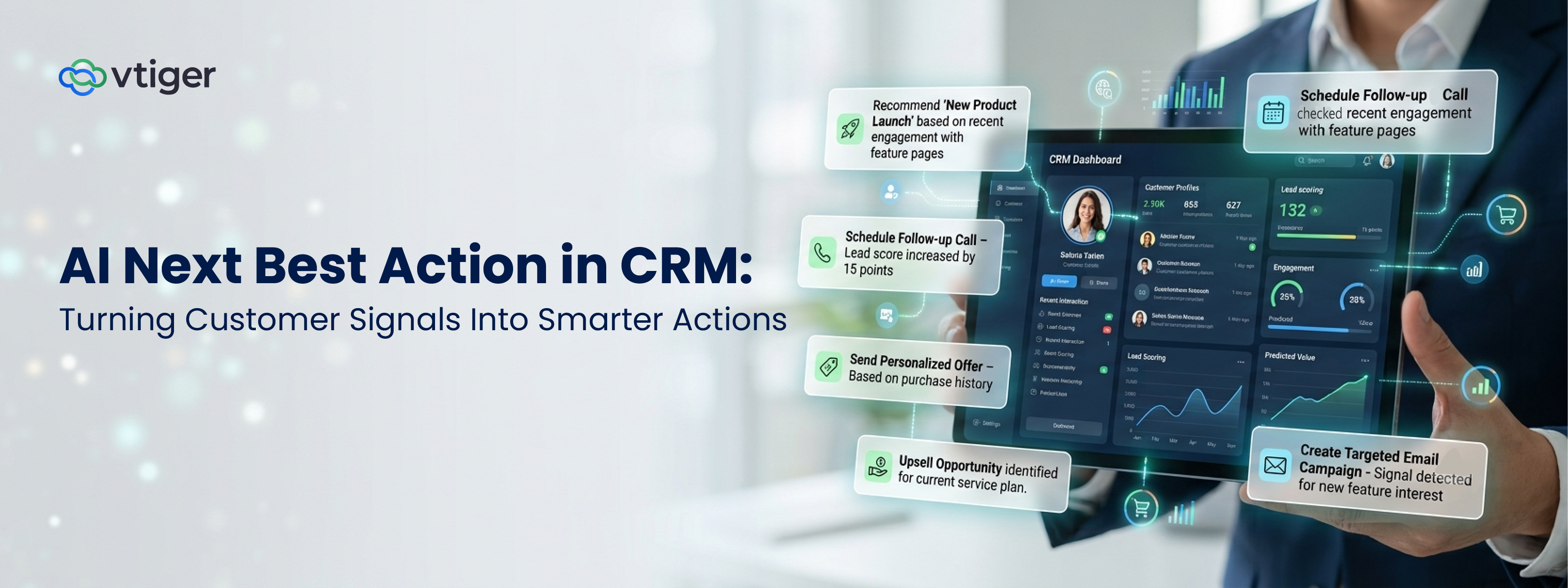
- Next-Best-Action Guidance: Analyzes CRM history to recommend the exact next step reps should take for each account.
- Dynamic Customer Segmentation: Group leads and clients based on real-time behavior rather than static, outdated demographics.
- Automated Workflow Hand-Offs: Executes internal processes through pre-configured CRM triggers instead of manual email threads.
- Personalized Engagement: Tailors messaging directly to individual account records to deliver relevant, context-aware communications.
- Data-Driven Revenue Forecasting: Combines live pipeline data with historical trends to project revenue accurately without relying on rep gut feel.
Vtiger One’s Calculus AI predicts deal outcomes and recommends next steps from historical CRM data. The customer-facing team acts on the recommendation.
Best Practices for Successful AI Adoption
Strong AI programs share a small set of disciplines that compound across deployment cycles. Each connects to either output quality or operational scale. The disciplines below are observable in deployments that moved past the pilot stage:
- Start with high-impact use cases that have measurable baselines and clear success criteria.
- Focus on measurable outcomes rather than activity volume or vendor-reported metrics.
- Maintain human oversight at decision-making points until failure modes are well understood.
- Improve data quality continuously through cleansing, deduplication, and enrichment.
- Integrate AI into existing workflows so the technology compounds rather than fragments operations.
- Continuously monitor performance to detect model, prompt, and process drift early.
Frequently Asked Questions
Which business problems are best solved by AI?
The business problems best solved by AI are those involving large volumes of data, repetitive decisions, pattern recognition, and forecasting at scale. Customer service automation, lead scoring, demand forecasting, fraud detection, and content generation consistently produce measurable returns when the underlying data is clean and the workflow is integrated with the system of record.
What are the most common AI use cases in business?
The most common AI use cases in business are customer service automation, sales lead scoring and forecasting, marketing personalization and content creation, workflow automation, fraud detection, demand forecasting, customer segmentation, and knowledge management. These deployments span every department and produce measurable productivity gains.
How do I know if a process is suitable for AI?
A process is suitable for AI when it is repetitive, data-rich, has measurable outcomes, and can scale beyond the initial pilot. The strongest candidates have high decision volume and clear baseline metrics that enable quantification of productivity gains. Processes requiring nuanced human judgment, complex negotiation, or ethical reasoning are typically better kept human-led with AI support rather than AI-automated end-to-end.
Can AI replace human decision-making?
AI cannot reliably replace human decision-making in cases requiring judgment, relationship context, or ethical reasoning. The most productive deployments augment human decision-making rather than replace it, particularly in strategic planning, complex negotiations, and any decision with regulatory or reputational stakes.
What industries benefit most from AI?
Industries with high transaction volumes, structured data, and repetitive decisions benefit most from AI. Financial services, retail and e-commerce, healthcare administration, manufacturing, telecommunications, and professional services consistently produce the strongest AI returns.
What is the difference between AI and automation?
Traditional automation runs rules-based scripts on structured inputs and performs deterministic tasks reliably at high volume. AI handles ambiguous inputs, learns from data over time, and produces outputs that adapt to context. Most production deployments combine both, with traditional automation handling deterministic workflows and AI handling pattern recognition, classification, and decisions where rules cannot anticipate every case the workflow will encounter.
How can CRM systems use AI?
CRM systems use AI to surface customer insights, score leads predictively, recommend next-best-action for sales reps, segment audiences by behavior, automate routine workflow hand-offs, personalize engagement at the individual record level, and forecast revenue from pipeline data.