Retail and supply chain management is the coordinated work of planning, sourcing, storing, moving, and delivering products from suppliers to shoppers. When done well, it enables retailers to maintain the right inventory, reduce logistics costs, forecast demand more accurately, fulfill orders faster, and improve the customer experience without eroding margins.
Traditionally, retail supply chains were viewed as simple, low-cost assembly lines moving goods from supplier to store. Recent market shifts proved that the model is no longer viable.
Today, historical data can no longer forecast volatile demand, and retailers can no longer afford separate inventories for stores, websites, and digital marketplaces. Everything has to come from one dynamic stock pool.
The retailers pulling ahead in 2026 read the chain the other way around, starting from the customer signal. They treat what people buy, browse, and return as the input that shapes purchasing, allocation, and replenishment.
What is retail supply chain management?
Retail supply chain management governs every step required to turn raw materials into a finished product and deliver it to the customer. By integrating procurement, inventory, warehousing, and fulfillment, it serves as the core foundation driving everyday retail operations.
The key difference between a retail supply chain and a B2B supply chain is the final buyer.
While B2B supply chains rely on predictable bulk orders from business clients, retail targets individual shoppers whose habits change overnight. These constant shifts in consumer preference make retail supply chains inherently unpredictable, turning every inventory decision into a bet on human behavior.
Why is supply chain management important in retail?
Supply chain management in retail is where strategy meets the shelf. A brilliant merchandising plan collapses if goods arrive late, land in the wrong location, or trap cash in stock that never sells, so the chain is what converts intent into availability, and availability into revenue.
Modern supply chain management delivers several interconnected returns that compound over time:
- Improved Inventory Visibility: Provides a single, real-time view of stock across all channels, eliminating reliance on outdated spreadsheets.
- Reduced Operational Costs: Minimizes expensive emergency shipments, reduces excess stock liquidations, and optimizes warehouse space utilization.
- Faster Order Fulfillment: Shortens the time between a customer’s click and product delivery—the primary battleground for modern retail competition.
- Higher Customer Satisfaction: Ensures products are in stock, orders arrive on time, and returns are processed seamlessly.
- Stronger Supplier Relationships: Delivers consistent order signals, allowing vendors to plan production accurately and reliably.
- Accurate Demand Forecasting: Combines sales history and market signals to align purchase quantities with actual market demand.
- Increased Profitability: Protects margins by optimizing working capital, minimizing forced markdowns, and eliminating lost sales.
None of these arrives in isolation. Visibility feeds forecasting, forecasting steadies suppliers, and steadier suppliers cut the cost of buffer stock. Retailers that treat this as one connected system, not seven separate projects, move the profitability line.
How the retail supply chain works
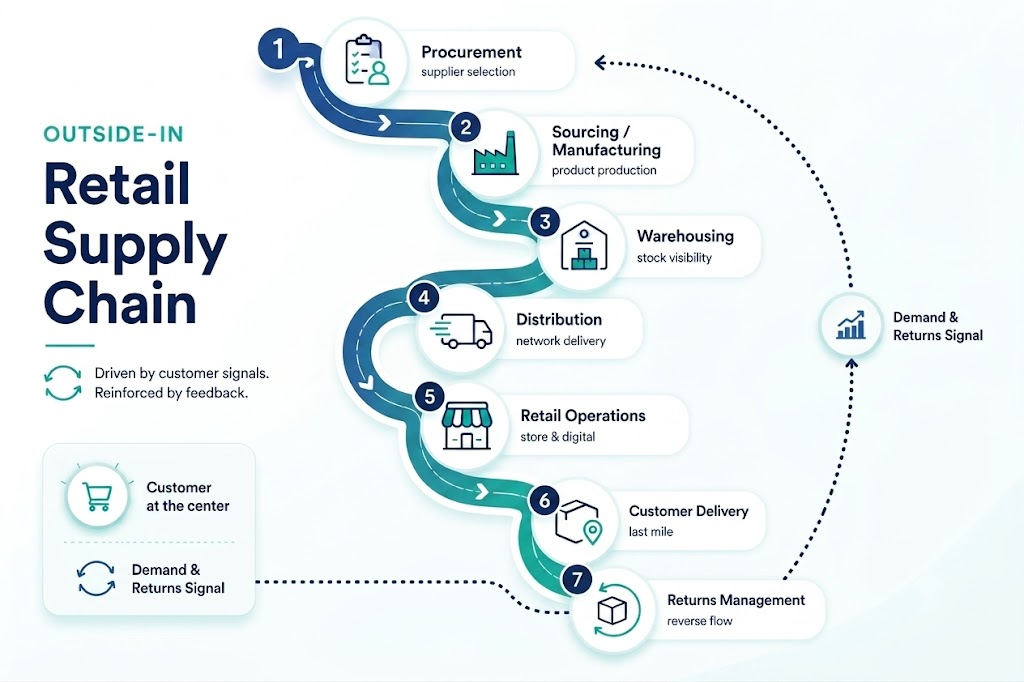
The retail supply chain runs as an end-to-end sequence where each stage hands off to the next, and the whole flow reveals where visibility breaks and cost hides.
A few retail supply chain examples show how differently the same seven stages play out across formats. A grocery chain optimizes around perishability and daily replenishment, a fashion retailer around seasonality and markdown timing, and a big-box store around SKU breadth and buy-online-pickup-in-store fulfillment.
Step 1 – Procurement
The chain begins with supplier selection and purchasing. Retailers weigh vendors on price, reliability, lead time, and quality, then commit purchase orders against a demand plan.
Step 2 – Manufacturing or product sourcing
For private-label goods, this covers production; for branded goods, vendor management and order placement. Coordination decides whether the right quantities arrive on a timeline that matches selling seasons.
Step 3 – Warehousing
Goods move into storage, where inventory tracking keeps a live count of what is on hand. Accurate warehousing is the foundation of visibility, since a miscount cascades into overselling online or empty shelves in store.
Step 4 – Distribution
Distribution centers and transportation move stock toward the point of sale. This is the heart of retail distribution and retail logistics, where routing, carrier choice, and network design set both speed and cost.
Step 5 – Retail operations
Product reaches stores and digital shelves, where in-store inventory and omnichannel fulfillment converge. Strong retail operations treat a store as both a destination and a distribution node that can fulfill online orders.
Step 6 – Customer delivery
Shipping and last-mile delivery close the gap to the shopper. According to Forrester’s store fulfillment research, US click-and-collect volume is on track to double by 2028 and exceed $200 billion, roughly 12% of online retail sales. Pickup and same-day delivery are now baseline expectations.
Step 7 – Returns management
Reverse logistics and customer support handle what comes back. A returned item is both a data point and a resale opportunity, and retailers that process returns quickly recover margin and goodwill. Read together, these seven stages form a loop: every delivery and return feeds a signal back to procurement that sharpens the next cycle.
Key components of the retail supply chain
Behind the flow sit the components that keep it running. Each is a discipline in its own right, and each contributes to operational efficiency in a specific way.
- Demand forecasting predicts what customers will buy, where, and when, turning signals into purchase and replenishment quantities.
- Inventory management balances holding enough to sell against trapping cash and shelf space; disciplined retail inventory management is the axis the system turns on.
- Supplier relationship management keeps vendors aligned on volume, quality, and timing.
- Logistics and transportation move goods at the lowest viable cost and the highest viable speed.
- Warehouse management governs storage, picking, and dispatch so stated availability is real.
- Order management decides which location fulfills which order to protect speed and margin.
- Customer service resolves delivery and return issues while capturing feedback that improves the next forecast.
Demand forecasting deserves special attention, because one wrong number cascades. Lora Cecere, founder of Supply Chain Insights and author of the Supply Chain Shaman blog, argues that planning must be rebuilt from the outside in.
In her framing, a supply chain “needs to be market-driven and built from the outside-in,” starting from real market signals rather than internal ERP transactions. That principle links clean customer segmentation strategies to accurate replenishment: the better a retailer reads its customers, the less it has to guess.
Common retail supply chain challenges
Most retail supply chain challenges do not stem from a single root cause. Instead, individual bottlenecks trigger ripple effects across the entire operation.
Inventory shortages
Stockouts lose the sale and often the customer, who substitutes at a competitor. The usual cause is a missed demand spike or a slipped supplier lead time, so real-time signals and safety stock tuned to actual volatility are the practical defenses.
Overstocking
The mirror image traps capital in stock that clears only at a markdown, eroding margin twice. Tighter forecast granularity and faster markdown decisions keep it contained.
Supply chain disruptions
Port delays, supplier failures, weather, and geopolitical shocks can invalidate a plan overnight. Diversifying suppliers and moving production closer to end markets stops a single point of failure from stalling the network.
Rising transportation costs
Freight volatility and last-mile expense squeeze margins. Network redesign, smarter routing, and using stores as fulfillment nodes absorb the pressure instead of passing it to customers.
Poor demand forecasting
Models leaning on historical averages miss the promotions, trends, and events that move demand. Multi-factor forecasting, applied with business process automation, lets planners act on insight instead of rekeying it.
Lack of supply chain visibility
Many chains still run disconnected systems that do not talk in real time, leaving blind spots across inventory, shipments, and delivery. Unifying that data is often the highest-return fix available.
Returns and reverse logistics
Returns are costly to process and easy to mishandle. Treating reverse logistics as a designed process, with clear resale and restocking rules, converts a cost center into recovered margin.
Most of these problems share one root fix: better data, applied faster. A few mitigation priorities address several at once:
- Unify inventory, order, and shipment data into a single real-time view before buying new tools.
- Rebuild forecasts on multiple demand signals rather than historical averages alone.
- Diversify suppliers and shorten lead times to blunt disruptions.
- Design returns as a managed workflow, not an ad hoc exception.
Technologies transforming retail supply chains
Technology makes the outside-in model operationally real, letting retailers sense demand and act on it at a granularity no team could manage by hand.
The spend behind this shift is large. Gartner forecasts that supply chain management software with agentic AI capabilities will grow from under $2 billion in 2025 to $53 billion by 2030, showing where the advantage is heading.
The technologies below each play a distinct role:
- Artificial intelligence analyzes sales history, weather, and promotions in parallel to produce forecasts statistical models cannot match at speed or scale.
- Customer relationship management supplies the demand signal; strong AI CRM software turns customer history into forward-looking prediction.
- Inventory management software keeps stock counts accurate and synchronized across stores, warehouses, and channels.
- IoT and smart sensors track goods and conditions in real time, from shelves to refrigerated transport.
- Cloud computing connects the network, and a cloud CRM platform makes that data accessible wherever decisions are made.
- Automation and robotics handle picking, packing, and repetitive warehouse work, easing labor shortages while lifting throughput.
- Data analytics turns the exhaust of these systems into the reports and dashboards that guide planning.
Value compounds only when these tools share data. A forecasting model is only as good as the customer and inventory data feeding it, which is why integration, not any single tool, is the differentiator.
Benefits of CRM in the retail supply chain
A CRM is usually filed under sales and marketing, but in a supply chain it plays a structural role: it is where the demand signal lives. Every purchase, browse, service ticket, and return is a data point about what customers want, exactly the input an outside-in chain needs.
The benefits show up across the chain:
- Customer demand insights from behavior data feed more accurate forecasts than sales totals alone.
- Sales forecasting improves when pipeline and buying patterns inform how much to order and when.
- Supplier collaboration gets easier when demand signals are clean enough to share for joint planning.
- Customer service management captures the delivery and return issues that reveal where the chain fails.
- Order tracking gives customers and staff one source of truth on where an order stands.
- Personalized experiences flow from a unified record that reflects each shopper across channels.
- Cross-department collaboration aligns merchandising, marketing, and operations around one customer view.
CRM does not replace ERP or inventory systems; it complements them. ERP runs transactions, inventory software tracks stock, and a strong contact management system holds the relationship context behind both.
Vtiger One brings these threads together, with Calculus AI predicting demand and churn patterns and recommending next actions from the unified record. Calculus AI predicts and recommends; the retail team makes the call. A CRM integration platform is what lets that signal reach the planning systems.
Best practices for retail supply chains
Best practice here is less about adopting every tool and more about disciplined execution of the few that matter. These practices separate resilient chains from fragile ones:
- Improve demand forecasting by adding external signals, since historical averages no longer capture real demand.
- Maintain optimal inventory levels by tuning safety stock to measured volatility, not legacy rules.
- Build strong supplier relationships through shared goals, shared data, and consistent order signals.
- Automate repetitive processes so planners spend time deciding rather than rekeying.
- Use real-time analytics to catch demand and supply drift before it becomes a markdown or stockout.
- Integrate CRM with supply chain systems so the customer signal reaches the planners.
- Continuously monitor KPIs, tied to clear ownership so the numbers drive action.
The through-line is integration: a retailer that manages customer, inventory, and supplier data as one system gets compounding returns. Layering these onto strong customer experience management turns supply chain optimization from a cost exercise into a growth one.
Retail supply chain KPIs
Retailers cannot improve what they do not measure, and the right KPIs turn a supply chain from a black box into a managed system.
| KPI | What it measures | Why it matters |
| Inventory turnover | How fast stock sells and refills | Flags trapped cash and slow movers |
| Order fulfillment rate | Share of orders shipped complete | Signals availability and reliability |
| Stockout rate | How often items go unavailable | Tracks lost-sales risk directly |
| Order accuracy | Share of orders shipped correctly | Drives returns and trust |
| Lead time | Time from order to receipt | Sets replenishment responsiveness |
| Perfect order rate | On time, complete, undamaged | The composite quality score |
| Customer satisfaction | How customers rate the experience | Links operations to loyalty |
These KPIs are most useful when read together. A high fulfillment rate propped up by bloated inventory is not a win, and turnover that drives stockouts is a false economy. Pairing them with CRM analytics reports connects operational metrics to the customer outcomes they serve.
Future trends in retail supply chains
The direction of travel is clear even where the timing is not: the retail supply chain is becoming faster, more autonomous, and more tightly wired to the customer signal. Gartner predicts that 70% of large organizations will adopt AI-based demand forecasting by 2030, moving it from a periodic exercise to a near-continuous one.
Several trends are converging on that future:
- AI-powered forecasting ingests more signals and updates more often, shrinking the errors that cause markdowns and stockouts.
- Predictive inventory management positions stock ahead of demand rather than reacting after it.
- Autonomous warehouses use robotics and physical AI to sense, decide, and act with less human intervention.
- Sustainable supply chains treat forecast accuracy and reduced overproduction as part of the environmental ledger.
- Omnichannel fulfillment hardens as unified commerce makes a single inventory view non-negotiable.
- Digital twins simulate disruptions like port closures so retailers can plan responses in advance.
- Generative and agentic AI move from surfacing insights to drafting plans and proposing actions for approval.
- Intelligent CRM keeps the customer signal central, so an automated chain still plans around real demand.
The common denominator across all eight is the outside-in principle. As the machinery gets smarter, the retailers that win will be the ones whose systems point at the customer, not just at the warehouse.
Frequently Asked Questions
What is retail and supply chain management?
Retail and supply chain management is the coordinated planning, sourcing, storage, movement, and delivery of products from suppliers to shoppers. Its goal is to keep the right items available in the right place at the right time, with an individual shopper always sitting at the end of the chain rather than another business.
Why is supply chain management important in retail?
Retail is unforgiving of gaps. A shopper who cannot find an item in the size, location, or timeframe they want rarely waits; they substitute the product or leave for a competitor. Supply chain management is what converts merchandising strategy into actual shelf availability, so its quality shows up directly in sales, working capital, markdown rates, and whether customers come back.
What are the main stages of a retail supply chain?
A retail supply chain typically has seven stages: procurement, manufacturing or product sourcing, warehousing, distribution, retail operations, customer delivery, and returns management. Together they move goods from supplier to shopper and back, and they work best when treated as one connected loop rather than a series of isolated handoffs.
What are the biggest retail supply chain challenges?
The common challenges are inventory shortages, overstocking, supply disruptions, rising transportation costs, weak forecasting, poor visibility, and costly returns.
The difficulties observed in these instances are noteworthy considering how they literally feed each other: a poor forecast causes both stockouts and overstock, and disconnected systems create the visibility gaps that hide both problems until they become expensive.
How does CRM help retail businesses?
In a retail supply chain, the CRM is where demand first appears as data. It unifies purchase, browsing, service, and return history into a single view of what customers actually do, then complements rather than replaces other systems: ERP runs transactions, inventory software tracks stock, and the CRM explains the demand behind both. Once that signal is integrated with planning, it sharpens forecasting, supplier collaboration, order tracking, and personalization across every channel.
What technologies improve supply chain management?
The core technologies are artificial intelligence, CRM, inventory management software, IoT sensors, cloud computing, automation and robotics, and data analytics. Their value compounds only when they share data, so integration across the stack matters far more than adopting any single tool on its own.
What KPIs should retailers monitor?
Key retail supply chain KPIs include inventory turnover, order fulfillment rate, stockout rate, order accuracy, lead time, perfect order rate, and customer satisfaction. They are most useful when read together, since optimizing one in isolation, such as a fulfillment rate propped up by bloated inventory, can quietly damage another.