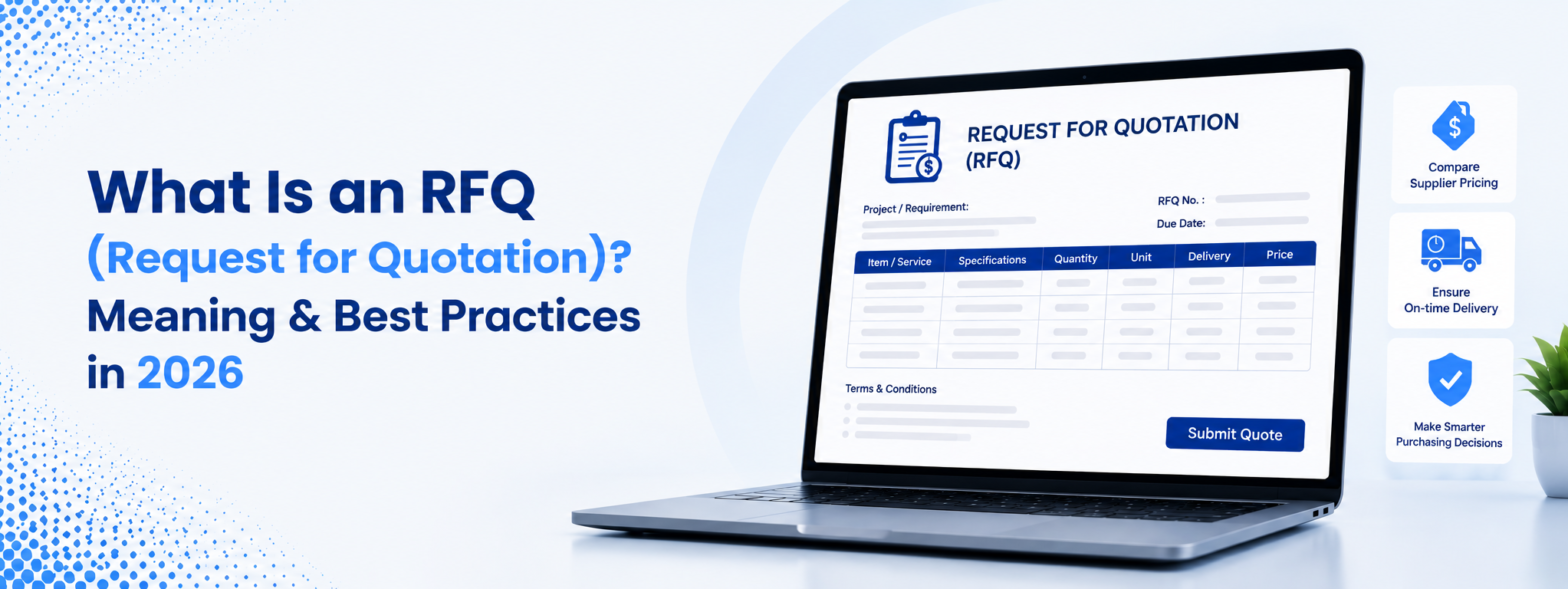
An RFQ (Request for Quotation) is a procurement document used to request price quotations from suppliers for clearly defined products or services. It helps businesses compare vendor pricing, evaluate suppliers, and standardize purchasing decisions. A well-run RFQ process brings transparency and measurable cost savings to sourcing, and makes vendor selection faster and easier to defend.
Teams working on processes like sourcing, category management, contract management and more still run procurement informally. They start with requesting a few prices, pick the lowest, and move on.
That habit unfortunately then leaks money, because the cheapest quote often hides the longest lead time or the weakest payment terms. Structured sourcing closes that gap by making every supplier compete against one fixed specification, and the request for quotation is the document that forces the comparison.
Businesses use RFQs to invite competitive, apples-to-apples quotations from multiple suppliers for purchases they can describe precisely. It is one stage in the wider procurement lifecycle, and it is frequently confused with a Request for Proposal.
What is an RFQ (Request for Quotation)
An RFQ is a formal request a buyer sends to pre-qualified suppliers asking for pricing on a specific, well-defined set of goods or services. Because the requirements are already settled, the supplier is not being asked to design a solution. It is being asked to quote a number against a fixed specification, along with terms such as taxes, lead time, and payment conditions.
When every vendor quotes against identical specifications and delivery expectations, their responses become directly comparable. Buyers get transparent price comparison, standardized procurement records, a fair basis for supplier evaluation, and faster purchasing decisions. The RFQ then turns an informal price inquiry into a repeatable, defensible sourcing event.
When Should You Use an RFQ
An RFQ is the right tool when you already know exactly what you need and mainly need to know what it costs. Use one when specifications are clearly defined, when several qualified suppliers can fulfill the same requirement, and when the purchase is driven by budget and value rather than by which vendor can invent the best approach.
RFQs work best for standardized or recurring purchases: raw materials, office equipment, components, licenses, logistics, or maintenance services with predictable scope. They suit competitive supplier bidding, where inviting multiple vendors to quote against the same brief creates price tension and protects procurement transparency. If the requirement is still vague, or you want suppliers to propose how to solve a problem, an RFQ is premature.
RFQ vs RFP: What’s the Difference
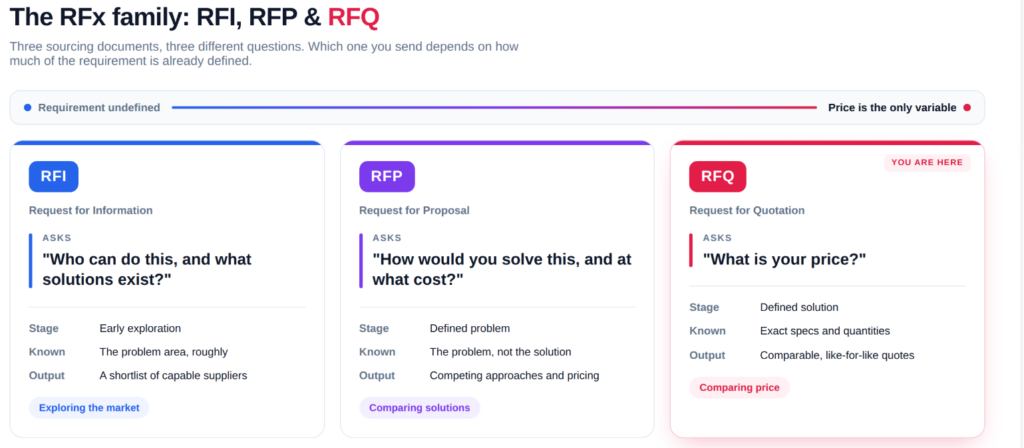
Although RFQs and RFPs are both procurement documents, they serve different business needs. Understanding the distinction helps you pick the right sourcing approach and set the right expectations with suppliers.
| Dimension | RFQ (Request for Quotation) | RFP (Request for Proposal) |
| Objective | Obtain competitive prices | Obtain solutions and approaches |
| Type of purchase | Standardized, well-defined goods or services | Complex, custom, or strategic requirements |
| Pricing | Central and directly compared | One factor among many |
| Scope definition | Fixed and detailed by the buyer | Open, shaped by the supplier’s proposal |
| Evaluation criteria | Primarily lowest qualified price | Capability, methodology, fit, and cost |
| Typical use cases | Repeat buys, components, logistics | Software rollouts, agencies, consulting |
In practice, mature teams often run an RFI first to build a supplier shortlist, then choose an RFQ or an RFP depending on how well the requirement is defined. Which is why, being aware of variety of competitive pricing strategies also helps buyers read quotes critically rather than defaulting to the lowest line
How Does the RFQ Process Work
The RFQ process runs in eight steps, from identifying the requirement to issuing a purchase order. Send before the supplier list is shortlisted, and the quotes come back non-comparable:
- Identify purchasing requirements. Define the exact item, quantity, and quality standard.
- Prepare the RFQ document. Translate requirements into unambiguous specifications and terms.
- Shortlist suppliers. Invite only vendors who can realistically meet the spec.
- Send RFQs. Distribute the same document to every shortlisted supplier.
- Receive supplier quotations. Collect responses by a fixed deadline.
- Compare quotations. Evaluate price alongside lead time, terms, and reliability.
- Negotiate if necessary. Clarify inclusions, discounts, or delivery.
- Select supplier and issue a purchase order. Convert the winning quote into a binding order.
Teams that manage this cycle inside a structured sales process or a shared system, rather than across scattered inboxes, keep every quote comparable and every decision traceable. Dedicated configure price quote tools do the same on the sell side, generating accurate, rule-based quotes in response to incoming RFQs.
What Should an RFQ Include
A complete RFQ removes guesswork for the supplier. Every component it includes cuts the back-and-forth that slows sourcing.
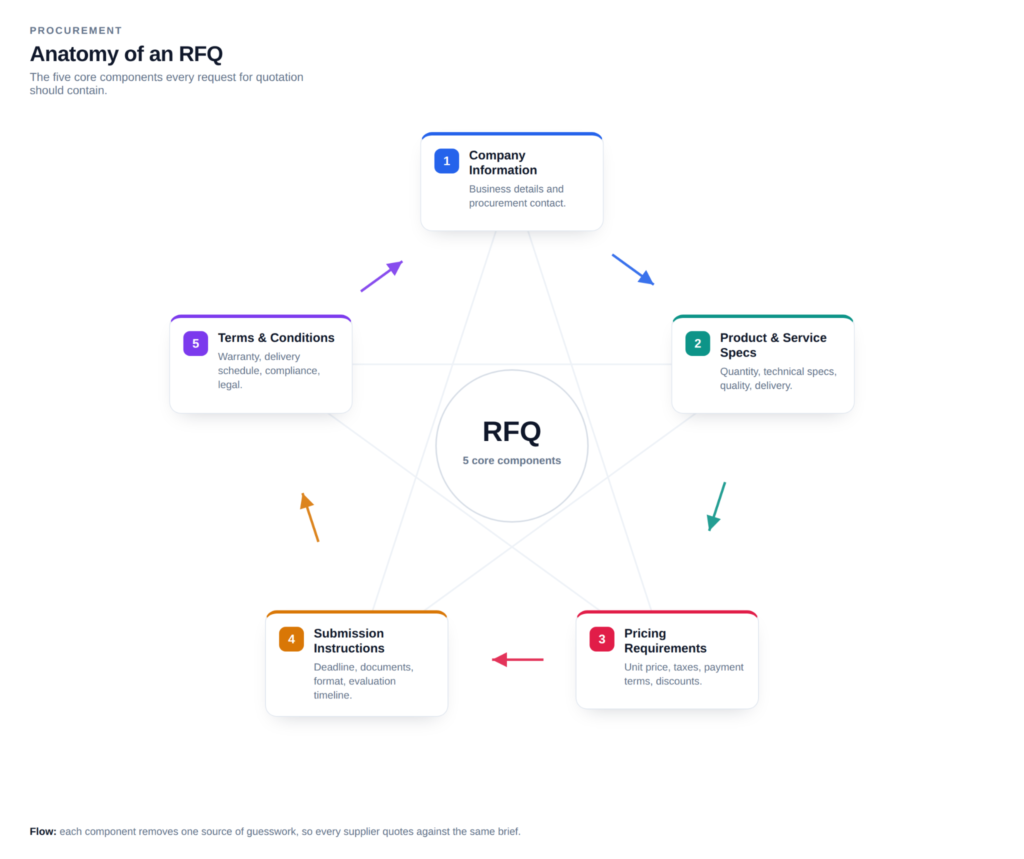
Company Information
Business details, the buying entity’s contact information, and the procurement team or point of contact responsible for the RFQ.
Product or Service Specifications
Quantity required, technical specifications, quality expectations, and delivery requirements. This is the section that makes quotes comparable, so it deserves the most detail.
Pricing Requirements
Unit price, total cost, applicable taxes, payment terms, and any volume discounts. Ask for a structured breakdown rather than a single figure.
Submission Instructions
Submission deadline, required documents, expected proposal format, and the evaluation timeline so suppliers know when to expect a decision.
Terms and Conditions
Warranty, delivery schedule, compliance obligations, and any legal clauses that govern the eventual purchase order.
RFQ Template
Copy the template below, fill in the bracketed fields, and send the identical version to every shortlisted supplier so their quotes stay comparable.
REQUEST FOR QUOTATION
| RFQ number | [RFQ-2026-001] |
| Issue date | [DD / MM / YYYY] |
| Response deadline | [DD / MM / YYYY] |
| Currency | [INR / USD] |
1. Buyer details
| Field | Detail |
| Company name | [Your company] |
| Contact person | [Name, title] |
| Email and phone | [[email protected]] |
| Delivery address | [Full delivery address] |
2. Items requested
| # | Item or service | Specification | Qty | Unit price | Tax | Line total |
| 1 | [Item name] | [Grade, model, standard] | [00] | [ ] | [ ] | [ ] |
| 2 | [Item name] | [Grade, model, standard] | [00] | [ ] | [ ] | [ ] |
| 3 | [Item name] | [Grade, model, standard] | [00] | [ ] | [ ] | [ ] |
| Total | [ ] | |||||
3. Terms and conditions
| Term | Requirement |
| Payment terms | [e.g. Net 30] |
| Delivery date | [Required by DD / MM / YYYY] |
| Warranty | [Duration and coverage] |
| Quote validity | [e.g. valid 30 days] |
| Compliance | [Certifications or standards] |
4. Submission instructions
| Field | Detail |
| Submit to | [Email address or portal] |
| Required documents | [Quote, catalogue, certifications] |
| Accepted format | [PDF or spreadsheet] |
| Evaluation timeline | [Decision by DD / MM / YYYY] |
| Point of contact | [Name, email, phone] |
Authorized by (supplier): [Name] [Signature] [Date]
Standardizing this format across a team supports cleaner revenue operations alignment and makes historical quotes easy to reference for future negotiations.
Best Practices for Creating an Effective RFQ
The quality of the quotes you receive is decided before any supplier replies. A precise, consistently run RFQ produces sharp, comparable bids, while a vague one invites padded guesses and wide price variance. Build every RFQ around these habits:
- Clearly define product or service requirements before you send anything.
- Invite only qualified vendors, so every response is genuinely usable.
- Standardize quotation submissions into one comparable format.
- Specify realistic timelines that give suppliers room to quote well.
- Evaluate quality and reliability alongside price, not price alone.
- Maintain transparent, consistent communication with every vendor.
- Document procurement decisions for auditability and future reference.
- Review quotations against the same criteria for every supplier.
Buyers who understand supplier economics, including value chain analysis, tend to negotiate better because they know where a vendor’s costs and margins actually sit.
Common RFQ Mistakes to Avoid
A poorly run RFQ costs more than a missed discount. It produces quotes that cannot be compared, decisions that cannot be defended, and suppliers who quote less sharply the next time around. Most of that damage traces back to a handful of avoidable mistakes.
Unclear Specifications
Vague specifications force every supplier to guess differently, which makes the returned quotes impossible to compare. Define quantity, quality, and delivery in detail before the RFQ goes out.
Chasing the Lowest Price
The cheapest quote often hides the longest lead time or the weakest terms. Judge bids on total cost of ownership, not the headline unit price alone, so quality and reliability stay in the decision.
Inviting Unsuitable Suppliers
A longer invitation list is not a stronger one. Vendors who cannot realistically meet the spec dilute the response set and slow evaluation without improving the result.
Unrealistic or Missed Deadlines
Deadlines set too tight invite rushed, padded pricing, and missed ones stall the entire cycle. Set a realistic response date, then hold it firmly for every supplier.
Poor Communication
Sourcing depends on a clear trail of questions, clarifications, and revisions. When that history is scattered across inboxes, vendors quote defensively to cover the uncertainty.
Inconsistent Evaluation Criteria
Scoring each quote by different rules produces decisions you cannot defend later. Fix the evaluation criteria before quotes arrive, and apply the same standard to all of them.
Most of these mistakes share one root cause: scattered information. A CRM for sales teams on the supplier side, and a disciplined procurement record on the buyer side, keep every specification, quote, and clarification in one place. That single source of record is what a CRM is at its core, and it is where accurate pre-sales workflow steps begin.
Frequently Asked Questions (FAQs)
Q1. What is an RFQ?
An RFQ, or Request for Quotation, is a procurement document a buyer sends to pre-qualified suppliers to request pricing for clearly defined goods or services. Because specifications are already fixed, the RFQ focuses on price and terms, making supplier quotes directly comparable.
Q2. What is the purpose of an RFQ?
The purpose of an RFQ is to gather competitive, standardized price quotations so a buyer can compare suppliers fairly and select the best value. It brings transparency to procurement, speeds up purchasing decisions, and creates a documented, defensible record of how a vendor was chosen.
Q3. What is the difference between an RFQ and an RFP?
An RFQ requests pricing for a requirement that is already fully defined, so cost is the main deciding factor. An RFP requests proposed solutions to a broader or more complex problem, where capability, approach, and fit matter alongside price. RFQ answers “how much,” RFP answers “how would you solve this.”
Q4. What information should an RFQ include?
A complete RFQ includes company and contact information, detailed product or service specifications, quantities, pricing requirements, submission instructions with a deadline, and clear terms and conditions. The more precise the specifications, the more comparable and useful the supplier quotations become.
Q5. When should businesses use an RFQ?
Use an RFQ when requirements are clearly defined, several qualified suppliers can meet the same spec, and the purchase is driven mainly by price. It suits standardized, repeat, or high-volume buys. If suppliers still need to propose how to solve a problem, use an RFP instead.
Q6. Can software automate the RFQ process?
Yes. CRM and quoting tools can standardize RFQ templates, route documents to suppliers, collect responses, and compare quotations in one place. Vtiger One, for example, connects quoting, pricing, and pipeline data so teams manage the full quote-to-order cycle without switching systems.
Q7. What are the benefits of using an RFQ?
An RFQ delivers competitive pricing, transparent supplier evaluation, standardized procurement records, and faster decisions. By forcing every vendor to quote against identical specifications, it reduces bias, supports cost savings, and gives buyers a clear audit trail for every purchasing decision.