Pricing strategies are methods businesses use to determine the selling price of products or services. The right pricing strategy balances profitability, customer demand, market competition, and perceived value. Common approaches include cost-plus pricing, value-based pricing, competitive pricing, penetration pricing, and premium pricing, each serving different business goals and market conditions.
A price tag does more operational work than any other element of a product launch. It signals positioning to prospective buyers. It sorts the customer pool by who can and will pay. It locks in the margin expectations that fund everything else.
Most businesses still set prices by gut feel rather than framework. The cost of that habit shows up in margin compression six to twelve months later, by which point the original decision is hard to reverse. The choice of pricing strategy is one of the highest-leverage decisions a business makes.
What is a Pricing Strategy?
A pricing strategy is the framework a business uses to decide what to charge for its products or services. It defines the logic behind every price point, the conditions under which prices change, and the trade-offs between volume, margin, and positioning. Without that framework, every pricing decision becomes a one-off negotiation rather than an expression of strategic intent.
The distinction between pricing strategy and pricing tactics matters in practice. Strategy is the durable model that holds for quarters or years; tactics are the short-term promotions, discounts, and adjustments that operate within the strategic frame. Confusing the two produces decisions that contradict each other.
Pricing decisions touch 4 parts of the business at once
- Revenue generation depends on it
- Market positioning is signalled by it
- Customer acquisition is filtered through it
- Competitive advantage is either built or eroded by it.
A coherent strategy makes the trade-offs across these four explicit rather than accidental.
Why Are Pricing Strategies Important?
An effective pricing strategy influences customer buying decisions and directly affects profitability. The right model attracts the right customers at the right margin; the wrong model attracts the wrong customers at unsustainable economics. Pricing is the rare business decision that affects every other variable.
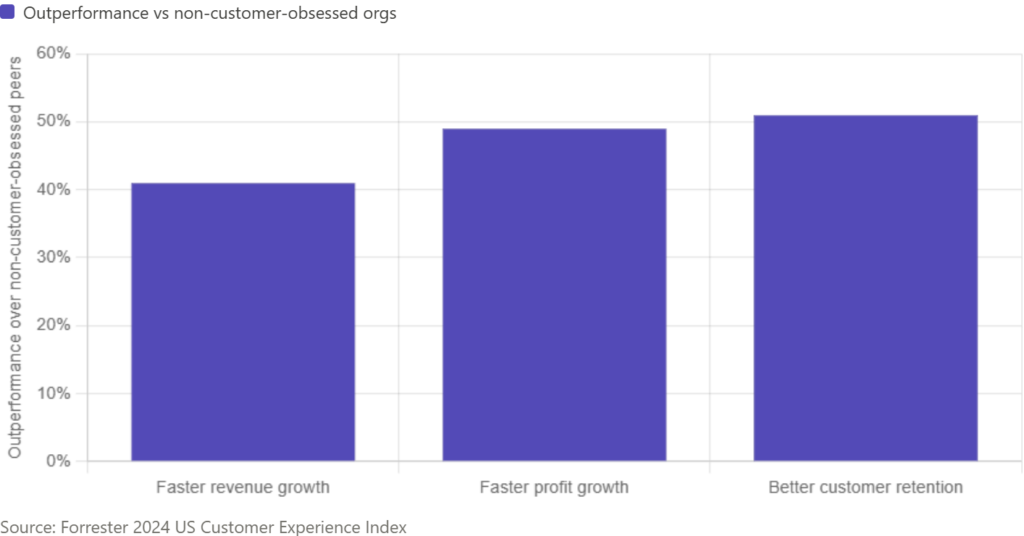
Source: Forrester 2024 US Customer Experience Index. https://www.forrester.com/press-newsroom/forrester-2024-us-customer-experience-index/
The benefits compound when pricing is treated as a strategic discipline rather than a periodic adjustment. According to Forrester research, customer-obsessed organizations report 41% faster revenue growth, 49% faster profit growth, and 51% better customer retention than non-customer-obsessed organizations. Customer-led pricing is one of the channels through which this outperformance shows up.
A disciplined pricing approach produces a set of benefits that compound across the business. The benefits operate independently but reinforce each other over multi-quarter cycles. The list below covers the recurring outcomes well-executed pricing tends to deliver:
- Maximizes revenue by aligning the price point with what the segment is willing to pay rather than what the cost structure suggests.
- Improves profit margins by capturing value the product actually delivers rather than discounting reflexively to close.
- Supports brand positioning by signalling intentionally where the product sits in the category.
- Enhances competitiveness by giving the sales team a defensible reason for the price when prospects compare options.
- Drives customer acquisition through pricing that aligns with how target segments actually buy.
- Encourages customer retention by avoiding the surprise increases that trigger churn in long-term accounts.
Types of Pricing Strategies
Businesses use different pricing models depending on their goals, industry, and customer expectations. The eight strategies below cover most of what modern businesses use, with the right choice depending on cost structure, customer value, and the competitive landscape. No single strategy is universally superior; fit matters more than novelty.
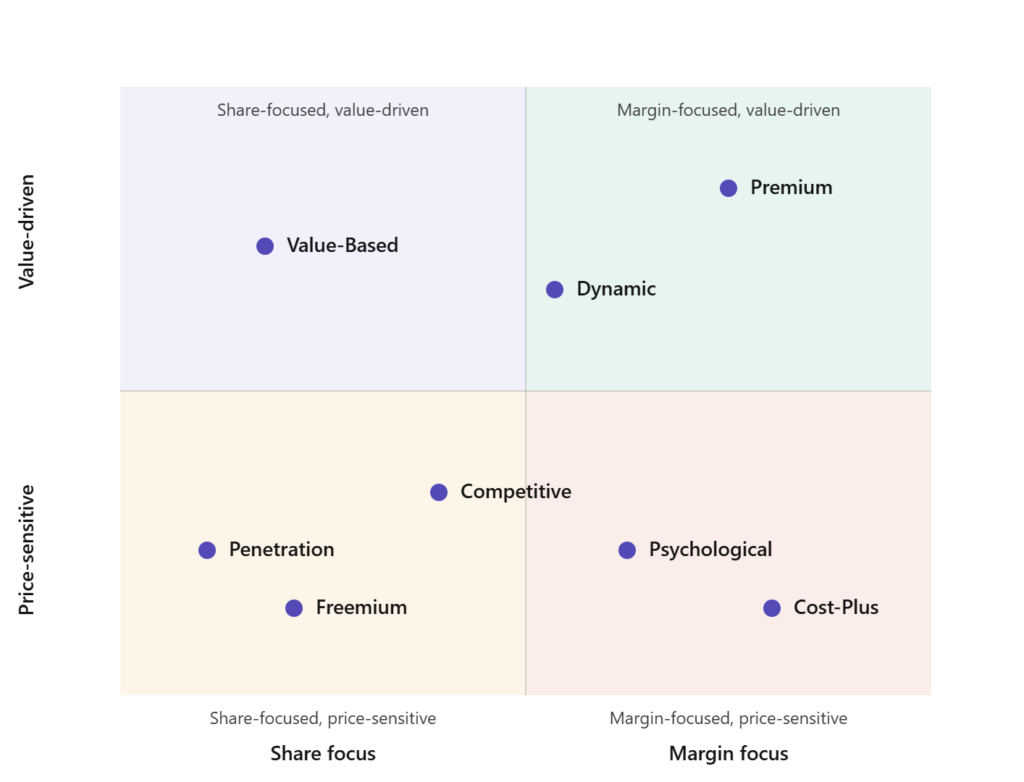
X-axis: Goal (Share focus ↔ Margin focus). Y-axis: Customer driver (Price-sensitive ↔ Value-driven).
Cost-Plus Pricing
Cost-plus pricing adds a fixed markup to the unit cost of production, delivery, and overhead. The approach is simple to implement and explains margin transparently to internal stakeholders. It works best for industries with stable cost structures and limited price sensitivity, like construction contracting and certain manufacturing categories.
The criticism of cost-plus is that it ignores what buyers actually value. A widget priced at cost plus 30% sells for the same number regardless of whether buyers would happily pay 50% more or refuse to pay 20% more. The pricing leaves money on the table or silently loses the sale.
Value-Based Pricing
Value-based pricing sets the price based on what the customer perceives the offering is worth. The seller measures or estimates the value delivered, then prices to capture a share of that value rather than mark up costs. The approach typically yields higher margins than cost-plus when executed well.
The challenge is operational. According to Forrester’s pricing research, more than 50% of B2B organizations still rely on cost-plus or competitive pricing rather than value-based pricing. Most product managers find the customer value research required by value-based pricing harder than it looks.
Competitive Pricing
Competitive pricing benchmarks the price against the competitive set and positions deliberately above, below, or at parity. The approach is easy to defend internally because the comparison is always available. It works in mature categories with relatively similar offerings.
The risk is that competitive pricing reduces the business to a price-takers’ game. When everyone benchmarks against everyone else, the floor drops over time and category margins compress. The model also outsources strategic positioning to whoever moves first.
Penetration Pricing
Penetration pricing sets the launch price significantly below the prevailing market rate toquickly capturemarket sharey. The strategy trades short-term margin for volume and market position. Subscription businesses, streaming platforms, and SaaS companies are the most visible practitioners.
The price typically rises gradually as the customer base stabilizes. The retention question is whether the customers acquired at the low price will stay through the increase. Most penetration pricing failures trace back to weak retention infrastructure rather than the launch price itself.
Premium Pricing
Premium pricing intentionally sets the price above the category benchmark to signal quality, exclusivity, or status. The pricing itself becomes part of the product’s positioning. Luxury goods, high-end professional services, and certain consumer brands use this approach.
The strategy depends on the product actually delivering on the premium signal. Buyers paying above market expect to see the difference, whether in the product, the brand experience, or the service surrounding both. Premium pricing without premium delivery destroys trust quickly.
Dynamic Pricing
Dynamic pricing adjusts prices in real time based on demand, inventory, time, and competitor activity. Airlines, hotels, and rideshare platforms operate the most familiar versions. The approach requires the pricing infrastructure to react faster than a manual review cycle allows.
The technology requirement is the gating factor. Dynamic pricingrequiress clean data feeds, pricing rules, and operational discipline to avoidsettingg prices customers find arbitrary. Done badly, it erodes the trust that pricing is supposed to build.
Psychological Pricing
Psychological pricing exploits how buyers perceive numbers rather than the numbers themselves. Charm pricing ($9.99 instead of $10.00), anchoring against a higher reference price, and bundling all fall into this category. Retail uses psychological pricing most visibly.
The technique works at the margin rather than as a primary strategy. Psychological pricing tactics layer on top of a base strategy rather than replacing it. The risk is that overuse becomes obvious to buyers and erodes the credibility the pricing was meant to support.
Freemium Pricing
Freemium pricing offers a free tier with limited functionality and charges for upgrades to premium features. SaaS applications, mobile apps, and certain consumer services dominate freemium usage. The model requires careful product design to make the upgrade obvious without crippling the free tier.
Pricing Strategy Comparison Table
The table below summarizes the eight pricing strategies across five practical dimensions. The right choice depends on which combination of customer, competition, and cost structure best matches the business. Most businesses use a primary strategy with secondary tactics layered on top.
| Pricing Strategy | Best For | Advantages | Challenges | Typical Industries |
| Cost-Plus | Stable categories | Easy to calculate transparent | Ignores customer value | Manufacturing, construction |
| Value-Based | High-value B2B | Strong margins, customer-centric | Hard to research and apply | SaaS, professional services |
| Competitive | Mature markets | Easy to defend internally | Race to the bottom risk | Retail, commodity goods |
| Penetration | Market entry | Fast acquisition, share gain | Margin sacrifice, churn risk | SaaS, streaming, telecom |
| Premium | Differentiated brands | High margins, status positioning | Demands premium delivery | Luxury, high-end services |
| Dynamic | High-velocity markets | Captures full willingness to pay | Tech investment, trust risk | Airlines, hotels, rideshare |
| Psychological | Retail and consumer | Lifts conversion at margin | Loses effect with overuse | Retail, e-commerce |
| Freemium | SaaS and apps | Low acquisition friction | Free tier cost, low conversion | SaaS, mobile apps |
A useful pattern is to choose the primary strategy based on customer and competitive context, then layer psychological pricing as a tactical adjustment. The primary model holds for quarters; the tactical layer adapts to launches and promotions. Most pricing failures trace to confusing the two layers rather than to choosing the wrong primary strategy outright.
How to Choose the Right Pricing Strategy
Choosing a pricing strategy starts from inputs, not from preferences. The three inputs that should converge on the decision are the cost structure, the customer perception of value, and the competitive position. A strategy that ignores any one of the three tends to fail in predictable ways. The five steps below walk through the analysis from cost foundations to ongoing optimization.
Understand Your Costs
Cost analysis is the foundation. Fixed costs, variable costs, and target profit margins set the floor below which pricing destroys economics regardless of how attractive the share gains look. The analysis covers direct production, allocated overhead, customer acquisition, and the cost of servicing the customer over the relationship.
Most cost analyses underestimate the customer acquisition piece. Sales effort, marketing campaigns, and onboarding investment all need to roll into the unit economics. A solid foundation through a strong sales process makes this layer transparent rather than aspirational.
Analyze Your Target Market
Customer expectations, purchasing behavior, and price sensitivity vary by segment in ways that aggregate numbers hide. The work includes interviewing buyers, analyzing purchase patterns, and segmenting customers by price elasticity. A disciplined customer segmentation approach surfaces these patterns reliably.
The segment-level view is where most pricing decisions actually happen. The same product can support a value-based price in one segment and a competitive price in another. Treating the market as a single block misses these segment-specific opportunities.
Evaluate Competitors
Market positioning analysis covers what competitors charge, what they include in their packages, and how they justify their prices in their messaging. The work is less about matching competitor prices and more about understanding the ceiling and floor the competition has set. Pricing transparency varies widely by category, so the analysis often requires more sleuthing than the topic initially suggests.
Competitor analysis also surfaces the positioning whitespace. If competitors cluster at one price point with one feature set, there is usually room to position at a different price with a different feature mix. The opportunity costs nothing to identify and is often missed by businesses too focused on direct matching.
Define Business Goals
Revenue growth, market share, and profitability targets need to be quantified before the pricing model is chosen. A strategy optimized for share will not maximize margin, and vice versa. The trade-offs need to be explicit so that the resulting model is internally coherent.
The goal-setting also surfaces the time horizon question. Share strategies pay off over years; margin strategies pay off within quarters. Misaligning the strategy with the planning horizon produces internal pressure to abandon the strategy before it works.
Test and Optimize Pricing
A/B testing, customer feedback, and performance monitoring close the loop on the chosen strategy. Pricing should be revisited at planned intervals rather than only when something feels wrong. According to Gartner research, organizations with the highest maturity in AI-ready data and analytics capabilities achieve up to 65% greater business outcomes, including revenue growth.
Pricing optimization depends on the data infrastructure as much as on the strategy itself. The teams that hold a credible test cadence iterate faster than those running pricing on intuition alone. Both pieces need to be in place before the optimization work can compound into durable margin gains.
Common Pricing Strategy Mistakes
Most pricing failures repeat a predictable set of patterns, regardless of the industry or company size. Each of these mistakes turns pricing into an operational afterthought, causing severe and preventable damage to profit margins.
- Competing Only on Price: Relying on discounts instead of showing your product’s unique value forces you into a price war. This ties your success to whoever is willing to charge the least.
- Ignoring Customer Value: Setting prices based only on your internal costs or competitor rates ignores what customers are actually willing to pay. This leaves significant revenue on the table.
- Underpricing for Quick Sales: Slashing prices to win deals quickly creates long-term problems. When you try to raise prices later to a sustainable level, it often triggers high customer churn.
- Overpricing Without Justification: Charging a premium price without delivering the high-quality product or experience to back it up alienates buyers. Customers will quickly see the value doesn’t match the cost.
- Neglecting Regular Reviews: Failing to review your prices on a regular schedule allows your rates to drift away from market reality. This leaves you vulnerable and forces you to make panic adjustments when the market shifts.
- Overlooking Competitor Shifts: Failing to track how competitors structure and price their offerings leaves your strategy outdated and misaligned with current market expectations.
How CRM Helps Businesses Optimize Pricing Strategies
A CRM holds the customer data that pricing decisions actually need to optimize. Customer purchase history, segmentation by buyer type, and sales performance data that shows what closes at what discount all live in the same system. The data foundation determines how good the pricing decisions can get.
Sales performance analysis surfaces patterns the pricing team needs to see. Win-loss data by segment, discount distribution across the sales force, and deal velocity by price tier all reveal where the current pricing is and is not working. Revenue forecasting models then project the financial impact of pricing changes before they roll out.
A focused approach to CRM analytics turns this raw data into pricing decisions. Opportunity tracking shows where deals stall on price. Customer purchase history shows what existing customers will accept, and segmentation lets the business price differently for different cohorts.
Vtiger One holds these capabilities against a unified customer record, with the Calculus AI layer surfacing recommendations for next best action on pricing-sensitive deals. Calculus AI predicts and recommends; the final pricing decision stays with the human team. Modern marketing automation then runs the campaigns that test new prices against defined customer cohorts.
Real-World Pricing Strategy Examples
Pricing strategies look different across industries because the underlying economics, customer expectations, and competitive structures differ. 4 examples below show how the same conceptual strategies translate into different operational decisions across sectors.
SaaS Businesses
SaaS companies dominate the use of freemium and value-based pricing, with the underlying economics favouring both. The low marginal cost of serving an additional user supports freemium tiers, while subscription mechanics favour value-based capture across the customer lifetime. Strong sales management capability connects the freemium funnel to paid conversion.
Retail Companies
Retail uses psychological pricing and competitive pricing more than any other sector. Charm pricing, bundle offers, and price-matching policies all reinforce the same positioning. Premium retail brands use price as a status signal that the rest of the merchandising experience reinforces, with marketing CRM capabilities supporting segment-specific campaign execution.
Manufacturing Firms
Manufacturing traditionally used cost-plus pricing, but the move toward value-based pricing is accelerating across industrial categories. Long sales cycles and complex value propositions make value-based viable, while a strong sales funnel keeps the pipeline visible during evaluations. A unified sales CRM holds deal context across multi-quarter buying cycles where pricing conversations evolve.
Professional Services
Professional services firms increasingly price for outcomes rather than hours, moving from cost-plus billing to value-based engagements. The shift requires explicit conversation about what the client values and what the firm is on the hook to deliver. Strong attention to customer experience sustains the relationship as the pricing model evolves.
Frequently Asked Questions
Which pricing strategy is best for small businesses?
The best pricing strategy for a small business depends on whether the priority is acquisition speed, margin protection, or positioning. Penetration pricing favours acquisition; value-based pricing favours margin; competitive pricing favours category neutrality.
What is value-based pricing?
Value-based pricing sets the price based on what the customer perceives the offering is worth, rather than the cost of producing it or what competitors charge. The approach typically yields higher margins than cost-plus but requires real customer research to know what buyers actually value.
How does competitive pricing work?
Competitive pricing benchmarks prices against the competitive set and positions deliberately above, below, or at parity. The approach is easy to defend internally because comparison data is always available.
How often should businesses review pricing?
Most businesses should review pricing at least quarterly, with a more thorough annual review tied to budget planning. Categories with high competitive velocity, such as SaaS or e-commerce, may require monthly or even continuous review. The review cadence should match the speed at which inputs (costs, competitors, customer value) actually change, with formal triggers for off-cycle reviews when major shifts occur.
How can CRM software help improve pricing decisions?
CRM software supports pricing decisions by centralizing customer purchase history, segmentation, win-loss data, and sales performance metrics in a single platform. The data reveals which segments accept current pricing, where deals stall on price, and which discount patterns destroy margin without lifting close rates.