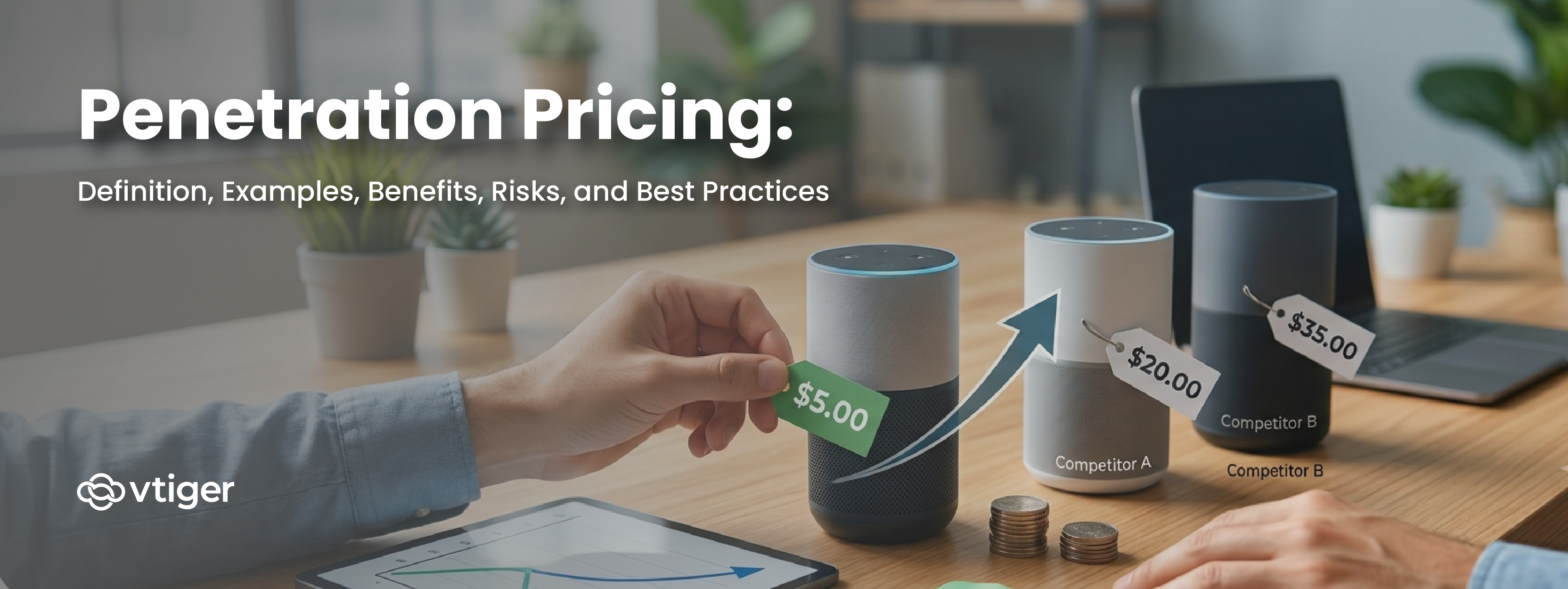
Penetration pricing is a strategy where businesses launch products or services at a lower-than-market price to quickly attract customers and gain market share. Once a customer base is established, prices may gradually increase. This strategy is commonly used by startups, SaaS companies, subscription businesses, and brands entering competitive markets.
Pricing decisions sit at the centre of every market entry. The price at which a new product launches signals what kind of business it intends to be. A premium price says one thing; a low price says another.
Markets dense with competitors leave little room for new entrants to charge the same as incumbents. Customer acquisition has become more expensive across categories. The pressure to capture share before competitors respond has intensified.
Penetration pricing is built for this situation. The strategy trades short-term margin for faster customer acquisition and stronger positioning. Selecting the right pricing strategies determines whether a product builds momentum or stalls.
What is Penetration Pricing?
Penetration pricing is a market-entry strategy in which a business sets the launch price of a new product or service significantly below the prevailing market rate. The price is then raised gradually as the customer base stabilizes. Volume becomes the strategic priority during the launch window.
The mechanism rests on price elasticity in competitive markets. Price-sensitive buyers move faster toward the cheaper option when they perceive functional parity. A new entrant pricing below incumbents accelerates trial purchases and lowers switching friction.
The low introductory price often becomes the marketing message itself. Different motives drive penetration pricing decisions. Some businesses use it for customer acquisition, others for share displacement against a dominant incumbent, and others as a competitive positioning move against a category benchmark.
How Does Penetration Pricing Work?
The mechanics of penetration pricing follow a predictable sequence. Each stage builds on the trust and volume established in the previous one. A well-executed strategy is more about disciplined execution of each stage than about the size of the initial cut.
- Launch with lower prices: Set an introductory price significantly below the market rate, often below the price point at which mature competitors operate profitably.
- Attract early customers: Use the price gap to drive trial volume, supported by a strong sales funnel that converts interest into completed transactions.
- Build market share: Grow the acquired customer footprint to negotiate better supplier terms and reach the economies of scale that make the strategy sustainable.
- Increase customer loyalty: Invest in onboarding quality, product improvements, and engagement so the acquired base does not churn as prices rise.
- Gradually optimize pricing: Adjust prices upward to sustainable levels as the customer base stabilizes and switching costs accumulate.
Streaming services and telecommunications providers run visible versions of this sequence. Introductory pricing for the first three to twelve months. Retention activities embedded throughout the period. Gradual price increases as customers transition to standard-rate plans.
Why Businesses Use Penetration Pricing
Companies use penetration pricing when entering new markets or launching products where customer acquisition is the priority. The current market environment has intensified this trade-off across B2B and B2C categories. The shift shows up in budget data as well as launch behaviour.
According to the Gartner 2026 CMO Spend Survey, awareness and conversion activities now account for 62.6% of total media spend. Investment in loyalty and retention has fallen 29% since 2024 to less than 15% of total media spend. The budget mix reflects how acquisition-led growth has become the dominant marketing posture.
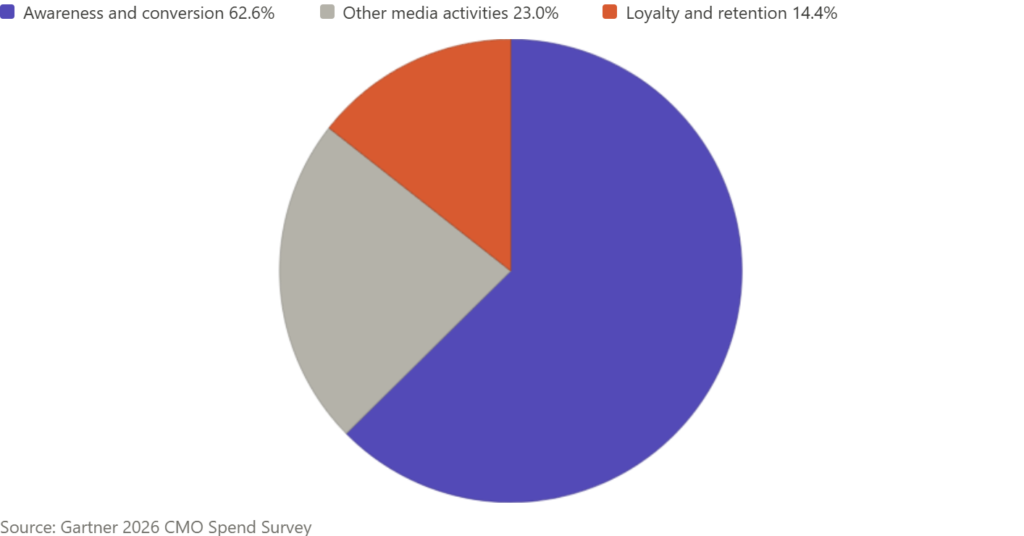
Source: Gartner 2026 CMO Spend Survey
Penetration pricing supports this acquisition-led posture by addressing five business needs simultaneously. Each needs maps to a specific operational outcome that the introductory pricing window is designed to produce. The list below covers the recurring reasons businesses choose this approach over alternatives during launch windows.
- Faster customer adoption: Lower price points compress the consideration cycle and shorten the time between awareness and purchase decision.
- Increased market visibility: A price significantly below the category average creates earned media and word-of-mouth that paid media alone cannot deliver at the same efficiency.
- Competitive differentiation: Price becomes a deliberate positioning lever that separates the new entrant from incumbents who cannot match the cut.
- Reduced barriers to purchase: Trial friction drops when the financial commitment is low, which improves conversion from interest to first transaction.
- Opportunity to build customer loyalty: The acquired base becomes the foundation for upsell, cross-sell, and retention activity once the launch window closes.
Advantages of Penetration Pricing
Penetration pricing produces compounding advantages for businesses that execute it well. Each advantage reinforces the others when paired with strong operational discipline. Five advantages recur across successful implementations.
Rapid Customer Acquisition
- Encourages trial purchases by removing the financial hesitation that typically delays first-time buyer decisions in unfamiliar categories.
- Attracts price-sensitive buyers who would otherwise be unreachable at standard market pricing, expanding the addressable customer pool meaningfully.
Faster Market Share Growth
- Competes effectively with established brands by neutralizing the switching cost defence that protects incumbents from new entrants.
- Accelerates market entry by collapsing the timeline from launch to meaningful share, often by months compared to standard pricing approaches.
Increased Brand Awareness
- Generates earned attention through the price story itself, which becomes a credible marketing message in categories where pricing transparency is unusual.
- Encourages word-of-mouth marketing among acquired customers, who reference the price advantage when discussing the product with prospective buyers.
Competitive Advantage
- Makes it difficult for competitors to respond quickly because matching requires either a margin sacrifice from a larger revenue base or a structural cost change.
Customer Base Expansion
- Builds a foundation for long-term growth, supporting a healthier customer retention strategy in the quarters following the introductory window.
Disadvantages of Penetration Pricing
The same mechanism that produces the advantages of penetration pricing also produces its disadvantages. Five recurring failure modes appear across implementations that did not deliver the expected return. Each disadvantage can be planned for but not eliminated.
Lower Profit Margins
Reduced short-term profitability is the most obvious cost of penetration pricing. Each unit sold contributes less to gross margin than it would at standard pricing. The longer the introductory period runs, the deeper the impact on cumulative profitability becomes for the business.
Businesses that did not plan for sustained margin compression often run into cash flow strain. The financial pressure usually arrives before the volume gains have time to compound. Working capital reserves need to be sized for the full introductory window.
Customers attracted by low introductory prices are often the most likely to churn when prices rise. According to Forrester’s 2025 B2C predictions, rising prices will prompt brand loyalty to decline by 25% in 2025. Price-sensitive customers respond to increases by switching brands rather than absorbing the change.
The retention risk is structural to penetration pricing. It needs to be planned for from the launch window onward, not addressed only when prices begin to rise. The retention infrastructure has to exist before it is needed.
Perceived Low Value
A sustained low price can weaken premium positioning. Buyers often use price as a proxy signal for quality, especially in categories where they cannot easily evaluate the product on objective specifications. The perception of low value forms quickly when the price stays below the category benchmark.
Once that perception sets, repositioning the brand upmarket later becomes operationally and strategically difficult. The buyers who came for the low price often resist paying more. New premium buyers find the brand history difficult to overlook.
Competitive Price Wars
Aggressive competitor reactions are predictable following a meaningful price-penetration launch. Incumbents have strong incentives to defend their installed base, and retaliatory price cuts often follow within weeks. The price war that develops can erode margins across the entire category.
Even if the new entrant survives the price war, the long-term price ceiling for the category often resets downward permanently. The strategic gain from the launch can be offset by the loss of category-wide pricing power. Recovery to pre-war pricing levels is rare.
Revenue Challenges
The path to profitability lengthens under penetration pricing. Sometimes the extension spans several quarters or years, compared to a standard pricing model. Investors and internal stakeholders need to be aligned on the extended timeline before launch.
Mid-strategy pressure to raise prices early usually destroys the customer loyalty the strategy was designed to build. The financial discipline required to hold the introductory price for the planned duration is often the hardest part of the execution. Premature optimization defeats the strategy.
Penetration Pricing vs Skimming Pricing
Penetration pricing and price skimming are opposite pricing approaches used for different business goals. Penetration sets the launch price low to capture volume and share. Skimming sets the launch price high to capture early-adopter margin before competitive pressure arrives.
| Factor | Penetration Pricing | Price Skimming |
| Initial Price | Low | High |
| Goal | Market Share | Profit Maximisation |
| Customer Target | Mass Market | Early Adopters |
| Competition | High Competition | Lower Competition |
| Growth Strategy | Volume-Based | Margin-Based |
Penetration pricing works best in highly competitive markets with price-sensitive buyers and scalable cost structures. Price skimming works best for innovative or unique products with limited competition and buyers willing to pay a premium for early access. Most pricing decisions in practice involve choosing between these poles at launch and adjusting toward the centre as the market matures.
Real-World Examples of Penetration Pricing
Penetration pricing is most visible in industries with high customer acquisition costs and low marginal cost of service. Strong recurring revenue mechanics make the long-tail economics work. Four sectors apply it as a standard playbook rather than an occasional tactic.
SaaS Companies
SaaS providers routinely use free trials, low introductory pricing, and freemium models to drive trial volume. According to Gartner’s tech CEO benchmarks, high-growth SaaS providers report median contract values of $60,000 against $149,599 for low-growth providers. They favour monthly and usage-based pricing models that lower the entry threshold.
- Free trial periods of 14 to 30 days with no upfront payment required.
- Introductory pricing plans pegged below comparable enterprise tools to encourage initial commitment.
Streaming Platforms
Streaming services launch in new markets with discounted subscription rates. Prices rise once content libraries and viewing habits stabilize. The introductory period is structured to coincide with content investment phases that build the catalogue customers will eventually pay full price for.
- Discounted subscriptions for the first three to twelve months of service.
- Promotional offers tied to content launches, sports seasons, and regional platform expansion.
Retail Brands
Retail brands use penetration pricing during market entry campaigns and major product launches. Some price flagship products below cost to drive traffic and category awareness. The execution is typically time-bounded, so the introductory price acts as a launch signal rather than a permanent positioning.
- Market entry campaigns combining introductory pricing with category-wide promotional support.
- Launch promotions bundling hero products with complementary items to lift average basket size.
Telecommunications Companies
Telecom providers offer deeply discounted introductory rates for the first 6 to 12 months. They know a meaningful percentage of customers will stay at higher standard rates once promotions end. Switching friction in the category supports the long-tail retention assumption.
- Introductory service pricing covering data, calling, and bundled services during the promotional window.
- Bundled packages combining internet, mobile, and entertainment services at a single introductory rate.
When Should Businesses Use Penetration Pricing?
Penetration pricing is not a universal strategy. Applying it where market conditions do not support it usually destroys margin without producing the share gains the strategy promises. The decision depends on three converging factors that together determine fit.
When the three factors above converge, penetration pricing has the best chance of producing durable share gains. When anyone is missing, the strategy usually produces volume without the retention or margin path that justifies launch losses. The best-fit scenarios where all three converge are listed below:
- New market entry in a market with an established competitive set, where the entrant needs to displace share rather than create demand.
- New product launches in categories where comparable alternatives are widely adopted and customers have a reference price.
- Highly competitive industries with low product differentiation, where price becomes the decisive factor in purchase decisions.
- Subscription-based businesses where customer lifetime value justifies acquisition-phase losses against future recurring revenue.
- Customer acquisition-focused growth strategies where share metrics drive valuation more than near-term profitability.
When penetration pricing is the wrong choice, the strategy backfires regardless of how disciplined the execution is. Structural conditions need to support sustained volume growth at compressed margins for the approach to work. The common signals that penetration pricing should not be applied are listed below:
- Premium brands where positioning depends on signalling exclusivity and quality through price.
- Luxury products where the buyer cohort is small and would interpret low pricing as a quality concern.
- Limited production capacity where volume cannot scale fast enough to recover the margin sacrifice.
- High-cost offerings with structurally high marginal costs that volume cannot compress.
How to Implement a Penetration Pricing Strategy
Implementation discipline distinguishes campaigns that build durable customer bases from those that produce volume without retained value. Five sequential steps map the work from pre-launch analysis through post-launch optimization. Each step has a specific deliverable.
Step 1: Understand Market Conditions
Competitor analysis comes first. A meaningful penetration price needs to sit visibly below the competitive set, not just below the highest priced option in the category. The analysis covers list prices, promotional pricing, customer segmentation, and the cost structure that allows competitors to price where they do.
Step 2: Define Customer Acquisition Goals
Market share targets and revenue objectives need to be quantified before launch. Vague goals produce vague execution. Targets typically include a customer count, a market share percentage, a CAC ceiling, and a timeline to standard pricing, tracked through a robust lead management system.
Step 3: Calculate Sustainable Pricing
Cost analysis ensures the introductory price covers variable costs even at peak volume. Pricing below variable cost compounds losses rather than building share. Profitability planning models the path from introductory price to standard pricing with explicit assumptions about churn, retention rate, and elasticity.
Step 4: Launch and Monitor Performance
Customer acquisition metrics and sales tracking need to be live from day one. Penetration pricing depends on tight feedback loops to identify what is working before strategy compounds in a bad direction. A foundation in CRM analytics converts launch data into adjustments.
Step 5: Gradually Optimize Pricing
Price adjustment strategy and retention planning define the post-launch period. Prices rise incrementally toward sustainable levels without triggering mass churn. The cadence aligns with contract structure, while retention planning identifies high-risk segments before churn happens.
Key Metrics to Measure Penetration Pricing Success
Measurement determines whether penetration pricing is producing the strategic outcome it was designed for. Volume growth alone does not validate the approach if the acquired customers do not retain. Seven metrics consistently appear in penetration pricing dashboards.
- Customer Acquisition Cost (CAC): Total cost to acquire a new customer, including sales, marketing, discounting, and onboarding investment, normalized against the cohort.
- Customer Lifetime Value (CLV): Total expected revenue across the relationship, the metric that determines whether CAC is sustainable in the segment.
- Market Share Growth: Percentage point change in market share over the introductory window, segmented by region, segment, and competitive cohort.
- Conversion Rates: The rate at which leads progress through the funnel into paying customers during the introductory pricing window.
- Revenue Growth: Top-line revenue movement over the introductory window, segmented by new versus existing customer cohorts to isolate the pricing effect.
- Customer Retention Rates: Percentage of acquired customers who remain after the introductory window closes and standard pricing applies.
- Churn Rate: Percentage of customers who leave per period, segmented by acquisition channel and tenure to identify durable sources.
How CRM Helps Manage Penetration Pricing Campaigns
CRM software supports penetration pricing by consolidating customer records that connect acquisition, retention, and revenue data on a single platform. The economic case is direct.
Lead tracking inside the CRM creates the visibility every penetration campaign needs. Every prospect is mapped to source, stage, and engagement signal. Customer segmentation then splits the acquired base by price sensitivity, lifecycle stage, and projected retention so interventions can be targeted.
Customer retention management becomes critical as the introductory window closes. Marketing automation runs the nurture sequences that maintain engagement through price transitions. Sales analytics feed the conversion data that drives price adjustment decisions, while revenue forecasting models the financial path through the introductory period.
A unified marketing CRM and sales CRM foundation makes these capabilities work on one customer record. Vtiger One holds these capabilities together. The Calculus AI layer analyses historical CRM data to predict churn risk and recommend retention interventions, predicting and recommending while the final retention decision remains with the human team.
The result is a customer experience consistent enough that retention holds through price normalization. The acquired base stays engaged through the price transition. The economics of penetration pricing close out as planned rather than collapsing at the price-raise inflection.
Common Mistakes to Avoid While Finalizing Penetrating Pricing
Most penetration pricing failures trace back to a small set of execution errors. The errors compound through the introductory window into structural problems afterward. Six mistakes recur across campaigns that produced volume without retained value.
- Setting unsustainable prices that do not cover variable costs at the planned peak volume, converting every additional customer into a deeper loss rather than a path to profitability.
- Ignoring profitability metrics during the introductory window, letting volume hide deteriorating unit economics until a cash flow constraint forces a hard correction.
- Raising prices too quickly after the introductory period, triggering the churn, the strategy was designed to manage gradually rather than abruptly.
- Failing to plan retention strategies for the post-introductory period, leaving the acquired base without the engagement infrastructure it needs to stay through increases.
- Underestimating competitors and their willingness to match or undercut the introductory price, extending the price war beyond what the business plan accounted for.
- Neglecting customer experience during the high-volume acquisition window damages retention rates exactly when the strategy depends on retaining the volume it just acquired.
Frequently Asked Questions (FAQs)
Q1. What is penetration pricing?
Penetration pricing is a market-entry pricing strategy where a business sets the launch price for a new product or service comparatively below the prevailing market rate, then raises it gradually as the customer base stabilizes. The strategy prioritizes customer acquisition speed and market share growth over per-unit margin during the launch window, with profitability arriving as prices normalize.
Q2. Why do businesses use penetration pricing?
Businesses use penetration pricing when entering competitive markets, launching products against established alternatives, or pursuing acquisition-led growth where market share drives valuation. The lower price compresses trial cycles, reduces purchase barriers, attracts price-sensitive buyers, and produces faster market share gains than standard pricing approaches in categories with comparable alternatives already available.
Q3. What are the advantages of penetration pricing?
The advantages include rapid customer acquisition, faster market share growth, increased brand awareness through earned attention, competitive advantage against incumbents who cannot easily match the cut, and customer base expansion that supports long-term growth. The advantages compound when combined with strong product quality and disciplined execution of the customer experience during the introductory window.
Q4. What are the disadvantages of penetration pricing?
The main disadvantages include lower short-term profit margins, retention risk from price-sensitive customers who churn when prices rise, potential perception of low value that weakens premium positioning, competitive price wars that erode category margins, and revenue challenges from the extended path to profitability. Each disadvantage can be planned for but not eliminated entirely.
Q5. What is the difference between penetration pricing and skimming pricing?
Penetration pricing sets the launch price low to capture volume and market share, while skimming pricing sets the launch price high to capture early-adopter margin before competitive pressure arrives. Penetration targets mass markets in competitive categories; skimming targets early adopters in innovative or differentiated categories. The choice depends on whether acquisition speed or per-unit profitability is the priority.
Q6. Which industries commonly use penetration pricing?
SaaS companies, streaming platforms, retail brands, and telecommunications providers use penetration pricing as part of their standard playbooks. The common pattern across these industries is high customer acquisition costs, low marginal cost of service delivery, and strong recurring revenue mechanics that justify acquisition-phase losses. Subscription business models reinforce the long-tail economics that penetration pricing depends on.
Q7. How can CRM software support penetration pricing strategies?
CRM software supports penetration pricing by holding the customer record that connects acquisition, segmentation, retention, and revenue data on one platform. Lead tracking maintains acquisition pipeline visibility, segmentation enables targeted retention interventions, marketing automation runs nurture sequences through price transitions, and analytics provide the conversion and forecasting data that feeds price adjustment decisions during and after the introductory window.