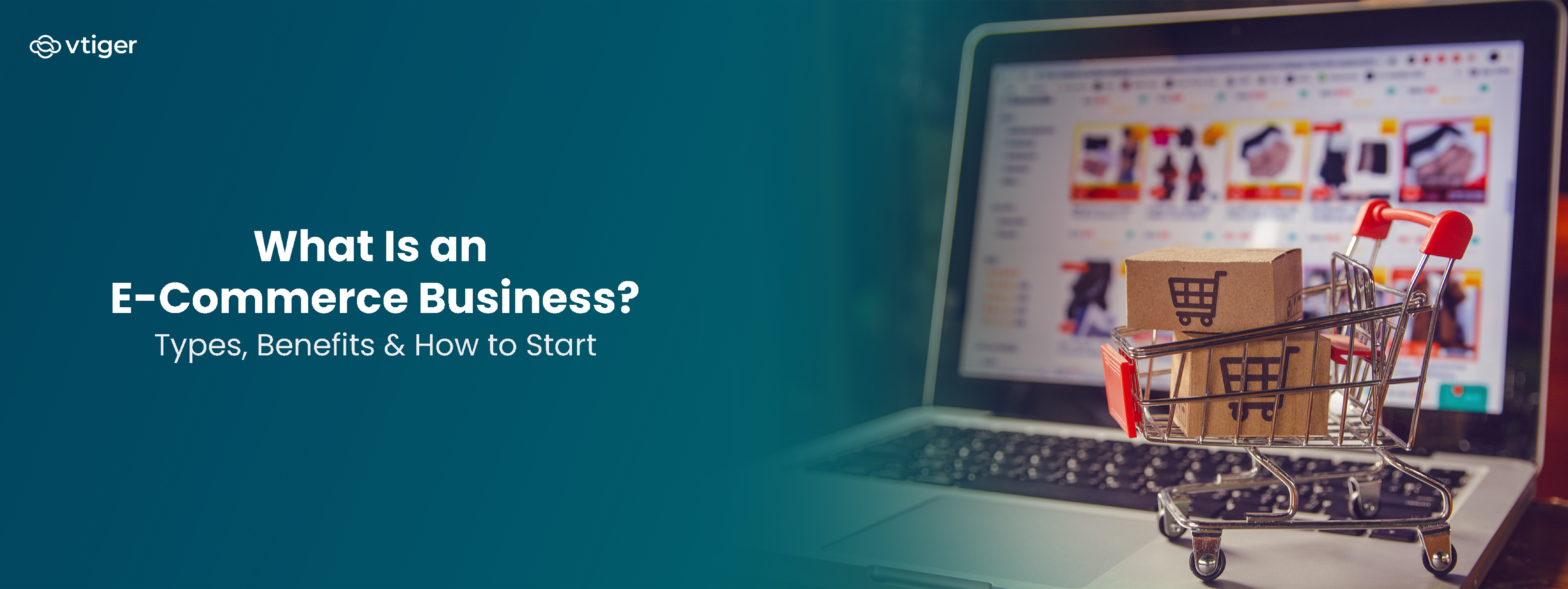
An e-commerce business buys and sells products or services online through websites, marketplaces, or mobile apps. It lets businesses reach customers globally, automate sales operations, accept digital payments, and manage inventory efficiently. Choosing the right business model and technology is what builds a scalable, profitable online business.
Online shopping has moved from a side channel to the core of how a growing share of companies operate. A founder can list a product tonight and take orders from another continent by morning, with no shopfront and no fixed opening hours. That reach is why businesses of every size are moving online, and why e-commerce now covers far more than retail, extending into services, software, subscriptions, and wholesale trade between companies.
What Is an E-Commerce Business?
An e-commerce business buys and sells products or services online, through its own website, a third-party marketplace, or a mobile app. It runs on digital transactions: a customer discovers a product, pays electronically, and the business fulfills the order and supports the buyer afterward.
It helps to separate two terms people use interchangeably. An online store is the storefront. An e-commerce business is the whole operation behind it, including payments, inventory, order fulfillment, customer support, and the customer data that connects them. The store is what a shopper sees; the business is everything that makes the sale repeatable.
The scale explains the urgency. Forrester projects global online retail sales will reach $6.8 trillion by 2028, growing roughly 8.9% a year. As demand keeps shifting online, the customer experience a business delivers increasingly decides whether a first order becomes a second.
How Does an E-Commerce Business Work?
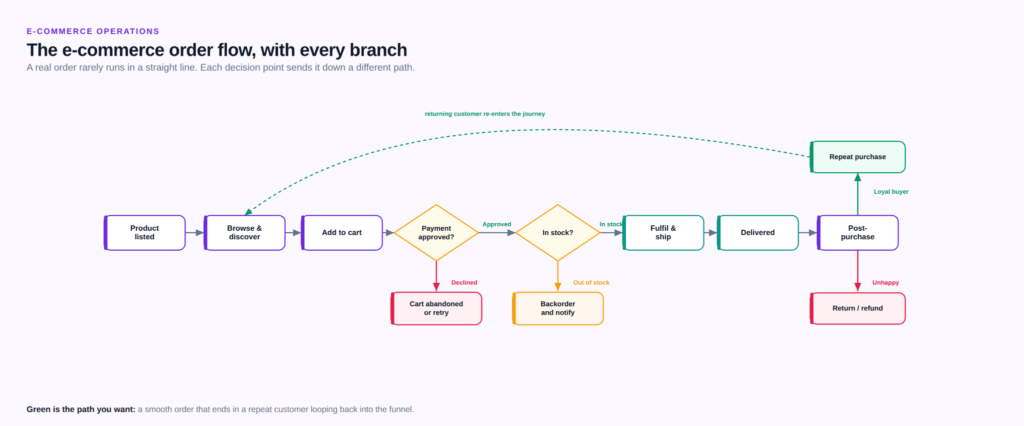
Every e-commerce business follows a structured workflow that starts when a customer discovers a product and ends with post-purchase support. Technology automates much of this journey to create a seamless buying experience.
- The business lists products with descriptions, images, and prices.
- A customer visits the website or marketplace.
- They browse and discover products through search or recommendations.
- The customer places an order and adds items to the cart.
- Payment is processed securely through a payment gateway.
- The system verifies stock against live inventory.
- The order is fulfilled, packed, and shipped.
- Post-purchase support and follow-up turn the buyer into a repeat customer.
Behind stock verification and fulfillment sits the retail supply chain, where inventory levels, warehouses, and delivery partners must stay in sync for the promise made at checkout to hold.
Types of E-Commerce Business Models
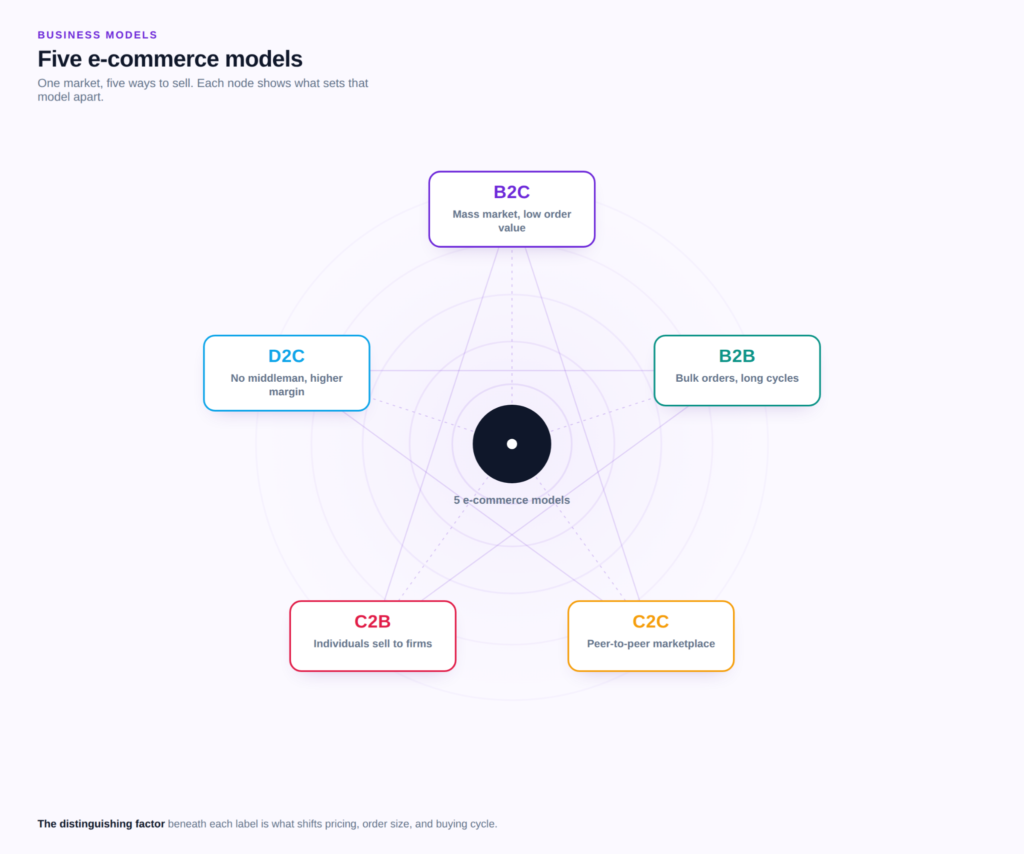
The model you pick is a strategic choice, not a label. It sets your average order size, how long a sale takes to close, and who you design the storefront for. 5 models cover most online businesses.
| Model | Who sells to whom | Typical example |
| B2C | Business to individual shoppers | An online fashion or electronics store |
| B2B | Business to other businesses | A wholesale supplier’s ordering portal |
| C2C | Consumer to consumer, via a marketplace | A resale or auction platform |
| C2B | Individuals to businesses | Freelancers, influencers, stock contributors |
| D2C | Brand direct to consumer, no middleman | A manufacturer’s own online shop |
The model you choose shapes pricing, margins, buying cycles, and how closely you manage each product life cycle from launch to retirement.
Key Components of an E-Commerce Business
A storefront is the visible tip of an e-commerce business. The parts customers never see- payment, inventory, data, and support, are what decide whether a sale completes and comes back. 6 components carry that weight.
Online Storefront
The website or mobile app where customers browse and buy. Its design and user experience decide how easily a visitor becomes a buyer.
Product Catalog
Structured product information, pricing, images, and categories that make items easy to find, compare, and trust.
Payment Gateway
The service that processes secure online payments, supports multiple methods, and protects card and account data at checkout.
Inventory and Order Management
Real-time stock tracking, order processing, and shipping coordination that keep what you promise aligned with what you can actually deliver.
Customer Relationship Management (CRM)
The system that stores customer data, purchase history, and support conversations, and ties sales activity to each individual buyer.
Marketing and Automation
Email campaigns, customer segmentation, and personalized messaging, most of it automated through marketing automation so outreach scales without extra headcount.
Where a CRM fits an online business
A storefront captures orders; a CRM captures customers. As catalogs, payments, and support channels multiply, sellers need one record of every buyer’s history in place of scattered exports.
An all-in-one platform like Vtiger One unifies that: orders, tickets, and campaigns sit on a single customer profile, with an AI-powered CRM scoring and segmenting buyers automatically. Smaller sellers can run the same on a small business CRM without enterprise overhead.
Benefits of an E-Commerce Business
The advantages compound once the storefront and the systems behind it work together. Buyers increasingly expect to self-serve, and Gartner found 67% of B2B buyers prefer a rep-free buying experience, which is exactly what a well-built online business offers.
“We see our customers as invited guests to a party, and we are the hosts.” Jeff Bezos, founder of Amazon
- Lower cost to operate: with no retail lease or floor staff, a larger share of every sale goes into product, ads, and working margin.
- Borderless, always-on selling: one storefront reaches new cities and time zones around the clock, and automated cart-recovery flows keep earning while the team sleeps.
- Personalization at scale: each shopper’s browsing and purchase history feeds tailored recommendations, the same mechanism that lifts average order value and repeat rate for large retailers.
- Decisions backed by real data: every click, search, and checkout is measurable, so pricing, stock, and campaign choices follow behavioral evidence measured from real sessions.
- Automation that frees the team: order logging, follow-ups, and marketing sequences run on their own, turning routine admin into engagement while people focus on growth and product.
- Scales without the overhead: adding customers rarely adds fixed cost, and real-time inventory keeps stock, channels, and revenue in sync as order volume climbs into new markets.
Challenges of Running an E-Commerce Business
The barriers are real, and most online sellers meet the same ones. Each shapes how much of your traffic turns into lasting revenue.
- Rising acquisition costs: crowded categories and pricier paid ads push customer-acquisition cost up, squeezing the margin on every order a store wins.
- Cart abandonment: most shoppers leave before paying, so recovery emails and instant conversational AI support are what claw a share of those sales back.
- Retention over acquisition: the second purchase is harder to earn than the first, and whether a buyer returns depends almost entirely on the post-sale experience.
- Inventory and logistics: stock accuracy and reliable delivery decide whether a strong first impression survives contact with the warehouse and the courier.
- Security and compliance: handling payment and personal data raises the stakes, since one breach erodes the trust an online business depends on to convert at all.
- Multi-channel sprawl: running a website, a marketplace, and social storefronts together multiplies pricing, stock, and support work across every channel at once.
How to Start an E-Commerce Business
Most first-time sellers stall by trying to perfect everything at once. You do not need the full stack on day one; you need the steps in the right order, each built on the one before it.
Step 1: Choose Your Business Idea
Identify the products or services you will sell, research real market demand, and define the audience you are selling to before building anything.
Step 2: Select a Business Model
Decide whether you are B2C, B2B, D2C, or marketplace-based, because that choice shapes pricing, logistics, and how you reach buyers.
Step 3: Build Your Online Store
Choose an e-commerce platform, design a clear website, and optimize it for mobile, where a large share of online shopping now happens.
Step 4: Set Up Payments and Logistics
Connect a payment gateway, line up shipping partners, configure tax rules, and write a returns policy customers can actually understand.
Step 5: Implement CRM and Automation
Add a lead management system to capture and track buyers, then automate customer communication, marketing, and sales follow-up from one place.
Step 6: Launch, Monitor, and Scale
Track performance, gather customer feedback, refine your marketing with proven business marketing ideas, and expand into new products or markets as demand grows.
Own your stack, or run it managed?
Most sellers start on managed, cloud tools for speed. Teams with in-house developers and unusual workflows sometimes choose an open source CRM they can self-host and extend line by line, accepting that they take on hosting, security, and upgrades themselves. It is a trade of convenience for control, and the right call depends on your technical depth.
Best Practices for Building a Successful E-Commerce Business
Knowing what to do and doing it consistently are different problems. These habits are what separate stores that keep growing from ones that plateau after a strong launch.
- Lead with customer experience: treat speed, clarity, and support as the product, because they drive the repeat purchases that make a store profitable.
- Design mobile-first: most sessions happen on phones, so a slow or clumsy mobile checkout quietly loses real orders every day.
- Personalize with real history: use each buyer’s past orders to tailor offers, the tactic that reliably lifts average order value.
- Run relationships through a CRM: hold every order, ticket, and campaign on one customer record as volume grows past what a spreadsheet can track.
- Automate the repetitive work: send cart-recovery and order-update flows automatically, so the team’s hours go to decisions and growth.
- Review analytics on a cadence: watch conversion, retention, and site speed weekly, since a one-second checkout delay costs measurable orders.
- Protect retention like acquisition: a returning customer costs far less to win than a new one, so post-sale experience earns its budget.
- Keep optimizing after launch: treat go-live as the starting line, tuning pages, flows, and pricing continuously as you learn.
Frequently Asked Questions (FAQs)
Q1. What is an e-commerce business?
An e-commerce business sells products or services online through a website, marketplace, or app. It handles digital payments, order fulfillment, inventory, and customer support, using technology to manage the full journey from a customer’s first visit to post-purchase follow-up.
Q2. What are the different types of e-commerce businesses?
The main models are B2C (business to consumer), B2B (business to business), C2C (consumer to consumer), C2B (consumer to business), and D2C (direct to consumer). They differ by who sells to whom, which in turn shapes pricing, order size, and buying cycles.
Q3. How does an e-commerce business work?
A customer discovers a product, places an order, and pays through a secure gateway. The system checks inventory, and the business fulfils, ships, and supports the order. Automation connects these steps so the experience stays fast and consistent at scale.
Q4. What are the benefits of starting an e-commerce business?
Lower overheads, global reach, and round-the-clock selling are the headline gains. Beyond those, online businesses collect rich data on customer behavior, personalize experiences, automate marketing and sales, and scale to new markets without the fixed costs of physical stores.
Q5. What tools do I need to run an e-commerce business?
At minimum, an e-commerce platform, a payment gateway, and inventory and shipping tools. Most growing sellers add a CRM and marketing automation to manage customer relationships, segment buyers, and run follow-up campaigns from a single, connected system.
Q6. Can a CRM help an e-commerce business grow?
Yes. A CRM centralizes customer data, purchase history, and support conversations, so you can personalize offers and retain buyers. An all-in-one platform such as Vtiger One connects sales, marketing, and support, which is where much of e-commerce growth is won or lost.
Q7. What is the difference between an online store and an e-commerce business?
An online store is the storefront customers see and shop from. An e-commerce business is the full operation behind it, including payments, inventory, fulfillment, support, and customer data. The store sells; the business is everything that makes selling repeatable and profitable.