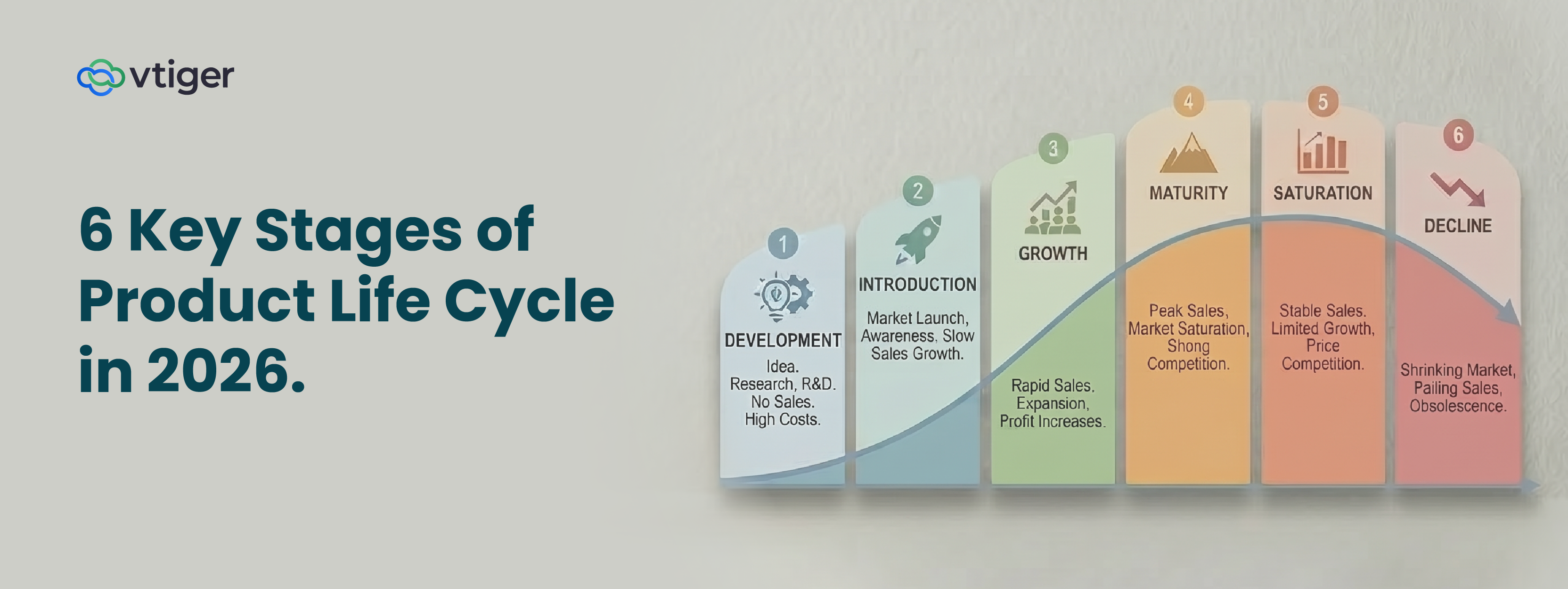
The product life cycle describes the stages a product moves through from idea to market retirement. The six stages of the product life cycle are development, introduction, growth, maturity, saturation, and decline. Businesses use the product life cycle to guide marketing, pricing, customer engagement, and innovation at each phase to maximize profitability and extend market success.
Every product has a life span, and the choices a business makes at each phase shape how long that life span lasts. A new launch needs awareness building. A maturing product needs a retention strategy. A declining product needs reinvention or a graceful exit. Understanding the product life cycle gives leaders a structured way to plan marketing, pricing, product strategy, and customer engagement across each phase.
The product adoption lifecycle is shaped by market demand, competitive positioning, customer behaviour, and innovation cycles. Different categories move through the stages at different speeds, but the underlying pattern is consistent. This blog covers the six stages, examples, strategies, challenges, and how technology is changing product life cycle management today.
What is Product Life Cycle?
The product life cycle is a business framework that maps a product’s journey from initial development through eventual decline. Each stage carries different revenue patterns, customer behaviours, and operational priorities. Companies use the framework to align teams around the product’s needs at each phase rather than applying the same playbook to every stage.
The model has four widely recognized core stages: introduction, growth, maturity, and decline. Many modern frameworks add development and saturation to make six. Tracking a product against these stages helps leaders forecast revenue, set pricing, and decide when to invest in promotion, retention, or innovation. Modern CRM software connects this stage view to actual customer data, so the lifecycle drives operational decisions.
6 Key Stages of the Product Life Cycle
The six stages of the product life cycle define a complete arc from concept to retirement. Each stage has predictable signals, customer dynamics, and business priorities. Recognizing which stage a product is in is the first step to making the right strategic decisions.
Development Stage
The development stage is the pre-launch phase where the product concept is researched, designed, prototyped, and tested. Revenue is zero, costs are high, and risk is concentrated in product-market fit decisions. The product development lifecycle at this stage focuses on customer research, MVP validation, and refining positioning before public launch. Decisions made here influence cost structure and competitive defensibility for the entire product life.
Introduction Stage
The introduction stage begins when the product launches to market. Awareness is low, sales build slowly, and marketing spend runs ahead of revenue. Businesses prioritize marketing automation, customer education, and early adopter acquisition to establish category presence.
Growth Stage
The product growth stage is marked by rapidly rising sales, expanding customer adoption, and the arrival of direct competitors. Margins improve as production scales, and the focus shifts from awareness to share capture. Effective sales pipeline management becomes critical as opportunity volume rises faster than processes can absorb manually. Differentiation, distribution expansion, and feature investment define the winning teams in this stage.
Maturity Stage
The product maturity stage is the longest and most profitable phase for most products. Sales plateau, the market is largely served, and competition intensifies on price, feature parity, and customer experience. Strategy shifts from acquisition to retention, cross-sell, and operational efficiency. Brands focus on customer loyalty programs, account expansion, and incremental innovation to defend share.
Saturation Stage
The saturation stage is the point where the market is fully addressed, and growth slows to near zero. Every customer who is going to buy has bought, and new sales come almost entirely from replacements or switches between competitors. Pricing pressure peaks, and only the most efficient operators stay profitable. Many businesses treat saturation as a signal to start the next innovation cycle in parallel.
Decline Stage
The decline stage in the product life cycle is marked by falling demand, declining revenue, and structural shifts in the market. Customer preferences move to newer alternatives, technology shifts make the product obsolete, or substitutes erode share. Businesses choose between three responses: harvest the remaining demand efficiently, reposition the product for a niche, or reinvent the offering for a new use case. Continued investment without a clear repositioning rarely succeeds.
Benefits of Understanding the Product Life Cycle
Understanding the business product lifecycle helps teams move from reactive product management to structured planning. Each stage answers a different question, and matching the right strategy to the right stage reduces wasted spend. According to Gartner (2025), the worldwide CRM software market grew 13.4% to $128 billion in 2024, reflecting the extent to which businesses invest in software that supports lifecycle decisions. The benefits include:
- Sharper product planning. Roadmaps align with where the product actually sits in the market rather than where the team wishes it sat.
- Smarter marketing investment. Spend mix shifts from awareness to retention to revival depending on the stage, instead of running the same campaigns at every phase.
- Better pricing decisions. Pricing power is highest in growth and lowest in saturation, and lifecycle awareness keeps pricing strategy aligned with that reality.
- Stronger customer retention. Maturity stage focus on loyalty and account growth offsets slowing acquisition, supported by CRM analytics that surface churn risk early.
- Cleaner innovation pipeline. Recognising saturation early triggers the next product investment before decline forces it.
Product Life Cycle Examples
Real product life cycle examples make the stages easier to recognize in your own portfolio. The same framework applies across consumer electronics, software, fashion, and services, although speed varies dramatically by category. Each category below illustrates one or more stages clearly enough to validate the model in practice.
Smartphones reflect the maturity stage globally, with most growth coming from replacement cycles and premium-tier upgrades rather than from first-time buyers. Streaming platforms show what saturation looks like in practice. Most addressable households already subscribe to at least one service, and growth now comes from price increases, ad tiers, and switching between providers rather than new subscribers entering the category.
At the opposite end, generative AI products sit squarely in the growth stage. Adoption is rising rapidly across consumer and enterprise categories, and the predictive AI category is expanding into business workflows from sales to product analytics. Physical media including DVDs, Blu-rays, and traditional cable packages sits in structural decline, with revenue contracting each year as streaming replaces it. Fast fashion compresses the entire arc into weeks rather than years.
Strategies for Managing Product Life Cycle Stages
A strong product marketing strategy adapts as the product moves through stages rather than holding constant. The same launch tactics that win at introduction fail at saturation, and the retention focus that works in maturity is misallocated during launch. Matching strategy to stage is the operational core of product lifecycle management.
Introduction Stage Strategies
The introduction stage requires high marketing investment to build awareness and educate the market about a new category or product. Budgets concentrate on positioning, demonstration, and acquiring early adopters who will validate the product socially. Customer feedback loops at this stage drive rapid iteration on messaging and the product itself. Common tactics include:
- Awareness campaigns and PR to establish category presence
- Customer education content such as guides, demos, and webinars
- Early access programs and pilot deals with reference customers, supported by structured customer engagement tracking from day one
Growth Stage Strategies
The growth stage strategy shifts from awareness to capturing share before competitors lock in their positions. Distribution expansion, pricing flexibility, and operational scaling all matter more than continued education spend. Teams focus on closing the gap between demand and capacity. Common tactics include:
- Expanding distribution channels and partner ecosystems
- Sales team scaling with structured playbooks and onboarding
- Feature investment that creates differentiation against direct competitors
Maturity Stage Strategies
The maturity stage shifts focus to retention, account expansion, and operational efficiency. Acquisition costs rise as the market saturates, so revenue per customer becomes the key growth lever. Investment moves toward loyalty programs and post-sale experience using customer service software that supports account-level continuity. Common tactics include:
- Loyalty programs, renewals, and contract expansion plays
- Cross-sell and upsell to existing accounts based on usage data
- Incremental product improvements that extend perceived value
Decline Stage Strategies
The decline stage demands clarity on whether to harvest, reposition, or reinvent. Continued investment without a clear path creates losses that compound quickly. Many businesses use workflow automation at this stage to reduce operational cost while the product winds down. Common tactics include:
- Harvest mode with reduced marketing spend and price increases for inelastic segments
- Repositioning into a niche where the product still delivers superior value
- Innovation or relaunch under a new positioning, often as a successor product
Challenges in Product Life Cycle Management
Even well-run product organizations face structural challenges in managing products through every stage. The issues compound throughout the lifecycle because early decisions constrain options later. The most common challenges are predictable but still trip up experienced teams.
- Changing customer behaviour. Buyer preferences, channel mix, and decision criteria shift faster than product strategy adjusts, leaving the product positioned for a market that no longer exists.
- Increasing competition. Each successful stage attracts new entrants, and differentiation that worked at launch erodes during growth and maturity without continuous investment.
- Innovation pressure: Forrester (2024) found that 67% of enterprises are already exploring generative AI for product and marketing workflows, which sets the pace for innovation cycles across categories.
- Operational cost growth: Production, support, and channel costs grow with scale, and margins compress in maturity unless efficiency programs offset them.
- Market disruption: New technology, regulatory shifts, or substitute products can compress the entire lifecycle, forcing decline decisions years earlier than planned.
- Forecasting accuracy: Predicting transitions between stages is difficult, and misreading the signals can lead to over-investment in declining products. Predictive analytics tools reduce this risk when fed clean historical data.
How Technology and AI are Transforming Product Life Cycle Management
Modern technology has changed how businesses track, predict, and manage products through their lifecycle. The product performance management process is now data-driven, with customer behaviour signals flowing directly into product decisions. AI accelerates that loop by detecting patterns humans miss and surfacing predictions earlier than traditional reporting allows.
AI-Driven Analytics and Forecasting
AI CRM platforms now analyze customer interactions, deal patterns, and product usage to predict where each product sits in its lifecycle. According to Gartner (2024), by 2026, 40% of customer service organizations will adopt proactive strategies powered by predictive technology rather than reactive ticket queues. The same predictive layer applies to product analytics. Models score churn risk, identify expansion accounts, and flag products entering decline before revenue confirms it.
CRM Integration and Customer Behaviour Analysis
CRM integration pulls product usage, support interactions, and pipeline signals into a single record. Teams see the full lifecycle of each customer relationship, not just the latest transaction. Customer behaviour analysis then surfaces which segments are entering decline, which need re-engagement, and which are growing. Connected sales forecasting ties this customer-level view back to product-level revenue projections and product innovation strategy decisions.
Automation and Performance Monitoring
Automation handles repetitive lifecycle tasks: renewal reminders, churn flags, segment-specific campaigns, and product usage alerts. Real-time dashboards monitor each product against its stage-specific KPIs. The combination of automation and monitoring shortens the gap between a lifecycle signal and a business response, which is what separates teams that extend product lives from those that watch them decline.
Conclusion
The product life cycle remains one of the most useful planning frameworks in business because it forces clarity about where each product sits and what it needs next. Development demands research discipline, introduction demands marketing investment, growth demands share capture, maturity demands retention, saturation demands efficiency, and decline demands a clear strategic choice. Treating every stage with the same playbook is the most common mistake teams make.
Modern platforms like Vtiger One bring product life cycle data into the same system that runs sales, marketing, and support. That unification turns the lifecycle model from a planning exercise into an operational system that guides decisions every day.
Frequently Asked Questions (FAQs)
Q1. What are the stages of the product life cycle?
The product life cycle has six stages: development, introduction, growth, maturity, saturation, and decline. The four core stages most frameworks reference are introduction, growth, maturity, and decline. Development covers the pre-launch phase, and saturation marks the period when the market is fully addressed before structural decline begins.
Q2. Why is the product life cycle important?
The product life cycle helps businesses match strategy to where the product actually is in the market. Marketing, pricing, and investment decisions that work at launch fail at maturity, and vice versa. Lifecycle awareness reduces wasted spend, improves forecasting accuracy, and surfaces the right moment to invest in the next innovation cycle.
Q3. What happens during the maturity stage?
The maturity stage is when sales plateau, the market is largely served, and competition intensifies on price, features, and customer experience. Acquisition costs rise as the addressable market shrinks, so businesses shift focus to retention, cross-sell, and operational efficiency. Loyalty programs, account expansion, and incremental improvements define the strategy at this stage.
Q4. Can products re-enter the growth stage?
Yes, products can re-enter the growth stage through repositioning, innovation, or expansion into new markets. A new feature set, a different customer segment, or a fresh use case can pull a maturing product back into growth. This is most common in software and consumer technology, where capability upgrades can effectively launch a new lifecycle inside the existing brand.
Q5. How do businesses manage declining products?
Businesses manage declining products through one of three strategies: harvest the remaining demand efficiently, reposition the product for a niche segment, or reinvent the offering for a new use case. Each path requires honest assessment of remaining value. Continued investment without a clear strategic choice usually destroys margin without changing the lifecycle trajectory.
Q6. What factors affect product life cycles?
Product life cycles are shaped by market demand, competitive intensity, customer behaviour, innovation pace, regulatory shifts, and substitute products. Categories with rapid technology change move through stages in months, while durable consumer goods may take decades. Effective lifecycle management requires monitoring all of these factors continuously rather than assuming the pace of the last cycle will repeat.
Q7. How does AI help in product lifecycle management?
AI helps in product lifecycle management by analyzing customer interactions, usage data, and market signals to predict stage transitions earlier than traditional reporting. Predictive models score churn risk, identify expansion opportunities, and flag declining products before revenue confirms the trend. Automation then triggers stage-appropriate responses, from onboarding campaigns at introduction to retention plays at maturity.