Writing a business plan means defining your business goals, target market, products or services, competitive strategy, financial projections, and operating plan. A clear, well-structured plan helps you secure funding, align your team, measure progress, and make better decisions as the business grows and market conditions shift.
Most founders write a business plan just for investors and archive it after funding. When a plan becomes a static requirement instead of an active guide, it offers zero operational value.
Plans that drive success are living documents. It is built on initial assumptions about customers and costs, they evolve as market feedback arrives. Steve Blank, who teaches entrepreneurship at Stanford and UC Berkeley, put the idea bluntly in The Startup Owner’s Manual.
| “No business plan survives first contact with customers.” Steve Blank, The Startup Owner’s Manual. |
This guide provides a practical, operator-focused approach to business planning. It covers core fundamentals, essential components, a step-by-step writing framework, and a reusable template. It also highlights common drafting errors and strategies for maintaining the plan as an active operational asset.
What Is a Business Plan?
A business plan is a document that describes what your business does, who it serves, how it earns revenue, and how it will operate over its first few years. It turns a founder’s intent into goals, numbers, and decisions others can read, fund, and act on. It is the company’s operating thesis, not a form to be filed.
Its purpose extends far beyond securing capital. A well-crafted plan sharpens internal strategy, builds credibility with investors, and aligns a growing team around shared objectives. It provides equal value whether you are a first-time founder, an established business expanding its portfolio, or an enterprise entering a new market.
Format is a choice, not a rule. The U.S. Small Business Administration distinguishes a traditional plan, detailed and common when seeking funding, from a lean startup plan built around a one-page model. Many founders now start with a Business Model Canvas, the framework popularized by Alexander Osterwalder, to map assumptions before expanding the strongest into a full document.
Why Is a Business Plan Important?
A strong business plan turns abstract ideas into verifiable operational choices. Writing it reveals the gap between optimistic forecasts and underlying market realities. The benefits below are the ones founders feel most directly.
- It clarifies goals by turning a broad vision into specific, time-bound objectives that the whole team can work toward.
- It secures funding by providing investors and lenders with the evidence they need to assess risk and potential returns.
- It guides strategic decisions by setting the priorities against which every later trade-off can be weighed.
- It identifies risks and opportunities early, while they are still cheap to address or act on.
- It aligns teams and stakeholders around one version of the strategy rather than several competing interpretations.
- It tracks performance by defining the metrics that show whether the business is on course or drifting.
Business planning builds operational discipline. A plan cannot guarantee success, but it replaces guesswork with clear, testable decisions. At its core, the strategic clarity gained during the writing process is even more valuable than the final document itself.
What Should a Business Plan Include?
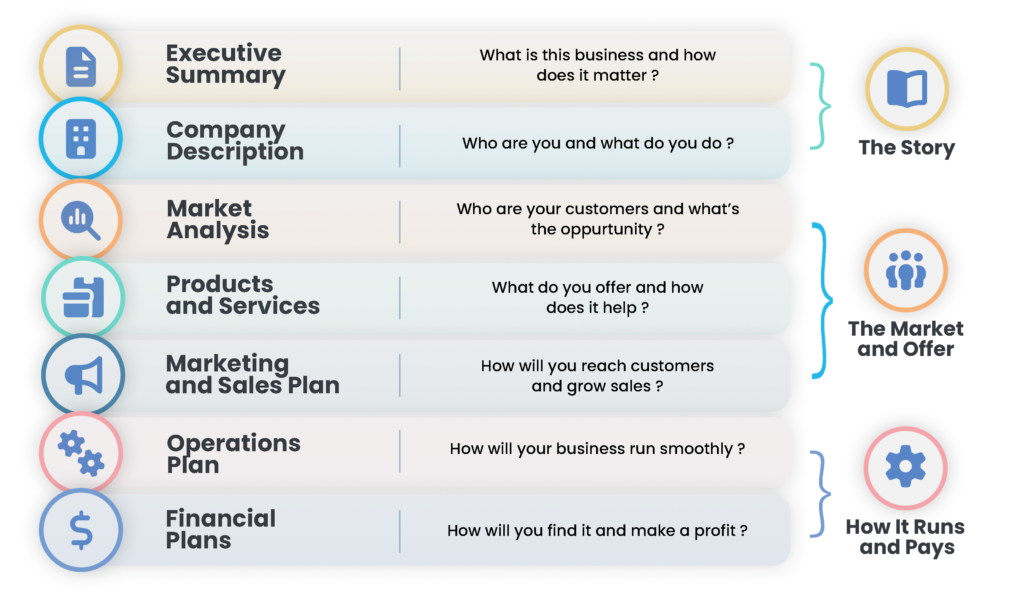
A business plan should give a complete picture of your business, market, operations, and finances in a structure investors already recognize. The seven sections below map closely to how lenders and partners expect to read a plan, and each answers a specific question about viability.
Executive Summary
The executive summary is a short overview of the whole plan, written last but placed first. It states what the business does, its mission, and the top objectives a reader should remember. Many investors decide whether to keep reading from this section alone, so keep it concise.
Company Description
The company description explains your business model, what you sell, and the value you offer. It covers legal structure, location, and the problem you solve better than existing options. This is where you argue why the business deserves to exist.
Market Analysis
Market analysis proves that a real, reachable market exists. It defines your target audience, sizes the opportunity, maps competitors, and names the trends shaping demand. A sound customer segmentation strategy turns a broad market into specific groups you can actually serve, and a SWOT analysis frames your position against rivals.
Rigour here is not optional. According to Forrester’s State of Business Buying, 81% of B2B buyers are dissatisfied with the provider they ultimately choose. That gap between expectation and experience is exactly the opening a well-researched plan is built to find and fill.
Products or Services
This section details what you sell, the benefits customers gain, and how you price it. Describe features in terms of the customer problem they solve, not the technology behind them. Include any intellectual property or supply considerations that affect delivery.
Marketing and Sales Plan
The marketing and sales plan explains how you will acquire and keep customers. It names your channels, acquisition approach, sales strategy, and retention plan. The strongest versions connect each channel to a measurable outcome rather than listing tactics.
Operations Plan
The operations plan describes how the business runs day to day. It covers team structure, key processes, suppliers, and the technology that supports delivery. Founders who map workflows early and adopt business process automation where tasks repeat avoid the bottlenecks that stall growing companies.
Financial Plan
The financial plan turns the strategy into numbers. It includes revenue projections, expenses, cash flow, a break-even analysis, and any funding requirements. Break-even analysis in particular shows the sales volume at which the business stops losing money, which is often the single figure investors check first.
How to Write a Business Plan Step by Step
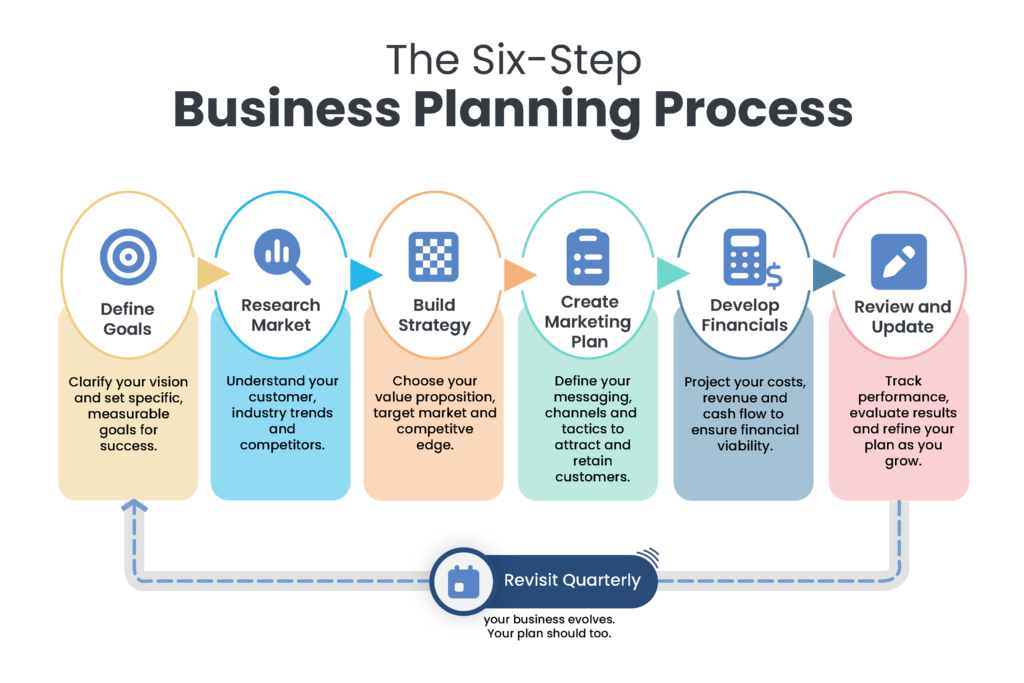
Building a business plan in the correct sequence ensures a cohesive strategy. The process below moves from purpose through research, strategy, and numbers, and ends where most plans should but few do, with a review loop.
Step 1: Define Your Business Goals
Start by separating short-term objectives from long-term vision. Short-term goals are concrete and measurable, such as revenue or customer targets for the first year. The long-term vision describes where the business is headed over three to five years, and every later section should ladder up to it.
Step 2: Research Your Market
Turn assumptions into evidence before you commit to a strategy. Study your target customers, analyze direct and indirect competitors, and identify the industry trends shaping demand. Good research tells you not only who your customer is, but why they currently choose an alternative you intend to beat.
Step 3: Build Your Business Strategy
Decide how you will position, price, and grow. Positioning defines the space you own in the customer’s mind, pricing reflects the value you deliver, and your growth approach sets the pace. Tracking these decisions inside a clear sales pipeline management process keeps strategy connected to real deals rather than slides.
Step 4: Create a Marketing Plan
Translate strategy into demand. Choose the mix of SEO, content, social media, email, and paid advertising that fits your audience and budget, and define how each channel will be measured. A small team can sustain more of this than it expects once marketing automation tools handle the repetitive sending and follow-up.
Step 5: Develop Financial Projections
Build revenue forecasts, profit estimates, and a working budget grounded in your research rather than optimism. Model a base case and a conservative case so a reader can see your assumptions. Pairing pipeline data with AI sales forecasting gives projections a basis in actual deal behavior rather than round-number guesses.
Step 6: Review and Update Your Plan
Treat the finished plan as version one. Set a cadence, usually quarterly, to compare actual performance against the plan, record what the market taught you, and adjust. This is the step that turns a document into a management tool, and it is the one most first-time founders skip.
The six steps compound in order. Skipping research weakens the strategy, and skipping the review loop lets the plan drift out of date. The disciplines that keep a plan useful are worth stating plainly:
- Write goals before tactics, so every activity traces back to a measurable objective.
- Ground every financial figure in research, not in the number you wish were true.
- Schedule the review before you finish the draft, so updating becomes a habit rather than an afterthought.
Business Plan Template: Section-by-Section Outline
A template removes the blank-page problem and ensures nothing important is missed. Use the outline below as a working structure, filling each section with your own research and numbers. It follows the order investors expect and adds risk and appendix sections that a funding-ready plan usually needs.
| Section | What it covers |
| Executive summary | The business, mission, and top objectives |
| Company description | Model, offering, and value proposition |
| Market analysis | Audience, competitors, and opportunity |
| Products and services | Features, benefits, and pricing |
| Marketing plan | Channels and customer acquisition |
| Sales strategy | Sales process and retention |
| Operations plan | Team, processes, and tools |
| Financial plan | Projections, cash flow, and funding |
| Risk analysis | Key risks and mitigations |
| Appendix | Supporting data and documents |
A template is a starting frame, not a finished plan. The sections stay constant across most businesses, but the depth of each should reflect your audience, since a bank, an angel investor, and an internal team each read for different things.
Common Mistakes to Avoid When Writing a Business Plan
Most business plans fail for predictable reasons rather than market unpredictability. Recognizing these recurring mistakes allows founders to build a solid strategy that maintains financial credibility under investor review.
- Unrealistic Financials: Expecting non-stop, rapid revenue growth instead of presenting conservative, defensible numbers.
- Biased Market Research: Researching what you hope the market looks like rather than how it actually operates.
- Ignoring Competitors: Pretending rival businesses don’t exist, which makes you look unprepared to investors.
- No Clear Targets: Leaving out specific performance goals, making it impossible to measure real business progress.
- Too Much Jargon: Hiding your core message behind complicated buzzwords instead of explaining your business clearly.
- Never Updating the Plan: Treating the plan as a one-time project rather than updating it as your market changes.
A business plan is not a fixed script; it is a list of assumptions waiting to be tested. The goal isn’t to write a perfect plan that never changes, but to build a flexible guide that adapts as soon as you get real customer evidence.
How a CRM Helps You Execute a Business Plan
A plan only creates value once it meets customers, and that is where a CRM earns its place. A CRM is the record where the market, sales, and financial assumptions in your plan get tested against real behavior.
Adoption is now the norm rather than the exception among established businesses. According to Cirrus Insight’s 2025 CRM research, 91% of companies with 11 or more employees use a CRM. Choosing a small business CRM built for lean teams lets a founder start with the same discipline before headcount forces it.
Turn the plan into a tracked pipeline
The sales strategy in your plan becomes real when leads and deals move through defined stages you can see. A CRM captures every contact, scores opportunities, and shows where deals stall, so your forecast reflects the pipeline rather than hope. That visibility is what lets you compare actual sales against the projections you wrote.
Track marketing and revenue against the plan
Marketing automation, customer analytics, and revenue reporting all feed back into the assumptions you documented. When a channel underperforms the plan, the data shows it early enough to reallocate budget. Vtiger One’s Calculus AI predicts likely deal outcomes and recommends a next best action from historical CRM data. Calculus AI predicts and recommends, and the team makes the call.
Report, review, and adjust
Execution generates the evidence your quarterly review needs. Dashboards summarize pipeline health, conversion, and retention so the review is grounded in fact, not impression. That closes the loop between the written plan and daily operations.
Best Practices for Business Planning
Strong business planning is a habit more than a document. The practices below keep a plan realistic, current, and connected to execution as the business changes around it. They apply whether you are drafting your first plan or maintaining your fifth revision.
- Keep the plan realistic by grounding every projection in research and conservative assumptions.
- Base decisions on data from the market and your own operations, not on instinct alone.
- Focus on customer needs, since a plan that solves a real problem outperforms one built around a clever product.
- Set measurable KPIs, so progress is visible, and course corrections are timely.
- Review the plan on a fixed cadence, and use CRM analytics reports to see performance against target.
- Train your team on the plan so the strategy is executed rather than filed away.
- Adapt quickly as market conditions change instead of defending an outdated plan.
The last practice is the hardest and the most valuable. According to Gartner’s strategic planning research, only 29% of strategists say their organization changes plans fast enough to respond to disruption. A plan you revisit and revise on evidence is worth far more than a perfect one that sits untouched while the market moves.
Frequently Asked Questions
What is a business plan?
A business plan is a written document that describes what your business does, who it serves, how it will earn revenue, and how it will operate over the next one to three years. It sets goals, outlines strategy, and projects finances. Founders use it to secure funding, align a team, and guide decisions as the business grows and market conditions change.
How do I write a business plan?
Start by defining your goals, then research your market, build a strategy, create a marketing plan, and develop financial projections. Draft each standard section, from the executive summary through the financial plan, using real data rather than optimism. Finish by scheduling a regular review so the plan stays current. Even a lean one-page version is better than no written plan at all.
What should a business plan include?
A complete business plan includes an executive summary, company description, market analysis, products or services, a marketing and sales plan, an operations plan, and a financial plan. Funding-ready versions often add a risk analysis and an appendix of supporting data. Each section answers a specific question a reader has about whether the business is viable and worth backing.
How long should a business plan be?
Length depends on purpose. A lean startup plan can fit on a single page, while a traditional plan seeking bank or investor funding often runs 15 to 25 pages plus appendices. Clarity matters more than length. A focused plan that a reader can absorb quickly usually outperforms a long document that buries its argument in detail and repetition.
Can I write a business plan without investors?
Yes. Many founders write a plan purely to organize their own thinking, set goals, and guide day-to-day decisions. A plan built for internal use can be shorter and less formal than one prepared for funding, focusing on strategy, milestones, and finances. It still pays to write it down, because the discipline of planning exposes weak assumptions before they cost money.
How often should a business plan be updated?
Review a business plan at least quarterly, and update it whenever something material changes, such as a new competitor, a pricing shift, or a change in funding. Treat the first version as a baseline you improve as evidence arrives. Regular updates keep the plan useful as a management tool rather than letting it become an out-of-date document that no longer reflects reality.
How can a CRM help execute a business plan?
A CRM turns your sales, marketing, and financial targets into tracked activity you can measure. It records leads and deals, moves them through pipeline stages, automates follow-up, and reports on performance against target. That gives you early evidence when results diverge from the plan, so you can adjust strategy or spending before small gaps become large ones.