Starting a small business means validating a profitable idea, researching your market, and writing a business plan before you choose a legal structure, register the company, and secure funding. From there, you build a brand, set up operations, and start acquiring customers. Adopting tools such as a CRM, accounting software, and marketing automation early keeps operations organized as you grow.
More people are building companies than at almost any point in recent memory, largely because the starting tools have become cheap and accessible. Online storefronts, website builders, and cloud software now let a single founder reach customers that once required premises and a sales team. The hard part is rarely the idea itself, but the sequence of decisions that turn an idea into a registered, funded business.
What is a Small Business?
A small business is an independently owned company that operates at a limited scale, usually defined by employee count or revenue thresholds that vary by country and industry. Their teams are lean, the owner is involved in daily decisions, and cash and time are always tight. These constraints shape almost every early choice.
The category is broad. It covers service businesses such as agencies and trades, retail shops and their online equivalents, ecommerce brands, independent consultants, small software ventures, and freelancers who sell their skills directly. What unites them is the need to do more with fewer people, which is why early structure matters far more for a small business than inside a large organization.
Why Start a Small Business?
People start businesses for reasons that go beyond income, though financial independence is often the trigger that pushes them to act. Ownership offers control over how you spend your time and which problems you choose to solve. It also builds equity in something you own rather than a salary you rent.
The leap is rarely tidy. As LinkedIn co founder Reid Hoffman put it, “Starting a company is jumping off a cliff and assembling the airplane on the way down.” The lesson is not that recklessness pays off. It is that you never have complete information before you begin, so you reduce risk deliberately rather than wait for a certainty that never arrives.
The most common reasons people commit to starting a small business include:
- Financial independence that ties your earnings to your effort rather than a fixed wage.
- Flexibility over your schedule, location, and the kind of work you take on.
- Growth potential that lets a proven idea scale into a larger team or market.
- A personal brand that compounds as customers and partners come to trust your work.
- The satisfaction of solving a real customer problem better than the incumbents do.
- Long-term wealth creation through an asset you can eventually sell or pass on.
How to Start a Small Business Step by Step
The path from idea to open business follows a repeatable sequence. Each step reduces a specific risk, and skipping one usually creates a problem you pay for later.
Step 1: Identify Your Business Idea
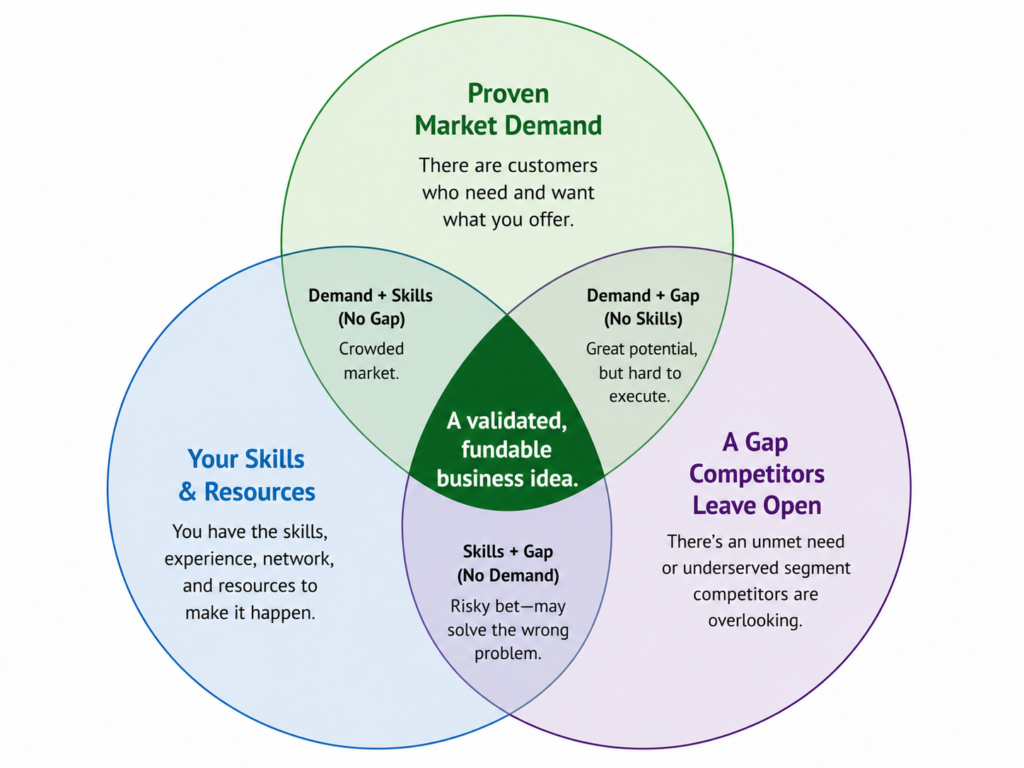
Start with a problem worth solving rather than a product you like. Look for a gap where customers already pay for a poor solution, then confirm they will pay for a better one. Assess the competition so you know what you must do differently.
Step 2: Conduct Market Research
Market research turns assumptions into evidence. Define your target audience by need, budget, and behaviour, then study both direct and indirect competitors. Map the industry trends shaping demand so you know whether the market is growing or shrinking.
Step 3: Write a Business Plan
A business plan connects your idea to real numbers. Set concrete goals, describe your revenue model, and build honest financial projections. Even a lean one-page plan beats keeping the strategy in your head, because it exposes weak assumptions early.
Step 4: Choose a Business Structure
Your legal structure affects taxes, paperwork, and personal liability. Common options include a sole proprietorship, a partnership, a limited liability company, and a corporation. Rules differ widely by country, so confirm the specifics with a local accountant before you commit.
Step 5: Register Your Business
Business registration makes the company official. Reserve a business name, obtain the licences and permits your activity requires, and complete tax registration. Requirements vary by location and sector, so build a short compliance checklist for your city and industry.
Step 6: Secure Funding
Most new businesses need capital before revenue arrives. Founders combine personal savings with bank loans, angel or venture investment, grants, or crowdfunding. Each source carries its own cost and control implications, so match the type to your risk tolerance.
Step 7: Build Your Brand
Your brand is how customers recognize and remember you. Choose a clear name, create a simple logo, publish a website that explains what you sell, and claim your social profiles. Consistency across these touchpoints matters more than polish in the early days.
Step 8: Set Up Business Operations
Operations are the systems that let you deliver reliably as volume grows. Put accounting, payments, and communication tools in place, and adopt a customer system early so enquiries never live in one inbox. A purpose-built CRM for startups keeps every lead, deal, and conversation in one record.
Step 9: Market Your Business
Marketing is how strangers become customers. Combine SEO and content with social media, email sequences, referrals, and paid advertising where the maths works. Well-configured marketing automation tools help a small team run these channels consistently without hiring for every task.
Step 10: Launch, Measure, and Grow
Launch is a starting line rather than a finish. Track a few key indicators such as leads, conversion rate, and cash flow, then collect feedback and improve in short cycles. Scale deliberately once the numbers show a repeatable, profitable model.
Small Business Startup Checklist
A checklist keeps the launch sequence from turning into guesswork. Use the two stages below as a practical business startup checklist you can work through, adjusting the details to your country and industry.
Before You Launch
Cover the groundwork that protects you legally and financially:
- Validate the business idea with real prospects, not just friends and family.
- Research your target market and name your main direct competitors.
- Create a business plan with goals, pricing, and financial projections.
- Complete business registration along with tax and licensing requirements.
- Open a dedicated business bank account to separate personal and company money.
At Launch and Early Growth
Put the systems in place that let you sell and measure from day one:
- Set up accounting so income and expenses are tracked from the first sale.
- Choose a CRM to organize leads, contacts, and follow ups in one place.
- Build a website and claim your core social media profiles.
- Launch your first marketing campaigns to a clearly defined audience.
- Track business performance against a few clear metrics every week.
Common Mistakes to Avoid When Starting a Small Business
Most early failures trace back to avoidable mistakes rather than bad luck, and many come from doing manually what a system should handle. According to Forrester (2023), sales representatives spend only about 23% of their time actually selling, with the rest lost to administration. For a small team, that lost time is often the difference between growth and stall.
- Skipping market research: Building before you confirm demand wastes money on a product nobody asked for, so test the idea with real buyers first.
- Not having a business plan: Without a written plan, pricing and priorities drift, while a short plan keeps every decision anchored to your goals.
- Underestimating costs: Owners routinely miss recurring expenses and slow-paying customers, so build a buffer and forecast cash flow monthly.
- Ignoring customer feedback: Early customers tell you exactly what to fix, so treat complaints as a roadmap rather than noise.
- Relying on manual processes: Tracking leads across spreadsheets breaks as soon as volume rises, so automate repetitive steps early.
- Delaying technology adoption: Adopting tools only once you are busy means learning them at the worst time, so start while setup is simple.
Essential Tools Every Small Business Needs
The right software lets a small team operate like a much larger one, and demand reflects that value. Gartner (2024) reported that the global CRM software market grew 13.4% to reach 128 billion dollars in 2024, driven partly by smaller firms adopting tools once reserved for enterprises. Six categories cover most early needs.
CRM Software
A CRM stores every lead, contact, deal, and support case in one record so customer history never lives in one person’s memory. It gives a small team a shared view of each customer. If you are unsure where to begin, a plain explanation of what CRM software is clarifies the core functions.
Accounting Software
Accounting tools track income, expenses, invoices, and tax obligations without a full-time bookkeeper. Most connect directly to your bank to reduce manual entry. Many also integrate with a CRM so sales and finance share the same records.
Project Management Tools
Project management software assigns tasks, tracks milestones, and shows what is slipping. It replaces scattered notes and status meetings with a single view of the work. For service businesses, it links delivery back to the customers paying for it.
Marketing Automation
Marketing automation runs email sequences, captures leads from web forms, and nurtures prospects without manual sending. It lets one marketer maintain campaigns that would otherwise need a team. It also records each interaction so follow up stays timely.
Collaboration Tools
Chat, video, and shared documents keep a distributed or hybrid team aligned. They cut the internal email volume that quietly slows small teams down. Shared access means work continues when any one person is unavailable.
Analytics and Reporting
Analytics turn raw activity into decisions by showing which channels and customers drive revenue. Clear reports replace guesswork with evidence when you plan the next move. Even simple dashboards help a founder spot problems while they are cheap to fix.
How CRM Helps Small Businesses Grow
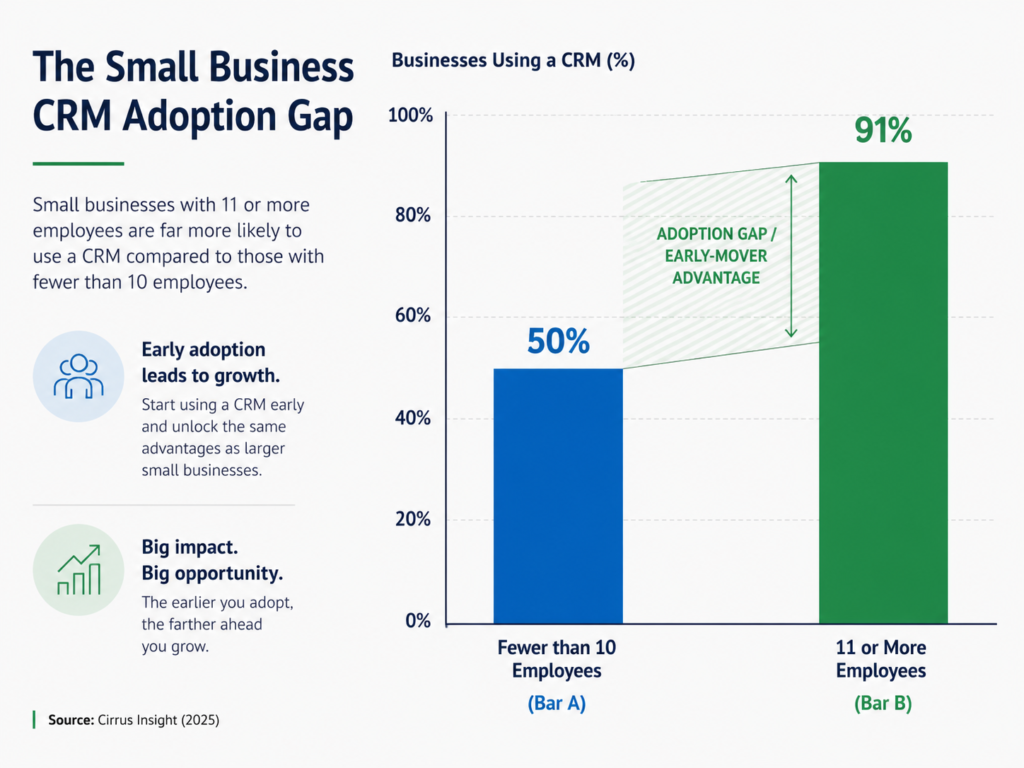
A CRM turns scattered customer interactions into a repeatable growth engine, yet adoption among the smallest firms still lags. Cirrus Insight (2025) found that only 50% of small businesses with fewer than ten employees currently use a CRM, which leaves a clear advantage for those that adopt early. Choosing a CRM for small businesses built for lean teams closes that gap quickly.
Turning Leads Into Repeat Customers
Peter Drucker wrote that “the purpose of a business is to create and keep a customer,” and a CRM puts both halves of that idea into practice. It captures leads, tracks them through pipeline stages, and prompts timely follow-up so opportunities do not slip away. A disciplined lead management process separates steady pipelines from feast-and-famine selling.
In practice, a CRM supports growth in several concrete ways:
- Scoring and routing leads so the highest intent prospects get attention first.
- Tracking every deal stage so forecasts reflect reality rather than hope.
- Recording each interaction in a single customer view the whole team can access.
Automating Routine Sales and Support Work
Beyond organizing contacts, a CRM removes the repetitive work that drains small teams. Workflow automation handles reminders, assignments, and status updates based on rules you define. In Vtiger One, for example, Calculus AI analyses historical CRM data to forecast likely deal outcomes and recommend the next best action, while the decision to act stays with the person.
That automation typically covers work such as:
- Follow-up reminders and task assignments triggered by deal activity.
- Capture of enquiries from web forms and email into the correct record.
- Support case routing so no customer request is ever missed.
Best Practices for Growing a Small Business
Growth rewards steady habits more than occasional heroics, and one habit stands out. Cirrus Insight (2025) reported that 65% of companies implement a CRM within their first five years, which reflects how early structure supports later scale. The small business tips below keep a growing company focused as it adds customers and staff.
- Prioritize customer experience, since retaining a buyer costs far less than winning a new one.
- Build repeat business through consistent follow-up, loyalty offers, and dependable service.
- Invest in automation, so routine work does not scale in lockstep with headcount.
- Monitor cash flow closely, because profitable businesses still fail when cash runs out.
- Measure a few clear KPIs regularly rather than tracking everything and acting on nothing.
- Train your team so the systems you adopt are actually used rather than bypassed.
- Keep improving the offer as customer needs and competitors continue to change.
Learning how to start a small business is ultimately about sequencing decisions and adopting the right structure before complexity arrives. Validate the idea, plan the finances, register properly, and put customer systems such as Vtiger One in place early. Do that, and the launch becomes a foundation for growth rather than a scramble to catch up.
Frequently Asked Questions (FAQs)
Q1. How do I start a small business?
Validate a profitable idea, research your target market, and write a business plan. Choose a legal structure, register the business, and secure funding. Then build a brand, set up operations including a CRM, and launch to a clearly defined audience.
Q2. How much money do I need to start a small business?
It depends heavily on your model. A service or freelance business can start for a few hundred dollars, while retail or product ventures need stock and premises. Estimate one-time setup costs plus several months of running expenses, then add a buffer.
Q3. Do I need a business plan?
Yes, in almost every case. A business plan connects your idea to pricing, costs, and financial projections, which exposes weak assumptions early. Even a lean one-page plan guides everyday decisions, and most lenders or investors will expect to see one.
Q4. Which business structure should I choose?
Choose based on liability, tax treatment, and your growth plans. Sole proprietorships are simple but expose personal assets, while a company structure separates business risk at the cost of more paperwork. Confirm the specifics with a local accountant before registering.
Q5. What tools does a small business need?
At minimum, accounting software, a payment system, a CRM, and basic marketing and collaboration tools. Accounting keeps the books accurate, a CRM organizes leads and customers, and marketing automation runs your campaigns. Analytics then reveal which activities actually drive revenue.
Q6. When should I implement a CRM?
Implement a CRM as soon as tracking leads and follow ups in spreadsheets or inboxes starts to slip. Adopting one early, while your data is still small, avoids a painful migration later. Most growing businesses benefit within their first trading year.
Q7. How can I grow my small business faster?
Focus on keeping existing customers, since retention costs far less than acquisition and repeat buyers spend more over time. Automate routine sales and support work, watch cash flow closely, and measure a few clear metrics every week to stay on track