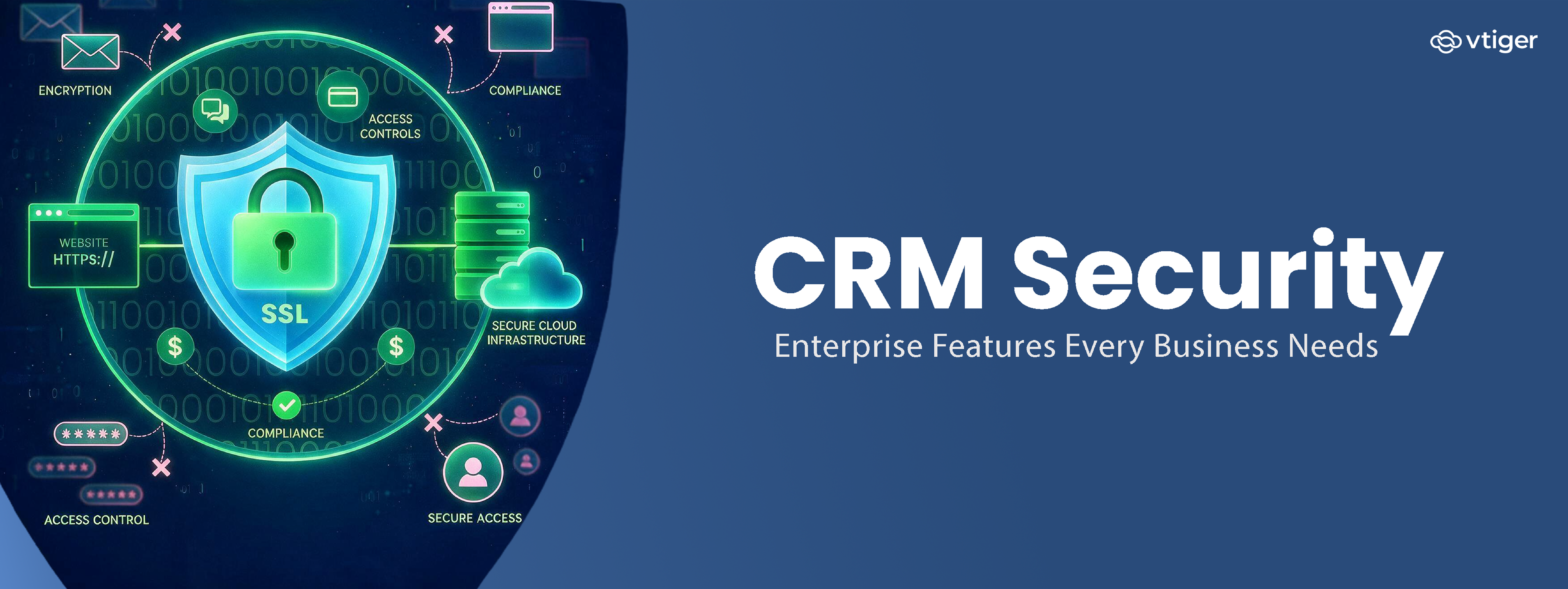
A CRM concentrates a company’s most valuable data- complete customer identities, payment and contract details, and the full history of every deal, in one system, which makes it the highest-value target most businesses run.
The risk compounds as they scale: every new user, integration, and remote endpoint widens the attack surface. CRM security is the discipline of governing access, encrypting data in transit and at rest, and proving compliance, so that records stay trustworthy however many hands touch it.
Vtiger CRM helps growing businesses secure sensitive customer data, control user access, monitor system activity, and reduce security risks while enabling teams to collaborate confidently in a cloud-based environment. Read this blog to learn the mechanism behind it.
What Is CRM Security?
CRM security is the combination of encryption, access controls, authentication, and compliance measures that protect the customer data inside a CRM system from unauthorized access, breaches, and loss.
The reason it matters is what a CRM concentrates: customer contact information, sales and pipeline records, communication history, business documents, and user credentials, all in one login. Each is valuable to an attacker, and the cost of losing it keeps climbing. IBM’s 2025 research put the average cost of a breach at USD 4.44 million. The common risks are familiar: stolen credentials, over-broad user access, unencrypted data, and the logins that departed employees quietly keep.
Why CRM Security Matters for Growing Businesses
Security gets harder precisely as a business succeeds. More users, more customer records, and more integrations widen the surface an attacker can reach, and remote and hybrid work stretches that surface to every home network a rep signs in from.
“Security is a process, not a product.” Bruce Schneier, security technologist
That framing matters for a CRM, because protection is a habit, not a one-time setting. Privacy regulations like GDPR raise the stakes again, turning a single lapse into a compliance failure and a breach. For a growing team, strong customer data security defends three things at once: business continuity, customer trust, and the freedom to collaborate securely across locations.
How Vtiger CRM Protects Customer Data
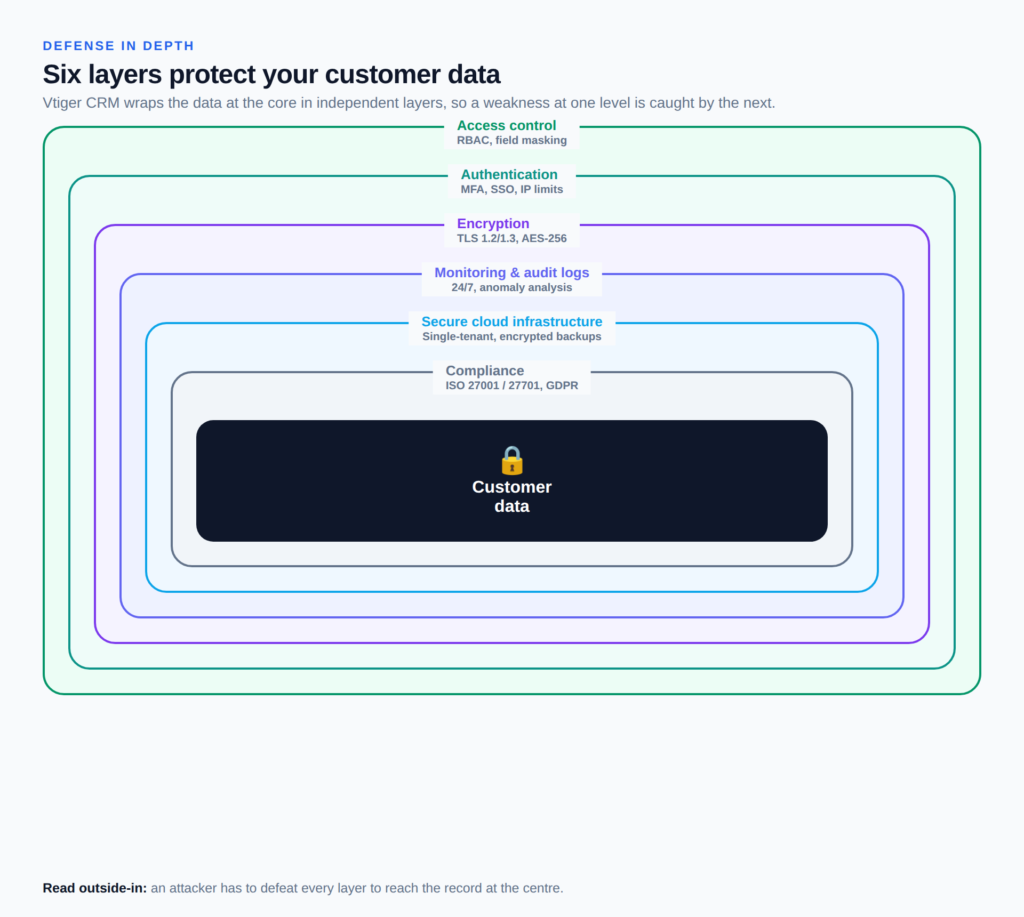
No single control stops every attack, so Vtiger CRM stacks six of them into a defense-in-depth model. Each layer is built to hold even when another fails, so a stolen password still meets encryption, and a curious insider still meets strict access limits.
Role-Based Access Controls
Vtiger CRM uses role-based access control to enforce least privilege: a user’s role and profile decide which records, modules, and fields they can view or edit, and sharing rules govern access across teams, the essence of CRM access control. Data masking hides sensitive field values from users whose profile lacks clearance, and approval workflows keep high-risk actions under review before they commit.
Secure Authentication
Protection starts at login. Vtiger CRM supports multi-factor authentication, single sign-on, and strong password policies, and administrators can restrict access to trusted IP ranges. Together, these confirm that the person signing in is who they claim to be before any customer data appears on screen.
Data Encryption
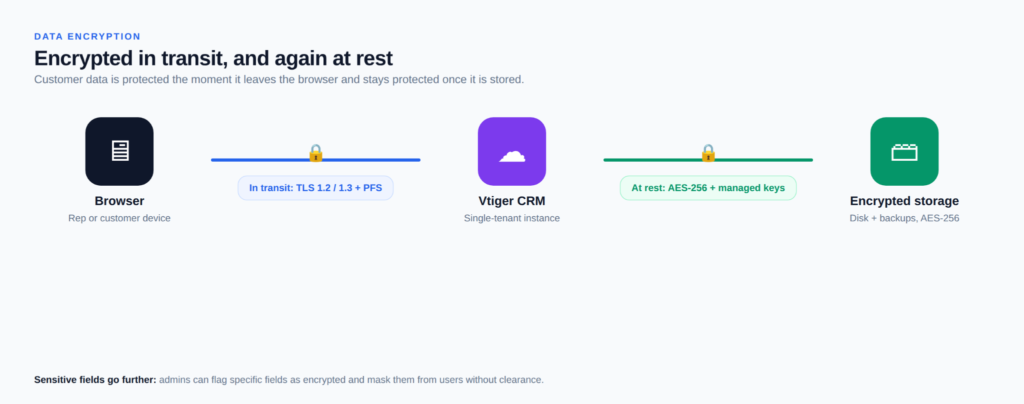
CRM encryption in Vtiger works on two fronts: customer data is protected both in transit and at rest. Traffic between the browser and Vtiger runs over TLS 1.2 and 1.3 with perfect forward secrecy, while sensitive fields are stored using 256-bit AES encryption with keys held in a managed key service. Administrators can flag specific fields as encrypted, so identification and financial numbers stay protected even inside an open record.
Activity Logs and Audit Trails
Every login, record change, and administrative action is logged. Vtiger CRM monitors its infrastructure and applications around the clock and runs anomaly analysis across event, audit, and administrator logs, so an unusual bulk export or an off-hours login surfaces quickly. For an admin, that audit trail turns a vague worry into a specific, traceable event.
Secure Cloud Infrastructure
Cloud CRM security starts with the infrastructure. Vtiger CRM runs on a secure cloud CRM platform with disk-level encryption, and a single-tenant architecture gives each customer an isolated space of their own. Data is backed up continuously and restorable within hours, and businesses can choose data residency across regions including the EU, UK, US, India, and Singapore. Teams that need to own the deployment outright can self-host the open source CRM edition and keep every record on their own infrastructure.
Compliance and Privacy
Vtiger CRM is certified to ISO/IEC 27001 for security management and ISO/IEC 27701 for privacy information management, and it supports GDPR and CCPA obligations through a dedicated privacy portal. Its cloud providers add SOC 2 and PCI DSS coverage, and breach notification follows a 72-hour disclosure timeline. For regulated industries, that documented CRM compliance turns a security promise into an auditable fact.
AI introduces a newer risk: IBM found that 97% of organizations that suffered an AI-related breach lacked proper AI access controls. Vtiger’s Calculus AI is built to avoid that gap, operating within the same role and field permissions as every user, so its predictions and recommendations only ever draw on data a person is already cleared to see.
CRM Security Best Practices for Businesses
Even the most secure CRM depends on how a team runs it, and a disciplined CRM implementation makes these habits in from day one. The practices that close the gaps technology alone cannot are straightforward:
- Control user access: assign roles by need, review permissions on a schedule, and automate joiner and leaver steps with business process automation so access never lingers after someone moves on.
- Strengthen authentication: turn on multi-factor authentication everywhere, enforce strong passwords, and rotate shared credentials on a regular cycle.
- Train the team on security: teach staff to spot phishing and handle customer data responsibly, since people stay the most-targeted layer of any system.
- Monitor CRM activity: review audit logs for unusual access and respond to suspicious events quickly, before a small foothold becomes a full breach.
- Keep systems updated: apply updates, patch vulnerabilities, and re-audit connected integrations, which are a frequent and overlooked backdoor.
Benefits of a Secure CRM
Security reads like pure cost until a breach reprices it overnight. Solid CRM data protection turns that spend into returns a business can measure: fewer incidents, cleaner audits, and customers who stay because their data did:
- Protects sensitive customer information from theft, loss, and unauthorized changes.
- Reduces the risk of unauthorized access through least-privilege roles and MFA.
- Supports regulatory compliance with GDPR, ISO, and industry-specific standards.
- Builds customer trust, which is slow to earn and hard to rebuild after a breach.
- Enables secure collaboration across remote and hybrid teams.
- Improves business continuity with reliable backups and fast recovery times.
- Minimizes operational risk from human error and insider mistakes.
- Protects the brand reputation that a single public incident can undo.
How to Evaluate CRM Security Before Choosing a CRM
Security standards are not equal across vendors, and the CRM security features that matter most are easy to compare once you know what to look for. Score each option against these criteria.
| What to check | What good looks like |
| Certifications and compliance | ISO 27001, ISO 27701, SOC 2, and documented GDPR support |
| Access and permission controls | Role-based access, field-level permissions, and data masking |
| Encryption | TLS in transit, AES-256 at rest, and encryptable fields |
| Backup and recovery | Automated backups with a defined restore time |
| Audit logging | Full activity logs with anomaly monitoring |
| Vendor policy and data ownership | Clear breach notification, data residency, and you own your data |
A structured CRM tools guide helps you score these side by side before you commit.
Frequently Asked Questions (FAQs)
Q1. What is CRM security?
CRM security is the set of controls that protects the customer data inside a CRM from unauthorized access, breaches, and loss. It combines encryption, role-based access controls, authentication like MFA, activity monitoring, and compliance measures such as ISO certification and GDPR support.
Q2. Why is CRM security important?
A CRM holds a business’s most sensitive data in one place, which makes it a prime target. Strong protection prevents breaches that carry high financial and reputational costs, keeps the business compliant with privacy laws, and preserves the customer trust that is difficult to rebuild.
Q3. How does Vtiger CRM protect customer data?
Vtiger CRM protects data with layered security: role-based access and data masking, multi-factor authentication, TLS and AES-256 encryption, round-the-clock monitoring with audit trails, single-tenant cloud infrastructure with backups, and ISO 27001 and 27701 certification.
Q4. What security features should a CRM include?
Look for role-based access control, field-level permissions, encryption in transit and at rest, multi-factor authentication, detailed audit logs, automated backups, and recognized compliance certifications. For regulated businesses, breach-notification and data-residency policies matter just as much.
Q5. How can businesses improve CRM security?
Assign access by least privilege and review it regularly, enable multi-factor authentication, train staff to spot phishing, monitor audit logs for unusual activity, and keep the system and its integrations patched, since most breaches exploit weak access habits more than the software itself.
Q6. Is cloud CRM secure?
A well-built cloud CRM is often more secure than on-premise alternatives, because the provider handles encryption, monitoring, and patching at scale. Verify the vendor’s certifications, encryption standards, and breach-notification and data-residency policies before you commit.
Q7. How does CRM security help maintain customer trust?
Customers share personal and payment data expecting it to stay private. Visible, certified CRM security signals that a business takes that responsibility seriously, and it prevents the breaches that erode trust and send customers elsewhere.