A value chain is a framework that describes all the activities a business performs to create, deliver, and support products or services. Introduced by Michael Porter, value chain analysis helps organizations identify opportunities to improve efficiency, reduce costs, enhance customer value, and gain a competitive advantage by optimizing both primary and support activities.
Most teams can describe their value chain after a 30-minute exercise. Far fewer can point to where last quarter’s analysis led to an actual operational change. The gap between mapping the value chain and acting on it is where competitive advantage quietly stops appearing on the income statement.
What is a Value Chain?
A value chain is the structured set of activities a business performs as raw inputs move toward a delivered product or service. The framework organises those activities so leaders can see where value gets added and where margin gets lost. Each activity either contributes to customer value or consumes resources without producing it.
Origin of the Concept
The term was introduced by Harvard Business School professor Michael Porter in his 1985 book Competitive Advantage. Porter argued that competitive advantage cannot be understood by looking at a firm as a whole; it requires examining the discrete activities that produce value. The model categorizes business activities into two groups: primary activities directly involved in producing the offering, and support activities that enable them.
Purpose of the Framework
The purpose is to identify where the business can either reduce cost or increase differentiation. Cost advantage comes from performing activities more efficiently than competitors. Differentiation advantage comes from performing activities in ways competitors cannot replicate. Both paths require visibility into how each activity contributes to the final margin.
Why is the Value Chain Important?
Every business performs a series of activities that contribute to creating value for customers. Understanding these activities improves profitability, sharpens strategic decisions, and reveals which functions deserve more investment. According to Cirrus Insight’s 2025 CRM analysis, the average CRM deployment returns $8.71 for every $1 spent, which underscores how operational technology investment compounds across the value chain when it is implemented with discipline.
The benefits show up across six recurring areas:
- Improved operational efficiency because the framework reveals which activities consume disproportionate resources.
- Better customer experiences because each activity is evaluated against the value it delivers to the end customer.
- Reduced business costs because inefficiencies become visible rather than absorbed into overhead.
- Competitive differentiation because the analysis identifies which activities can be performed in ways competitors cannot replicate.
- Higher profit margins because cost reduction and differentiation both flow to the bottom line.
- Stronger strategic decision-making because investment is targeted at activities with the highest leverage on customer value.
Components of a Value Chain
According to Porter’s Value Chain Model, business activities are categorized into primary activities and support activities. The two groups operate together: support activities make primary activities possible, and primary activities directly produce what the customer pays for.
Primary Activities
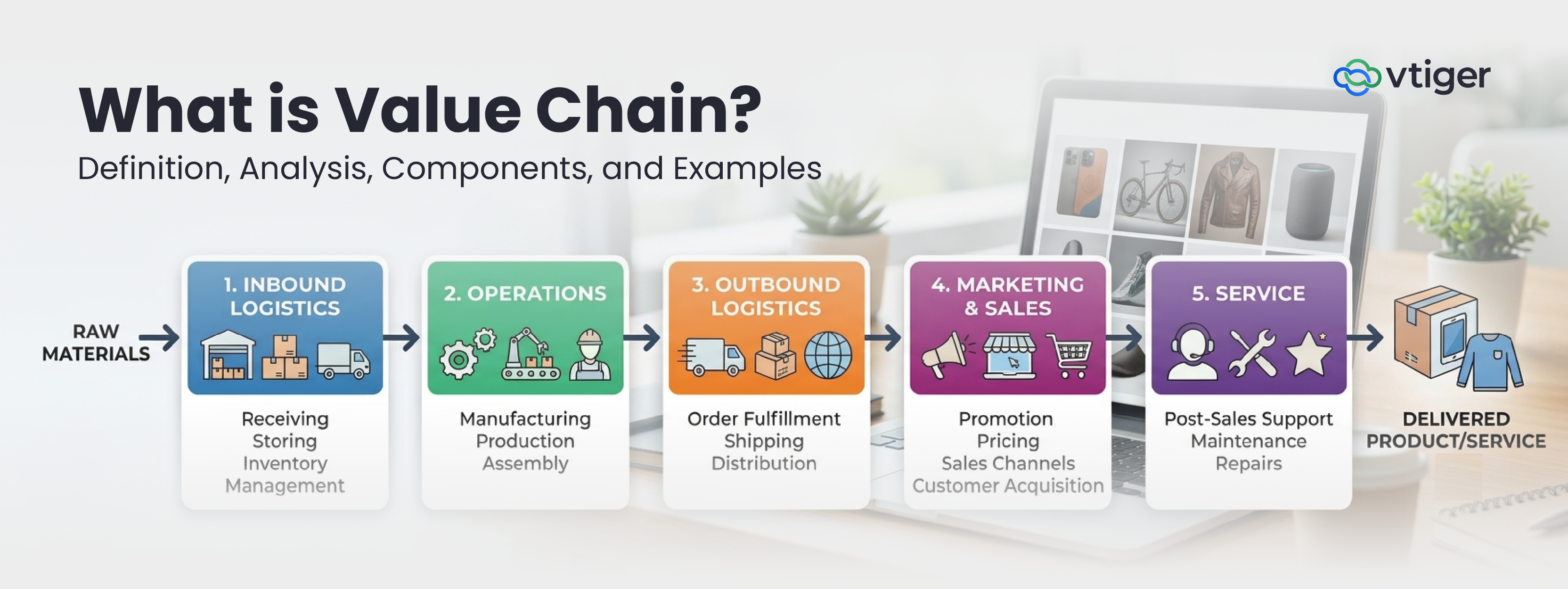
Primary activities are directly involved in creating and delivering products or services. Each represents a stage where raw inputs move closer to delivered customer value. A weakness in any one stage cascades downstream.
- Inbound Logistics: Receiving, storing, and managing the inputs the business turns into products or services, including inventory management and supplier coordination.
- Operations: Production processes or service delivery that transform inputs into the offering the customer receives.
- Outbound Logistics: Distribution, order fulfilment, and the systems that move the finished product to the customer.
- Marketing and Sales: Demand generation, customer acquisition, and the sales process that converts interest into revenue.
- Service: Customer support, warranty work, and after-sales activities that maintain the value the customer expected at purchase.
Support Activities
Support activities enable primary activities to function efficiently. They do not produce customer value directly, but their absence or weakness reduces the value primary activities can produce. Strong support functions are usually invisible when they work and impossible to miss when they fail.
- Firm Infrastructure: General management, finance, legal, accounting, and the planning systems that hold the business together.
- Human Resource Management: Hiring, training, compensation, and employee development across every function.
- Technology Development: Innovation, R&D, software, and the digital systems that improve how primary activities run.
- Procurement: Sourcing and purchasing the inputs, services, and capabilities the rest of the business depends on.
What is Value Chain Analysis?
Value chain analysis is the structured evaluation of each activity against its cost and the value it contributes. The exercise produces a map of where the business creates margin, where it loses it, and where opportunities for improvement sit.
Cost vs Value Evaluation
Each activity is scored on two dimensions: the cost of performing it and the value it adds to the final customer offering. Activities that cost a lot and add little are candidates for elimination or restructuring. Activities that cost little but add significant value are candidates for investment and scale.
Opportunity Identification
Analysis converts the cost-value map into a list of specific changes. The list typically includes processes to automate, hand-offs to streamline, suppliers to renegotiate, and capabilities to invest in. Without the list, the analysis stays decorative.
How to Conduct a Value Chain Analysis
The analysis follows five steps, each producing an artifact the next step builds on. Skipping any step produces a thinner output and weaker recommendations.
Step 1 – Identify Primary Activities
Map every customer-facing operation from raw input to delivered product. Document the activities, the team that owns each one, and the systems that support them. The output is a working list that other departments can validate.
Step 2 – Identify Support Activities
Document the enabling functions that make primary activities possible. Treat support activities as first-class participants, since their efficiency directly determines what primary activities can achieve. The output is a parallel list mapped to which primary activities each support function enables.
Step 3 – Evaluate Costs and Performance
Assign cost and performance metrics to each activity. Identify bottlenecks, redundant steps, and gaps between current performance and what the activity could deliver if it ran well. The output is a ranked list of where margin is being lost.
Step 4 – Identify Opportunities for Improvement
Translate the ranked list into specific changes the business can make in the next quarter or year. Look first for business process automation opportunities, since automation typically delivers the fastest measurable returns. The output is a prioritized initiative list with owners and timelines.
Step 5 – Create Competitive Advantages
Translate the initiative list into either cost reduction or differentiation improvement. Each initiative should connect to one of the two advantages; initiatives that connect to neither are likely decorative work. The output is a strategic narrative the rest of the business can act on.
Value Chain Example
A practical example clarifies how the framework applies in operational reality. Service businesses and software businesses both fit Porter’s model even though it was originally written for physical-product manufacturers.
Example: SaaS Company
A SaaS company’s value chain runs through several activities, each of which directly affects either customer acquisition cost or lifetime value:
- Product development: R&D activities that turn customer problems into shipping features.
- Marketing: Awareness, content, and demand generation that fill the top of the funnel.
- Sales: Discovery, demonstrations, and contract closing that convert qualified demand to revenue.
- Customer onboarding: Implementation and time-to-first-value activities that determine early retention.
- Customer support: Ongoing service that protects renewal probability and upsell opportunity.
- Product improvements: Feedback loops from support and customer success that inform the next iteration.
Each activity contributes to either the customer acquiring the product, valuing it post-purchase, or expanding the relationship. A breakdown in any single activity reduces the value the others can produce.
Value Chain vs Supply Chain
Value chain and supply chain are often used interchangeably, but the two frameworks address different operational questions. Treating them as synonyms produces analyses that miss the strategic angle of one or the operational rigour of the other.
Key Differences
The value chain focuses on value creation across all business activities; the supply chain focuses on the physical movement of goods from supplier to customer. The value chain is internal-strategic; the supply chain is internal-external-operational.
| Factor | Value Chain | Supply Chain |
| Focus | Value Creation | Product Movement |
| Goal | Competitive Advantage | Operational Efficiency |
| Scope | Internal and External Activities | Logistics and Distribution |
| Customer Focus | High | Indirect |
How They Work Together
Strong businesses optimize both. The supply chain handles the physical and logistical efficiency of getting products to customers, while the value chain ensures every activity along that path is producing the value customers pay for. The two are complementary, not competitive.
Benefits of Value Chain Analysis
The benefits of disciplined value chain analysis show up across six specific areas of business performance. Each one ties back to either cost advantage or differentiation advantage, the two paths Porter identified.
Improved Efficiency
Activities are evaluated against their actual contribution to customer value, which exposes redundant work and low-leverage effort. Teams that have run the analysis report cleaner hand-offs and shorter cycle times.
Reduced Costs
Cost reduction becomes targeted rather than across-the-board. Activities that consume resources without contributing value become candidates for elimination, automation, or restructuring.
Better Customer Experiences
Activities are reorganized around the moments that matter to the customer, not the convenience of the operating team. The customer-facing outputs become more consistent because the inputs were aligned to them.
Increased Profitability
Cost reduction and differentiation both flow to the bottom line. Margin expands when the business charges the same and spends less, or charges more for the same spend.
Competitive Advantage
The analysis reveals activities the business can perform in ways competitors cannot match. These are the activities that justify pricing power or attract customers who would otherwise default to alternatives.
Enhanced Innovation
Visibility into how activities connect reveals where small changes produce disproportionate downstream effects. Innovation gets directed at the highest-leverage points rather than the most visible ones.
Common Challenges in Value Chain Management
Most value chain analyses break down in implementation rather than design. According to Forrester research, 21% of brands saw their customer experience scores decline in 2025 while only 6% improved, with the disparity between intended and delivered experience widening. The gap between intent and delivery is where the challenges below recur.
Data Silos
Customer, sales, and operations data sit in separate systems with no common view. Without unified data, the analysis runs on incomplete inputs and produces incomplete recommendations. Strong CRM integration closes the visibility gap that data silos create.
Process Inefficiencies
Hand-offs between functions consume time and create error rates that the affected teams have learned to absorb. The absorbed inefficiency becomes invisible until the analysis surfaces it.
Technology Gaps
The systems running primary and support activities were often selected at different times for different reasons. The result is a stack that does not share data well and forces manual reconciliation work.
Poor Cross-Department Collaboration
The value chain crosses functional boundaries that traditional organizational structures defend. Without cross-functional ownership, improvement initiatives stall at the first boundary they cross. Workflow CRM customization helps bridge boundaries by embedding cross-departmental workflows into shared systems.
Limited Visibility into Operations
Leaders cannot manage what they cannot see. When operational metrics arrive monthly or quarterly, intervention happens too late to affect outcomes within the quarter.
How CRM Supports Value Chain Optimization
A CRM is where the value chain becomes operational rather than theoretical. It holds the customer data, workflow logic, and analytics that turn analysis recommendations into measurable change.
Customer Data Centralization
Customer interactions, transactions, and history sit in a unified record accessible across functions. The unified view makes cross-functional analysis possible without manual reconciliation.
Sales and Marketing Alignment
The CRM enforces the same definition of a qualified lead, the same stage labels, and the same outcome metrics across both functions. Effective marketing automation, plus aligned sales workflows, closes the alignment gap that causes most lead leakage.
Workflow Automation
Routine hand-offs between activities run as configured workflows rather than email chains. Automation reduces both cycle time and the error rate introduced by manual handoffs.
Performance Analytics
Metrics for each activity arrive in dashboards rather than monthly reports. Faster feedback shortens the loop between insight and operational change.
Customer Experience Management
Service interactions become traceable to the activities that produced them, which closes the feedback loop between customer experience outcomes and value chain inputs. The traceability turns customer feedback into actionable change rather than reported sentiment.
Technology and AI in Modern Value Chains
Modern value chains run on digital infrastructure even when the underlying business is physical. According to Gartner research, AI agent software spending will grow from $86.4 billion in 2025 to $206.5 billion in 2026 and $376.3 billion in 2027. The scale of investment signals how much operational work is shifting onto AI-assisted systems.
Process Automation and Workflow Optimization
Routine work in inbound logistics, operations, and service gets automated as it is mapped. The team’s time shifts to exception handling and the cases automation cannot resolve.
AI-Driven Insights and Predictive Analytics
AI CRM systems analyze historical CRM data and predict outcomes like churn risk, next best action, and pipeline health. Vtiger One’s Calculus AI surfaces these patterns and recommends interventions; the customer-facing team takes the action. AI predicts and recommends; the human still operates.
Customer Personalisation
Personalization operates from the unified customer record rather than channel-specific guesses. The result is communication that reflects what the customer has done across the business, not what one channel happens to know.
Best Practices for Value Chain Management
Strong value chain programmes share a small set of disciplines. The practices below are observable across businesses that have held operational improvement programmes for multiple cycles. A coherent CRM strategy underpins most of them by giving every activity a shared system to operate in.
- Continuously evaluate processes rather than treating value chain analysis as a one-time exercise.
- Align activities with customer needs so the framework stays connected to the value being created.
- Use data-driven decision-making by replacing opinion with operational data wherever it is available.
- Invest in automation at the highest-volume routine activities first.
- Improve cross-functional collaboration by removing handoff friction that absorbs cycle time.
- Monitor performance metrics in real time rather than monthly review cycles.
- Focus on customer value creation as the organizing principle for every activity decision.
Frequently Asked Questions (FAQs)
Q1. What is a value chain?
A value chain is a framework that describes the activities a business performs to create, deliver, and support products or services. Introduced by Michael Porter in 1985, it categorizes activities into primary (directly producing the offering) and support (enabling the primary activities) groups.
Q2. What is value chain analysis?
Value chain analysis is the structured evaluation of each activity in the chain against its cost and the value it contributes to the customer. The exercise produces a cost-value map of every activity, which then converts into a list of specific changes the business can make. Without the conversion step, the analysis stays decorative rather than operational.
Q3. Who introduced the value chain concept?
Harvard Business School professor Michael Porter introduced the value chain framework in his 1985 book Competitive Advantage. Porter argued that competitive advantage cannot be understood by looking at a firm as a whole; it requires examining the discrete activities that produce value. The framework has remained the dominant model for analyzing business activities for nearly four decades.
Q4. What are the primary activities in a value chain?
The 5 primary activities are Inbound Logistics, Operations, Outbound Logistics, Marketing and Sales, and Service. Each represents a stage where raw inputs move closer to delivered customer value. A weakness in any one stage cascades downstream and reduces the value the others can produce.
Q5. What are support activities in a value chain?
The support activities for creating a value chain include Firm Infrastructure, Human Resource Management, Technology Development, and Procurement. They do not produce customer value directly, but their absence or weakness reduces the value primary activities can produce. Strong support functions are usually invisible when they work and impossible to miss when they fail.
Q6. What is the difference between a value chain and a supply chain?
A value chain focuses on value creation across all business activities, while a supply chain focuses on the physical movement of goods from supplier to customer. The value chain is internal-strategic, asking how each activity contributes to customer value; the supply chain is operational-logistical, optimizing how products move through the distribution network.
Q7. How can CRM software improve value chain management?
A CRM unifies customer data, sales pipeline, marketing campaigns, and service interactions in one system, which closes the data silos that break most value chain analyses. With unified data, cross-functional decisions run from the same source, automation reduces hand-off friction, and analytics shorten the loop between insight and operational change. The CRM is where the analysis becomes day-to-day operational reality rather than a strategic document.