A Unique Selling Proposition (USP) is the distinctive benefit, feature, or value that sets a business apart from its competitors. It explains why customers should choose one product or service over another. A strong USP helps businesses attract the right audience, strengthen brand positioning, and create a competitive advantage in crowded markets.
Most businesses have a unique selling proposition somewhere on their homepage. Far fewer can point to where that USP shows up in their sales conversations, their support replies, or their renewal experience. The gap between the stated USP and the operated USP is where positioning quietly stops working.
A USP is the operational answer to why a specific customer should choose your business over the next-best alternative. Without that clarity, marketing conversion rates drop, and sales cycles stretch.
What is a Unique Selling Proposition (USP)?
A USP combines three operational ideas. The first is what your business does better than alternatives; the second is what your target customer specifically values; the third is how that combination shows up consistently across every touchpoint. The three together determine whether a stated USP earns its keep or becomes wallpaper.
Definition and Purpose
A Unique Selling Proposition is a clear statement describing the distinctive benefit a product or service delivers, who receives it, and why competitors cannot replicate it. It functions as the strategic anchor for marketing, sales, and product decisions. A coherent USP narrows the customer pool rather than appealing to all.
Origin of the Concept
The term was coined by advertising executive Rosser Reeves in the 1940s and formalized in his 1961 book. Reeves argued that every successful campaign was built on a single, specific promise the competition could not credibly make. The framework outlasted its origin because the underlying logic about differentiation still holds.
USP vs Marketing Message
A USP is the durable strategic claim. A marketing message is the campaign-level expression of that claim. The USP holds across years; marketing messages adapt to seasons and segments. Confusing the two causes USP drift, in which the anchor changes whenever a new campaign launches.
Why is a Unique Selling Proposition Important?
Without a clear USP, businesses struggle to communicate why customers should choose them over competitors. The cost compounds across every channel, from search rankings to sales conversations to customer support. A strong USP is upstream of nearly every commercial metric.
The case for treating USP as a strategic priority sharpens against actual buyer behaviour. According to Forrester research, 92% of B2B buyers start their purchase journey with at least one vendor in mind, and 41% already have a single preferred vendor before formal evaluation begins. Differentiation happens long before the sales conversation, or it does not happen at all.
The benefits of a disciplined USP show up across recurring areas of business performance. Each one traces back to acquisition efficiency, conversion, or retention durability. Six benefits appear consistently across businesses with coherent positioning:
- Stronger brand positioning because the USP gives prospects a clear mental shortcut in the category.
- Better customer attraction because the right customers recognize themselves, while the wrong customers opt out early.
- Increased conversions because the buying decision is easier when alternatives are implicitly compared.
- Improved customer loyalty because the original reason for choosing the brand persists post-purchase.
- Competitive advantage because the USP makes brand awareness compounding rather than transactional.
- Clearer marketing communication because every campaign has a defined claim to ladder up to.
What Makes a Strong USP?
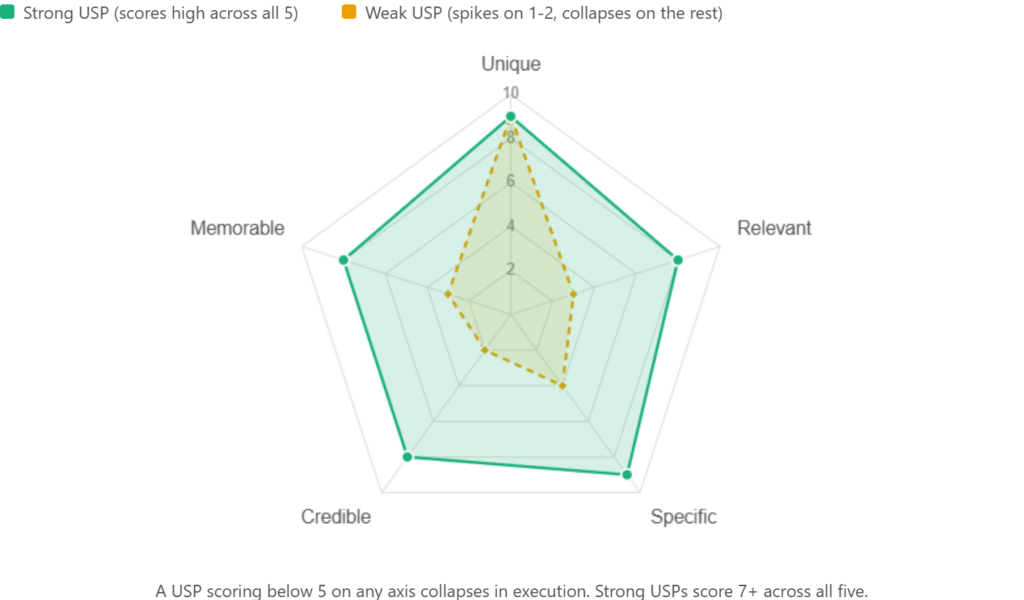
An effective USP focuses on delivering meaningful value competitors cannot replicate. The five qualities below are the operational test a draft USP must pass before deployment. A USP failing any one of them tends to collapse in execution within a quarter.
Unique
The proposition has to be distinct from what competitors currently claim or could easily claim. “High quality” and “great customer service” are not USPs because every competitor says the same. Distinct means a claim others have not credibly occupied, not necessarily novel.
Relevant
Your unique feature must solve a major problem for the customer. If the customer does not care about the problem you are solving, your feature has no business value. Your unique feature must be the exact reason the customer chooses you instead of a competitor.
Specific
The USP has to be concrete enough that someone outside marketing can recognize it in operational terms. Vague claims like “innovative solutions” fail this test. Specific claims like “decisions in 45 seconds instead of 2 weeks” pass it.
Credible
The claim must be supported by visible evidence that the customer can verify. Strong USPs are documented in case studies, customer testimonials, product capability, or operational data. Credibility erodes the moment a prospect finds a gap between claim and experience.
Memorable
The proposition has to be expressed so prospects can recall and repeat it without referring back. Memorability is not cleverness; some strong USPs are flatly literal sentences. The test is whether a customer can describe the proposition a week later.
Unique Selling Proposition vs Value Proposition
USP and value proposition are often used interchangeably, and the confusion costs clarity in execution. The two are related but address different operational questions about how a business presents itself. Treating them as synonyms confuses the messaging that flows from each.
Key Differences
A USP focuses on what makes the business different from competitors. A value proposition focuses on the complete value the business delivers. The USP is comparative, the value proposition is customer-centric. The two work together but answer different prospect questions.
| Factor | USP | Value Proposition |
| Focus | Differentiation | Overall Customer Value |
| Purpose | Stand Out from Competitors | Explain Benefits |
| Scope | Specific Advantage | Complete Value Offering |
| Messaging | Competitive | Customer-Centric |
The USP answers the question of why us instead of them. The value proposition answers the question of what the customer gets by working with you. A landing page typically leads with the value proposition. The USP shows up where competitive comparison is implicit.
How They Work Together
Strong positioning uses both, with the USP nested inside the broader value proposition. The value proposition tells the prospect the full story of what they will receive; the USP tells them why this provider delivers that value better than the alternative. The hierarchy keeps marketing messaging coherent across the funnel.
A common mistake is to write only one and then bend it to cover both jobs. The result is a statement that either sounds defensive (USP-only) or generic (value-proposition-only). Writing them separately and then linking them produces stronger messaging than collapsing them into one document.
How to Create a Unique Selling Proposition
Creating a USP is an analytical exercise before it is a writing exercise. The five steps below produce the inputs from which the USP statement is built, each delivering a specific output that feeds into the next. Skipping any step usually produces a USP that sounds right and stops working in execution.
Step 1 – Understand Your Target Audience
The USP work starts with research into what the target customer actually cares about. According to Gartner research, 58% of consumers say companies trying to sell to them do not understand their needs and preferences. Disciplined customer segmentation produces the segment-level insight the USP will serve.
Step 2 – Analyze Competitors
Competitor analysis covers what alternatives claim, what they actually deliver, and where the gap creates positioning space. The work goes beyond marketing collateral into actual product behaviour, reviews, and case studies. Mapping the competitive sales funnel reveals where competitor positioning leaves room for a differentiated claim.
Step 3 – Identify Your Unique Strengths
The internal audit identifies which capabilities, expertise, service qualities, or technology advantages your business actually delivers better than alternatives. Self-perception often differs from external reality, so strengths should be validated against customer feedback rather than internal opinion. The valid strengths form the candidate pool for the USP claim.
Step 4 – Focus on Customer Benefits
A USP built on features fails in execution. A USP built on customer benefits earns commercial traction. The translation asks what this lets the customer do, save, gain, or avoid. Outcomes are what customers buy.
Step 5 – Craft a Clear USP Statement
The statement combines the earlier inputs into a single, testable claim. A reliable template is “We help [target audience] achieve [desired outcome] through [unique differentiator].” The template is a scaffold, not a final form. The final USP can deviate stylistically as long as the three components remain identifiable.
Examples of Unique Selling Propositions
USPs look different across industries because customer decision-making and competitive contexts differ. The five examples below illustrate how the same framework yields different operational claims across sectors. Each is grounded in evidence the customer can verify on first encounter.
SaaS Business
A B2B SaaS USP combines speed, integration depth, or workflow specificity. “The CRM small businesses can configure without code in a weekend” names the audience, the outcome, and the differentiator. The claim is verifiable through documented setup times.
E-commerce Brand
E-commerce USPs frequently lead with delivery, return policy, or social proof at scale. “Free overnight shipping on every order, no minimum” is specific enough to verify and meaningful enough to influence purchase. The alternative is usually a fee, minimum, or wait.
Financial Services Company
Financial USPs often rely on regulatory transparency, fee structures, or specific customer outcomes. “Mortgage approval in 24 hours, fully digital, no branch visit” works in a market where the historical baseline is several weeks of paperwork. The claim is verifiable on the first transaction.
Healthcare Provider
Healthcare USPs center on access, specialization, or outcome data. “Same-day appointments with board-certified specialists across 12 conditions” works because the comparison is waiting weeks for a referral. The claim has clear evidence requirements and tangible patient impact.
CRM Software Provider
A CRM USP differentiates on platform breadth, cost structure, or implementation effort. “All-in-one sales, marketing, and support on a single platform priced for growing businesses” works because the comparison is stitching together multiple specialized tools. The claim invites direct cost comparison.
Common USP Mistakes to Avoid
Most USPs underdeliver because of recognizable execution patterns rather than weak analysis. According to Gartner research, 84% of companies are stuck in a brand “doom loop” and are half as likely to exceed organizational growth targets as companies that credibly evaluate brand value. The mistakes below recur across that doom-loop pattern.
Being Too Generic
USPs like “great quality at affordable prices” fail because every competitor says the same. Generic USPs leave the prospect to figure out the actual differentiation, which most prospects will not do. The fix is specificity in audience, outcome, or differentiator.
Focusing Only on Features
Feature-led USPs read like spec sheets and miss the customer outcome the feature delivers. A USP that names a feature without naming the benefit assumes the prospect will make the translation. Most prospects will not.
Copying Competitors
Mirroring a competitor’s USP makes the brand a follower at best and indistinguishable at worst. The competitive analysis identifies what others claim so the brand can claim something different. A copied USP fails the Unique test by definition.
Making Unverifiable Claims
“World’s leading” or “industry’s best” without evidence reads as puffery and erodes credibility. Strong USPs make claims that can be substantiated through documentation, customer evidence, or operational data. Unverifiable claims weaken the entire brand they are attached to.
Ignoring Customer Needs
A USP naming a real differentiator no customer cares about produces no commercial advantage. The differentiator has to map to a customer pain point the business genuinely solves. A solid customer retention strategy provides feedback that prevents drift between business emphasis and customer value.
How to Communicate Your USP Effectively
A USP that exists only in the marketing deck has no commercial impact. The communication work spreads the USP across every channel where the customer encounters the brand. The six channels below are where most USPs come alive or quietly die from neglect.
Website Messaging
The homepage hero, the about page, and product pages all need to express the USP in voice and structure, not just include it as a tagline. A visitor who skims the page should be able to articulate the USP within ten seconds. If they cannot, the website is not doing the USP’s work.
Marketing Campaigns
Every campaign should ladder up to the USP rather than introduce a new differentiator each quarter. Disciplined campaign management makes the USP the central claim around which messaging adapts. The USP is the constant; the campaigns are the variables.
Sales Conversations
Sales reps should articulate the USP in three ways, tailored to discovery, evaluation, and objection handling. The USP is the answer sales reps fall back on when a prospect asks why you over them. A unified lead management system surfaces the USP at relevant stages of the deal cycle.
Product Positioning
Product pages, feature names, and onboarding screens should reinforce the USP through what the product actually does. A USP promising speed should manifest as a fast product. Misalignment between USP and product behaviour erodes trust faster than any other failure.
Social Media Marketing
Social presence should consistently express the USP through content choices, tone, and engagement style. Random social content that does not ladder back to positioning trains followers to expect inconsistency. Strong USPs show up in what the brand chooses to post about.
Customer Communication
Support replies, renewal emails, and customer success conversations all touch the USP whether they intend to or not. A USP promising responsiveness needs support replies that prove it. Quality customer experience management aligns operational reality to the USP claim.
How CRM Helps Strengthen Your USP
The CRM is where the gap between the stated USP and the operating USP closes. Customer data centralization, segmentation depth, and feedback collection all feed back into the USP work so the claim stays anchored to customer reality. Without the CRM layer, the USP drifts away from the experience it is supposed to describe.
Customer Insights and Segmentation
The CRM holds customer data revealing which segments value which parts of the USP. According to Cirrus Insight’s 2025 CRM analysis, 65% of businesses report improved engagement with prospects and customers through AI-powered virtual sales assistants. Strong CRM analytics surface segment-level patterns that inform USP refinement.
Personalized Communication Across Channels
The CRM lets the team express the USP differently for different audiences while keeping the core claim intact. Personalization operates from the unified customer record rather than channel-specific guesses. The infrastructure scales USP communication without diluting it.
Customer Feedback Collection
Survey responses, NPS results, and support interactions carry signals about whether the USP is landing as intended. The CRM aggregates that signal into patterns the marketing team can act on. Without aggregation, individual feedback gets lost, and the USP drifts from customer reality.
Campaign Optimization
Modern marketing automation lets the team test variations of USP-aligned messaging against defined segments. The optimization cycle reveals which expressions convert best in which contexts. The USP itself stays stable; the expression evolves through testing.
Customer Experience Reinforcement
The CRM holds operational data that proves or disproves the USP at every touchpoint. Vtiger One unifies sales, marketing, and support data, with Calculus AI surfacing patterns and predicting churn from the gap between promise and delivery. Calculus AI recommends; the customer-facing team acts. A coherent CRM strategy ties the USP to the systems that operationalize it.
USP Examples for Different Business Types
USP application varies by business model, customer profile, and competitive context. The six examples below show how the framework adapts across business types. Each tackles a different competitive dynamic the business type tends to face.
Small Businesses
Small-business USPs often lean on personal service, local knowledge, or niche expertise. “The neighborhood accountant who knows your local tax landscape” works because national alternatives cannot credibly claim local depth. The USP earns trust before the price comparison starts.
Startups
Startup USPs emphasize speed, modern design, or category innovation. “Onboard your sales team in one day, not one quarter” works because incumbents require lengthy implementation cycles. The USP turns the incumbent’s strength into an effective weakness.
B2B Companies
B2B USPs ladder up to business outcomes like revenue impact, cost reduction, or risk mitigation. “Reduce sales cycle by 30% within 90 days of deployment” works because the metric is measurable and bounded. The verifiable claim becomes the contract for the relationship.
SaaS Companies
SaaS USPs emphasize platform breadth, integration ecosystem, or pricing transparency. “The unified CRM at half the per-seat price of legacy platforms” works because the comparison is implicit and verifiable. The USP turns competitor pricing into a smaller-vendor advantage.
Service-Based Businesses
Service USPs center on expertise, response time, or outcome guarantees. “Fixed-fee engagements, no scope creep, completed in six weeks or your money back” works because uncertainty around service delivery is the buyer’s biggest objection. The USP directly addresses the buyer’s biggest fear.
E-commerce Businesses
E-commerce USPs focus on selection, delivery, return policy, or social mission. “Every purchase plants ten trees, free returns for life” combines a tangible product benefit with a brand identity competitors cannot replicate. Both pieces are verifiable to the buyer.
Best Practices for Building a Strong USP
Most strong USPs share a small set of disciplines that protect them from drift. The practices below are observable across brands that have held coherent positioning through multiple competitive cycles. Treating USP as a one-time exercise rather than an ongoing discipline is where most positioning programs fail.
- Focus on customer outcomes rather than internal capabilities, because outcomes are what customers buy.
- Differentiate clearly by naming what you are not, in addition to what you are.
- Keep messaging simple so that frontline employees can repeat the USP in their own words.
- Validate claims with proof through documented case studies, customer evidence, and operational data.
- Continuously evaluate market changes because competitor positioning shifts and the USP needs to respond.
- Align USP with customer experience so the operational reality matches the marketing claim across every touchpoint.
- Support USP with consistent branding so the visual and verbal identity reinforce the strategic positioning.
Frequently Asked Questions
What is a Unique Selling Proposition (USP)?
A Unique Selling Proposition is the distinctive benefit, feature, or value that sets a business apart from its competitors. It explains why customers should choose one product or service over another in clear, specific, and verifiable terms. A strong USP combines what the business does better than alternatives, what target customers genuinely value, and how that combination shows up consistently across every customer touchpoint.
Why is a USP important?
A USP is important because it makes the buying decision easier for the right customer and protects pricing power against commoditization. Without a clear USP, businesses compete primarily on price, which produces lower margins and weaker customer loyalty. Forrester research shows 92% of B2B buyers start with at least one vendor in mind, which means differentiation work happens long before the formal sales conversation begins.
How do I create a USP for my business?
Creating a USP follows five steps: understand your target audience through research, analyze what competitors currently claim and deliver, identify your genuine unique strengths, focus on the customer benefits those strengths produce, and craft a clear statement using the template “We help [audience] achieve [outcome] through [differentiator].” The analysis matters more than the writing; a USP grounded in real differentiation outperforms a clever statement built on weak inputs.
Can a business have more than one USP?
A business can have different USPs for different audience segments or product lines, but each segment or product should have one primary USP rather than several competing claims. Multiple USPs in the same audience produce confusion and dilute positioning. Most multi-segment businesses maintain a parent USP at the brand level and segment-specific USPs at the product or audience level.