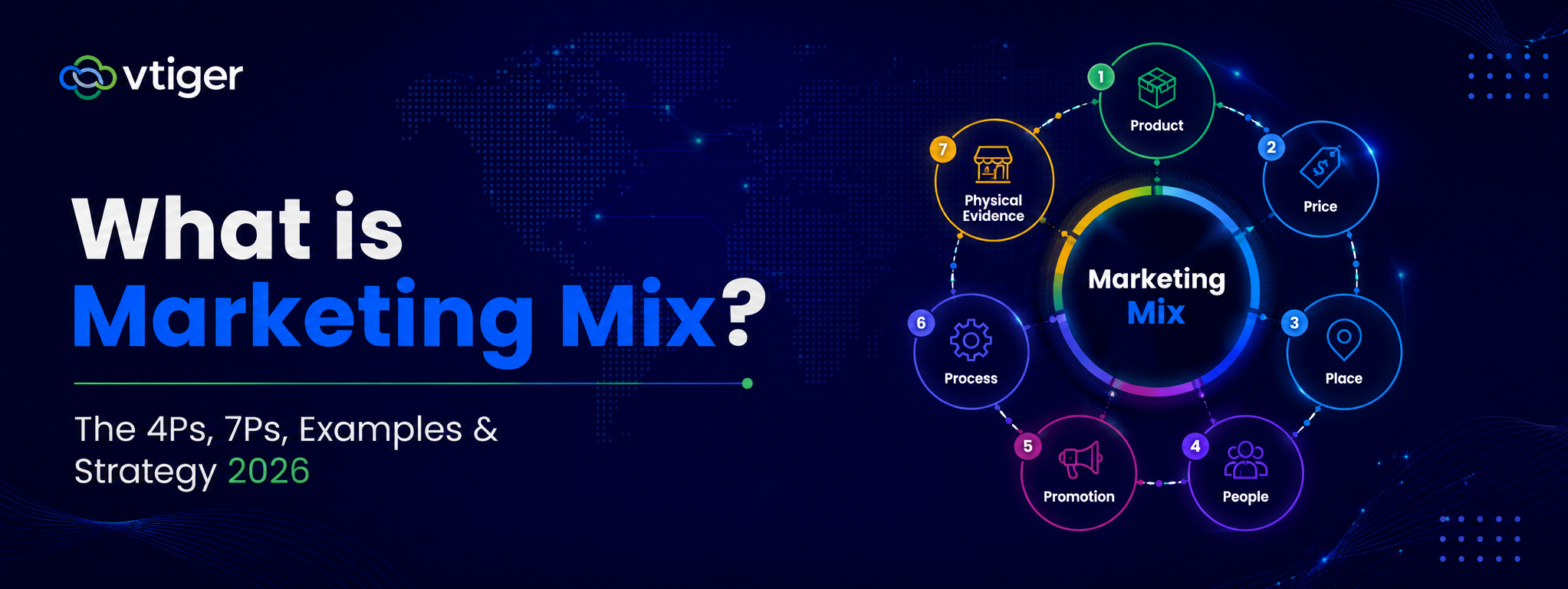
The marketing mix is the set of decisions a business makes about product, price, place, and promotion to bring an offering to market. Expanded from these 4Ps to 7Ps with people, process, and physical evidence, it gives teams a shared checklist for turning a good product into a bought one. A balanced mix wins customers; an unbalanced one wastes budget.
Most guides treat the marketing mix as a plan you set once. You research the market, fix your 4 or 7 Ps, launch, and move on. That framing is why so many mixes drift out of step with the customers they were built for within a season.
The sharper way to read the mix in 2026 is as a control panel rather than a plan. Each P is a dial, and the readings that tell you which one to turn come from customer behaviour: what people buy, abandon, return, and ask for.
The businesses that win keep adjusting the dials in response to live feedback rather than defending a mix they set during a planning offsite. Getting there starts with understanding what each element of the mix actually controls, and how the pieces move together the moment customer behaviour shifts.
The 4Ps of marketing
The 4Ps are the original marketing mix, defined by Jerome McCarthy in 1960 and still the fastest way to pressure-test whether an offering is ready for market. Each P answers a different question the customer is silently asking, and a gap in any one of them shows up as lost sales elsewhere.
Product
Product covers what you sell and the value it delivers, from features and quality to branding, packaging, and lifecycle stage. A product early in its lifecycle needs education and proof; a mature one competes on refinement and trust. Getting this P right means matching the offering to a real, felt need rather than an assumed one.
Price
Price signals value as much as it captures it, so the number is never just a cost calculation. Teams choose between competitive pricing that tracks the market, value-based pricing that reflects the outcome, and tactical discounts that move volume without training customers to wait. The right approach depends on how buyers judge worth in your category.
Place
Place is about distribution: where and how the customer can buy. The decision spans online versus offline, retail versus direct-to-consumer, and the marketplaces where demand already gathers. Place has shifted most in the last decade, because a purchase now often begins on a phone and ends in a store without the buyer treating them as separate channels.
Promotion
Promotion is how the market learns the product exists and why it matters, spanning advertising, search, social, email, public relations, and sales promotions. The discipline is not doing all of them; it is choosing the few channels where your buyer already pays attention. Promotion works when the message meets a genuine need the earlier three Ps have already made real.
The four Ps are interdependent, not a sequence. A premium price with discount-brand packaging confuses buyers, and brilliant promotion cannot rescue a product placed where its audience never shops. Read together, they form a single coherent offer.
The 7Ps of marketing
As services grew to dominate modern economies, the original four Ps left gaps. A haircut, a consulting engagement, or a SaaS subscription has no box on a shelf, so Booms and Bitner extended the mix in 1981 with three service-oriented Ps that address how the offering is delivered and experienced.
People
People are everyone who touches the customer, from frontline staff to support agents, and in service businesses they often are the product. A single unhelpful interaction can undo months of careful positioning, which is why hiring, training, and culture belong inside the marketing conversation rather than beside it.
Process
Process defines how customers experience your business. Every interaction, from onboarding to support to returns, shapes their perception. Smooth, efficient processes create confidence and keep customers coming back. Poorly designed ones create frustration, leading customers to walk away, even if they can’t pinpoint exactly why.
Physical evidence
Physical evidence is the tangible proof that an intangible service is real and trustworthy, from a clean storefront to a confirmation email to visible reviews. Because buyers cannot inspect a service before purchase, these signals carry the weight that packaging carries for a physical product. They reduce the perceived risk of saying yes.
Together, the three service Ps explain why two companies with identical products and prices can see very different loyalty. The difference lives in the delivery, and the extended mix makes that difference something a team can design on purpose.
Why is the Marketing Mix Important?
The marketing mix matters because it turns an abstract goal like “grow the brand” into concrete, owned decisions that different teams can act on without tripping over each other. It is the connective layer between strategy and execution, and it forces trade-offs into the open where they can be argued and measured.
Philip Kotler framed the underlying purpose in the following way: “Marketing is not the art of finding clever ways to dispose of what you make. It is the art of creating genuine customer value.” The mix is simply how that value gets built and delivered in practice, one P at a time.
The practical payoffs of a deliberate mix show up across the business:
- A premium product sold with coupon-code ads sends a mixed signal; align the three and the positioning sharpens.
- When checkout takes two clicks, and a return takes one email, the friction that causes cart loss is gone.
- A campaign aimed at buyers the product and price already fit beats the same ad blasted at a cold list.
- Spend chases evidence of what actually sold, not the loudest opinion in the room, so the budget delivers more.
- Tune the whole mix to a segment rivals serve carelessly, and you take it before they notice.
A well-run mix does not guarantee a hit, but a neglected one almost guarantees waste. When the Ps pull in different directions, customers feel the incoherence and buy elsewhere.
How to build a marketing mix strategy
A marketing mix strategy is built from the customer inward, not from the product outward. Each decision depends on the one before it, which is why pricing set before you understand the customer is a guess dressed up as a plan.
The stakes for getting allocation right have risen. According to Gartner’s 2025 CMO Spend Survey, marketing budgets have flatlined at 7.7% of company revenue, with 59% of leaders calling that insufficient to execute their strategy. When budgets stop growing, the mix has to earn more from the same spend.
Step 1 – Understand your target audience
Everything downstream depends on knowing who you serve, so start with research and real buyer personas rather than assumptions. A disciplined customer segmentation approach separates buyers by need and behaviour, not just demographics, and tells you which version of each P a given group actually responds to.
Step 2 – Define your product value
State the customer benefit before the feature list, because buyers pay for outcomes, not specifications. Clarify what makes the offering meaningfully different from the nearest alternative, and make sure that difference is something the target segment already cares about.
Step 3 – Develop a pricing strategy
Choose an approach that matches how your buyers judge value: cost-based for predictability, value-based for outcome-driven categories, penetration to win share quickly, or premium to signal quality. Test the number against willingness to pay rather than internal cost comfort.
Step 4 – Choose distribution channels
Decide where the offering will be available: online, offline, on a marketplace, or directly. The goal is to be present where demand already gathers rather than forcing buyers to a channel that suits your operations but not their habits.
Step 5 – Create a promotion plan
Select the channels your audience actually uses, then build a plan across content, paid advertising, email, social, and search. A structured campaign management process keeps messages coordinated so a prospect sees one coherent story rather than three disconnected ones.
Step 6 – Measure and optimize
Set the KPIs that matter, gather customer feedback, and read campaign performance honestly. Clear CRM analytics reporting turns scattered results into a picture the team can act on, closing the loop back to Step 1 with evidence about what to change next.
Step 6 is not a finish line but the start of Step 1 again. The team that reads this month’s numbers and adjusts next month’s Ps keeps pace with buyers who never stop changing.
Marketing Mix Examples
The same seven Ps concentrate differently depending on the business. A SaaS company lives or dies on product and process, while a local service business competes mostly on people and place, and the five models here show where each one leans.
| Business type | Where the mix concentrates | Representative move |
| SaaS company | Product, process | Free trial that proves value fast |
| E-commerce business | Place, promotion | Frictionless checkout, retargeting |
| Retail brand | Product, physical evidence | Store experience, packaging |
| Restaurant | People, physical evidence | Service quality, ambience |
| B2B software | People, price | Consultative selling, tiered pricing |
None of these businesses ignores the other Ps; they invest disproportionately where their buyers decide. A SaaS company lives on product and process, since trials and onboarding make or break the sale and a strong customer retention strategy turns that first sale into recurring revenue. Reading your own model this way shows which dials deserve attention.
Marketing Mix vs Marketing Strategy
The marketing mix and the marketing strategy are often used interchangeably, but they operate at different altitudes. Strategy sets the direction; the mix executes it. Confusing the two leads teams to tweak tactics when the real problem is strategic, or to keep debating vision when the fix is a mispriced product.
| Factor | Marketing mix | Marketing strategy |
| Purpose | Tactical execution | Long-term direction |
| Focus | Product, price, place, promotion | Business goals and positioning |
| Scope | Campaign and product decisions | Overall marketing vision |
| Timeframe | Short to medium term | Long term |
A strategy without a working mix stays a slide deck, and a mix without a strategy becomes busy activity with no destination. The customer data that shapes the mix also validates the strategy, and understanding your sales funnel stages shows where mix decisions advance or stall the journey.
Common marketing mix mistakes
Most mix failures are not exotic; they are a handful of avoidable errors repeated across industries. Naming them makes them easier to catch before they cost a quarter.
Ignoring customer needs
Teams that build the mix around what they can make, rather than what buyers want, produce offerings that look complete and still do not sell. The fix is to start every mix revision from fresh customer evidence, not last year’s assumptions.
Poor pricing decisions
Pricing should reflect customer value, not just internal costs. When prices align with customers’ willingness to pay and the outcomes delivered, businesses can capture more value without sacrificing competitiveness.
Weak distribution strategy
An excellent product placed where its audience never shops will underperform a mediocre one that is easy to buy. Match the channel to buyer habit, not to internal convenience.
Inconsistent brand messaging
When product, price, and promotion tell different stories, buyers sense the incoherence and trust erodes. Coordinate the Ps so they reinforce a single claim.
Failing to measure results
A mix that is never measured cannot be improved, and gut feel quietly drifts from reality. Set KPIs before launch and treat every result as input to the next revision.
All five share a common root: they treat the mix as a single decision. A team that revisits the Ps whenever returns and sales data shift catches these errors before they cost a quarter.
How CRM supports your marketing mix
Every P in the mix is a decision, and better decisions come from better evidence about the customer. A CRM is where that evidence lives, holding the purchase history, campaign responses, and service interactions that tell you which dial to turn next. This is what converts the mix from a plan into the feedback loop described at the start.
The connection to each element is direct. A marketing automation platform runs promotion while capturing which messages land, and a marketing CRM software layer ties those responses to real buyers rather than anonymous clicks. Segmentation sharpens targeting, a lead management system stops promotion wasting on prospects who never fit, and unified analytics show which Ps work for which segments.
The evidence for a data-led mix is strong. According to the IBM Institute for Business Value 2024 Consumer Study, three in five consumers would like to use AI while shopping. That signals place and promotion are moving toward personalized, assisted experiences, and a mix tuned to that shift needs a live customer record rather than a static plan.
Vtiger One’s Calculus AI predicts which segments are likely to respond and recommends the next best actions based on the unified customer record. Calculus AI predicts and recommends. The marketing team makes the call and adjusts the mix.
Best practices for building an effective marketing mix
A durable mix is less about clever tactics and more about disciplined habits applied consistently. The practices below keep the Ps aligned and the whole mix responsive to the customers it is meant to serve:
- Start every revision from the customer need, not the product you already have.
- Keep branding consistent so all seven Ps reinforce a single claim.
- Base decisions on data and honest feedback rather than the loudest internal opinion.
- Test pricing against real willingness to pay before committing to a number.
- Concentrate promotion on the few channels your buyers actually use.
- Personalize the experience using the customer history you already hold.
- Review performance on a fixed cadence and treat each result as input to the next change.
The businesses that get the mix right are not the ones with the biggest budgets. They are the ones that keep listening and keep adjusting, quarter after quarter.
FAQs
What is the marketing mix?
The marketing mix is the combination of decisions a business makes about product, price, place, and promotion, later extended to include people, process, and physical evidence, to bring an offering to market effectively. It gives teams a shared framework for turning a product into sales, and a balanced mix is one where every element reinforces the same customer value rather than pulling in different directions.
What are the 4Ps of marketing?
The 4Ps are product, price, place, and promotion, defined by Jerome McCarthy in 1960 as the core marketing mix. Product is what you sell and the value it delivers; price is what you charge and the worth it signals; place is where and how customers buy; and promotion is how the market learns the offering exists. The four are interdependent and work only when coordinated.
What are the 7Ps of marketing?
The 7Ps add people, process, and physical evidence to the original four, extending the mix for service businesses where the offering is delivered rather than boxed. People are everyone who touches the customer, process is the steps and systems they move through, and physical evidence is the tangible proof that an intangible service is trustworthy. Together, they explain why identical products earn different levels of loyalty.
Why is the marketing mix important?
The marketing mix matters because it converts broad marketing goals into concrete, owned decisions that different teams can execute without conflict. It forces trade-offs into the open, keeps product, price, place, and promotion telling a single story, and directs the budget toward what the evidence supports. A deliberate mix sharpens positioning and lifts conversion, while a neglected one wastes spend on incoherent effort.
What is the difference between the marketing mix and marketing strategy?
Marketing strategy sets long-term direction, goals, and positioning, while the marketing mix is the tactical execution that delivers on that direction through specific product, price, place, and promotion choices. Strategy decides where you are going; the mix decides how you get there. They are complementary, and problems arise when teams adjust tactics while the real issue is strategic, or debate vision when the fix is operational.
How do businesses use the marketing mix?
Businesses use the marketing mix as both a checklist and a control panel: first to ensure an offering is ready for market, and then to continually adjust each element in response to customer behaviour. They set the Ps based on audience research, launch, measure buyer responses, and revise the elements that underperform.
How can CRM improve marketing performance?
A CRM improves marketing performance by centralizing the customer data that tells teams which parts of the mix are working. It links campaign responses, purchases, and service history to real buyers, enabling sharper segmentation, better-timed promotion, and pricing informed by actual behaviour.