Digital transformation is the process of embedding digital technology into every part of a business to change how it operates and delivers value. It goes beyond adopting tools, reshaping processes, culture, and customer experience around cloud computing, AI, automation, analytics, and CRM to drive efficiency, innovation, and durable growth.
Most coverage of digital transformation treats it as a shopping list of technologies. Buy the cloud platform, add the AI, layer on automation, and transformation is supposed to follow. It rarely does, and the gap between spending and results is where most programmes quietly stall.
The distinction between a real transformation and an expensive upgrade is whether the customer data underneath it is unified. A business can modernize every tool it owns and still make the same disconnected decisions if each system holds its own version of the customer.
Transformation is what happens when those versions become one and every function acts on the same truth. This guide covers the definition, pillars, enabling technologies, a roadmap, industry examples, challenges, and the direction of transformation.
What is digital transformation?
Digital transformation is the deep rewiring of how an organization creates and delivers value using digital capability. It touches five areas at once: business processes, customer experience, culture, technology, and the capacity to innovate. The reason it is hard is that changing all five together is a business challenge wearing a technology costume.
The confusion usually starts with three terms that get used interchangeably. Separating them is the first step to running a real programme rather than a cosmetic one.
| Term | What it means | Example |
| Digitization | Converting analog to digital | Scanning paper files |
| Digitalization | Using digital to improve a process | Automated approvals |
| Digital transformation | Rethinking the model itself | New data-led business |
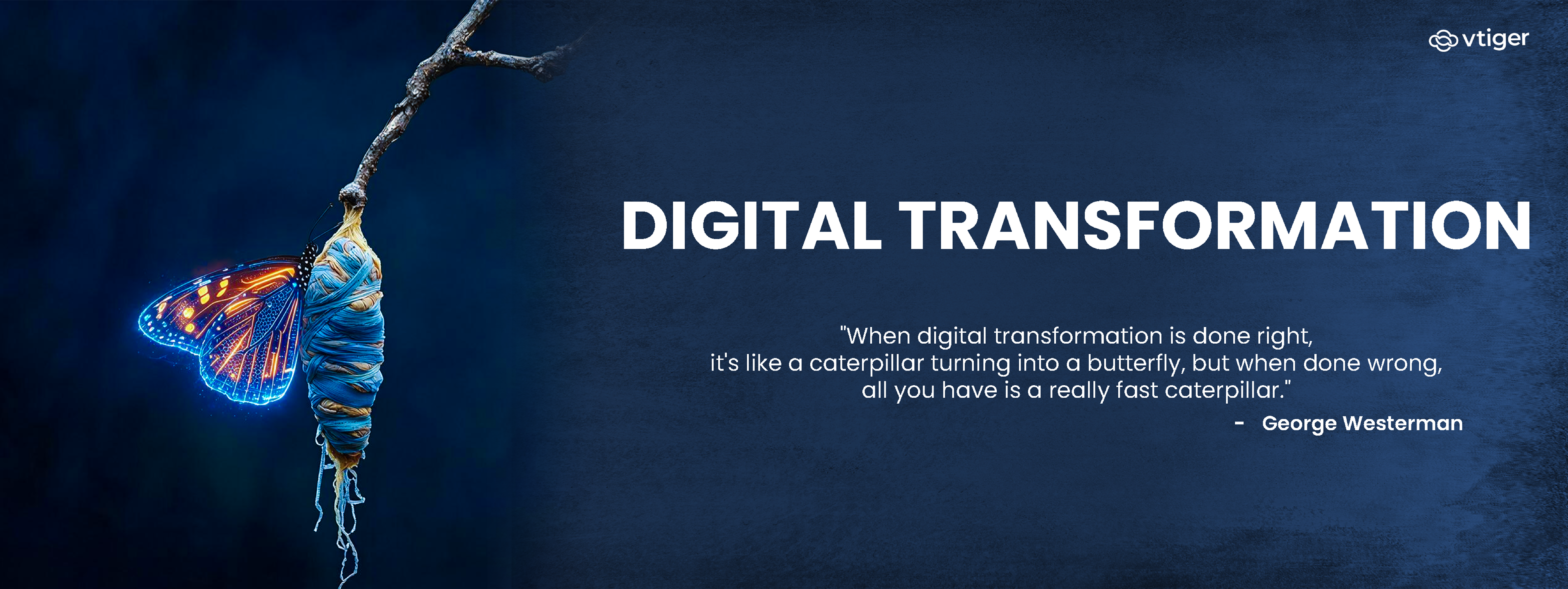
George Westerman of MIT Sloan captured the stakes memorably: “When digital transformation is done right, it’s like a caterpillar turning into a butterfly, but when done wrong, all you have is a really fast caterpillar.” A faster caterpillar is a digitized process; the butterfly is a business that works differently.
Why is Digital Transformation Important?
Transformation matters because the businesses that rewire around digital capability compound advantages that laggards cannot easily close. The gains are concrete rather than aspirational, and they show up across the operating model:
- Operational efficiency rises as manual handoffs give way to automated, monitored workflows.
- Customer experience improves because teams act on one shared view rather than fragments.
- Decisions get faster when data is available in real time instead of assembled by hand.
- Business agility grows, letting the organization respond to change without rebuilding from scratch.
- Employee productivity climbs as repetitive work moves to systems and people focus on judgement.
- Data-driven growth becomes repeatable once insight is a habit rather than a quarterly project.
None of these benefits arrive from technology alone. They arrive when technology, process, and people change together, which is why the pillars below matter as much as the tools.
Key Pillars of Digital Transformation
Successful transformation rests on a small number of load-bearing pillars. Neglect any one and the programme tilts toward the fast-caterpillar failure mode, where tools change, but outcomes do not.
Customer experience transformation
This pillar reorganizes the business around the customer through omnichannel engagement, personalization, and faster support. The goal is an experience that feels continuous rather than stitched together from separate departments.
Business process transformation
Here, the work itself is redesigned, using workflow automation and process optimization to remove manual steps. Streamlined processes cut the friction that slows delivery and quietly hides errors.
Data and analytics
Data is the pillar the others depend on, turning business intelligence, predictive analytics, and real-time reporting into decisions. Strong CRM analytics dashboards make that insight visible where the work happens rather than trapped in a report.
Technology modernization
Modernization replaces brittle legacy systems with cloud computing, AI, APIs, and integrations. A modern stack lets the rest of the organization move quickly and connect cleanly.
Organizational culture
Culture is the quiet pillar, and often the decisive one. An innovation mindset, employee adoption, and change management decide whether the new tools are actually used.
The pillars reinforce each other. A business that modernizes technology but ignores culture ends up with capable systems nobody trusts, while strong culture without modern tools runs out of runway.
Technologies Driving Digital Transformation
Technology makes transformation operationally real, and the capital behind it signals how central it has become. According to Gartner’s 2026 forecast, worldwide IT spending is projected to reach $6.31 trillion in 2026, up 13.5% and driven largely by AI infrastructure. The tools only matter, though, when they share data.
Artificial intelligence (AI)
AI analyses patterns across large datasets to forecast outcomes, personalize experiences, and surface insights people would miss. It moves decisions from reactive to predictive at a scale no team can match by hand.
Customer relationship management (CRM)
A CRM holds the unified customer record that most transformation initiatives depend on. A capable AI CRM platform turns that history into forward-looking prediction rather than backward-looking reports.
Cloud computing
The cloud provides the elastic foundation for transformation, scaling resources up or down on demand. A cloud CRM system makes customer and operational data accessible wherever a decision is being made.
Workflow automation
Automation removes the repetitive, rules-based work that consumes staff time. Disciplined business process automation lets people act on insight instead of rekeying it.
Internet of Things (IoT)
Connected sensors stream real-time data from physical assets and environments. That live visibility is something no manual process could gather at the same speed.
Big data and analytics
Analytics turns the exhaust of every system into forecasts and dashboards. It converts raw volume into decisions the organization can actually act on.
Robotic process automation (RPA)
RPA handles high-volume, structured tasks across systems without human intervention. It frees up capacity and reduces the error rate introduced by manual processing.
Low-code/no-code platforms
These tools let business teams build and adjust applications without deep engineering. Capable low-code development platforms shorten the distance between a process idea and a working tool.
Digital transformation roadmap
A transformation roadmap turns intent into a sequenced action plan. The steps below must be followed in order, and skipping the early ones is the most common reason the later ones fail.
Step 1 – Assess your current state
Map existing systems, business challenges, and technology gaps honestly. A transformation built on a flattering self-assessment fixes problems that were never the real ones.
Step 2 – Define business goals
Anchor the programme to outcomes such as customer experience, revenue growth, productivity, or cost optimization. Every later decision then has a clear test to pass.
Step 3 – Build a digital transformation strategy
Prioritize initiatives, allocate resources, and define KPIs. Resist the urge to fund every idea at once instead of the few that move the defined goals.
Step 4 – Select the right technologies
Choose CRM, AI, automation, and cloud tools against the goals rather than the hype. Favour systems that integrate over ones that merely impress in a demo.
Step 5 – Implement and integrate
Deploy in stages, plan data migration carefully, and treat integration as a first-class task, since disconnected systems recreate the silos the programme set out to remove. A phased CRM implementation process reduces the risk of a big-bang rollout.
Step 6 – Train employees
Invest in change management, user adoption, and skill development. The return on any tool is capped by how well the people using it understand it.
Step 7 – Measure, optimize, and scale
Track performance metrics, improve continuously, and scale what works. Treat the roadmap as a loop rather than a project with an end date.
The roadmap compounds in sequence. Teams that rush to Step 4 before finishing Steps 1 through 3 tend to buy tools that look good in demos and stall in production.
Digital Transformation Examples By Industry
Transformation looks different in each sector, but the underlying pattern of unifying data and redesigning around the customer holds across sectors.
Retail
Retailers connect online and in-store data into one view of each shopper. That supports consistent omnichannel experiences, personalized promotions, and inventory that reflects real demand.
Manufacturing
Manufacturers use connected sensors and analytics for predictive maintenance and smarter supply planning. The result is less unplanned downtime and less wasted material.
Healthcare
Healthcare providers digitize records and workflows to coordinate care across teams. Shared data shortens wait times and gives clinicians a fuller patient picture.
Financial services
Financial firms deploy automation and analytics for faster, more consistent decisions. The same data strengthens fraud detection and personalizes advice at scale.
Education
Institutions adopt digital platforms for blended learning and stronger student engagement. Administrative automation frees staff to spend more time teaching.
SaaS
SaaS companies instrument the entire customer lifecycle with product and usage data. That data drives onboarding, retention, and expansion decisions.
Real estate
Real estate businesses use digital listings, virtual tours, and CRM-driven follow-up. Together they shorten sales cycles and sharpen the client experience.
Across every industry, the initiatives differ, but the winners share a habit. They treat unified customer and operational data as the asset, and technology as the means rather than the goal.
Common challenges in digital transformation
Most transformation failures trace back to a familiar set of obstacles. Naming them, with the fix alongside, makes them easier to manage before they derail a programme.
Legacy systems
Aging systems resist change and hoard data behind old interfaces. A phased modernization that migrates data cleanly beats a risky rip-and-replace.
Resistance to change
People protect familiar ways of working, especially when change feels imposed. Early involvement and clear communication matter more than another mandate.
Data silos
Disconnected systems fragment the customer view across departments. Reliable CRM integration tools are often the highest-return fix a programme can make.
Cybersecurity risks
A larger digital surface widens exposure to attack. Security and governance belong in the design from the start, not bolted on after launch.
Budget constraints
Limited funding forces focus, which is healthier than it sounds. Spend then follows a small set of measurable outcomes rather than every promising idea.
Lack of digital skills
Skills gaps slow adoption more than any single technology. A plan combining training with targeted hiring closes the distance faster than self-teaching.
Poor technology integration
Tools that do not talk to each other quietly recreate silos. Integration should be a selection criterion, not an afterthought discovered during rollout.
The pattern across these challenges is consistent. Almost all of them are organizational problems that surface as technology problems, which is why culture and data discipline decide the outcome.
How CRM supports digital transformation
A CRM is often the foundation of transformation because it holds the one asset every other system needs: a single, current view of the customer. When sales, marketing, and support draw on the same record, the organization stops making contradictory decisions, which is the difference between a butterfly and a faster caterpillar.
The evidence that data is the constraint is striking. According to the IBM Institute for Business Value 2025 CEO Study of 2,000 CEOs, 72% view their proprietary data as the key to unlocking generative AI value, yet 50% admit recent investment has left them with siloed, disconnected data. That gap is exactly where transformation programmes underdeliver.
A CRM closes the gap by centralizing customer data, automating sales, marketing, and service workflows, and connecting functions around a shared record. Vtiger One’s Calculus AI predicts which customers are likely to churn or convert and recommends next best actions from that unified record. Calculus AI predicts and recommends. The team makes the call and acts on it.
Best practices for successful digital transformation
Transformation succeeds less on ambition and more on disciplined execution of a few principles. The practices below separate programmes that change the business from those that just change the tools:
- Start with business objectives, not with a technology you want to adopt.
- Prioritize customer experience, since it is the outcome most transformations are ultimately judged on.
- Invest in scalable technology that integrates rather than tools that impress in isolation.
- Break down data silos early, because they cap the value of everything built on top.
- Encourage employee adoption through training and involvement, not mandates.
- Measure ROI continuously and redirect spend toward what demonstrably works.
- Build a culture of innovation so improvement continues after the initial rollout.
The organizations that transform successfully treat it as an ongoing capability rather than a finite project. The tools change; the discipline of unifying data and redesigning around the customer does not.
Future of digital transformation (2026 and beyond)
The next phase of transformation shifts from digitizing work to letting intelligent systems shape it. Several forces are converging, and each raises the premium on clean, unified data:
- Generative AI moves from content creation to reasoning across enterprise data.
- AI agents handle multistep tasks, and a capable AI agent builder makes them configurable rather than custom-coded.
- Hyperautomation extends automation across whole processes rather than single tasks.
- Predictive analytics becomes standard, embedded in the tools people already use.
- Autonomous workflows execute routine decisions within human-set guardrails.
- Digital twins model operations so changes can be tested before they are made.
- Intelligent CRM turns the customer record into a live, forward-looking system.
The through-line is unchanged. Every one of these advances depends on unified data, so the businesses that fix their data foundation now are the ones positioned to use what comes next.
Frequently Asked Questions (FAQs)
Q1. What is digital transformation?
Digital transformation is the process of embedding digital technology across a business to fundamentally change how it operates and delivers value. It spans processes, customer experience, culture, technology, and innovation, and it differs from simply adopting tools because it rethinks the operating model itself. The clearest sign of real transformation is that decisions across the organization draw on one unified view of the customer rather than fragmented, system-by-system versions.
Q2. Why is digital transformation important?
Digital transformation matters because businesses that rewire around digital capability compound advantages in efficiency, decision speed, and customer experience that competitors struggle to close. It turns manual, disconnected work into automated, data-led processes and makes the organization more agile in the face of change. The payoff is concrete rather than aspirational, but it arrives only when technology, processes, and people change together, not in isolation.
Q3. What are the key components of digital transformation?
The key components are business processes, customer experience, culture, technology, and innovation capacity. Successful programmes address all five together, supported by pillars such as customer experience transformation, process redesign, data and analytics, technology modernization, and organizational culture.
Q4. How do businesses create a digital transformation strategy?
Businesses build a strategy by assessing their current state, defining clear business goals, prioritizing initiatives, selecting technologies that fit those goals, implementing in stages, training employees, and measuring results continuously. The discipline is to anchor every decision to a defined outcome rather than to technology hype.
Q5. What technologies drive digital transformation?
The main technologies are artificial intelligence, CRM, cloud computing, workflow automation, IoT, big data and analytics, robotic process automation, and low-code platforms. Each contributes something distinct, from prediction to real-time visibility to faster application building. Their value compounds only when they share data through integration, since a forecast or automation is only as reliable as the unified customer and operational data feeding it across connected systems.
Q6. How does CRM support digital transformation?
A CRM supports transformation by holding the unified customer record that other systems depend on, centralizing data and connecting sales, marketing, and support around one shared view. It automates workflows, surfaces analytics, and enables personalization at scale.
Q7. What are examples of successful digital transformation?
Successful examples span industries: retailers unifying online and in-store data for omnichannel experiences, manufacturers using sensors for predictive maintenance, healthcare providers digitizing records to coordinate care, and financial firms applying analytics for fraud detection and personalization.