Enterprises operate on structured workflows supported by CRM systems, ERP platforms, ticketing tools, and approval engines. Daily operations involve data entry, document validation, compliance checks, customer communication handling, and transaction processing. Despite digital systems, many steps still require manual review, exception handling, and decision validation.
Traditional automation uses fixed rules and conditional logic. When predefined criteria are met, the system executes an action. This approach works for structured data but fails with unstructured inputs such as emails, contracts, PDFs, chat transcripts, or free-text forms. Rule-based systems cannot interpret intent, extract contextual meaning, or adjust to variable inputs.
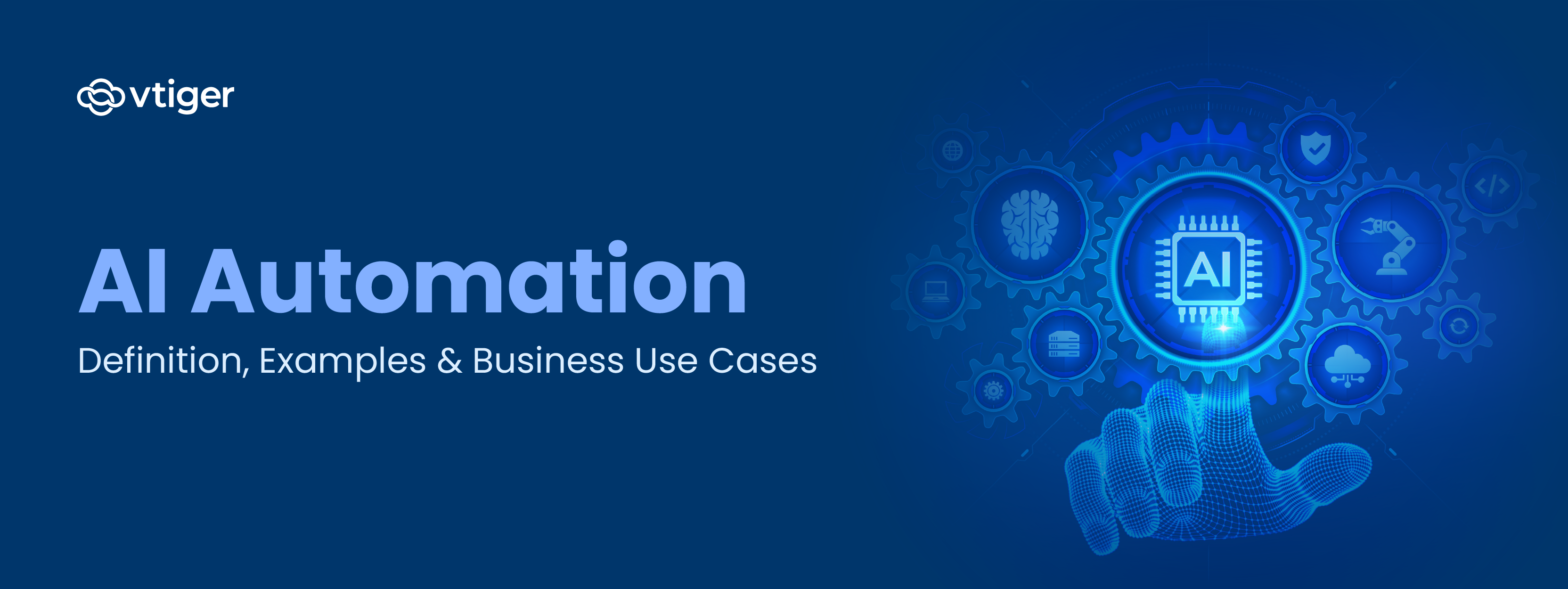
AI automation is the use of artificial intelligence technologies such as machine learning, natural language processing, and computer vision to automate complex, repetitive, and decision-based tasks. Unlike traditional automation that follows fixed rules, AI automation can understand context, process unstructured data, make decisions, and improve over time.
It handles non-routine and judgment-based tasks while learning continuously from data and feedback. This is an end-to-end workflow automation across structured and unstructured processes.
Read this blog to learn more about the meaning of AI automation, how it works, and explore examples of how it thrives in business environments.
What Is AI Automation?
Understand what AI automation is by definition: AI automation refers to the integration of artificial intelligence models into automation frameworks to create systems capable of learning, reasoning, and executing tasks independently. It merges computational intelligence with workflow execution layers to enable adaptable operational systems.
AI Automation in Practical Terms
In practical business terms, AI automation means that workflows are no longer limited to fixed instructions. Instead, they analyze incoming data, interpret context, and determine the appropriate action based on probability models and historical patterns. This makes processes more resilient to variation and complexity.
For example, rather than routing support tickets based only on keyword matching, AI automation evaluates sentence structure, urgency indicators, and historical customer interactions to determine priority and assignment.
Decision Intelligence within Automation
The key differentiator in AI automation is embedded decision intelligence. Machine learning models evaluate multiple variables simultaneously. Natural language processing extracts meaning from unstructured text. Predictive algorithms forecast likely outcomes.
AI automation has a meaning in business environments, therefore enabling systems to act not just automatically, but intelligently.
Adaptability and Continuous Learning
Unlike static rule engines, AI systems update their internal parameters through training cycles. When exposed to new patterns or corrected outcomes, they improve performance. This adaptability is critical in environments where customer behavior, regulations, and operational variables constantly change.
How AI Automation Works
AI automation is built on a structured, multi-layered system that combines data engineering, artificial intelligence models, workflow orchestration, and governance mechanisms. It is not a single tool but an integrated architecture that allows machines to process information, make contextual decisions, and execute actions across enterprise platforms. Unlike traditional rule-based automation, AI automation adapts to new data patterns and improves performance over time through learning mechanisms.
In enterprise environments, AI automation connects CRM systems, ERP platforms, marketing software, analytics engines, and operational databases into a unified decision framework. Each layer in the architecture performs a specific role, ensuring scalability, reliability, and compliance.
Data Collection and Ingestion
AI automation systems begin by collecting data from multiple enterprise sources. Structured data includes CRM records, transaction logs, financial entries, inventory tables, and customer databases. Unstructured data includes emails, chat transcripts, scanned contracts, support tickets, images, and voice recordings.
Data ingestion occurs through APIs, cloud connectors, database integrations, and streaming pipelines. Secure authentication protocols ensure controlled access. High-throughput ingestion frameworks allow organizations to process large volumes of data without compromising system performance.
Data Processing and Preparation
Raw enterprise data must be transformed into machine-readable formats. Text inputs are cleaned, tokenized, and converted into vector embeddings for natural language processing. Images are processed into pixel matrices, while optical character recognition extracts structured fields from documents.
Structured records undergo normalization, deduplication, and schema validation. Missing values are handled through statistical or rule-driven methods.
Effective preprocessing reduces noise and improves model accuracy, which directly impacts AI automation reliability.
AI Model Analysis and Decision Logic
Once prepared, the data enters the analytical layer. Machine learning models perform classification, regression, clustering, or anomaly detection tasks. Natural language processing models interpret intent and sentiment. Computer vision models extract information from visual documents.
Each prediction generates a confidence score. Decision thresholds determine whether workflows execute automatically or escalate for human review. This probabilistic evaluation allows AI automation systems to balance autonomy with governance.
Automated Workflow Execution
The execution layer converts model predictions into business actions. These actions may include updating CRM records, assigning leads, triggering marketing workflows, generating notifications, or initiating procurement steps.
For example, integration with CRM software ensures that sales teams receive prioritized leads based on predictive scoring.
Workflow orchestration engines coordinate multi-step processes across departments, ensuring synchronization and operational continuity.
Feedback and Model Optimization
AI automation systems incorporate monitoring and feedback loops. User corrections and overrides are logged for retraining.
Performance metrics such as precision, recall, latency, and error rates are continuously evaluated. If model drift is detected, retraining pipelines update the system using new datasets.
This continuous improvement cycle ensures that AI automation evolves alongside changing business environments.
Key Technologies Behind AI Automation
AI automation is powered by multiple artificial intelligence technologies working together within the enterprise infrastructure. These technologies provide predictive, analytical, and generative capabilities that enable intelligent decision-making at scale.
Understanding these components helps organizations design scalable and secure AI automation frameworks aligned with operational goals.
Machine Learning
Machine learning enables predictive analytics, forecasting, segmentation, and anomaly detection. Supervised learning models rely on historical labeled data. Unsupervised models detect hidden patterns. Reinforcement learning optimizes sequential decision-making processes.
Machine learning transforms static workflows into adaptive systems that improve with exposure to new data.
Natural Language Processing
Natural language processing allows systems to understand text and speech inputs. It powers customer service automation, email classification, document analysis, and conversational interfaces.
NLP models extract entities, detect sentiment, summarize conversations, and automate contextual responses in enterprise systems.
Computer Vision
Computer vision enables machines to interpret images and scanned documents. It supports invoice extraction, compliance validation, defect detection, and visual inspection workflows.
By converting visual data into structured outputs, computer vision expands AI automation beyond text-based applications.
Generative AI
Generative AI creates contextual outputs such as summaries, recommendations, automated responses, and content drafts.
In enterprise settings, generative models assist sales outreach, customer engagement, and reporting processes by reducing manual drafting effort while maintaining contextual relevance.
AI Agents
AI agents represent advanced AI automation systems capable of multi-step reasoning and autonomous execution. They combine reasoning models, memory layers, and tool integrations to achieve defined objectives.
A deeper understanding of what AI agents are explains how these systems coordinate data access, decision-making, and workflow orchestration across enterprise platforms. AI agents are increasingly integrated into AI CRM and enterprise automation ecosystems.
Benefits of AI Automation
AI automation delivers measurable improvements across operational, financial, and strategic dimensions of a business. By integrating machine learning, predictive analytics, and workflow automation, organizations can move beyond basic task automation and enable intelligent process optimization. The benefits extend from cost reduction and efficiency gains to improved customer engagement and regulatory compliance.
When implemented with proper governance and scalable architecture, AI automation becomes a long-term capability rather than a short-term productivity tool.
Improved Operational Efficiency
AI automation reduces manual workloads by handling repetitive, rule-driven, and data-intensive tasks automatically. Departments such as sales, customer support, finance, and operations benefit from faster processing times and reduced dependency on manual intervention.
By automating data validation, document processing, ticket routing, and reporting workflows, organizations streamline day-to-day operations and eliminate bottlenecks.
Increased Accuracy and Reduced Errors
Manual processes are prone to inconsistencies and data entry mistakes. AI automation systems apply consistent logic and predictive models to minimize human error.
Machine learning algorithms detect anomalies, validate data patterns, and flag inconsistencies before they impact downstream systems. This improves data quality and decision reliability across enterprise platforms.
Faster Decision-Making
AI-driven automation accelerates decision cycles by analyzing large datasets in real time. Predictive models generate insights instantly, enabling businesses to respond quickly to market changes, customer behavior, or operational risks.
Faster insights lead to improved responsiveness and competitive advantage in data-driven industries.
Cost Optimization and Resource Allocation
By reducing repetitive labor and improving process efficiency, AI automation lowers operational costs. Resources can be reallocated toward strategic, high-value activities such as innovation, customer engagement, and growth planning.
Scalable AI systems allow organizations to handle increasing workloads without proportional increases in staffing.
Enhanced Customer Experience and Personalization
AI automation supports personalized engagement through predictive analytics and behavioral segmentation. Systems analyze customer data to deliver tailored recommendations, timely follow-ups, and proactive support.
This improves satisfaction, retention, and overall customer lifecycle management.
Governance, Compliance, and Auditability
Enterprise AI automation includes monitoring frameworks, access controls, validation layers, and audit logs. These mechanisms ensure accountability and regulatory compliance.
Transparent decision tracking and human-in-the-loop controls provide oversight for high-impact workflows, making AI automation suitable for regulated industries such as finance and healthcare.
AI Automation vs Traditional Automation
Understanding the difference between AI automation and traditional automation is essential for designing scalable digital transformation strategies. While both approaches aim to reduce manual effort and increase operational efficiency, their capabilities, adaptability, and technical foundations differ significantly.
Traditional automation relies on predefined logic and rule-based execution. It performs repetitive, structured tasks efficiently but cannot interpret context or adjust dynamically when inputs change. AI automation, in contrast, integrates machine learning models, natural language processing, and predictive analytics to enable contextual decision-making and continuous improvement.
The comparison below outlines the key differences between AI automation and traditional automation (RPA).
| Feature | AI Automation | Traditional Automation (RPA) |
| Data Handling | Processes structured and unstructured data, including text, images, and speech | Primarily processes structured, rule-based data |
| Decision Making | Context-aware and probabilistic | Rule-based and deterministic |
| Learning Capability | Improves performance through continuous learning | Does not learn unless manually reprogrammed |
| Adaptability | Adjusts to new patterns and changing conditions | Limited flexibility once rules are defined |
| Use Cases | Predictive analytics, intelligent routing, personalization, anomaly detection | Data entry, form processing, repetitive workflows |
| Scalability | Scales with data complexity and model updates | Scales only within predefined rule boundaries |
| Human Involvement | Human-in-the-loop for validation when required | Minimal involvement, but requires manual updates for changes |
Types of AI Automation
AI automation implementations vary depending on autonomy, integration level, and business objectives. Organizations often begin with task-level automation before expanding into enterprise-wide intelligent systems.
Selecting the appropriate automation model depends on data maturity, infrastructure readiness, and governance requirements.
Intelligent Automation
Intelligent automation enhances structured workflows by integrating predictive analytics and AI-driven decision models.
For example, marketing automation software leverages predictive segmentation and behavioral analytics to improve campaign performance. Intelligent automation is commonly deployed in finance operations, HR processes, and customer engagement systems.
Agentic AI
Agentic AI systems operate with goal-oriented autonomy. They break objectives into tasks, access relevant systems, evaluate intermediate results, and adjust execution paths dynamically.
These systems represent a more advanced stage of AI automation, often integrated with AI CRM platforms and enterprise orchestration frameworks.
AI Automation Use Cases in Business
AI automation in business spans sales, marketing, operations, finance, and supply chain management. It enables enterprises to reduce operational friction while improving decision accuracy.
As data volumes grow, organizations increasingly rely on AI automation to manage complexity and maintain responsiveness.
Document Processing
AI-powered systems extract structured information from invoices, contracts, compliance forms, and procurement documents. This reduces processing time and improves validation accuracy.
Customer Support
Natural language processing models classify service requests, prioritize tickets, and generate response drafts. Integration with CRM software ensures case tracking and resolution management.
Sales and Lead Management
AI-driven scoring models prioritize high-value prospects. Automated workflows update pipelines and trigger follow-up tasks.
Integration with lead management systems improves conversion efficiency by aligning predictive insights with structured sales processes.
Marketing Operations
AI automation enhances segmentation, personalization, and lifecycle targeting within AI CRM platforms. Predictive analytics supports budget optimization and campaign timing decisions.
Inventory and Supply Chain
Predictive demand forecasting optimizes stock levels and reduces supply chain disruptions. Automation engines coordinate procurement and replenishment workflows based on predictive outputs.
Examples of AI Automation
AI automation examples include predictive sales forecasting, automated ticket routing, fraud detection systems, dynamic pricing engines, predictive maintenance in manufacturing, and medical data analysis in healthcare.
Retail organizations use demand forecasting models to optimize inventory. Financial institutions deploy anomaly detection models to identify suspicious transactions.
These examples demonstrate how AI automation supports complex, decision-driven workflows across industries.
The Future of AI Automation
AI automation is moving beyond task-level optimization toward enterprise-wide intelligence. As computing infrastructure becomes more scalable and cloud-native architectures mature, AI systems are being designed as foundational layers within digital ecosystems. Instead of functioning as standalone tools, AI automation platforms are increasingly embedded into CRM, ERP, finance, supply chain, and customer experience systems.
Advancements in large language models, real-time analytics, and distributed data processing are accelerating this shift. Enterprises are prioritizing scalable AI architecture, robust data governance, and interoperable APIs to ensure long-term adaptability. Organizations that build modular, observable, and compliant AI automation frameworks today will be better positioned to manage future complexity, regulatory evolution, and cross-platform orchestration requirements.
Autonomous AI Agents
Autonomous AI agents represent the next phase of AI automation. These systems move beyond predefined workflows and operate with goal-oriented reasoning. They can interpret objectives, break them into executable steps, access multiple enterprise systems, and adjust decisions dynamically based on intermediate outcomes.
In practical terms, autonomous AI agents may coordinate sales forecasting, trigger marketing outreach, update CRM records, and monitor performance dashboards without manual supervision. Their architecture combines reasoning models, memory layers, tool integrations, and decision policies. As enterprise AI matures, these agents will handle multi-department orchestration while operating within defined governance constraints.
Human in the Loop Governance
Even as AI automation becomes more autonomous, human oversight will remain essential. High-impact decisions involving finance approvals, compliance checks, healthcare diagnostics, or strategic planning require transparent validation mechanisms.
Human-in-the-loop governance ensures that AI systems operate within ethical, legal, and operational boundaries. Enterprises will increasingly implement audit trails, explainability frameworks, bias detection tools, and approval hierarchies. Confidence thresholds will determine when automation proceeds independently and when escalation to human reviewers is required.
This balance between autonomy and oversight will define responsible AI automation adoption.
Industry Specific AI Workflows
Future AI automation systems will be more domain-specific. Instead of generic automation engines, organizations will deploy verticalized AI workflows tailored to industry requirements.
Healthcare automation platforms may integrate diagnostic support, patient record classification, and compliance validation. Manufacturing AI workflows may combine predictive maintenance, defect detection, and supply chain forecasting. Retail systems may embed dynamic pricing, demand prediction, and personalized marketing.
Industry-specific AI models trained on domain datasets improve precision, reduce false positives, and accelerate deployment cycles. This specialization will increase adoption across regulated and complex sectors.
Embedded Decision Engines
AI-driven decision engines will become core components of enterprise infrastructure. Rather than acting as add-on analytics modules, decision engines will operate in real time within transactional systems.
Embedded decision engines enable continuous intelligence across workflows. This shift will transform AI automation from reactive processing into proactive, real-time operational optimization across departments.
Frequently Asked Questions (FAQs)
What is AI automation in simple terms?
AI automation is the use of artificial intelligence to perform tasks that normally require human thinking. Instead of following fixed rules, AI systems analyze data, recognize patterns, make decisions, and improve over time. It helps businesses complete work faster, more accurately, and with less manual effort.
How is AI automation different from RPA?
RPA follows predefined rules and works best with structured, repetitive tasks. AI automation goes further by understanding unstructured data such as emails, documents, or images. It uses machine learning and natural language processing to make context-aware decisions and improve performance through continuous learning.
What are common examples of AI automation?
Common examples include automated customer support chat systems, predictive sales forecasting, invoice data extraction, fraud detection, demand forecasting, and intelligent lead scoring. Businesses also use AI automation for ticket routing, personalized marketing campaigns, and predictive maintenance in manufacturing environments.
How does AI automation work in business?
AI automation works by collecting business data, processing it using machine learning models, generating predictions or classifications, and triggering automated workflows. It integrates with enterprise systems like CRM or ERP platforms to update records, assign tasks, and optimize decisions based on real-time insights.
What technologies are used in AI automation?
AI automation relies on machine learning, natural language processing, computer vision, generative AI, data engineering pipelines, and workflow orchestration tools. APIs, cloud infrastructure, and analytics platforms also play important roles in enabling scalable, secure, and integrated automation systems.
Is AI automation expensive to implement?
The cost depends on complexity, infrastructure, and customization needs. Basic AI automation tools can be affordable, especially cloud-based solutions. Large-scale enterprise deployments may require higher investment in integration, data preparation, and governance. However, long-term efficiency gains often justify the initial cost.
Can AI automation replace human jobs?
AI automation typically replaces repetitive, data-intensive tasks rather than entire roles. It reduces manual workload and allows employees to focus on strategic, creative, and relationship-driven responsibilities. In most cases, AI augments human productivity instead of fully eliminating human involvement.
What industries use AI automation the most?
Industries such as finance, healthcare, retail, manufacturing, technology, and telecommunications widely use AI automation. These sectors rely on data-driven decision-making, customer engagement, fraud detection, predictive analytics, and operational optimization to improve efficiency and competitiveness.
What are AI agents in automation?
AI agents are advanced automation systems capable of multi-step reasoning and autonomous decision-making. They analyze goals, plan actions, access tools, and execute workflows with minimal supervision. AI agents integrate memory, learning models, and orchestration logic to manage complex business processes.
Why is AI automation important for modern businesses?
AI automation improves efficiency, reduces errors, accelerates decision-making, and enhances customer experiences. It enables organizations to scale operations without proportional increases in workforce. In competitive digital markets, AI automation helps businesses remain agile, data-driven, and operationally efficient.