Customer Relationship Management (CRM) has become a fundamental part of modern business, especially since the post-pandemic digital era. More than just a tool, CRM is a business growth enabler that brings sales, marketing, and customer support together into a single, efficient system.
Industries such as e-commerce, retail, banking, and education have adopted CRM to meet the growing expectations of today’s customers. For example, an e-commerce brand can use it to send personalized product offers, while a bank can use it for fraud detection and faster customer support.
As competition grows and customer behavior changes, businesses of all sizes, especially small and medium enterprises (SMEs), realize that factors such as personalization, automation, and data-driven insights are essential for survival and long-term success.
What is CRM and How Has It Evolved by 2026?
CRM stands for Customer Relationship Management—the mix of tools and strategies used to manage interactions and strengthen customer ties. Its evolution reflects business needs: from manual records and databases in the past to today’s integrated, AI-powered platforms shaping customer experiences.
- Early days (1980s–1990s): CRM started as simple customer databases and spreadsheets used to store contact details and track sales leads.
- 2000s – Cloud CRM: The introduction of cloud CRM changed everything. It made powerful CRM software accessible and affordable for small businesses, as there was no longer a need to invest in expensive on-premise hardware and servers.
- 2010s – Mobile CRM: With the rise of smartphones, mobile-friendly CRM platforms emerged. This allowed sales and support teams to access data and manage tasks from anywhere, a crucial step for a mobile workforce.
- 2020s – Integrated Ecosystems: CRM evolved into a single, unified hub. It began integrating seamlessly with other systems like marketing automation tools, email platforms, and social media, creating a comprehensive view of the customer.
- 2026 – AI-driven CRM: The most significant evolution is the integration of Artificial Intelligence (AI) and Machine Learning (ML). These technologies especially enable both proprietary and open source CRM to offer predictive analytics, real-time personalization, and intelligent automation, transforming them from passive databases into proactive business partners.
CRM’s evolution reflects a shift from simple data storage to an intelligent, customer-centric system that is now critical for global business growth.
Key Factors Driving CRM Growth in 2026
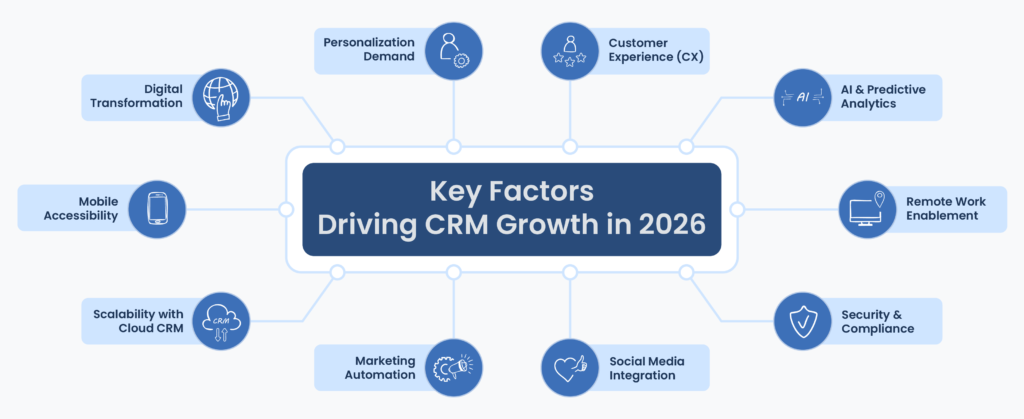
The pace of CRM growth is accelerating, driven by changing customer expectations, digital-first strategies, and advanced technologies. Given below are the 10 most significant CRM growth factors shaping the modern business world:
1. Digital Transformation
As companies embrace digital-first strategies, CRM systems become the central hub for managing both online and offline interactions. This shift is one of the core drivers of CRM growth, as businesses need unified platforms to handle the rising complexity of data.
2. Personalization Demand
Customers no longer settle for generic interactions—they expect tailored experiences. CRMs leverage customer data to deliver personalized offers and recommendations at scale, directly fueling CRM growth by boosting loyalty and conversions.
3. Customer Experience (CX) Focus
In highly competitive markets, CX has become the ultimate differentiator. CRMs enable businesses to track satisfaction levels, manage feedback, and design retention strategies, making CX one of the strongest drivers of CRM growth
4. AI & Predictive Analytics
Artificial intelligence is transforming CRM into a proactive tool. By forecasting sales, identifying at-risk customers, and suggesting next-best actions, AI stands out as a critical CRM growth factor for smarter, more efficient operations.
5. Remote Work Enablement
Hybrid and remote work models have increased the demand for mobile-friendly CRMs. With collaboration tools and secure access, these platforms enable distributed teams to stay connected, further accelerating CRM growth worldwide.
6. Data Security & Compliance
With strict laws like GDPR, businesses are prioritizing secure, compliant CRM systems. This focus on trust and regulation is a major CRM growth driver, especially in industries that handle sensitive data.
7. Social Media Integration
Modern CRMs now integrate with WhatsApp, Instagram, and Facebook, enabling centralized campaign and conversation management. This omnichannel capability is a key CRM growth factor as businesses shift to customer engagement across social touchpoints.
8. Marketing Automation
From drip campaigns to lead scoring, CRM automation reduces manual work and speeds up conversions. This efficiency not only improves marketing outcomes but also plays a direct role in CRM growth adoption.
9. Scalability with Cloud CRM
Cloud-based platforms give startups and SMEs access to enterprise-grade features without heavy upfront investment. Their scalability makes cloud systems one of the most influential CRM growth drivers in emerging markets.
10. Mobile Accessibility
Field sales and support teams rely on mobile access to serve customers in real time. Faster responses and better engagement on the go strengthen customer relationships, making mobile-first design another critical CRM growth factor.
How Artificial Intelligence (AI) is Revolutionizing CRM
Artificial Intelligence is one of the most powerful CRM growth factors in 2026, reshaping how businesses interact with customers and manage data. Instead of being just an operational tool, AI has elevated CRM into a strategic partner that delivers smarter insights, faster responses, and more accurate predictions.
Customer Segmentation
AI-powered CRMs automatically segment customers based on behavior, purchase history, and demographics. For example, in retail, AI helps brands target high-value shoppers with tailored offers. According to IBM, AI in CRM not only enhances segmentation but also automates data management and lead qualification, reducing manual effort and improving business processes. This allows companies to run hyper-personalized campaigns at scale.
Predictive Analytics
With predictive analytics, CRMs can forecast future outcomes, such as which leads are most likely to convert or which customers are at risk of churn. In industries like banking, predictive models can even flag early signs of fraud. To support this, API-first CRM platforms that can quickly integrate AI agents and execute workflows, giving businesses faster insights and improved decision-making.
Chatbots & Virtual Assistants
AI-powered chatbots and virtual assistants are transforming customer service by handling routine queries 24/7. This not only reduces the workload for human support teams but also delivers immediate responses to customers. In fact, deploying AI chatbots within CRMs can cut response times by up to 70%, and research shows that 68% of firms using AI-enhanced service report higher customer satisfaction, compared to just 52% of those without AI support.
Personalization at Scale
Perhaps the most visible impact of AI is its ability to create truly personalized experiences. In e-commerce, AI-driven CRMs recommend products based on customer preferences much like Netflix curates content for viewers. By aligning personalization with predictive insights, businesses achieve higher engagement, stronger loyalty, and ultimately, sustained CRM growth.
The Role of Data Security and Privacy in CRM Adoption
As businesses collect and store vast amounts of customer data, security and privacy have become crucial for CRM adoption. Modern CRM platforms are designed to address these concerns.
Regulatory Compliance
Global data laws such as the GDPR mandate strict handling of personal information. A compliant CRM ensures smooth adoption by providing consent management, audit trails, and data access logs. These features directly contribute to CRM growth, as businesses can confidently operate across multiple markets without risking penalties.
Encryption & Authentication
Leading CRM systems employ strong encryption protocols and multi-factor authentication to secure sensitive data. This protection against unauthorized access not only strengthens resilience but also positions security as one of the most important CRM growth factors for organizations dealing with customer trust at scale.
Consent Management
Customers now expect full transparency regarding how their data is collected and used. Modern CRMs include built-in tools to track consent, manage communication preferences, and give users more control. This fosters stronger trust and deeper relationships, both of which are key drivers of long-term CRM growth.
Cloud CRM – Making Customer Management Accessible to Small Businesses
Cloud CRM has been a game-changer for small and medium businesses, offering a flexible and affordable alternative to traditional on-premise solutions.
| Factor | On-Premise CRM | Cloud CRM |
|---|---|---|
| Cost | High upfront costs for hardware and licenses. | Affordable, pay-as-you-go subscription model. |
| Scalability | Limited; requires new hardware to scale. | Easily scalable; can add or remove users as needed. |
| Accessibility | Limited to the office network or requires a VPN. | Access from anywhere with an internet connection. |
| Updates | Manual, time-consuming updates managed by an internal IT team. | Automatic, seamless updates and maintenance handled by the vendor. |
| Security | Depends entirely on your local IT team and infrastructure. | The CRM provider manages enterprise-grade security and backups. |
Cloud CRM’s affordability and ease of use are major contributors to CRM growth, where internet utilization is rising.
Personalization and Customer Experience as Growth Drivers
Personalization is no longer a luxury; it’s a competitive necessity. CRMs enable businesses to deliver unique customer experiences that foster loyalty and retention.
- Telecom: A telecom company can use CRM data to offer personalized data plans based on a customer’s usage patterns.
- Healthcare: Hospitals can send tailored follow-up reminders and appointment schedules to patients, improving care and engagement.
- Education: Educational institutions can send customized course recommendations or automate student progress updates based on their interests and performance.
Customer feedback loops built into CRM software allow businesses to continuously listen, adapt, and improve, which directly drives revenue growth.
Integration with Social Media and Marketing Automation
Modern CRMs are no longer just databases of customer information, they act as the operating system for customer engagement, connecting seamlessly with social platforms and marketing automation tools. Instead of toggling between multiple dashboards, teams can now manage everything from one central hub. Here’s how these integrations reshape operations:
- Omnichannel Engagement – A single timeline of customer interactions across email, social, SMS, and chat ensures consistency at every touchpoint. This holistic engagement approach is at the heart of sustainable CRM growth, creating stronger relationships and long-term loyalty.
- Lead Scoring Automation – By prioritizing leads based on behavior and intent, sales teams can focus on high-value prospects. This smarter allocation of resources is one of the most impactful CRM growth factors for improving conversions.
- WhatsApp Business Integration – Customer chats, updates, and responses are managed directly within the CRM, ensuring faster replies and measurable engagement that fuel consistent CRM growth.
- Instagram & Facebook Ads Sync – Leads captured from social ad campaigns are automatically routed into the sales pipeline, with attribution data intact. This automation not only saves time but also acts as a key CRM growth factor by improving lead quality and campaign ROI tracking.
- Email Campaign Automation – From drip campaigns to A/B tests, marketing efforts can be automated and tied directly to prospect engagement. Sales teams gain visibility into lead behavior, strengthening alignment and accelerating CRM growth across departments.
In short, by connecting marketing, sales, and customer engagement in one ecosystem, businesses achieve the operational efficiency they desire and influence the extent of personalization that can drive CRM growth worldwide.
Challenges in CRM Adoption and How to Overcome Them
A CRM system can completely reshape how organizations manage customer relationships, but implementing it isn’t always straightforward. Here are some of the common challenges businesses face and how they can be tackled effectively:
1. Data Fragmentation
One of the biggest hurdles is scattered customer data spread across spreadsheets, emails, and different systems, making it hard to get a complete picture. The best way to overcome this is to plan data migration carefully, while cleansing and standardizing all information, and importing it into the CRM so it becomes a single, reliable source of truth.
2. Lack of Training
Even the most advanced CRM won’t deliver results if teams don’t know how to use it effectively. Employees may feel lost or underuse the system without proper guidance. Regular, hands-on training workshops across departments not only build confidence but also ensure that the platform is adopted consistently.
3. Budget Constraints
For many small and medium businesses, the cost of a CRM can feel overwhelming, which often delays adoption. A practical approach is to choose a cloud-based CRM with a subscription model, allowing businesses to pay only for the features they need rather than committing to a large upfront investment.
4. Resistance to Change
Switching from old workflows to a new platform often sparks resistance, as employees prefer the comfort of familiar processes. To ease this transition, it helps to involve stakeholders early, highlight how the CRM will simplify daily tasks, and show clear productivity benefits that make the shift worthwhile.
CRM Implementation Best Practices
Many businesses fail to realize that the true value of a CRM lies in how well it aligns with company objectives, integrates into workflows, and is adopted by teams. Here’s a deeper look at the CRM growth factors that make implementation effective:
Define Clear Objectives
CRM adoption works best when it starts with a vision. Ask yourself: Are you looking to shorten sales cycles, improve customer support, or increase retention? Defining goals early ensures that your CRM is positioned as a driver of CRM growth, not just another tool.
Involve Stakeholders Early
One of the most underestimated CRM growth factors is early stakeholder involvement. Sales, marketing, and support teams must all have a voice in shaping the system. Their buy-in ensures that the platform meets real-world needs and accelerates adoption across the organization.
Choose the Right CRM Software
While popularity can be tempting, true CRM growth comes from choosing software that aligns with your size, scalability requirements, integrations, and support needs. Select a CRM that can evolve with your business demands.
Plan Data Migration Carefully
Wrong data will lead to misguided results. Poorly planned migrations often cripple new systems. Cleansing, standardizing, and mapping customer data before launch is essential. This operational discipline not only avoids early setbacks but also ensures that your CRM becomes a single source of truth, a key CRM growth factor for decision-making.
Conduct Regular Training
Even the most powerful CRM will fail if teams don’t know how to use it. Regular, hands-on training along with refresher sessions when new features roll out, ensures the system remains embedded in daily operations. This practice directly supports CRM growth by boosting user adoption and confidence.
Track KPIs and ROI
Implementation is only the beginning. To demonstrate value, track metrics such as sales cycle speed, customer satisfaction, lead conversion rates, and retention. Transparent measurement builds trust in the system and validates the investment as a key contributor to CRM growth.
Frequently Asked Questions (FAQs)
Q1: What is CRM, and why is it important for my business in 2026?
CRM helps businesses manage customer relationships, improve sales, and enhance the customer experience. In 2026, it’s essential to stay competitive by helping you manage customer expectations in an increasingly digital and connected world.
Q2: How does AI improve CRM tools?
AI adds intelligence to CRM by powering features like customer segmentation, predictive analytics, and smart chatbots. This helps businesses make smarter, faster, and more data-driven decisions.
Q3: Is CRM useful for small businesses with limited budgets?
Yes. Modern cloud-based CRMs are affordable and scalable. They operate on a pay-as-you-go model, allowing SMEs to access powerful tools without the high upfront cost of traditional software.
Q4: How can data security issues be handled in CRM?
Data security is handled by using CRMs that offer advanced security features like data encryption, access controls, and multi-factor authentication. These systems also help businesses comply with privacy laws like the DPDPA.
Q5: What role does cloud technology play in CRM growth?
Cloud technology lowers the cost of entry, improves accessibility, and allows small businesses to scale their operations quickly. It also shifts the burden of maintenance and updates from the business to the CRM provider.
Q6: Can CRM integrate with social media platforms?
Yes. Modern CRMs are designed to integrate seamlessly with social media platforms like WhatsApp, Instagram, and Facebook, allowing you to manage customer conversations and capture leads directly from a single dashboard.
Q7: How can I train my team to use CRM effectively?
You can train your team through a mix of hands-on onboarding workshops, regular refresher sessions, and providing easy access to training materials. It’s also important to have a CRM champion who can answer questions and encourage adoption.
Q8: What are the biggest challenges in CRM adoption and how can they be solved?
The main challenges include a lack of training, data fragmentation, and employee resistance. These can be solved with a phased implementation, strong leadership support, and providing ongoing training to highlight the CRM’s benefits.
Q9: How does personalization through CRM increase customer satisfaction?
Personalization increases satisfaction by making customers feel understood. CRMs allow you to send tailored offers, provide relevant recommendations, and communicate in a way that feels unique to each individual.
Q10: What future CRM trends should businesses prepare for?
Businesses should prepare for trends like voice-enabled CRM for hands-free operations, hyper-personalization powered by real-time data, and the use of blockchain for enhanced data security.