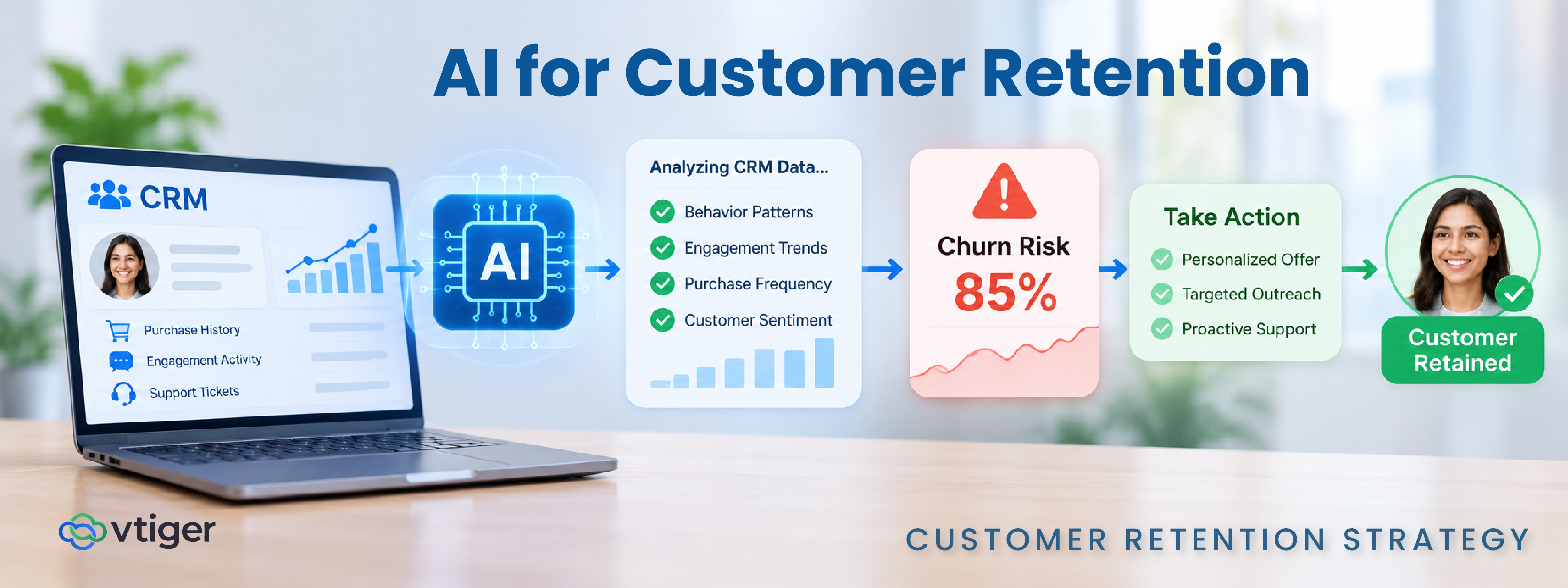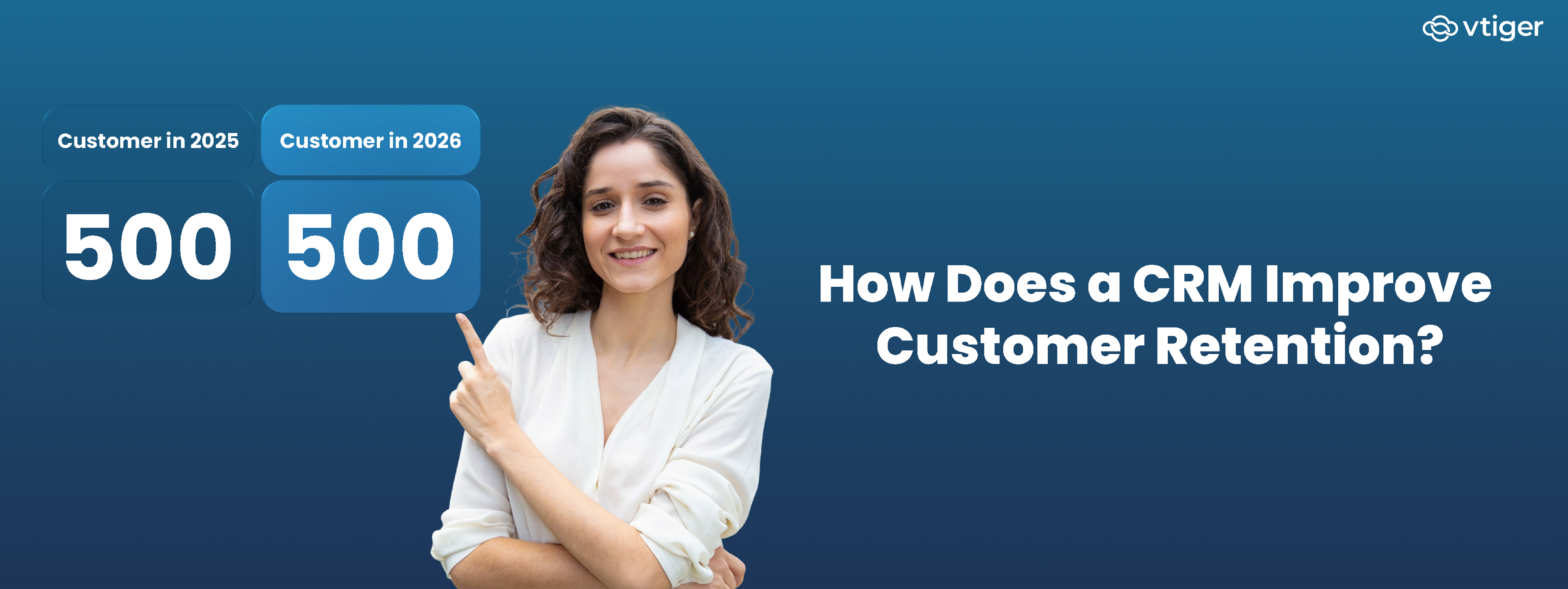
A CRM improves customer retention by centralizing customer data, tracking interactions, personalizing communication, automating follow-ups, and helping teams identify customer needs and potential churn risks. By giving sales, marketing, and support teams a complete view of each customer, CRM software helps businesses build stronger relationships, resolve issues faster, and encourage repeat purchases.
Customers rarely leave because of a single major failure. They usually leave after several small problems go unnoticed, such as a missed renewal follow-up or a repeat support ticket for the same issue. Because sales, support, and account managers often track their work in separate inboxes, no one connects these warning signs until the customer decides to leave.
Manual customer management forces teams to react after issues escalate, putting renewals at risk. A CRM unifies customer history and upcoming tasks into a single record, giving every department the visibility to resolve minor issues early and prevent churn.
Why Customer Retention Breaks Down Without a CRM
Customer retention breaks down without a CRM because the signals that predict a lost customer are split across sales, support, and marketing tools. Nobody sees them together in time to act. A sales rep knows the renewal falls in March, support knows about three invoicing cases in January, and marketing knows the product updates stopped being opened.
Each team holds a fragment, and no fragment looks alarming on its own. Together, on one record, the three facts describe an account that is likely to leave, with time left to change the outcome. A CRM for customer retention records those fragments together and names one person responsible for the next step.
The cost of missing that combination is high. Writing for Bain & Company, Frederick Reichheld noted that “a 5% increase in customer retention produces more than a 25% increase in profit” in financial services. His article explains that returning customers buy more over time and cost less to serve, so a renewal lost to a missed signal is lost profit.
Retention effort also has to be selective. Peter Fader, a Wharton marketing professor, said in an interview with Knowledge at Wharton that extra effort belongs with the customers who provide a lot of value. In his words, “You need to pick and choose.” That choice becomes workable in a CRM, because value, history, and risk become fields on one record.
Accelerate Business Growth with Vtiger
15-day free trialNo credit card requiredFull product access
Almost there!
Redirecting you to your free trial…
5 CRM Customer Retention Strategies
The five CRM customer retention strategies covered are behavior-based segmentation, personalized journeys, automated renewals, targeted churn-risk outreach, and omnichannel engagement. All five run on data the CRM already has so that a team can start any of them without a separate tool.
A first 90-day plan that applies the five strategies can start with five steps:
| Build one value-based segment and review it with the account owners each fortnight.Trigger a personalized journey from a purchase or case event, not a date.Set renewal tasks to open well before contract end for accounts above a set value.Define two churn signals with thresholds, and decide in advance which customers receive outreach.Log each existing channel to the record before adding a new channel. |
1. Segment Customers Based on Behavior
Segmenting customer behavior means grouping them by what they do, so retention effort follows value rather than account age. A CRM builds these groups from three kinds of data it already holds:
- Purchase frequency:
Customers who reordered monthly and have not ordered in ten weeks deserve a call before they become a churn figure. - Engagement:
Email opens, portal login, and meeting attendance tell the account manager whether the renewal call will be a review or a rescue. - Customer value:
Revenue and margin by account determine how much effort a segment receives, applying Peter Fader’s customer-centricity rule to prioritize your most profitable customers.
Because a saved segment is a filter rather than a fixed list, it updates as records change. Useful customer segmentation models combine all three dimensions, so a high-value customer with falling engagement gets different treatment from a low-value one.
2. Personalized Customer Journeys
A personalized customer journey in a CRM chooses each next message from what the record shows the customer did last. A customer who opened two cases about reporting receives content on reporting, not the newsletter. Purchase history decides which product a recommendation names, and the renewal date on the record decides when a targeted offer goes out.
The trade-off is restraint. A customer with an open complaint needs the fix before any offer, and an unsolicited product pitch reads as an error.
3. Automate Renewal and Follow-Up Campaigns
Renewal and follow-up automation works by creating the task before the deadline, not on it. An admin configures a workflow that opens a renewal task for the account owner 90 days before a contract ends. The same rules can send a subscription reminder 30 days out and start a re-engagement sequence when logins stop.
Emails sent through marketing automation workflows link to the record the account owner reads, so the call and the email align. A person still makes the renewal call, and the workflow puts the task on someone’s list before the deadline.
4. Identify and Address Churn Risks
Identify churn risk through changes in activity on the record and address it by reaching out to customers likely to churn. Signals include a drop in logins or orders, repeat cases on one issue, or a renewal with no recent contact. A CRM can alert the owner when one crosses a threshold the team has set.
Monitoring is the easy half. Deciding whom to contact is harder, and contacting every customer flagged as at risk can backfire. A field experiment reported in the Journal of Marketing Research tested recommendations that encouraged customers to switch to cheaper plans. Customers who received one churned at 10% over three months, against 6% in the control group.
| Field evidence: The authors of the plan-recommendation study traced the rise in churn to two effects. The recommendation made customers less inclined to stay on their current plan without thinking about it. It also drew attention to past usage among customers who were already likely to leave, and the data supported both explanations.The lesson for a CRM is about targeting. A churn-risk flag tells the team who might leave, not who will respond well to being contacted. Proactive outreach belongs with customers who are both at risk and likely to respond. For the other at-risk customers, fixing the issue behind the signal does more than a retention offer. |
5. Build Omnichannel Customer Engagement
Omnichannel engagement works when email, phone, chat, and social conversations are logged to the same customer record. The practical test is whether an agent answering a chat can see last week’s call with the account manager. If not, the customer repeats the story to a business that already holds it.
A customer engagement CRM keeps each channel on one timeline, so the next person to reply starts from the last conversation. Messages on a business’s social pages belong to the same relationship; the account owner answers them inside the CRM they use.
Customer Retention Metrics a CRM Can Track
A CRM can track churn rate, revenue retention, repeat purchases, lifetime value, resolution time, and satisfaction because it calculates each from records it already holds. Reading them together matters more than any single figure, since each catches a failure the others miss.
| Metric | What it shows | CRM data it needs | Act when |
|---|---|---|---|
| Customer churn rate | Customers lost | Account status, end dates | Rises in one sign-up month |
| Revenue retention | Revenue kept | Contract and invoice values | It falls while churn is flat |
| Repeat purchase rate | Customers reordering | Order history | Order gaps widen |
| Customer lifetime value | Relationship value | Revenue, tenure, margin | A segment drops |
| Time to resolution | Speed of fixes | Case open and close times | Cases miss target times |
| Satisfaction score | How a case felt | Post-case surveys | One account scores low twice |
Churn and revenue retention can move in different directions, since three large accounts can leave while the customer count looks healthy. CRM analytics reports that split both lines by the month customers joined show whether a problem is new or has affected the same group since onboarding.
CRM Features That Support Customer Retention
The seven CRM features that support customer retention are contact management, segmentation, marketing automation, workflow automation, customer support, analytics, and AI-powered insights. Each one provides a signal, an owner, or a filter for who to contact.
1. Contact Management
Contact management supports retention by keeping every person, account, purchase, and conversation on one record, so the CRM holds the customer relationship rather than an address book. When a key contact leaves the customer’s company, the record shows who else was involved.
In Vtiger One, sales, marketing, and the help desk share One View of each customer. The agent closing a case and the rep preparing a renewal therefore read the same history.
2. Customer Segmentation
Customer segmentation supports retention by identifying which accounts the team contacts first. A saved segment of high-value accounts with no contact in 60 days becomes the account team’s worklist. Accounts outside it are left unprompted by choice.
3. Marketing Automation
Marketing automation sends targeted onboarding and win-back campaigns using your shared CRM database. When a customer replies or clicks, that activity logs directly to the account record so the account owner has full context.
4. Workflow Automation
Workflow automation runs the rules an admin configures, such as opening a renewal task or escalating an ageing case. In the One Professional edition, Process Designer links those rules into multi-step processes, including approvals. Neither judges which customers matter, so the team writes that judgment into the rules.
| Watch out: A workflow applies its rule to every record that matches it. A re-engagement sequence set to start after 30 days of inactivity will also reach customers on an agreed seasonal pause. Build the exceptions into the rule before switching it on, and test it on a small segment first. |
5. Customer Support
Customer support protects retention, since a poorly handled case gives customers a concrete reason to leave. Service level agreements (SLAs) set response and resolution times by priority, and escalation rules move a case up before it breaches. A satisfaction survey after each resolved case keeps a consistent customer experience measurable rather than assumed.
6. Analytics and Reporting
Reports and dashboards show retention as a measured trend rather than an impression. Churn by segment tells a manager which segment lost accounts last quarter, and later reports show whether the changes worked.
7. AI-Powered Customer Insights
AI-powered customer insights analyze customer conversations and recommend a next step; the account owner decides whether to act. The Calculus AI analyzes the sentiment of customer conversations and recommends the next best action for an account. Because outreach to the wrong customer can raise churn, that human decision matters.
Benefits of Using CRM for Customer Retention
A CRM supports customer retention throughout the customer lifecycle, from onboarding and early engagement to repeat purchases, renewals, and long-term relationship management. By connecting customer history with purchase patterns, support interactions, and follow-up activities, CRM software helps businesses identify what each customer needs at different stages and respond before engagement declines.
- Higher customer loyalty:
Consistent interactions help customers feel recognized throughout their relationship with a business. Teams can refer to previous conversations, understand customer preferences, and follow through on commitments without making customers repeat themselves. - Reduced customer churn:
Changes in purchase frequency, engagement, support activity, or renewal status can signal that a customer may leave. A CRM brings these signals together so account owners can investigate concerns and act before the relationship deteriorates. - Increased repeat purchases:
Purchase history helps businesses identify when customers may be ready to reorder or need a complementary product. Timely reminders and relevant recommendations can encourage repeat purchases without relying on generic promotional campaigns. - Better customer experiences:
Access to previous interactions and unresolved cases helps teams maintain continuity across touchpoints. Customers receive more consistent responses because each representative can understand the relationship context before responding. - Higher customer lifetime value:
Relevant follow-ups, timely renewals, and appropriate product recommendations can help extend customer relationships and create additional purchasing opportunities. Over time, stronger retention can increase the value each customer generates. - More personalized communication:
Customer preferences, purchase history, and recent interactions help businesses tailor messages to individual needs. Communication becomes more relevant when it reflects a customer’s current situation rather than following the same sequence for every account. - Faster customer support:
Service-level agreements (SLAs), case tracking, and escalation workflows help teams prioritize urgent issues and monitor resolution deadlines. This reduces the likelihood of customer concerns remaining unresolved because they were overlooked in a busy inbox. - Better visibility into customer behavior:
CRM reports reveal patterns in engagement, purchase frequency, complaints, and churn across customer segments. Teams can use these insights to evaluate retention efforts and adjust their approach as customer needs change. - Improved cross-selling and upselling opportunities:
Purchase and usage history can reveal when customers need additional capabilities or products that complement their existing purchases. Sales teams can use this context to make relevant recommendations at an appropriate stage of the customer relationship.
These benefits depend on how consistently teams maintain customer records and act on the information available. Calls must be logged, follow-up tasks completed, and account ownership kept up-to-date for the CRM to support meaningful decisions.
A documented customer retention strategy helps translate these capabilities into lifecycle-specific actions, with clear responsibilities for maintaining engagement, addressing customer concerns, and strengthening long-term relationships.
Where to Start With Customer Retention Management
An effective customer retention management process starts with identifying which customer relationships need attention, defining the signals that warrant action, and assigning follow-up responsibility. Rather than introducing multiple workflows at once, businesses can begin with a priority customer segment and refine their approach based on the outcomes of the first renewal cycle.
When evaluating customer retention, prioritize a unified view of sales, marketing, and support interactions. Configurable workflows and segment-level churn reporting are also important, as they help teams turn customer data into timely action without recreating information silos across separate tools.
| Practitioner note: Review the first renewal cycle to assess what worked and what fell short. Examine customers who left despite the new approach to identify missing data or overlooked churn signals. Separately, review customers who received retention outreach but left anyway. These findings can help refine the signals teams track, improve targeting, and avoid unnecessary interventions in future retention cycles. |
Frequently Asked Questions
1. How does a CRM improve customer retention?
A CRM improves retention in two ways. It brings churn-predicting signals, such as falling activity and approaching renewals, into one record and turns each into a dated task with an owner. It also helps the team decide which customers to contact and which to leave alone, so effort goes where it is likely to work.
2. Can CRM software reduce customer churn?
Yes, when the team logs activity consistently and targets outreach with care. Voluntary churn, where a customer chooses to leave, responds to earlier service recovery and well-timed renewals. Involuntary churn, such as a subscription lapsing after a failed payment, responds to reminders a workflow can create. Neither fixes a product that no longer meets the customer’s needs.
3. How does CRM help build customer loyalty?
Loyalty depends on consistency, and consistency depends on keeping promises. A CRM records each promise as a task with an owner and a date, so a commitment made on a support call is still visible at renewal. The customer is treated as one relationship, not a series of transactions.
4. What CRM features help with customer retention?
Seven features contribute, but a team starting gets the most from three. A shared customer record gives everyone the same history. Renewal workflows turn deadlines into timely tasks, and help desk SLAs keep urgent cases from waiting. Segmentation, automation, analytics, and AI-powered insights add precision once the basic data is reliable.
5. How can CRM personalize customer communication?
A CRM personalizes communication at two levels. At the basic level, it inserts fields such as name and product into a template. The more useful level chooses the message based on behavior on the record, such as an open case. That second level is also where restraint applies, since the record can show that the right message is none.
6. How does CRM identify customers at risk of churn?
A CRM identifies churn risk by tracking changes in activity against thresholds the team sets. Typical signals are fewer orders or logins, several cases about one issue, low satisfaction scores, and negative conversation sentiment. The CRM flags the account to its owner, who reviews the context before deciding whether outreach will help.
7. Which customer retention metrics can CRM track?
A CRM can track churn rate, revenue retention, repeat purchase rate, lifetime value, resolution time, and satisfaction scores. Review cadence matters as much as the list. Review churn and revenue retention monthly, grouped by the month customers joined, and satisfaction weekly. Lifetime value suits a quarterly review, since it reflects decisions made months earlier.