Customer churn rarely happens without warning. A customer may gradually reduce product usage, stop engaging with the account team, experience repeated service issues, or become less responsive to communication. Individually, these changes may seem insignificant. Together, these signals can indicate that a customer is losing value from the relationship.
The challenge for businesses is identifying these signals early enough to take action.
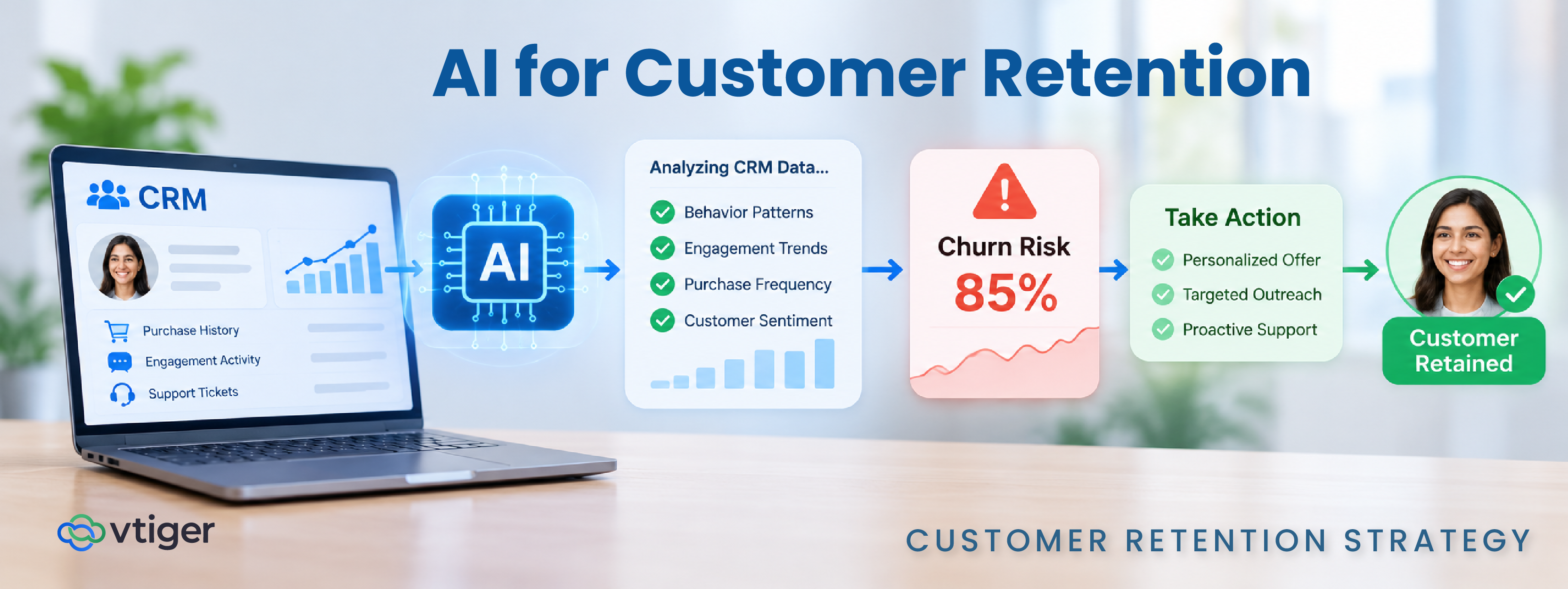
Traditional customer retention strategies often depend on teams noticing problems after they become visible. By then, customers may already be exploring alternatives. Artificial intelligence (AI) offers a more proactive approach by analyzing CRM data, customer interactions, purchase history, support activity, and engagement patterns to identify potential churn risks earlier.
With AI for customer retention, businesses can move beyond simply recording customer activity. They can understand what those activities indicate, identify accounts that need attention, and determine which actions could help strengthen customer relationships.
The goal isn’t to predict every customer departure perfectly. It is to recognize early warning signs and give businesses enough time to respond.
What Is AI for Customer Retention?
AI for customer retention uses artificial intelligence, machine learning, and predictive analytics to identify customers at risk of leaving and help businesses improve those relationships.
A traditional CRM system records information such as:
- Customer interactions and communication history.
- Purchase and transaction history.
- Support tickets and service requests.
- Account details and stakeholder information.
- Renewal dates and contract changes.
- Customer engagement and activity.
AI analyzes these data points together to identify patterns that may not be immediately apparent to employees.
For example, consider a subscription customer whose product usage has declined over several weeks. The customer has also raised multiple support tickets, stopped responding to account managers, and has an approaching renewal.
A CRM records these individual events. AI can connect them and identify a potential churn risk. This helps businesses shift from reacting to cancellations to recognizing when customer relationships may be heading in the wrong direction.
Why Traditional Customer Retention Strategies Often React Too Late
Many businesses start retention efforts only after a customer requests cancellation, files a complaint, downgrades a subscription, or approaches renewal. This indicates that the customer has already experienced dissatisfaction for some time.
A proactive retention strategy looks beyond these obvious events. It focuses on understanding changes in customer behavior and identifying problems before they affect the relationship significantly.
| Reactive retention | Predictive retention |
| Responds to visible problems | Identifies emerging risk patterns |
| Relies on complaints or cancellation requests | Analyzes multiple customer signals |
| Often intervenes close to renewal | Can intervene earlier |
| Uses standardized responses | Supports contextual interventions |
Predictive retention does not replace traditional customer service or relationship management. Instead, it gives teams an additional opportunity to address problems before customers decide to leave.
What Customer Signals Can Predict Churn?
There is no universal signal that reliably predicts customer churn.. The factors that contribute to churn depend on the business model, customer lifecycle, product, and customer expectations.
However, AI can analyze several categories of customer information to identify changes that may indicate increasing risk.
1. Product Usage and Adoption
For subscription-based businesses, product usage is an important indicator of customer engagement.
Potential warning signs include:
- Declining login frequency.
- Reduced adoption of important features.
- Fewer active users within an account.
- Reduced use of essential workflows.
- Failure to achieve onboarding or adoption milestones.
For example, a company may have purchased a CRM subscription for 20 employees, but only five use it actively after three months. This could indicate poor adoption, insufficient training, or a mismatch between the product and the team’s requirements.
AI can identify the decline and help customer success teams investigate the underlying reason.
2. Customer Engagement
Changes in communication and interaction patterns can indicate that a customer is losing interest in the relationship.
AI can monitor signals such as:
- Fewer meetings with account managers.
- Reduced email engagement.
- Delayed responses to follow-ups.
- Lower participation in customer programs.
- Fewer interactions with key stakeholders.
- Loss of an executive sponsor.
For instance, a customer who previously attended monthly review meetings but has stopped participating may need additional attention. AI can flag this change so the account manager can reconnect with the customer.
3. Support and Service Activity
Repeated support problems can affect customer satisfaction and increase the likelihood of churn.
Relevant signals include:
- Increasing support ticket volume.
- Repeated complaints about the same issue.
- Unresolved or escalated cases.
- Longer resolution times.
- Negative customer sentiment.
- Recurring product-related problems.
An increase in support requests does not automatically indicate churn. Some highly engaged customers may raise more tickets because they actively use the product. However, repeated unresolved issues combined with declining engagement can indicate a more serious problem.
Businesses can also use AI in customer service CRM to analyze interactions, understand customer concerns, and identify cases that require attention.
4. Commercial Signals and Customer Feedback
Purchase patterns and direct feedback provide additional context for understanding customer health.
AI can analyze:
- Approaching renewal dates.
- Reduced purchase frequency.
- Subscription downgrades.
- Changes in contract value.
- Declining expansion opportunities.
- Customer satisfaction surveys (CSAT).
- Net Promoter Score (NPS) responses.
- Reviews and product feedback.
The important point is that no single signal should automatically determine customer health. AI becomes more useful when it evaluates multiple signals together.
Why CRM Data Is Critical to Customer Retention
Customer relationships generate information across different business functions. However, this information is often distributed across sales, marketing, customer service, finance, and customer success teams.
For example, sales may know a customer is considering an expansion, while customer service handles unresolved implementation problems. Marketing may notice declining email engagement, and finance may identify reduced purchasing activity.
Each team has access to a different part of the relationship.
A CRM brings these details together into a more comprehensive customer record. AI can then analyze the combined information to identify patterns and potential risks.
This is why CRM data plays an important role in building customer intelligence. The more complete the customer context, the better equipped AI is to identify meaningful changes.
How AI Predicts Customer Churn
AI-powered churn prediction uses historical customer information and known churn outcomes to identify patterns linked to customer churn.
The process generally follows these 6 stages:
- Historical customer data: Collect customer interactions, purchases, usage, support records, and previous churn information.
- Behavioral pattern analysis: Identify changes and patterns that appeared before previous customers churned.
- Churn-risk prediction: Evaluate current customers against the identified patterns.
- Risk score and contributing factors: Estimate churn likelihood and identify the signals influencing the prediction.
- Retention action: Prioritize accounts and determine appropriate interventions.
- Outcome measurement: Monitor customer behavior and evaluate whether the intervention helped.
For example, a business may analyze customers who previously cancelled their subscriptions. It may discover that many of them experienced declining product usage, repeated support issues, and reduced engagement during the months preceding cancellation.
A churn prediction model can use these patterns to evaluate existing customers and estimate their likelihood of leaving within a defined period.
Read More: Predictive CRM: How AI Helps Businesses Anticipate Customer Needs
From Churn Prediction to Churn Prevention
Predicting churn is useful only when businesses can act on the prediction. The real value comes from connecting insights to appropriate retention activities.
A practical AI-driven retention workflow follows five stages:
- Detect: AI identifies customers whose behavior indicates increasing churn risk.
- Understand: The system identifies the signals contributing to the risk.
- Prioritize: Teams determine which customers need immediate attention based on risk, account value, and business context.
- Intervene: Customer success or account managers take appropriate action.
- Measure: Businesses monitor whether customer health, engagement, or adoption improves after the intervention.
Can AI Personalize Customer Retention Strategies?
Yes. Not every customer responds to the same retention approach. Some customers need training, others require better support, and some may need a conversation with senior account managers.
AI can use customer history, behavior, preferences, and engagement patterns to help businesses personalize their retention strategies.
For example, consider two customers with declining product usage.
- Customer A has not adopted several important features but has positive support feedback.
- Customer B has reduced usage, multiple unresolved complaints, and declining engagement with the account team.
Both customers may receive similar churn-risk scores, but their requirements are different.
Customer A may benefit from a feature-adoption session, while Customer B may require service recovery and direct engagement from an account manager.
This is where AI-driven CRM personalization becomes relevant. By considering individual customer context rather than relying entirely on predefined segments, businesses can make retention communication and interventions more meaningful.
How to Build an AI-Powered Customer Retention Strategy
Implementing AI for customer retention requires more than selecting a prediction model. Businesses need a clear understanding of their churn patterns, reliable customer data, and processes for responding to identified risks.
Here are some practical steps:
1. Define customer churn
Determine what churn means for your business. For a subscription company, it may mean non-renewal. For a retail business, it could mean no purchase within a specified period.
2. Study historical churn
Analyze customers who previously left and identify patterns that appeared before their departure.
3. Identify relevant customer signals
Consider product usage, purchase frequency, support history, engagement, customer feedback, and renewal information.
4. Validate CRM data
Ensure that customer records, interaction history, purchase details, and renewal dates are accurate and complete.
5. Build and evaluate predictions
Use historical information to estimate future churn risk. Review model performance and whether predictions are useful for the business.
6. Connect predictions to workflows
Assign account owners, create alerts, recommend retention actions, and establish escalation processes.
7. Measure retention outcomes
Track whether interventions improve customer health, engagement, renewal rates, and revenue retention.
8. Improve continuously
Customer behavior changes over time. Review the model and update it as business requirements and customer patterns evolve.
McKinsey’s article on customer lifetime value highlights the importance of calculating retention and acquisition costs to determine customers’ true value.
Common Mistakes to Avoid When Using AI for Churn Prevention
Even with advanced AI capabilities, businesses can make mistakes that limit the effectiveness of their retention strategies.
Some common ones include:
- Treating churn scores as facts: A prediction indicates probability, not certainty.
- Relying on one signal: Declining product usage alone may not indicate dissatisfaction.
- Using identical retention campaigns: Different customers have different problems and require different responses.
- Identifying risk too late: Predictions made just before renewal may leave little time to intervene.
- Over-automating communication: Sensitive customer situations may require personal attention rather than automated messages.
Take AI-Driven Customer Retention Further With Vtiger NextGen
Customer retention often involves more than identifying accounts that may leave. Teams need to understand what is happening across the customer relationship and respond in ways that address the actual issue. For example, a drop in product usage may call for onboarding support, while repeated service complaints may require a different response. The challenge is making sure these insights reach the people, applications, and processes responsible for acting on them.
Vtiger NextGen offers a way to build applications around these connected business needs. Businesses can create customer success applications that bring together customer information, retention workflows, and AI-driven capabilities. This can help teams move from viewing churn risk as a prediction on a dashboard to managing retention as an ongoing business process, with the right context and actions available within the applications they use.
Frequently Asked Questions (FAQs)
What is AI for customer retention?
AI for customer retention uses artificial intelligence to analyze customer data, identify patterns that indicate churn risk, and help businesses take proactive steps to retain customers. It enables teams to understand customer behavior and respond before dissatisfaction leads to a lost relationship.
How does AI predict customer churn?
AI analyzes historical customer data and behavioral patterns, such as declining product usage, reduced engagement, repeated support requests, and changes in purchasing activity. It uses these signals to identify customers who may be at risk of leaving.
What CRM data is useful for predicting customer churn?
Useful CRM data includes customer interactions, purchase history, product usage, support tickets, feedback, engagement levels, renewal dates, and payment history. Combining these details gives AI a broader view of customer behavior and potential retention risks.
Can AI identify why a customer is likely to churn?
AI can highlight patterns and customer signals associated with churn risk. For example, repeated complaints combined with declining engagement may indicate dissatisfaction. However, teams should review the available customer context before deciding on the appropriate response.
What is the role of CRM in AI-driven customer retention?
CRM brings customer information from different interactions and business activities into a shared system. AI can analyze this information to identify churn signals, assess customer health, and help teams plan timely retention activities.
Accelerate Business Growth with Vtiger
15-day free trialNo credit card requiredFull product access
Almost there!
Redirecting you to your free trial…