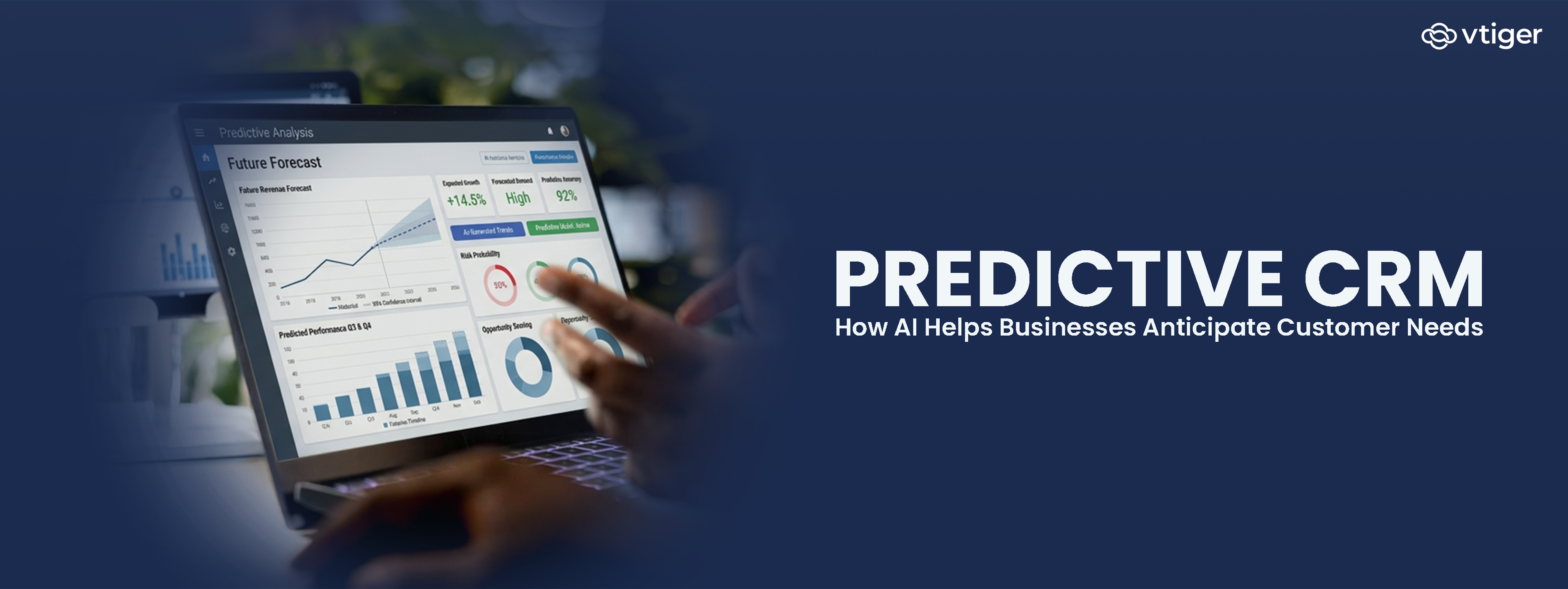
Most CRM systems tell businesses what has already happened. Predictive CRM uses AI and historical data to help them understand what is likely to happen next.
A sales team can see which deals are open, but predictive analytics can estimate which deals are more likely to close. A customer success team can track declining engagement, while predictive models can identify accounts at risk of churn. Similarly, a service team can use predictions to identify cases that may require attention before they escalate.
This is the shift from traditional CRM to predictive CRM.
Instead of waiting for an outcome and then responding, businesses can use patterns in their data to anticipate possible outcomes and make earlier, informed decisions. This helps sales, marketing, and customer service teams prioritize their efforts, allocate resources, and respond to customer needs more effectively.
What Is Predictive CRM?
Predictive CRM software uses artificial intelligence (AI), machine learning, and predictive analytics within a customer relationship management system to estimate future customer behavior and business outcomes.
It analyzes historical and current data to identify patterns associated with outcomes such as lead conversion, deal closures, customer churn, and purchase behavior.
Adobe’s Customer AI documentation explains how AI analyzes customer data to predict behaviors such as churn or conversion likelihood. These insights help businesses identify potential risks, improve customer segmentation, and tailor marketing efforts to customer needs.
Predictive CRM software can generate outputs such as:
- Probability scores: Estimate the likelihood of an event, such as a lead converting into a customer.
- Forecasts: Predict future sales, revenue, or customer demand.
- Risk predictions: Identify customers, deals, or service cases that may require attention.
- Rankings: Prioritize leads or opportunities according to their likelihood of achieving a specific outcome.
- Classifications: Group records into categories, such as high-risk and low-risk customers.
For example, a predictive CRM might estimate that an opportunity is likely to close within the expected period. It could also identify an account with an elevated likelihood of churn based on declining engagement and historical customer behavior.
These predictions are not guarantees. They are evidence-based estimates that help teams understand where to focus their attention.
How Does Predictive CRM Work?
There are four key stages involved in turning customer data into useful estimates:
1. Collect relevant customer data
The CRM provides historical and current information, including customer profiles, sales activities, purchases, conversations, campaign interactions, and service cases.
The more relevant and reliable the data, the better the chance of identifying meaningful patterns.
2. Identify patterns in historical behavior
Machine learning models analyze past records to find relationships between customer behavior and business outcomes.
For instance, historical data may reveal that opportunities with consistent engagement, multiple stakeholders, and scheduled meetings are more likely to close.
3. Generate predictions
The model applies learned patterns to current records and estimates likely outcomes. These may include lead conversion probability, deal win probability, expected closing time, or customer churn risk.
4. Bring predictions into business workflows
Predictions become more useful when employees can access them where they make decisions. For example, a churn score displayed on a customer account can help an account manager investigate a potential risk without switching between multiple systems.
The prediction informs the decision; it does not replace human judgment.
What Can Predictive CRM Predict?
Predictive CRM can support several business functions, from sales forecasting to customer retention. Specific predictions depend on the available data, the model used, and the business outcome being measured.
| Business area | What AI can predict | How teams can use it |
| Sales | Lead conversion, deal closure, sales cycle length | Prioritize promising leads and identify at-risk deals |
| Marketing | Campaign response, purchase frequency, channel effectiveness | Focus campaigns on audiences likely to respond |
| Customer service | Case escalation, SLA breach risk, customer satisfaction | Address potentially critical cases earlier |
| Customer retention | Churn likelihood, renewal potential, customer lifetime value | Identify accounts that may need attention |
| Business operations | Demand patterns, unusual activity, process risks | Plan resources and investigate emerging issues |
Does data quality matter in Predictive CRM?
Yes, data quality matters. If customer records are incomplete, outdated, inconsistent, or disconnected, the resulting predictions may be less reliable.
Consider a churn prediction model. If the CRM does not consistently capture purchases, support cases, customer interactions, account status, and engagement, the model may miss important signals that distinguish healthy customers from those at risk.
Businesses should focus on the following areas:
- Accurate records: Maintain correct customer details and minimize duplicate entries.
- Complete interaction history: Capture relevant emails, calls, meetings, purchases, and support conversations.
- Consistent processes: Use standardized deal stages, case categories, customer classifications, and status definitions.
- Reliable outcome data: Ensure that historical records reflect what actually happened, such as whether a lead converted or a customer churned.
- Connected information: Link relevant data across sales, marketing, service, and other business functions.
Why unified customer data makes predictions more useful
Customer behavior rarely stays within a single CRM module. A customer might engage with a marketing email, speak with a sales representative, open a support case, buy a product, and later renew a subscription.
When this information sits in disconnected systems, predictive models may see only part of the customer relationship.
A unified view can bring these signals together, helping the business understand the broader context. For example, declining engagement might appear less concerning when viewed alone. When combined with unresolved support cases and an approaching renewal, it may indicate a more significant risk.
How to Implement Predictive CRM
Businesses do not need dozens of predictive models to get started. A focused approach built around a specific business problem is often more practical.
- Start with a business decision: Identify a decision that would benefit from knowing what is likely to happen. Examples include prioritizing leads, identifying at-risk deals, reducing churn, or preventing SLA breaches.
- Define the outcome: Specify what the model should predict. For example, determine whether a lead will convert within a defined period or whether a customer will churn before renewal.
- Assess your data: Review data completeness, accuracy, historical depth, consistency, and the availability of known outcomes. Address major gaps before relying on predictions.
- Build and validate the model: Evaluate whether the model makes useful predictions against historical or separate test data. Examine both its errors and its ability to identify meaningful patterns.
- Integrate predictions into workflows: Display relevant scores, forecasts, or risk alerts where employees make decisions. Avoid hiding important insights in a separate dashboard that people rarely use.
- Measure business impact: Track outcomes like conversion rates, retention, forecast accuracy, case resolution times, or customer satisfaction. Establish a baseline for comparison.
- Monitor and improve: Customer behavior changes over time. Review model performance periodically, investigate inaccurate predictions, and update the approach when business conditions or data patterns change.
It is also important to establish appropriate access controls and governance. Employees should understand what a prediction means, which factors influence it, and when human review is necessary.
For more guidance on responsible AI adoption, see Vtiger’s article on AI security, privacy, and governance.
Predictive AI Designer in Vtiger CRM
Vtiger’s Predictive AI Designer helps businesses use historical CRM data to build predictive models and generate insights that support better decision-making. Instead of relying only on past reports, businesses can use these models to identify patterns and estimate likely outcomes based on available data.
For example, a sales team could use predictive insights to identify deals that are less likely to close, while a customer service team could use them to identify customers who may need additional attention. These predictions help teams prioritize efforts and act earlier. The accuracy and usefulness of the predictions depend on the quality of the data and how well the model fits the business objective.
Predictive AI Designer brings predictive capabilities into the CRM environment, helping businesses turn customer and sales data into actionable insights.
How Vtiger NextGen Can Extend Predictive AI Across Business Applications
Predictive AI becomes more valuable when its insights can be used across the applications and workflows where business decisions happen. This is where Vtiger NextGen takes the concept further.
Vtiger NextGen is an AI-native, metadata-driven, composable platform that allows businesses to build applications around their specific needs. It brings together business data, workflows, applications, and AI capabilities on a shared foundation.
By bringing predictive models together with relevant data, workflows, and AI agents, NextGen provides a broader environment for using predictive insights across different business applications—not just within a single CRM module. The goal is to help businesses move from predicting what might happen to using those insights to guide timely, context-aware actions.
Frequently Asked Questions (FAQs)
What is predictive CRM?
Predictive CRM uses AI and historical customer data to identify patterns, forecast future outcomes, and anticipate customer needs. It helps businesses make informed decisions about sales opportunities, customer retention, marketing, and customer service.
How does AI help predict customer behavior?
AI analyzes historical interactions, purchase patterns, engagement, and other relevant customer data to identify trends and estimate likely future behaviors. Businesses can use these predictions to identify potential churn, prioritize sales opportunities, and personalize customer experiences.
What is the difference between predictive CRM and traditional CRM?
Traditional CRM primarily stores customer information and tracks past and ongoing interactions. Predictive CRM uses AI to analyze that data and estimate what might happen next, helping businesses make proactive rather than purely reactive decisions.
What can predictive AI models predict in CRM?
Depending on the available data and model, predictive AI can help estimate deal conversion likelihood, customer churn risk, future sales outcomes, purchase behavior, and customer engagement patterns.
What is Predictive AI Designer in Vtiger CRM?
Predictive AI Designer is a Vtiger CRM feature that lets businesses build and train predictive models using historical CRM data. It can help forecast task completion times, identify leads or deals likely to convert, and anticipate potential SLA violations.
Is predictive AI the same as generative AI?
No. Predictive AI analyzes existing data to estimate future outcomes, such as conversion likelihood or task completion time. Generative AI creates new content, such as emails, summaries, and responses. Businesses can use both to improve decision-making and productivity.
What are the limitations of predictive CRM?
Predictive CRM depends on data quality, the relevance of historical patterns, and the suitability of the predictive model. Incomplete or outdated data can affect predictions, and changing customer behavior may reduce accuracy. Businesses should evaluate model performance regularly and use predictions alongside human judgment.