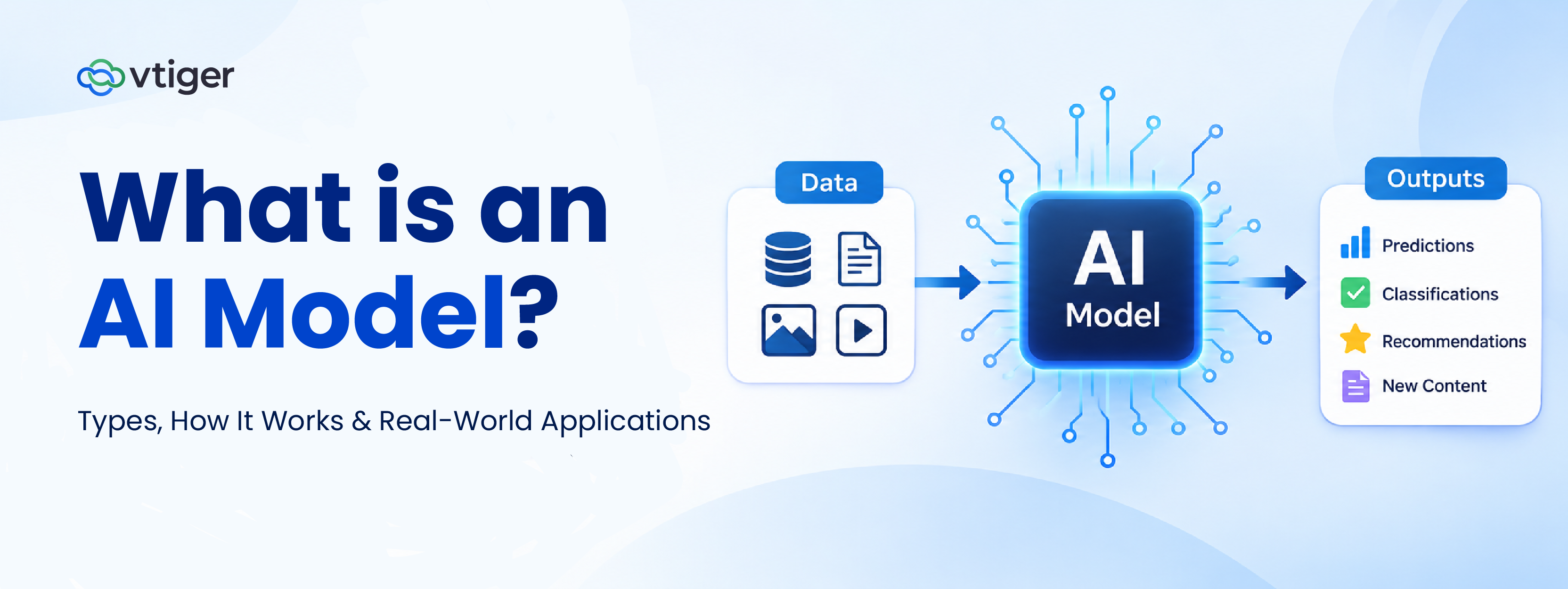
An AI model is a computer system trained on data to recognise patterns and produce outputs such as predictions, classifications, recommendations, or new content. Models learn in different ways, including supervised, unsupervised, reinforcement, and deep learning. They power fraud detection, personalised recommendations, virtual assistants, image recognition, and business forecasting.
Every time a bank blocks a suspicious card payment, a streaming service suggests a film, or a chatbot answers a question, a trained model is doing the work. The model is the part of artificial intelligence that turns data into a useful output.
A model holds what a system has learned from examples, so it can handle new cases without a person writing a rule for each one. Better data and better models usually mean more useful results.
A model is not the same as the product people use. Chatbots, scoring features in business software, and photo apps are AI tools or applications that run one or more models underneath. Confusing the two makes it harder to compare products or judge what a feature can really do.
Accelerate Business Growth with Vtiger
15-day free trialNo credit card requiredFull product access
Almost there!
Redirecting you to your free trial…
What Is an AI Model?
An AI model is a system trained on data to find patterns and turn new inputs into outputs such as predictions, classifications, recommendations, or generated content. It learns from examples instead of following only hand-written rules. Its behavior depends heavily on the data it learned from and how it was trained.
The purpose of a model is to apply past patterns to new cases. During training, it adjusts internal values called parameters until its outputs match known results as closely as possible. Afterward, those parameters hold what it has learned, so it does not need a copy of the original examples to work.
Data and training shape almost everything a model does. A model trained on complete, representative examples tends to perform well on similar cases. A model trained on narrow, outdated, or skewed examples carries those flaws into its outputs, no matter how advanced the method. It cannot know what its data never showed it.
Three related terms are easy to mix up.
| Term | What it is | Churn example |
|---|---|---|
| AI algorithm | The method used to learn from data | A training procedure that finds patterns in past customer records |
| AI model | The trained result that scores or generates for new cases | The trained predictor, with its learned parameters, that rates each customer’s risk of leaving |
| AI application or tool | The product people use, built around one or more models | A dashboard that shows account managers each customer’s churn risk |
Now see the model at work. A company gathers records of customers who stayed and customers who left, with details such as how often each used the product and how many support requests each raised. A model trained on those records learns which combinations tend to come before cancellation. For a current customer, it returns a risk score, such as 0.7 on a scale from 0 to 1.
How Does an AI Model Work?
An AI model works through a repeating cycle. Teams collect and prepare data, train the model on examples, evaluate it on cases it has not seen, use it to produce outputs on new data, and then monitor its performance as conditions change. Each stage affects the quality of the next one.
A team that understands how machine learning works is better placed to question an output before acting on it.
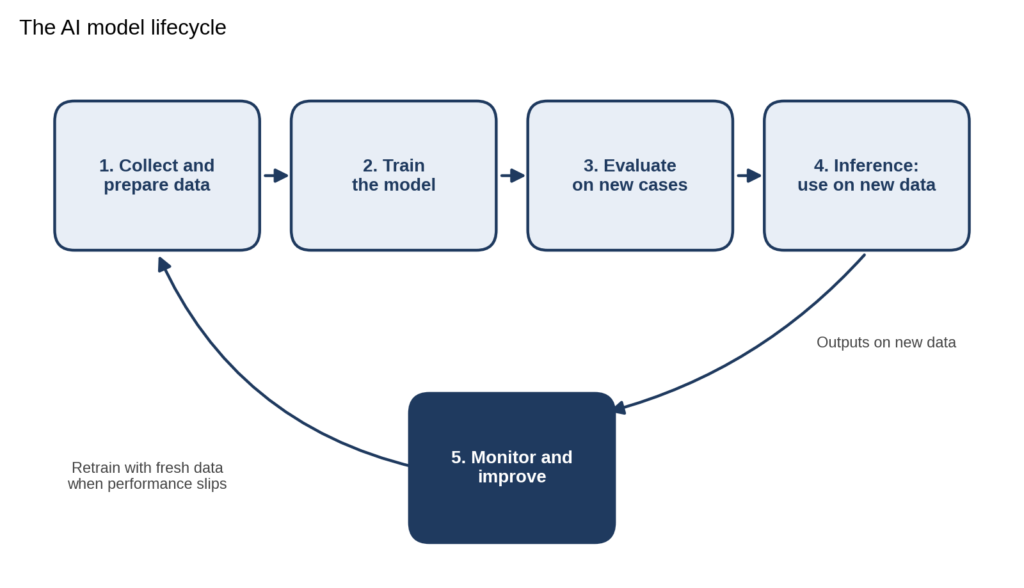
Figure 1. The five stages of the AI model lifecycle, with monitoring feeding back into new data and retraining.
- Data collection and preparation. Teams gather relevant, reliable examples, then clean them, remove duplicates, and fix errors. Weak data at this stage limits everything that follows.
- Model training. The model processes the examples and adjusts its parameters to reduce its errors.
- Model evaluation. The model is tested on data it did not see during training. Teams measure accuracy and look for weak spots, such as types of cases it handles poorly.
- Inference. The trained model receives new data and produces an output. It applies what it learned and does not learn from each new input.
- Monitoring and improvement. Teams compare outputs with real outcomes, watch for changes in the data, and retrain the model when performance slips.
A card fraud model shows the cycle in practice. Training data holds a large set of past transactions, each labeled genuine or fraudulent, with details such as amount, location, merchant type, and time of day. The model learns which combinations look risky. When a new payment arrives, it returns a fraud score within moments. The issuer sets a threshold. A payment scoring above it is held for a text confirmation, and one below it goes through. Fraudsters change tactics, so the bank monitors results and retrains the model regularly.
What Are the Different Types of AI Models?
AI models are commonly grouped by how they learn: supervised, unsupervised, reinforcement, deep learning, and generative models. In practice, these groups overlap. A deep learning model can be supervised or generative, for example, so a single model may belong to more than one category.
Each type suits a different kind of problem. The sections below describe the purpose of each one, with examples.
Supervised Learning Models
Supervised models learn from labelled examples, where each input comes with the correct answer. After training, they predict the answer for new inputs. A spam filter learns from emails marked as spam or not spam, then sorts incoming mail. A sales forecasting model learns from past months of sales and the factors around them, then estimates next quarter’s revenue. These examples show the two main tasks: classification, which picks a category, and regression, which predicts a number.
Unsupervised Learning Models
Unsupervised models work with unlabelled data, so nobody tells them the right answer. Instead, they look for structure, such as groups of similar items or unusual cases. Customer segmentation is the classic example. A model reviews purchase history, visit frequency, and order size, then sorts customers into groups with similar behaviour. Marketing teams can then decide what each group needs, because the model found the groups without being told what to look for.
Reinforcement Learning Models
Reinforcement learning models learn by acting, receiving feedback, and adjusting. The model earns rewards for good outcomes and penalties for poor ones. Over many attempts, it learns a strategy that earns more reward. Robotics is a common example, where a robot arm learns to grasp objects through trial and error. Systems that choose actions step by step, such as route planners and game-playing programs, use the same idea.
Deep Learning Models
Deep learning models are neural networks with many layers. Early layers pick up simple features, and later layers combine them into complex ones. In a photo, that might mean edges first, then shapes, then whole objects. This depth lets them handle images, speech, and text, where writing rules by hand is impractical. The trade-off is cost, because they usually need large datasets and substantial computing power, and their reasoning is harder to explain.
Generative AI Models
Generative models create new content instead of only labelling or predicting. They learn the patterns in large collections of text, images, audio, or code, then produce new items that follow those patterns. Large language models (LLMs) are the best-known example, writing, summarising, and answering questions in text. Generative AI in CRM extends to drafting proposals, summarising calls and preparing support replies, with a person checking each draft. Because the output is plausible rather than guaranteed correct, it needs checking.
What Are the Most Common AI Model Architectures?
An architecture is the internal design of a model, meaning how its parts are arranged and connected. Common ones include decision trees, neural networks, convolutional neural networks, transformers, and large language models. The choice of architecture affects which kinds of data a model handles well and how easily its results can be explained.
| Architecture | How it works | Typical use |
|---|---|---|
| Decision tree | Branching questions lead step by step to a prediction, much like a flowchart | Prediction and classification, especially where results must be easy to explain |
| Neural network | Layers of connected units learn patterns by adjusting the strength of their connections | Forecasting, pattern recognition, and many other tasks |
| Convolutional neural network (CNN) | Filters scan an image for local features such as edges and textures | Image and visual recognition |
| Transformer | An attention mechanism weighs how each part of a sequence relates to the others | Language processing and generative AI |
| Large language model (LLM) | A transformer-based model trained on very large collections of text to process and generate language | Chat assistants, drafting, summarising, and coding help |
Learning approach, architecture, and application category are three different ways of classifying the same model. An LLM, for example, has a transformer architecture, learns largely from unlabelled text and is used in chat assistants. None of these labels excludes the others, which is why a single model can appear under several headings in different guides.
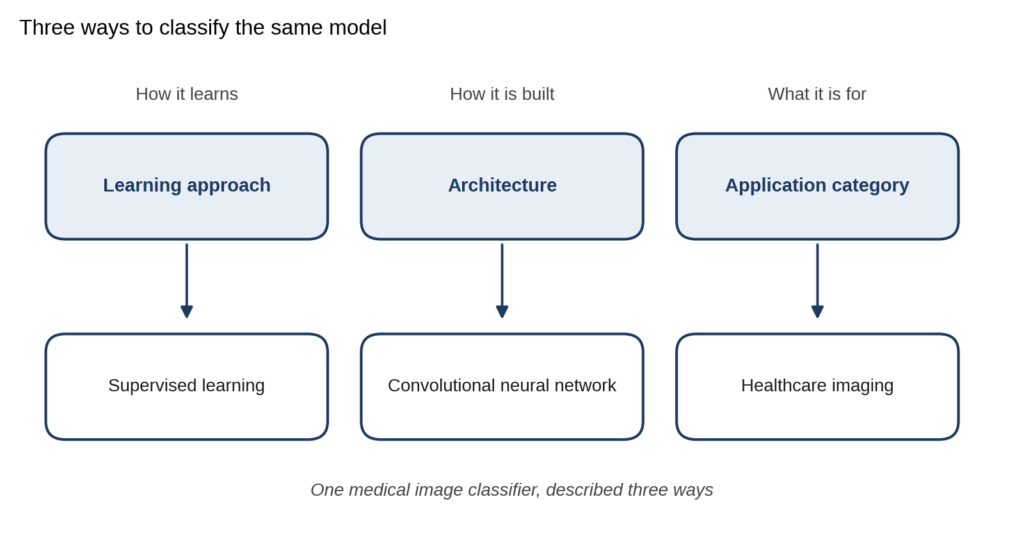
Figure 2. A single model can be described by how it learns, how it is built, and what it is used for.
What Are the Real-World Applications of AI Models?
AI models are used wherever large amounts of data contain patterns that people cannot review one by one. Common uses include lead scoring and forecasting in sales, image analysis in healthcare, fraud detection in finance, recommendations in retail, and ticket routing in customer service.
Each industry below draws on the model types described earlier. Teams that want more examples by department can read this overview of business use cases for AI.
AI Models in Business and Sales
Sales teams use models to rank leads by their likelihood to convert, forecast revenue from pipeline history, and group customers by behaviour. Recommendation models suggest the next product or action for each account. These outputs support decisions rather than replace them, because a salesperson may know context that the data does not show.
AI Models in Healthcare
Models analyse medical images, estimate patient risk, and support clinical decisions. An image model might highlight an area of a scan for closer review, and a risk model might flag patients who are likely to need follow-up care. Professional oversight remains essential, because clinicians carry responsibility for diagnosis and treatment, and a model can be wrong.
AI Models in Finance
Banks and payment firms use models for fraud detection, credit-risk assessment, and transaction monitoring. Fraud detection follows the lifecycle pattern above. Credit-risk models estimate how likely a borrower is to repay, and monitoring models watch transaction streams for unusual activity. These decisions affect access to credit, so fairness and explainability matter.
AI Models in Retail and E-commerce
Retailers use models for personalised product recommendations, demand forecasting, and customer behaviour analysis. A recommendation model suggests items based on browsing and purchase history. A demand model estimates how much stock each store needs, and behaviour analysis shows which customers buy often or may be drifting away.
AI Models in Customer Service
Service teams use chatbots to answer routine questions, classification models to sort incoming conversations by topic or urgency, and generative models to suggest replies to support staff. The category a model assigns lets routing rules an admin configured send each ticket to the right team. Support staff handle complex or sensitive cases. Agents stay in the loop for complex or sensitive cases.
What Is the Difference Between an AI Model and an AI Algorithm?
An algorithm is a procedure for solving a problem. A model is the trained result that applies learned patterns to new inputs. In machine learning, a training algorithm processes data and produces a model, so the algorithm is the method and the model is the outcome.
IBM’s explainer on AI models describes the algorithm as the logic by which a model operates. Three ingredients work together to produce a model. The algorithm sets the learning procedure, the training data supplies the examples, and the parameters store what was learned. Change the data, and the same algorithm produces a different model.
A sales example makes this concrete. Suppose a team uses linear regression, a standard algorithm, to predict monthly sales. Trained on three years of past sales, advertising spend, and seasonal patterns, it produces a model with specific parameters. Such as how much each extra $1,000 of advertising adds to sales. The regression method is the algorithm, and the trained set of parameters is the model. Given next month’s planned spend, the model returns a forecast.
What Is the Difference Between an AI Model and an AI Tool?
An AI model performs a specific prediction, classification, or generation task. An AI tool is the application or service that uses one or more models to give people a usable capability.
The model produces the output; the tool is everything around it, including the interface, data connections and controls.
A single tool often combines several models and other software. A customer-support assistant might use one model to classify an incoming message, a second to find relevant help articles, and a third to draft a reply. Ordinary software then logs the case and enforces permissions. Swapping one model inside the tool can change the quality of its answers without changing what the user sees.
Today’s models are specialized, and each handles a defined kind of task, even when it handles many tasks of that kind. Artificial general intelligence (AGI) is a different and still hypothetical idea: a system that could learn and reason across almost any domain at a human level. No current model or tool is generally agreed to meet that description.
What Are the Benefits and Limitations of AI Models?
AI models can process large volumes of data, find patterns, support predictions, automate repetitive work, and personalise interactions. They can also be wrong, reflect biased training data, raise privacy concerns, and degrade as conditions change. Human review and continuous evaluation keep their value real and their risks visible.
Benefits of AI Models
- Process large volumes of data. A model can review millions of records, messages, or images in the time a person would review a handful.
- Identify patterns and support predictions. Models can find relationships across many variables that are hard to spot manually, then estimate likely outcomes.
- Automate repetitive tasks. Sorting, tagging, summarising, and routing can run automatically, which frees people for work that needs judgement.
- Personalize recommendations and interactions. Models tailor suggestions and responses to each person’s history and context.
Limitations of AI Models
- Inaccurate outputs. A model can give a confident but wrong answer, especially on cases unlike its training data. Generative models can state false facts fluently.
- Biased training data. If historical data reflects unfair patterns, the model may repeat or amplify them.
- Privacy concerns. Training and using models can involve personal or confidential data, which needs access controls and clear policies.
- Performance degradation. Customer behaviour, markets, and language change, so a model that worked well last year may drift.
Why Human Review and Evaluation Matter
For these reasons, people should review high-impact outputs, and teams should test models regularly against real outcomes. Human review catches errors that a model cannot see in itself. Continuous evaluation shows when performance starts to slip, so the fix arrives before the damage does.
How Can Businesses Choose the Right AI Model?
Choose an AI model by starting with the business problem, not the technology. Define the outcome you want, check what data you have, match the task to a model type. Then compare accuracy, speed, cost, and scalability, test on realistic examples, and review security, privacy, explainability, and oversight needs before committing.
A polished demonstration can make almost any model look impressive. A structured process protects you from choosing on appearance.
- Define the problem and outcome. State which decision or task the model should improve and how success will be measured, such as fewer missed renewals.
- Check your data. Identify what data exists, how complete and accurate it is, and whether it connects to the outcome you want to predict.
- Match the task to a model type. Decide whether you need prediction, classification, clustering, or content generation, because each points towards different model families.
- Compare practical trade-offs. Weigh accuracy, speed, cost, and scalability. A slightly less accurate model that is faster and cheaper can be the better choice.
- Test on realistic examples. Use your own records, edge cases, and past outcomes, not only a vendor demonstration. Note how the model fails as well as how it succeeds.
- Evaluate security, privacy, explainability, and oversight. Confirm how data is protected, whether results can be explained to the people affected, and where humans approve decisions.
How Are AI Models Used in CRM Systems?
In a CRM, AI models turn customer records into predictions and drafts that support daily work. They can predict lead conversion and deal outcomes, flag churn risk, recommend next actions, and generate or summarise customer communications. Their output is only as reliable as the data connected to them.
Each use follows the pattern described earlier. Historical CRM records train a model, which then scores or drafts for new records.
- Predicting lead conversion and deal outcomes: Models learn from past won and lost deals which signals matter, then score new leads and deals. In the One AI edition, Calculus AI scores leads and forecasts sales from the records the team already keeps.
- Identifying behaviour patterns and churn risk: Falling usage, rising support requests, and quieter communication can resemble earlier cancellations. The value comes when the flag reaches the account owner in time to act.
- Recommending next actions: A model can suggest which contact to prioritize or what follow-up fits the deal stage, while the salesperson decides. Calculus AI provides deal scores and next-action recommendations.
- Generating or summarising customer communications: Generative models can draft replies, summarise calls, and prepare follow-ups, which a person should review before sending. Vtiger One includes generative AI and prompt-building capabilities for this kind of work.
Models can only use what the CRM holds. Duplicate contacts, outdated deal stages, and missing activities lead to weak scores, which is why CRM data quality deserves attention before any model is switched on.
AI models do not understand a customer relationship the way a person does. A churn model may flag an account that has already agreed to renew, because that agreement happened on a call nobody logged. Scores are probabilities rather than facts, and they cannot repair poor data or replace judgement. Treat them as aids that show people where to look first. Through its GPT integration in CRM, Calculus AI can generate customer-facing content with CRM context, which a person reviews before sending.
Where to Start With AI Models
A practical first step is to pick one decision in your business that repeats often, such as which leads to the call first. Write down the outcome you want, list the data you already hold about it, and check that data for gaps. That short exercise shows whether a model could help, and what it would need.
Frequently Asked Questions (FAQs)
What is an AI model in simple terms?
An AI model is a program that has learned patterns from examples and uses them to answer new questions. It keeps a compact set of learned values and applies them to each new input.
How does an AI model learn from data?
A model starts with arbitrary values, makes a prediction on an example, and compares it with the correct answer. The gap between them is the error. A training algorithm then nudges the model’s parameters to shrink that error, and the cycle repeats across many examples until improvement levels off.
What are the main types of AI models?
The main types are supervised, unsupervised, reinforcement, deep learning, and generative models. A quick memory aid: supervised learns from answers, unsupervised finds groups, reinforcement learns from rewards, deep learning handles complex data, and generative creates content. Real products often combine several types inside one system.
What is the difference between an AI model and machine learning?
Machine learning is a method, and a model is what it produces. Machine learning is the set of techniques that let systems learn from data, while an AI model is the specific trained artefact that results. Not every AI model uses machine learning, because some older systems rely on hand-written rules.
Are ChatGPT and other AI tools AI models?
Not exactly, because ChatGPT is an AI tool, meaning a product that people use. It runs on large language models, which are the AI models underneath. Many apps follow the same pattern. The tool supplies the interface, safety controls, and extra software, while the model generates the underlying language.
What are examples of AI models used in everyday life?
People meet AI models every day. Email spam filters, map apps that estimate arrival times, streaming recommendations, voice assistants, photo apps that group faces, and bank alerts for unusual payments all rely on them. Most work quietly in the background, so people notice the result without realising a trained model produced it.
Can AI models make mistakes?
Yes, models make mistakes when data is incomplete, biased, or unlike what they saw in training, and generative models can invent plausible but false details. Mistakes are easier to catch when outputs include confidence scores, when people review high-stakes results, and when teams track errors over time instead of trusting one test.
How do businesses choose the right AI model?
Begin with a narrow, measurable problem and test candidate models on your own data. Include non-technical staff in the trial, because they will judge whether outputs are usable. Run a small pilot, compare it with the current process, and expand only when the model proves reliable.