A CRM can tell you what happened.
A customer record shows when a lead entered the database. An opportunity tracks its current stage. A support case captures a customer’s issue, while marketing data records email opens and campaign interactions.
But knowing what happened is only the beginning.
The more important questions are:
- What does this customer need right now?
- Which customers are showing signs of buying intent?
- Which deals are at risk?
- What is causing customers to disengage?
- What should a sales or service team do next?
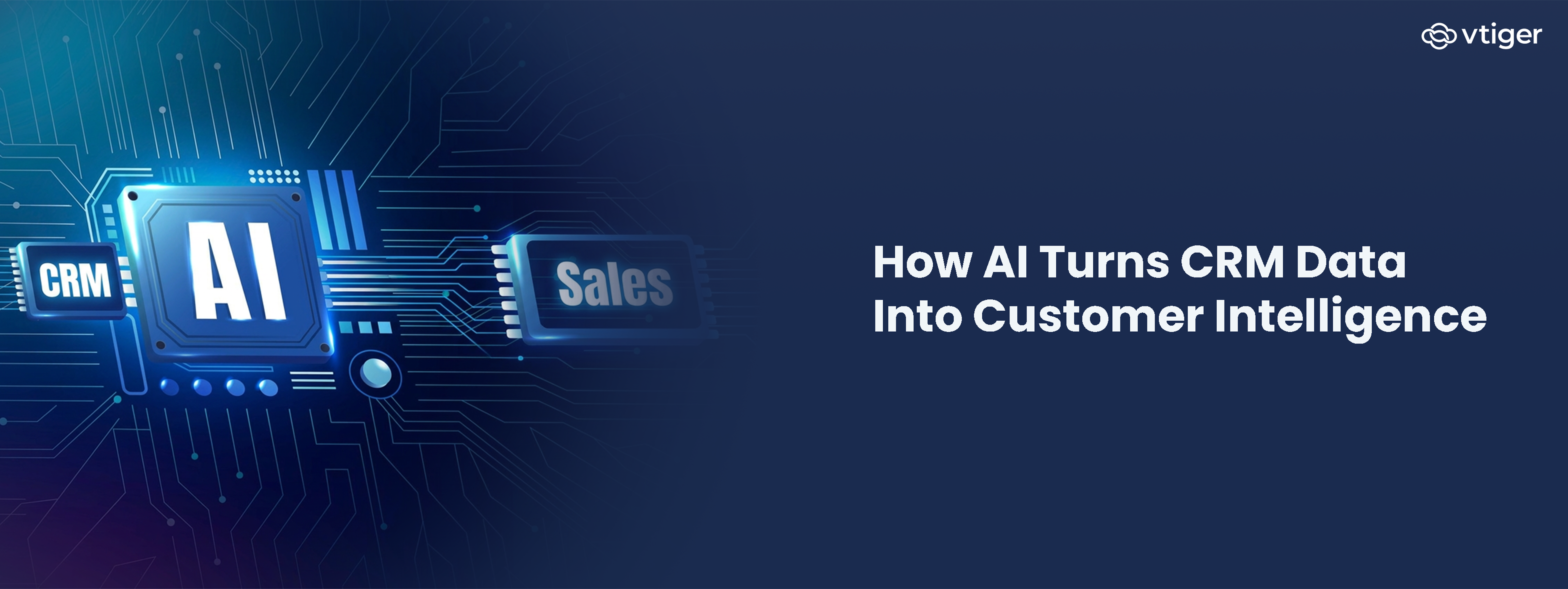
Answering these questions requires more than storing CRM data. It requires turning that data into customer intelligence.
This is where AI changes the role of CRM.
AI can analyze large volumes of structured and unstructured customer information, identify relationships between seemingly unrelated signals, detect patterns, make predictions, and recommend actions.
For example, the World Economic Forum explains how AI can analyze structured CRM data alongside unstructured customer feedback to support more relevant, personalized customer experiences.
What Is Customer Intelligence?
Customer intelligence is the process of using artificial intelligence to analyze customer behavior, preferences, needs, intent, and likely future actions.
It goes beyond basic customer information. For example, knowing that a customer purchased a product worth $10,000 is customer data.
Knowing that the same customer:
- Has increased product usage.
- Recently visited a pricing page.
- Engaged with three marketing emails.
- Contacted support about an additional feature.
- Has an upcoming renewal.
Creates a much richer picture.
AI can connect these individual data points and identify a potential business signal: the customer may be exploring additional products or services.
That is customer intelligence.
Top 6 ways AI Turns CRM Data into Customer Intelligence
AI turns CRM data into customer intelligence through a series of connected capabilities. It follows a process where data is collected, analyzed, interpreted, and eventually translated into action.
Let’s look at the 6 stages below:
1. AI Collects and Connects Customer Data
A CRM contains information from different stages of the customer lifecycle.
This can include:
- Contact and account information.
- Leads and opportunities.
- Emails and conversations.
- Calls and meetings.
- Website visits and campaign interactions.
- Purchase history.
- Support cases.
- Customer feedback.
- Tasks and activities.
- Product or service usage.
Individually, these data points may not reveal much. AI becomes more useful when it connects these pieces of information
For example, an inactive sales opportunity may not appear risky when viewed only through its deal stage. But when AI considers the last email exchange, previous engagement, meeting history, deal value, and customer activity, it can identify a more meaningful pattern.
This is why having connected CRM data matters.
Read the CRM Data Quality blog to understand why AI needs accurate, complete, and connected customer information to produce useful insights.
2. AI Finds Patterns Humans May Miss
CRM systems can store thousands or even millions of records. Humans cannot realistically examine every interaction and identify patterns across them.
AI can.
Machine learning models can analyze historical data to find relationships between customer behavior and outcomes.
For example, AI might discover that deals are more likely to convert when:
- Prospects attend a product demonstration.
- Respond to follow-up emails within a specific period.
- Engage with specific content.
The system can then use these patterns to identify similar situations in new customer records. This transforms CRM data from a historical archive into a source of continuous intelligence.
3. AI Adds Context to Customer Information
Data without context can be difficult to interpret. Consider a customer who has opened five emails. Is that a buying signal?
Not necessarily.
They could be researching a product, comparing alternatives, forwarding emails internally, or simply opening messages automatically. AI can interpret this activity alongside other signals, such as website visits, product interactions, previous conversations, and purchase history, to identify patterns that may indicate buying intent.
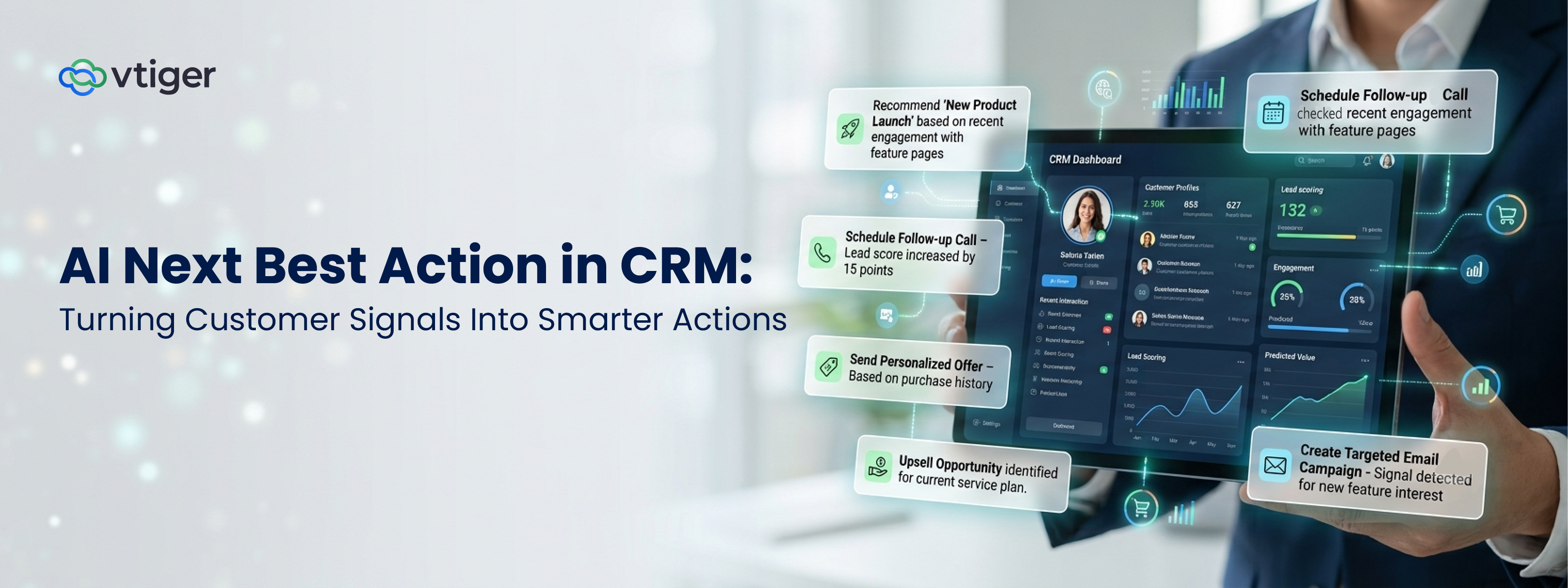
4. AI Recommends the Next Best Action
Consider a high-value opportunity that has shown no activity for several days. A traditional CRM may display the opportunity’s current stage and last interaction.
An AI-enabled CRM can analyze previous conversations, engagement history, deal stage, and customer activity to recommend a relevant next step.
For example, it might suggest scheduling a follow-up call, sharing a relevant case study, or addressing an unresolved customer concern.
These recommendations help sales teams prioritize their efforts and respond with greater context.
5. AI Turns Intelligence Into Action
Customer intelligence becomes far more valuable when it moves beyond insights and drives actions. This is where AI agents come into the picture.
Traditional AI can analyze CRM data, identify patterns, generate insights, or recommend what a salesperson or service rep should do next.
Integrating AI agents can take the next step by using those insights to carry out defined tasks within a workflow.
Instead of simply notifying a salesperson that a customer may need attention, an AI agent can gather the relevant customer context, determine the appropriate next step based on business rules, and initiate the required action.
6. AI Predicts What May Happen Next
One of the biggest differences between traditional CRM reporting and AI-driven customer intelligence is the ability to move from historical analysis toward prediction.
Traditional CRM reports can tell you how many leads entered the pipeline, which deals are open, or how much revenue was generated last quarter.
AI can analyze these historical patterns along with current customer behavior to identify what is likely to happen next.
Read More: 12 Practical AI CRM Use Cases for Your Business
What Types of CRM Data Can AI Analyze?
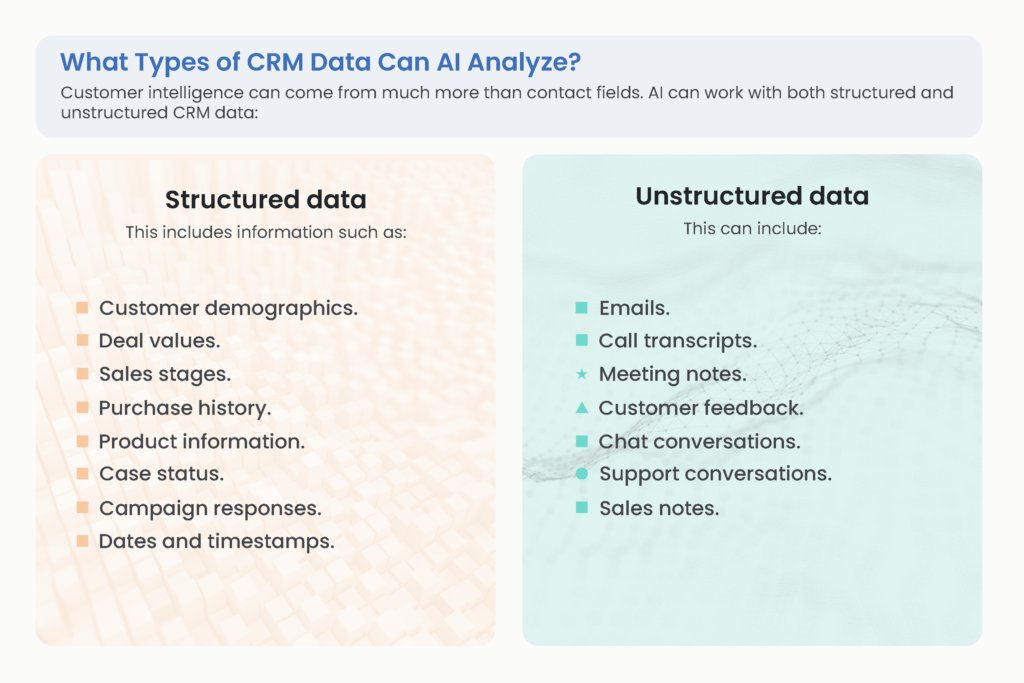
Combining both types of information provides a more complete picture of the customer.
For example, a CRM may show that a deal is in the negotiation stage. But an AI system analyzing the associated emails and conversation notes may identify that the customer is concerned about pricing.
That additional context can make the intelligence far more useful.
How Customer Intelligence Helps Different Teams
Customer Intelligence helps sales, marketing, and customer support teams make smart decisions. Let’s explore in more detail how it can support day-to-day business operations:
Sales
AI can help sales teams:
- Identify high-intent prospects.
- Prioritize leads.
- Detect stalled opportunities.
- Assess deal health.
- Forecast revenue.
- Identify buying signals.
- Recommend next actions.
- Prepare for customer conversations.
Instead of asking salespeople to manually analyze every interaction, AI can bring important signals to their attention.
Marketing
Marketing teams can use customer intelligence to understand:
- Content that customers engage with.
- Customer segments.
- Customer behavior.
- Campaigns.
- Customer journey.
Customer Service
For customer service teams, AI can connect a customer’s current issue with their broader history.
It can help identify:
- Previous cases.
- Repeated problems.
- Customer sentiment.
- Relevant account information.
- Suggested responses.
- Escalation signals.
- Potential recurring issues.
This allows support teams to move beyond resolving an individual ticket and understand the customer relationship behind the case.
CRM Data vs. Customer Intelligence: What’s the Difference?
The distinction is simple but important:
| CRM Data | Customer Intelligence |
| Records customer information | Interprets customer information |
| Shows historical activity | Identifies patterns |
| Requires human analysis | Uses AI to provide relevant insights |
| Supports record-keeping | Supports decision-making |
How Vtiger Turns CRM Data Into Customer Intelligence
Vtiger brings AI into the CRM through Calculus AI, which uses CRM data to provide predictive insights, recommendations, conversation analysis, and smart assistance
For example, Calculus AI can analyze signals to provide:
- Deal scores.
- Sales forecasts.
- Next-best-action recommendations.
- Best-time-to-contact suggestions.
- Conversation insights.
- Sentiment analysis.
- AI-generated responses.
This changes the role of CRM data. Instead of simply providing information that employees look up, it can actively support future decisions.
Take Customer Intelligence Beyond CRM With Vtiger NextGen
With the new NextGen platform, businesses can do more than ask AI to analyze customer data or recommend an action. They can build purpose-specific applications such as a recruitment app or a customer portal and extend AI capabilities into the workflows.
Rather than limiting AI to predefined CRM capabilities, NextGen provides a platform where businesses can bring together their data, processes, AI agents, and actions to build apps and create an environment where customer intelligence becomes a part of the applications and processes.

Frequently Asked Questions (FAQs)
What is customer intelligence?
Customer intelligence uses artificial intelligence to analyze customer data, identify patterns and signals, understand customer behavior, predict outcomes, and recommend relevant actions.
How does AI turn CRM data into insights?
AI analyzes structured and unstructured CRM data, connects information across customer interactions, identifies patterns, and uses those patterns to generate predictions, recommendations, and other actionable insights.
What CRM data can AI analyze?
AI can analyze customer profiles, sales opportunities, purchase history, emails, calls, meetings, support cases, campaign interactions, notes, feedback, and other relevant customer information.
Why is CRM data important for AI?
CRM data provides the customer context AI needs. Accurate, connected CRM data lets AI identify meaningful patterns and generate more relevant insights and recommendations.
How does Vtiger CRM use AI for customer intelligence?
Vtiger Calculus AI uses CRM data to provide capabilities such as deal scoring, sales forecasting, next-best-action recommendations, best-time-to-contact suggestions, and conversation analysis.