Customer relationship management has traditionally focused on just one important thing: keeping customer records in a centralized location and building meaningful relationships. CRM systems give sales, marketing, and customer service teams a shared place to store customer details, track interactions, manage pipelines, automate routine processes, and monitor performance.
With artificial intelligence getting embedded in CRM systems, CRM is evolving from software that primarily stores and organizes information into one that can analyze data, surface insights, recommend actions, and increasingly execute tasks.
This shift matters because customer data is becoming more valuable when it can be turned into action. Salesforce’s latest State of Service report highlights how AI can help teams create summaries, reports, service responses, and knowledge articles, allowing employees to spend more time on complex customer interactions.
So, what exactly is the difference between AI CRM and Traditional CRM?
In simplest terms, Traditional CRMs help businesses record information, while AI CRM uses that information to generate insights, predictions, and recommendations. Let’s understand the difference in more detail.
What is Traditional CRM
A traditional CRM is software that helps businesses manage customer relationships by centralizing customer data and organizing the processes around it.
Instead of keeping customer details in spreadsheets, email inboxes, documents, and separate applications, a traditional CRM brings information into one system. Teams can then use that information to manage leads, opportunities, customer interactions, tasks, and support requests. A CRM platform can also connect different stages of the customer journey.
How does traditional CRM work?
A traditional CRM generally works through structured records and predefined processes. For example, when a new lead enters the system, a CRM can:
- Create a lead record.
- Assign it to a sales representative.
- Record calls, emails, and meetings.
- Move the lead through predefined stages.
- Trigger reminders or notifications.
- Convert the lead into an opportunity.
- Generate performance reports.
Automation can reduce repetitive work, but the system generally follows rules the business creates.
What can a traditional CRM do?
A traditional CRM can help businesses:
- Store customer and company information.
- Track leads and opportunities.
- Manage sales pipelines.
- Record customer interactions.
- Schedule tasks and activities.
- Automate predefined workflows.
- Manage marketing campaigns.
- Track customer support cases.
- Create reports and dashboards.
- Share customer information across teams.
For example, a CRM can automatically assign an incoming lead to a salesperson based on territory or another predefined rule. Vtiger’s recent guide on CRM for Lead Management explains how CRM systems can centralize lead information, automate assignment and follow-ups, and help teams manage large volumes of leads.
Limitations of traditional CRM
Traditional CRM is useful, but it can place more responsibility on users.
A CRM may tell a sales representative that a deal has been inactive for 10 days. The representative still needs to review the deal, understand why it has stalled, decide what to do, and take action. Similarly, it can generate a sales report, but someone usually has to interpret the report and extract the outcome.
Common limitations include:
- Dependence on manual data entry.
- Heavy reliance on predefined rules.
- Manual interpretation of reports.
- Limited predictive capabilities.
- Time-consuming content creation.
- Difficulty handling large volumes of unstructured information.
- Human involvement is still required in many routine decisions and follow-up activities.
This doesn’t make traditional CRM ineffective. It simply means that the system primarily supports people in managing processes, rather than actively interpreting information and assisting with decisions.
What Is an AI CRM?
An AI CRM is a CRM software that uses artificial intelligence to analyze customer data, automate everyday tasks, recommend actions, generate insights, and help users with different CRM activities.
AI doesn’t replace the core CRM. Instead, it adds an intelligence layer to the information and processes already inside the system.
This distinction is important. Simply adding a chatbot or an AI writing feature does not necessarily make a CRM intelligent across the entire customer journey. AI becomes more useful when it can work with customer context and business data.
How does AI CRM work?
An AI CRM typically follows a process such as:
Collect data → Analyze information → Identify patterns → Generate insights → Recommend an action → User or AI Agent takes action
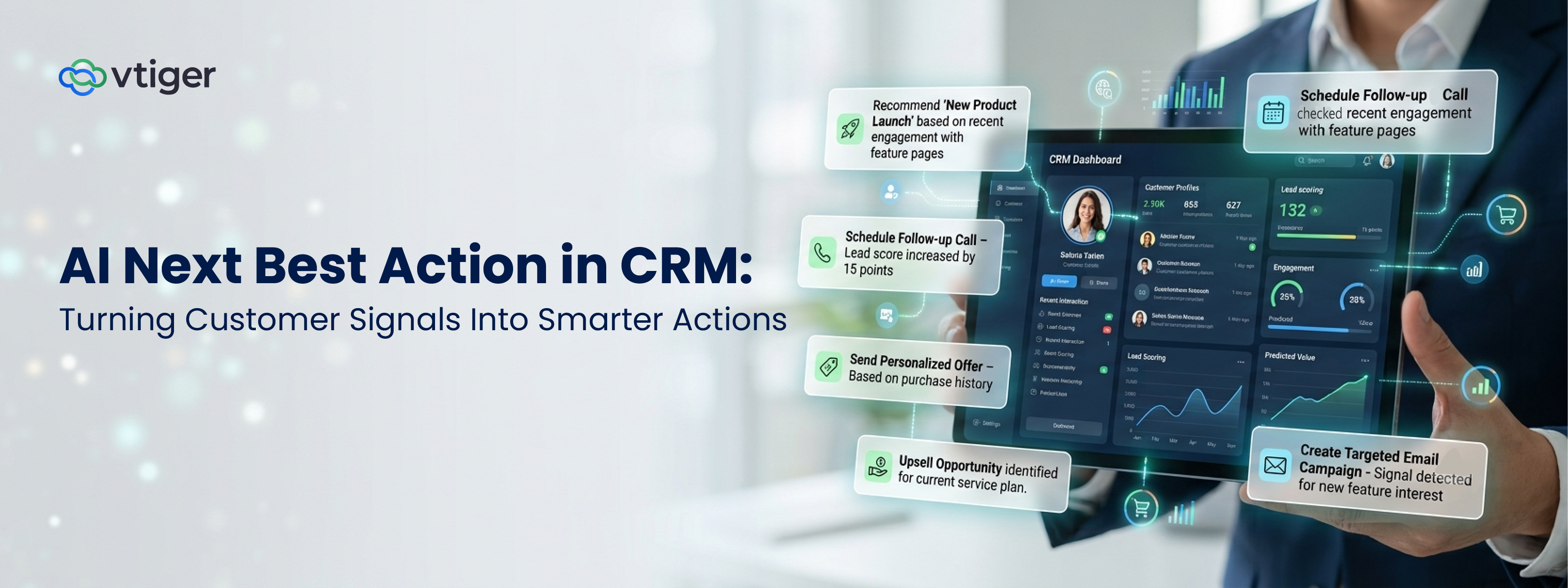
For example, an AI CRM could examine a customer’s previous interactions, purchase history, engagement, and current activity to identify potential opportunities or risks. Instead of asking a salesperson to manually search through several records, the CRM can offer relevant information and provide a recommendation. More advanced CRMs can have AI agents to carry out important functions like scheduling a meeting, and sending a follow-up email.
Explore this article to understand AI Automation
Top 7 Key Capabilities of AI CRM
Core Capabilities of AI CRM include:
- Predictive Lead Scoring
Instead of relying only on manually assigned scores or fixed rules, AI CRM can analyze historical patterns and customer behavior to identify leads that are more likely to convert. This helps sales teams spend more time on promising opportunities.
- Sales Forecasting
AI CRM can analyze historical sales data, pipeline information, and current deal activity to forecast likely sales outcomes. This helps sales teams understand future revenue and plan their efforts more effectively.
- Customer Segmentation
AI CRM can analyze customer data, behavior, interests, and interactions to identify meaningful customer groups. Businesses can use these segments to create more targeted campaigns and personalized engagement.
- Generative AI
AI-powered CRM systems can use Large Language Models (LLMs) to generate emails, summaries, responses, and other customer-facing content. This is particularly useful when employees spend significant time writing or summarizing information.
- Natural Language Queries
Users don’t always need to navigate multiple CRM screens to find information. With natural-language capabilities, they can ask questions in everyday language and receive answers based on available CRM data.
- Smart Recommendations
AI can identify patterns and recommend possible next steps. For example, it might identify a stalled deal, highlight relevant customer history, and recommend a follow-up.
- AI Agents
AI agents take AI-powered CRM a step further. Rather than only answering questions or making recommendations, agents can be designed to work toward a defined goal and perform multiple actions. Vtiger’s Agent Builder allows organizations to create AI agents for specific business requirements.
Traditional CRM vs AI CRM: Which one to choose?

The right choice depends on your business needs. A traditional CRM can be sufficient if your primary requirement is to organize customer data, manage sales activities, and automate predefined tasks.
An AI CRM can be a better choice for businesses that want to go beyond data management and use customer information to generate insights, make predictions, personalize interactions, and automate more complex tasks. For businesses looking to improve productivity and make faster, data-driven decisions, an AI CRM can offer greater value.
Benefits of AI CRM
Reduces repetitive work
AI CRM can assist with everyday activities such as summarizing conversations, drafting emails, and updating workflows. This way, teams can focus on other strategic tasks and make important business decisions rapidly.
Improves personalization
AI CRM can use customer context to help businesses deliver more relevant communication rather than treating every customer the same way.
Helps sales teams prioritize opportunities
Predictive scoring and recommendations can help sales reps focus on leads and deals that deserve attention.
Improves customer service
AI CRM can summarize customer history, suggest responses, identify sentiment, and help representatives find relevant information faster.
What Are the Limitations of AI CRM?
AI CRM is not automatically better just because it uses artificial intelligence. Its effectiveness depends heavily on the quality of the underlying data, how well the AI is configured, and how closely it fits the business process.
Some considerations include:
- Data quality: Poor, incomplete, or inconsistent CRM data can reduce the usefulness of AI-generated insights.
- Accuracy: AI-generated recommendations should be evaluated, particularly when they influence important customer or business decisions.
- Privacy and security: Customer information must be handled according to appropriate security, privacy, and access policies.
- Governance: Businesses need clear policies around how AI is used, what data it can access, and which actions it can perform.
- Human oversight: Organizations should determine which decisions AI can make and which require human review.
- Implementation: AI becomes more valuable when it is integrated into existing workflows rather than added as an isolated feature.
This is why successful AI adoption requires more than simply switching on AI features. Businesses need clear use cases, reliable data, appropriate controls, and measurable outcomes.
How Vtiger Is Bringing AI Into CRM
Vtiger is taking AI beyond individual CRM features with NextGen, its AI-native platform designed to help businesses build and manage applications around their specific needs. AI is built into the platform to work with business data, workflows, and processes, helping teams analyze information, get recommendations, automate tasks, and make better decisions.
NextGen also includes AI agents that can understand business context, work toward defined goals, and take actions within workflows. It also allows businesses to build composable applications tailored to their processes such as HR systems, recruitment, and real estate applications. By bringing CRM, AI agents, business data, workflows, and custom applications together, NextGen helps businesses adapt their applications as their needs change.

Frequently Asked Questions (FAQs)
What is an AI CRM?
An AI CRM is a customer relationship management system that uses artificial intelligence to analyze customer data, generate insights, predict outcomes, personalize interactions, automate tasks, and assist users with CRM activities.
What is the difference between AI CRM and traditional CRM?
Traditional CRM primarily stores and organizes customer information and automates predefined processes. AI CRM adds artificial intelligence to analyze data, generate insights, make predictions, personalize interactions, and recommend or perform actions.
Is AI CRM better than traditional CRM?
Not necessarily for every business. Traditional CRM can be sufficient for businesses that primarily need customer data management and rule-based automation. AI CRM can be useful when businesses need predictive insights, personalization, intelligent automation, or AI assistance.
What are the benefits of AI CRM?
The main benefits include reduced repetitive work, faster access to customer insights, better lead prioritization, improved forecasting, personalized communication, faster customer service, and more efficient use of CRM data.
Can AI CRM automate sales processes?
Yes. AI CRM can support sales automation through lead scoring, forecasting, recommendations, content generation, follow-up assistance, and workflow automation. More advanced systems can use AI agents to perform defined multi-step tasks.
Is every AI CRM an Agentic CRM?
No. An AI CRM can analyze data, generate content, make predictions, and provide recommendations without being agentic. An agentic CRM goes further by using AI agents that can reason through defined tasks and execute actions toward a goal.
What should businesses consider before adopting an AI CRM?
Businesses should consider data quality, security, integrations, AI accuracy, governance, human oversight, ease of adoption, and whether the CRM’s AI capabilities address their specific business needs and use cases.