For years, we have been using CRM to store business information, customer details, sales conversations, and other data. The State of Service Report by Salesforce clearly states that “82% of high-performing organizations use the same customer relationship management (CRM) platform across service, sales, and marketing — up from 62% just two years ago.”
However, with Artificial Intelligence (AI) coming into play, businesses can generate content, make predictions, analyze data, and help employees complete everyday tasks. And, as a cherry on the cake, the next evolution in the AI domain is Agentic CRM. AI agents in CRM can understand goals, work with business context, reason through tasks, and take actions on their own without any human assistance.
The center of this AI shift is Agentic AI. Unlike traditional AI systems, which can only respond to your prompts, these agents can understand business objectives and plan a series of actions to complete a particular task.
Let’s dive into it in detail.
What is Agentic CRM
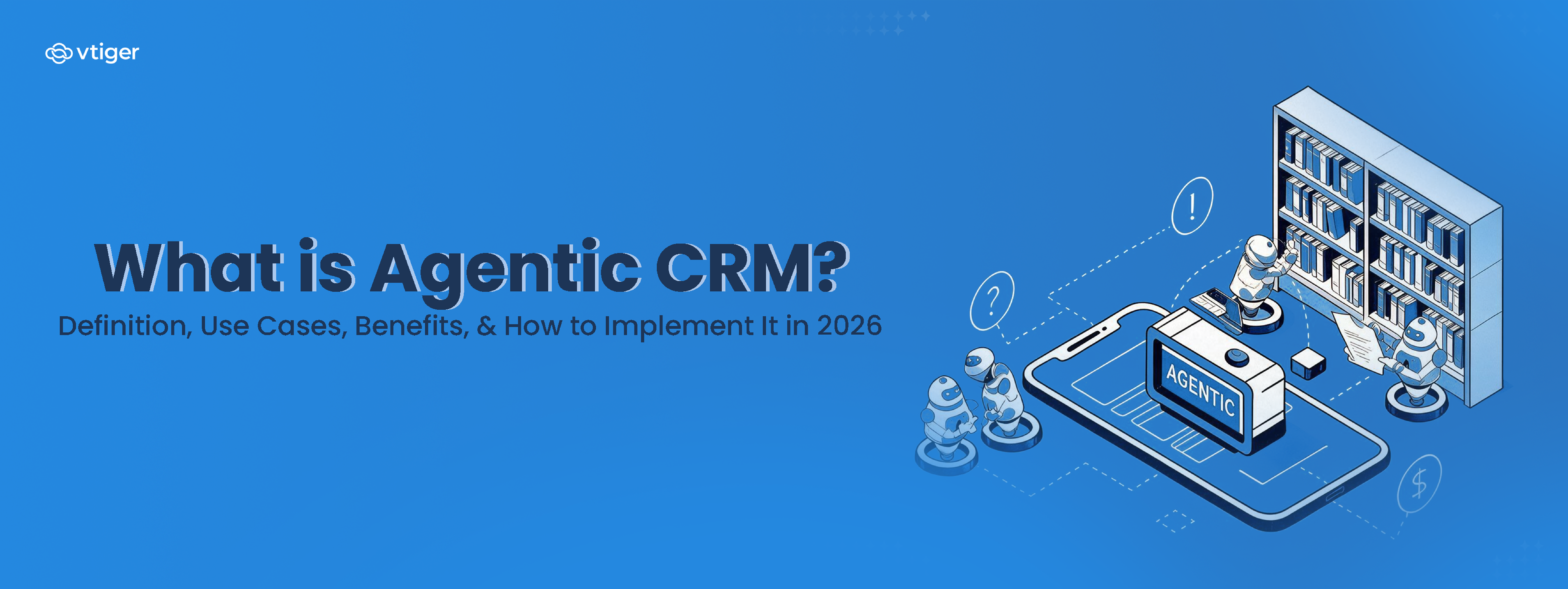
Agentic CRM is a CRM system built with AI agents that reason through information and take action on their own — not just surface insights or make recommendations. Rather than waiting for a person to act, these agents can analyze a situation, decide what needs to happen next, and execute the required action.
For example, instead of alerting a sales rep that a deal has been active for 5 days, an agentic CRM can analyze the stalled opportunity by reviewing the previous conversation, assessing the probability of closing, drafting a follow-up email, and creating a task for the sales rep.
This indicates an important shift:
- Traditional CRM: Records and manages customer information
- AI-powered CRM: Analyzes data, generates insights, and recommends actions.
- Agentic CRM: Enables users to determine what action to perform at the right time.
The goal is not necessarily to remove people from the process. Instead, agentic CRM can handle routine, complicated workflows while people remain responsible for decision-making and building meaningful relationships.
How Agentic CRM works
There are 4 important steps that an agentic CRM software follows:
- First, the AI agent receives a request, trigger, or a goal and decides what needs to be done.
- Second, it pulls information from the CRM and connected systems, including deal history, cases, invoices, emails, and previous conversations.
- Third, it evaluates the information, follows the business rules, and determines the steps needed to achieve the goal.
- Fourth, agents perform the required actions such as creating a task, sending an email, or escalating a customer issue.
Traditional CRM vs Agentic CRM
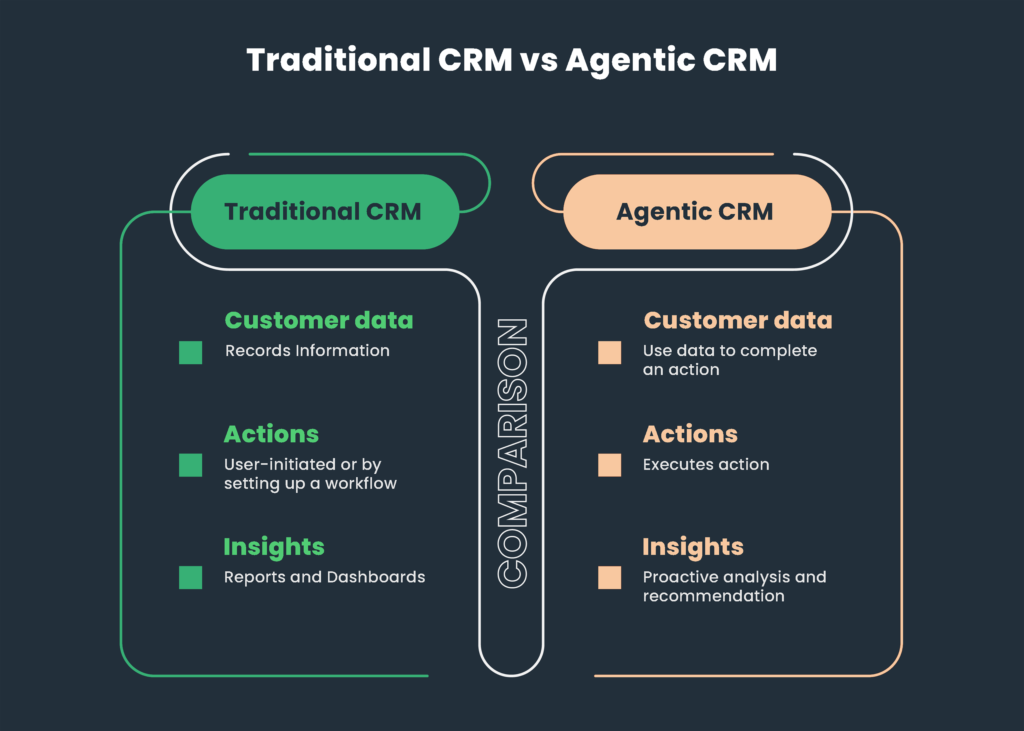
It’s important to show the difference because not every AI feature in a CRM makes it an Agentic CRM. Generating an email or summarizing a call is just AI assistance. AI agents in a CRM are something that analyzes a deal, determines the appropriate follow-up, prepares the communication, updates the CRM, and triggers the next step, demonstrating a higher level of agency.
Real-World Use Cases of Agentic CRM
Some real-life examples may be of great help for you in understanding how agentic CRMs work for different departments:
Agentic CRM for Marketing
Marketing agents can segment audiences, personalize email content, and analyze engagement instead of simply providing a campaign report. They can analyze which campaigns are performing well and which need improvement. These AI agents can also curate content for different groups and send emails accordingly
Agentic CRM for Sales
Sales agents could identify highly qualified leads, review their interactions, prioritize, and prepare personalized follow-ups for the sales team. These capabilities are associated with AI-powered sales, but agentic systems can take the process further by connecting multiple actions to achieve a single objective.
Agentic CRM for Customer Support
Customer service agents can monitor customer activity, detect churn, and track engagement. AI agents can review previous customer conversations, flag issues, and notify reps when human intervention is needed. This way, businesses can provide proactive support and build valuable connections.
Benefits of Agentic CRM
The biggest benefit of agentic CRM software is its ability to connect customer data, intelligence, and action.
Businesses can benefit from:
Reduced manual and repetitive work
Agentic CRM can reduce the manual, repetitive work involved in managing customer relationships. AI agents can handle routine tasks such as updating records, creating tasks, sending follow-ups, and organizing customer information. This allows employees to spend less time on repetitive CRM activities and focus on building customer relationships.
Faster response times
Agentic CRM enables businesses to respond to customer needs faster. AI agents in CRM can process information and take action without waiting for a human agent to handle every step of the conversation. They can identify customer requests and provide quick responses, which is useful for both sales and customer support representatives.
Proactive Customer Engagement
Agentic CRMs allow businesses to identify customer signals and bring them to the team’s attention at the right time. AI agents can detect situations such as an unanswered customer query or a lead that has not received a follow-up and alert the relevant team members. This helps teams keep track of customer interactions and respond before opportunities are missed.
Consistent Workflows
Agentic CRMs can maintain important workflows across different teams. AI agents can execute predefined tasks without missing important steps, helping teams follow the same process throughout the customer journey.
Personalized Customer Experiences
Agentic CRM can use customer information and past interactions to understand individual needs, while AI agents can then use this information to tailor emails, recommendations, offers, and follow-ups.
How to implement Agentic AI in CRM
The easiest way to succeed in building agents is to start with a small workflow and expand it over time. Here are the 5 steps to implement Agentic AI in CRM:
- Identify a Clear Process
Choose a process with a clearly defined goal and measurable outcome.
- Evaluate Your Data
Agents need reliable business data and enough context to make logical decisions.
- Connect Relevant Tools and Systems
An agent becomes more useful when it can work across the systems involved in a business process.
- Keep Human Oversight
Let people review and approve important decisions before the AI takes action.
- Measure Performance
Track accuracy, completion rates, time saved, errors, costs, and business outcomes.
The Future of Agentic CRM
CRM is moving from being a system that primarily records and manages customer information to one that can increasingly understand, predict, recommend, and act.
The future could involve multiple specialized agents working together across sales, marketing, customer service, finance, and other business functions. Instead of employees manually moving information between applications, agents could coordinate tasks across connected systems.
This does not mean businesses will simply hand over their CRM to autonomous AI. Governance, permissions, auditability, security, and human oversight will become increasingly important as agents gain more capabilities.
The result could be a CRM that functions less like a database and more like an intelligent operating layer for customer-facing business processes.
Is Vtiger CRM an Agentic CRM?
Yes, Vtiger’s NextGen platform brings agentic capabilities into CRM by combining AI agents, business data, predictive intelligence, workflows, and applications on a single platform.
With Vtiger’s AI Agent Builder, businesses can build AI agents for specific business requirements instead of relying only on predefined AI capabilities.
Its AI agents can work independently or together to handle different tasks across sales, marketing, customer service, and other business functions. For example, when a sales rep wants to understand how to improve the chances of closing a deal, AI can analyze the deal context and generate relevant recommendations.
Another important part of the NextGen architecture is predictive intelligence. It supports predictive scoring, forecasting, recommendations, and inputs for agentic reasoning.
Frequently Asked Questions (FAQs)
Q1. What is Agentic CRM?
Agentic CRM is a CRM system powered by AI agents that can understand information, make decisions, and take action on their own. Instead of just providing insights or recommendations, these agents can analyze a situation, decide what needs to be done, and act on it.
Q2. How is Agentic CRM different from AI-powered CRM?
AI-powered CRM can analyze data, generate content, make predictions, and provide recommendations. Agentic CRM takes this further by enabling AI agents to perform multi-step tasks and take defined actions.
Q3. What are some use cases of Agentic CRM?
Common use cases include lead qualification, sales follow-ups, deal management, customer support, ticket routing, etc.
Q4. Is Agentic CRM fully autonomous?
Not necessarily. The level of autonomy depends on the system, use case, permissions, and business rules. Human oversight remains important for high-impact decisions.
Q5. What is the future of Agentic CRM?
Agentic CRM is likely to become increasingly integrated with business workflows, with specialized AI agents collaborating across functions to help businesses move from reactive CRM management to proactive, intelligent action.