A product can be in demand and still struggle to sell if customers do not notice it, cannot find it, or have no reason to consider it alongside other products.
Retailers make hundreds of decisions around these moments, from which products share a shelf to what appears first on a category page and which items are promoted together. Those choices shape how easily customers move from browsing to buying. Merchandising brings these decisions together, but product placement is only part of the picture.
To improve sales consistently, retailers also need to understand what customers buy, what brings them back, and how those patterns should influence future merchandising decisions.
What Is Merchandising?
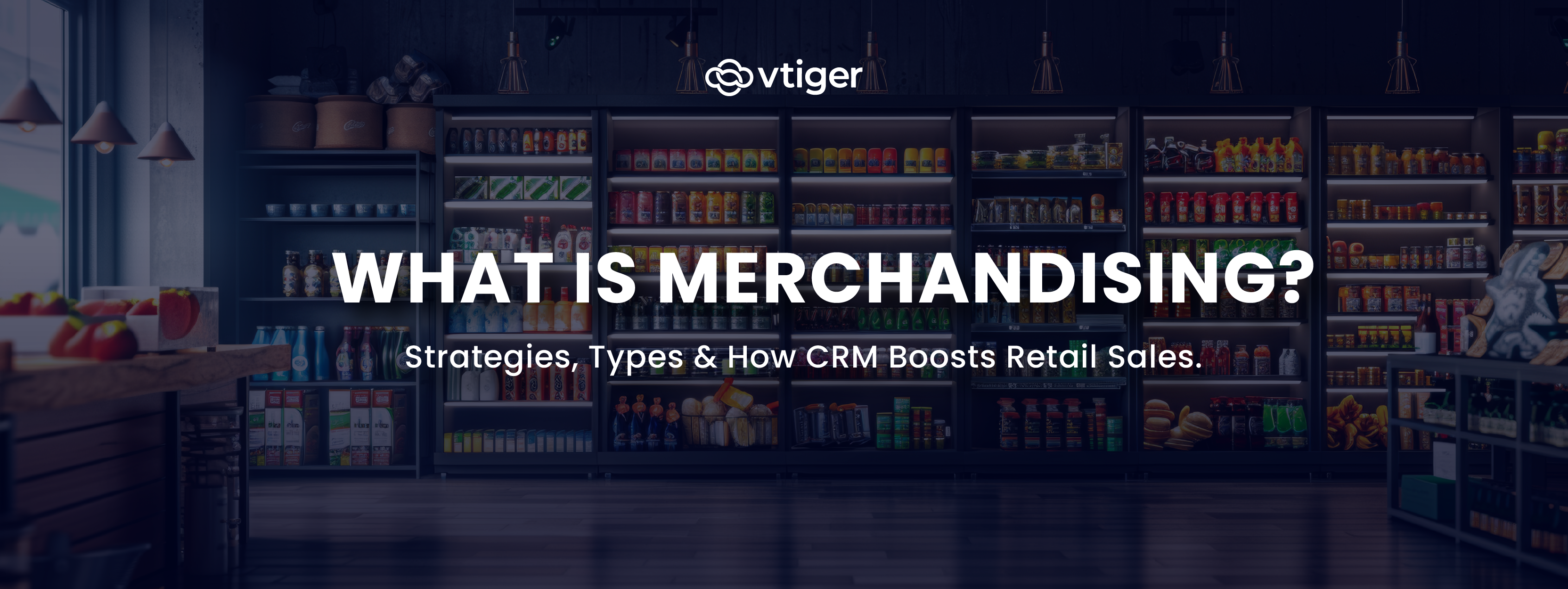
Merchandising is the planning and presentation of products to make them easier for customers to notice, evaluate, and buy. It covers assortment, placement, pricing, displays, promotions, and product availability across physical stores and digital channels.
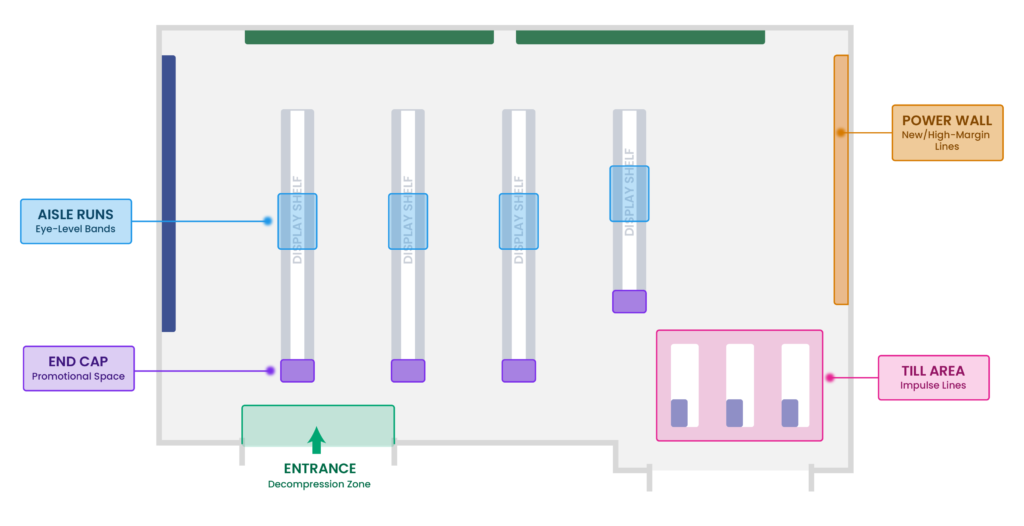
In a physical store, that can mean deciding which products occupy eye-level shelves, which products appear on an end cap, how related products are grouped, and how much stock should be available on the floor. Online, the equivalent decisions include category-page ordering, search results, product photography, recommendations, and bundles.
Merchandising therefore connects two decisions that are easy to separate but difficult to manage independently: what the retailer sells and how the customer encounters it.
It includes:
- Choosing which products and variants to stock
- Deciding how much inventory to carry
- Setting and reviewing prices
- Selecting products for promotions
- Planning displays and signage
- Grouping complementary products
- Managing shelf and product-page placement
- Maintaining product availability
- Reviewing which products are selling and which are consuming space without generating enough return
The distinction matters because a strong product can still underperform when customers can’t find it, don’t notice it, or encounter it at the wrong point in the buying journey.
Why Merchandising Matters
Merchandising affects sales by changing what customers see, how easily they can decide, and whether the product is available when they are ready to buy.
Four effects are particularly important:
- Visibility: Products that are easier to see have more opportunities to enter the shopper’s consideration set.
- Purchase convenience: Grouping related products reduces the effort required to find everything needed for an occasion or task.
- Store navigation: Clear layouts help shoppers find products without excessive searching or staff assistance.
- Inventory productivity: Faster-moving products generate sales from the space they occupy and reduce cash tied up in slow-moving stock.
These effects can reinforce one another. A shopper who finds the product they came for, sees a relevant complementary item nearby, and finds both products in stock may spend more without receiving a discount.
Availability is the foundation underneath those decisions. McKinsey reports that a one-percentage-point improvement in presubstitution in-stock rates can boost sales by 20 to 35 basis points.
That makes merchandising partly a presentation problem and partly an execution problem. A well-designed shelf, promotion, or product page cannot compensate for a product that is unavailable when the customer wants it.
Four Types of Merchandising
The term merchandising covers several different responsibilities across retail.
| Type | Where it happens | What it decides |
| Visual merchandising | Shop floor | Layout, displays, lighting, signage |
| Product merchandising | Buying and category teams | Assortment, variants, pricing and promotions |
| Retail merchandising | Store operations | Availability, replenishment and execution |
| Digital merchandising | Website or app | Category ordering, search, recommendations and product presentation |
Visual Merchandising
Visual merchandising controls how products are presented and how the physical store guides shopper movement.
It includes:
- Window displays
- Aisle and fixture layout
- Lighting
- Shelf placement
- Signage
- End caps
- Feature displays
- Product grouping
The objective is not simply to make the store look attractive. A display should help a shopper notice a product, understand its relevance, or move naturally towards a purchase.
For example, moving a product from a low shelf to an eye-level position can increase its visibility. Placing complementary products together can also make an additional purchase easier because the customer does not need to search another aisle.
The useful question, therefore, is not just whether a display looks good. It is whether the display changes shopper behavior.
Product Merchandising
Product merchandising determines what the retailer sells and how it structures the range.
Decisions include:
- Which product lines to carry
- How many variants to offer
- How much inventory to hold
- Which products should be priced together
- Which products should be promoted
- When products should be introduced, reduced, or removed
These decisions often have a longer lead time than store-level execution. A poor assortment decision can leave a retailer with excess inventory for months, while a missing product can send customers to competitors.
Product merchandising therefore needs to balance customer demand, available space, expected margin, inventory risk, and each product’s role within the wider category.
Retail Merchandising
Retail merchandising is the execution layer between the commercial plan and the customer.
It covers:
- Replenishing shelves
- Checking product availability
- Implementing planned displays
- Maintaining correct prices and promotional signage
- Moving inventory from stockrooms to selling areas
- Checking whether stores are executing central merchandising plans
This is where a strong merchandising strategy can fail, even if the original plan is sound.
For example, head office may create a promotion that requires a particular display, product quantity, and shelf position. If stores lack enough stock, staff time, or clear execution instructions, the promotion can underperform even when the offer itself is attractive.
Digital Merchandising
Digital merchandising applies merchandising principles to websites, apps, and other digital shopping environments.
It includes:
- Category-page ordering
- On-site search ranking
- Filters and navigation
- Product photography
- Product information
- Bundles
- Cross-sells
- Recommendations
- Promotional placement
The key difference is measurability. A retailer can change the order of products on a category page and monitor clicks, product views, add-to-cart rates, and sales to see whether the new arrangement performs better.
Digital merchandising also has a different constraint from physical stores. A shopper who does not find a relevant product can leave the site immediately. There is no neighboring aisle, end cap, or salesperson to create another opportunity.
Merchandising Strategies That Work
Effective merchandising is less about applying isolated tricks and more about connecting product placement and presentation to shopper behavior, inventory economics, and store execution.
Five strategies are particularly useful because each addresses a specific retail problem.
1. Place Products According to Shopper Traffic
High-traffic areas are valuable, but not every high-traffic location performs the same job.
The first few meters inside a store may function as a transition area where shoppers are still orienting themselves. Promotional or seasonal products can work better there than products that require careful comparison.
Retailers should therefore study:
- Shopper traffic by store zone
- Dwell time
- Conversion by location
- Sales per display
- Performance before and after a placement change
The objective is to match the product with the point in the journey where shoppers are most likely to consider it.
2. Use Eye-Level Space Deliberately
Eye-level shelf space is limited and commercially valuable because products placed there are easier to notice.
Instead of filling that space according to convenience, retailers can prioritize:
- High-margin products
- Fast-moving products
- Strategic new launches
- Products with strong attachment potential
- Products that need additional visibility
The important point is that eye-level placement should support a measurable commercial objective. A premium position should earn its space through sales, margin, or strategic value.
3. Group Products Around Shopping Missions
Customers do not always think in the same categories used by a retailer’s buying team.
Someone planning a pasta dinner may need pasta, sauce, cheese, and seasoning. Those products can belong to different merchandise categories while still serving one shopping mission.
Grouping products around occasions can therefore make the buying process easier and create natural opportunities for cross-selling.
Useful merchandising groups can include:
- Meal occasions
- Seasonal needs
- Product bundles
- Complementary accessories
- Beginner or starter kits
- Frequently purchased combinations
4. Design Promotions Stores Can Execute
A promotion is only as effective as its execution.
If a display requires significant staff time, complicated stock movement, or multiple pieces of signage, execution may vary widely between stores.
Promotion planning should therefore consider:
- Staff availability
- Display assembly time
- Required inventory
- Replenishment frequency
- Signage requirements
- Store size
- Expected sales volume
A simpler display that every store can execute consistently can outperform a more elaborate concept that only some stores build correctly.
5. Review Slow-Moving Products Regularly
Every slow-moving product consumes shelf space, working capital, and operational attention.
A monthly review can identify products with:
- Low sell-through
- Declining demand
- Excess stock
- Low margin contribution
- High return rates
- Weak attachment to other products
Removing or reducing weak lines can create space for products with stronger demand. The goal is not to maximize the number of products on the shelf. It is to improve the return generated by the available space and inventory.
Keep A Record of Merchandising Changes
Retailers should also record what changed, where it changed, and when it changed.
Without that record, comparing two merchandising results becomes difficult. A category may appear to have improved because of a new shelf position when the actual change came from a price promotion, seasonal demand, or higher stock availability.
A simple test log can capture:
- Change made
- Store or digital location
- Date implemented
- Product affected
- Baseline performance
- Result after the change
That turns merchandising from a collection of individual decisions into a process you can test and improve.
Where Merchandising Runs Blind
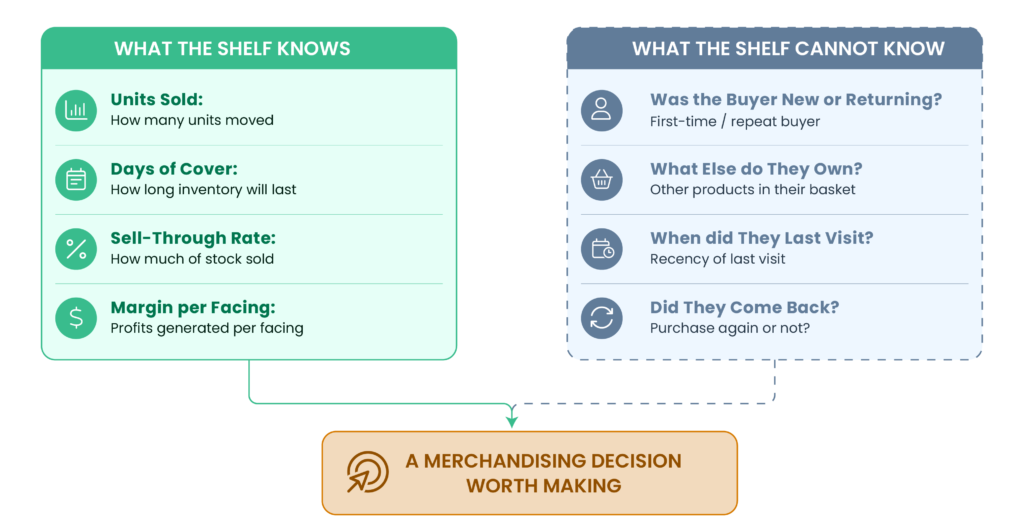
Merchandising systems are good at describing product performance. They are less effective at explaining the customer behavior behind that performance.
Sales data can show what sold, where it sold, and when it sold. On its own, it may not show whether the buyer was new or returning, what they purchased previously, whether they responded to a promotion, or what they bought next.
That gap matters because two products with identical sales can represent very different customer behavior.
Questions Sales Data Cannot Answer
Consider a display that generates 1,000 product sales.
The sales figure confirms that the display moved product. It does not necessarily tell the retailer:
- How many buyers were new customers
- How many had purchased the product before
- Whether customers bought other products on the same trip
- Whether the display caused the purchase
- Whether buyers returned later
- Whether the sales would have happened without the promotion
The same problem appears in discounting.
A promotion may produce a strong sales week because it attracted new customers. It may also produce the same sales figure because existing customers bought earlier than planned at a lower margin.
Those outcomes look similar in a product report but require different decisions.
What the Top Seller Hides
A category manager may see that one product generated the highest sales in its category. That is useful, but incomplete.
The same sales number could come from:
- A large number of customers buying once
- A smaller group buying repeatedly
- A promotional spike
- A loyal customer segment
- A product that attracts customers who also purchase several other lines
Those patterns lead to different merchandising decisions.
If a product attracts many new shoppers, the retailer may want to build complementary products around it. If a small group of highly loyal customers drives most of the sales, the retailer may instead need to protect retention and understand the risk of losing those customers.
This is where product data and customer data need to be considered together.
McKinsey has documented the value of improving availability alongside inventory management. In one convenience retail example, improving product availability through immediate corrections and a permanent inventory dashboard generated more than $100 million in incremental sales.
The broader point is simple:
Product data tells you what moved. Customer data helps explain who moved it and what happened next.
How CRM Supports Retail Merchandising
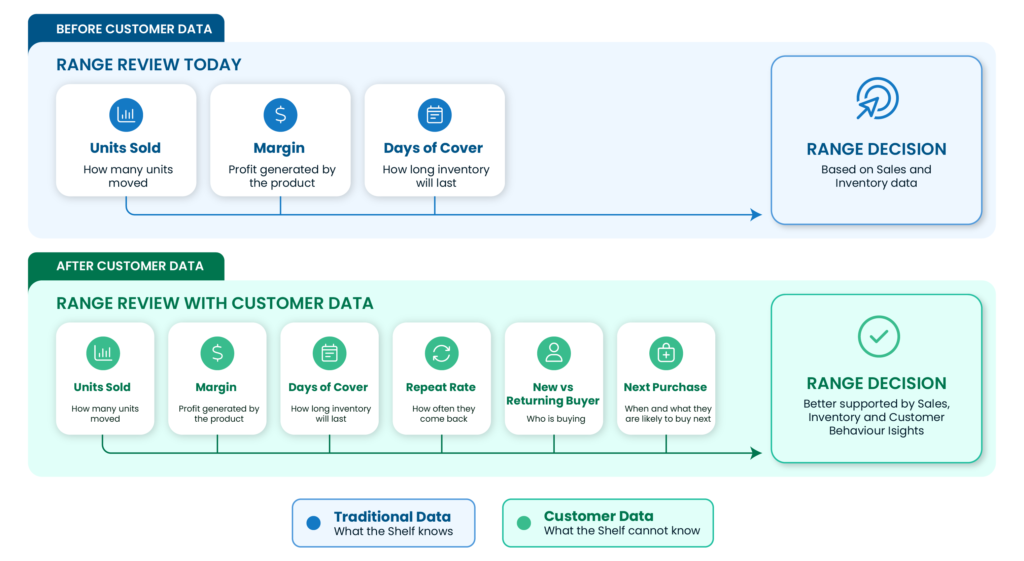
A customer relationship management system adds customer-level context to merchandising data. Instead of evaluating a transaction only as a unit sold, retailers can connect relevant purchase, engagement, and service information to the customer record.
That creates four useful capabilities: understanding buying patterns, personalizing engagement, connecting teams, and measuring outcomes beyond the initial transaction.
Understand What Customers Buy
A central customer database can bring purchase history, returns, inquiries, and service interactions into a customer record.
That changes the questions a merchandising team can ask.
Instead of only asking:
Which product sold the most?
The team can also ask:
- Which products generate repeat purchases?
- Which products are commonly purchased together?
- Which customers have stopped buying?
- Which products only move when discounted?
- Which first purchases tend to lead to another purchase?
These questions help connect assortment decisions with customer behavior.
Personalize Offers and Recommendations
Customer segmentation models allow retailers to group customers according to relevant behaviors and purchase patterns.
For example:
- Promotion-sensitive customers: Customers who regularly buy during discounts may need more selective offers to avoid unnecessary margin erosion.
- Category-focused customers: Customers who buy heavily from one category but have not purchased related products may be candidates for cross-sell campaigns.
- Lapsed customers: Customers who purchased once but have not returned may need a reactivation message rather than a generic promotional email.
The value comes from matching communication to customer behavior rather than sending the same offer to the entire database.
CRM email marketing can then deliver different messages to different segments. With marketing automation tools, follow-up can also be triggered by customer actions rather than managed manually.
For example, a customer who purchases a coffee machine could receive relevant accessory or consumable recommendations after an appropriate interval.
Connect Marketing and Sales
Retail information is often fragmented across different teams.
Buying teams know the assortment. Marketing knows campaign engagement. Sales teams may know customer conversations. Store teams see customer behavior directly.
When these records remain separate, each team sees only part of the customer’s journey.
A shared CRM record can connect those interactions. The same lead management process can retain the source of an inquiry, campaign engagement, sales activity, and subsequent outcome where those processes are relevant to the business.
That makes it easier to identify whether a campaign created an opportunity, whether an interaction progressed it, and which activities contributed to the eventual sale.
Measure What Actually Sold
CRM analytics reporting can extend merchandising analysis from product movement to customer and campaign outcomes.
Retailers can use customer-level information to investigate measures such as:
- Repeat purchase rate
- Customer retention
- Campaign response
- Cross-sell performance
- Revenue by customer segment
- Revenue following a campaign interaction
For retailers with larger sales or wholesale operations, the same customer records can continue through sales funnel stages, equipping teams trace an opportunity from its original source through to conversion.
This does not replace merchandising metrics such as sell-through or stock availability. It adds another layer of evidence so retailers can understand whether a merchandising decision created a one-time sale or contributed to a longer customer relationship.
Merchandising With NextGen by Vtiger
Merchandising decisions often draw on product, inventory, sales, customer, and marketing data. When these records live in isolated systems, teams must combine them before they can see why a product is selling, who is buying it, or what to do next.
NextGen by Vtiger brings CRM applications and business data together on a unified platform, with applications covering Sales, Marketing, Support, Projects, and Inventory. For retailers, this can connect inventory information with customer activity and sales context, giving teams a more complete view of merchandising performance.
NextGen also provides AI capabilities such as predictive scoring, recommendations, automation, and next-best actions. These capabilities can help teams identify relevant customers, prioritize activities, and act on available data without treating merchandising and customer engagement as separate processes.
Frequently Asked Questions
What is merchandising?
Merchandising is the planning and presentation of products to make them easier for customers to notice, evaluate, and buy. It covers assortment, placement, pricing, displays, promotions and availability across physical and digital retail channels.
What are the main types of merchandising?
The four types covered here are visual merchandising, product merchandising, retail merchandising, and digital merchandising. Visual merchandising focuses on presentation and store layout. Product merchandising focuses on assortment, variants, and commercial decisions. Retail merchandising focuses on availability and store execution. Digital merchandising applies similar principles to websites and apps.
What is visual merchandising?
Visual merchandising controls how products are presented in a physical store and how the layout guides shopper movement. It includes displays, lighting, signage, shelf placement, window displays, and product grouping.
Why is merchandising important in retail?
Merchandising affects what shoppers notice, how easily they can find and evaluate products, which products they encounter together, and whether those products are available. These decisions can influence sales and inventory productivity without changing the underlying product.
What are effective merchandising strategies?
Effective strategies include placing products according to shopper traffic, using eye-level space deliberately, grouping products around shopping occasions, designing promotions stores can execute consistently, and reviewing slow-moving products regularly.
How does CRM help retail merchandising?
Merchandising data shows what sold and when. CRM data can add customer context, including purchase history, engagement, and repeat behavior. Together, these data points can help retailers distinguish between one-time sales, repeat purchases, new customer acquisition, and other customer patterns.
What is digital merchandising?
Digital merchandising is the presentation and organization of products on websites and apps. It includes category-page ordering, search ranking, filters, product photography, bundles, cross-sells and recommendations.
How do retailers measure merchandising performance?
Common measures include sell-through rate, units per transaction, sales per square foot, gross margin, inventory turnover and on-shelf availability. Customer data can add measures such as repeat purchase rate, campaign response, customer retention, and revenue by customer segment.