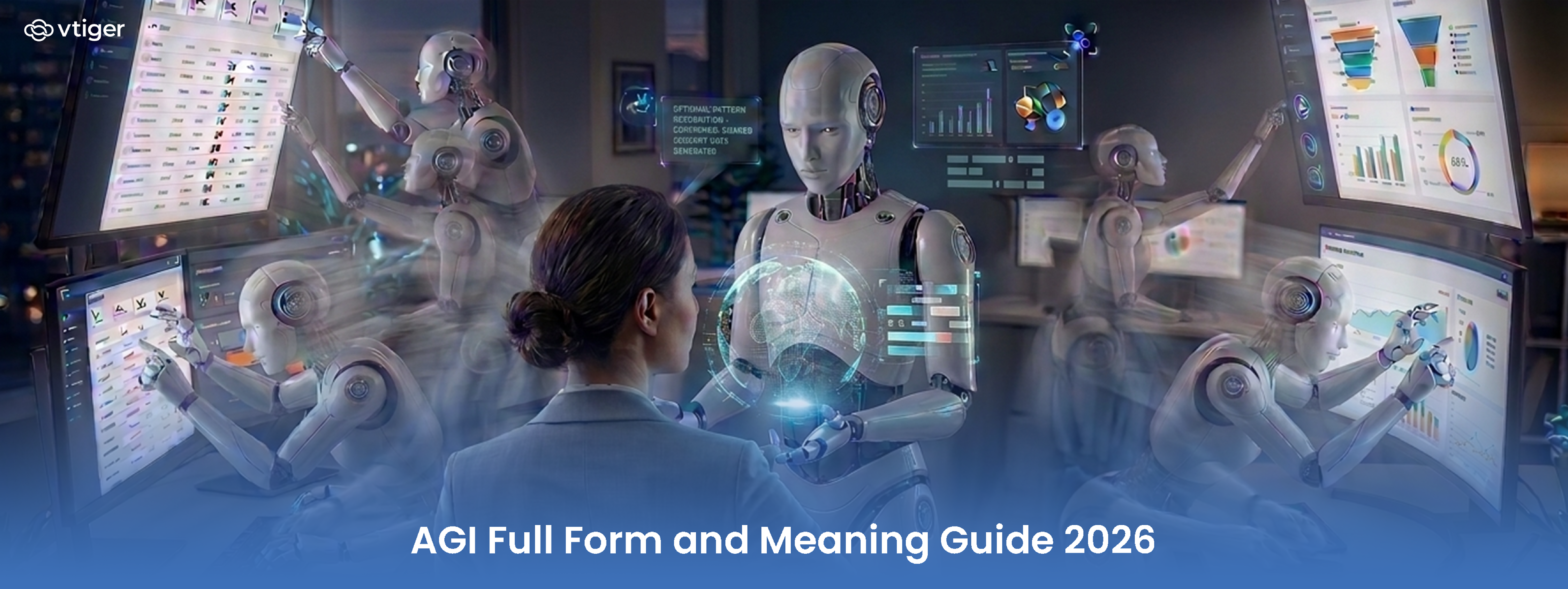
AGI stands for Artificial General Intelligence. It describes a system that can acquire new skills and solve problems it was never trained for, rather than performing one narrow function well. No AGI system exists commercially today. In CRM, AGI would mean software that reasons across sales, marketing, and support decisions instead of running predefined workflows.
If you ask a vendor what would make their product count as AGI, they may simply describe an upgraded version of what they already sell, such as faster automation, more features, or better personalization. But none of those improvements alone make a system truly general.
There is a stricter way to assess the claim. It focuses on whether a system can learn and solve genuinely unfamiliar problems, and a written benchmark exists to test that capability. Understanding what that test measures provides a clearer way to assess AGI claims.
What Is AGI?
AGI is a theoretical type of AI that can match or surpass human capabilities across virtually all intellectual and cognitive tasks. Unlike today’s specialized AI, an AGI system could learn, reason, and adapt to completely new situations without needing task-specific programming.
The most rigorous working definition belongs to François Chollet, the researcher behind the Keras deep learning library. In his 2019 paper On the Measure of Intelligence, he defined intelligence as skill-acquisition efficiency on unknown tasks rather than performance on tasks the system was prepared for.
That distinction is the whole argument, and it changes what a benchmark score means. If a model was trained on material resembling the test, a high score shows it can find an answer it has already seen. It says nothing about what happens when the problem is genuinely new.
Chollet built a benchmark to test it. ARC-AGI presents grid puzzles where a rule must be inferred from two or three examples and applied to a case the system has never seen. It resists memorization by design, since every task is unique and the examples are too few for statistical pattern matching.
Four characteristics separate AGI from what ships today:
- Transfer: Skill learned in one domain carries into an unrelated one without retraining, which no production system currently does.
- Novelty handling: The system solves problems its developers never thought of. Today’s models behave unpredictably as soon as the input stops resembling what they were trained on, and they rarely signal that this has happened.
- Autonomous goal decomposition: It breaks an ambiguous objective into steps without a human specifying the workflow.
- Efficiency: It learns from a handful of examples rather than millions, which is the criterion the definition above actually measures.
| Reality check: ARC-AGI-1 launched in 2019 to test whether AI systems could learn new rules from only a few examples and apply them to unfamiliar problems. By late 2024, frontier models had become dramatically larger, with training compute increasing by roughly 50,000 times, yet this benchmark remained a significant challenge. This means making models larger and giving them more compute can improve performance, but scale alone does not produce the efficient learning and generalization associated with AGI. |
AGI vs AI vs Generative AI
AI, generative AI, and AGI are often discussed as though they describe different levels of the same technology. They do not. The key difference is what a system can learn, how it handles unfamiliar problems, and how much of the decision-making process it can perform independently.
| Narrow AI | Generative AI | AGI | |
| Scope | Performs a defined task | Produces content across formats | Handles a broad range of intellectual tasks |
| Learns new tasks | No, usually requires retraining or reconfiguration | No, not from a few examples | Yes, from limited examples |
| Handles unfamiliar problems | Limited outside its defined task | Can produce plausible responses but may be unreliable on unfamiliar tasks | Designed to solve genuinely novel problems |
| Goal setting | Human-defined | Human-prompted | Can break broader goals into tasks independently |
| Commercially available | Yes, widely | Yes, widely | No |
The simplest distinction is this: generative AI can perform many types of content-generation tasks, while AGI would be able to learn how to handle new types of problems. A generative AI system can draft a follow-up email or a contract clause when prompted. AGI would need to determine whether sending that email is appropriate, consider the account context, and decide what to do next.
How Could AGI Transform CRM?
CRM is one of the areas where AGI could have a particularly significant impact because CRM systems already bring together the customer context a reasoning system would need. Contact history, deal activity, support interactions, campaign responses, and account information are stored in one environment. If AGI can reason across unfamiliar situations, this context could let it make decisions rather than simply execute predefined workflows.
- Autonomous Customer Engagement
Today, CRM automation usually starts with a predefined trigger, such as a change in deal stage or a customer action. An AGI system could instead assess the account as a whole and decide whether contact is necessary, which channel would be appropriate, what the message should address, and when it should be sent.
- Intelligent Lead Management
Lead scoring typically relies on rules and signals that administrators choose in advance, such as job title, company size, engagement, or industry. AGI could evaluate an account using a broader context and identify relevant signals that were never turned into predefined fields. This could make lead qualification less dependent on how many rules a CRM administrator has configured.
- Predictive Customer Insights
Predictive AI can identify patterns associated with outcomes such as churn, conversion, or deal closure. AGI could potentially take this further by reasoning about why an outcome is likely and determining what action could change it. Instead of simply flagging an account as at risk, the system could connect the underlying circumstances and recommend an appropriate intervention.
- Cross-Functional Workflow Decisions
CRM workflows generally follow processes that people have designed beforehand. AGI could make decisions across those processes based on changing circumstances. For example, it could recognize that a serious support issue should temporarily stop an upsell campaign, even if nobody created a rule connecting those two events.
These capabilities are not commercially available today. They represent a possible direction for CRM automation and provide a useful standard for judging how far current AI systems are from genuinely general intelligence.
| Interesting fact: Gartner’s roadmap points toward increasingly coordinated AI systems rather than a single general-purpose intelligence. It places collaborative multi-agent systems around 2027 and multi-agent ecosystems around 2029, focusing on multiple specialized agents working together. |
Potential Benefits of AGI-Powered CRM
The potential value of AGI in CRM would not simply come from making existing automation faster. The bigger change would be the ability to make decisions in situations never explicitly covered by a workflow, using the wider customer context already available in the CRM.
- Judgment Without Configuration
Most CRM automation depends on predefined rules. AGI could reduce that dependency by deciding which response yields the optimal outcome when a situation falls outside those boundaries. Rather than simply executing a static workflow, the system evaluates context to determine the most strategic course of action.
- Context That Survives Handoffs
Customer information often moves between sales, marketing, and support teams, creating gaps that employees have to bridge manually. An AGI system could carry the relevant account context across a sales-to-support transition, which is the gap revenue operations teams often have to patch manually.
- Explanation Alongside Prediction
A prediction is more useful when the person receiving it understands why it was made. Instead of simply flagging an account as likely to churn, an AGI system could connect the relevant customer signals, explain the reasoning behind the prediction, and suggest an appropriate response. This could move AI customer experience work from simply identifying problems to planning how to address them.
- Reduced Administrative Work
CRM administrators spend significant time creating fields, rules, workflows, and exceptions for situations the system cannot handle on its own. Greater generality could reduce some of this configuration by allowing the system to determine how to respond when a situation does not match an existing workflow.
Challenges of Using AGI in CRM
The challenges of using AGI in CRM are not entirely new. Narrow AI systems already expose businesses to many of the same risks, but AGI would increase them because it could access more data, make broader decisions, and require less human intervention.
- Data privacy: A system reasoning across every customer record needs access to every customer record, which enlarges the radius of any breach and complicates consent under data protection law.
- Accuracy and fabrication: Generative models produce answers that are fluent, confident, and wrong, with no change in tone to mark the difference. When a person reviews the output, one error costs a moment. When the system acts on its own output, the error reaches the customer, and the next decision is built on top of it.
- Accountability: When an autonomous system sends the wrong message to an enterprise account, the question of who authorized it has no clean answer under current governance models.
- Human oversight: Meaningful review requires understanding the reasoning, and reviewing decisions made faster than a person can read them is oversight in name only.
- Integration complexity: A reasoning system is only as good as its access to the systems where work happens, which makes this an architecture problem before it is an AI problem.
- Security posture: Broader system access raises the value of a compromised account, which is why CRM security controls become more load-bearing as automation deepens, not less.
The Future of AGI and CRM
Roadmap conversations about AGI assume the industry is walking towards it. The published forecasts describe the opposite journey. What gets built and sold is narrower each year, and the CRM roadmap you are offered follows that direction.
Task-Specific Agents Are What 2026 Delivers
Gartner predicts that 40% of enterprise applications will be integrated with task-specific AI agents by the end of 2026, up from less than 5% in 2025, and places multiagent ecosystems at 2029. Task-specific is the operative phrase, and it is the antonym of general.
An agent in this sense runs one job end to end, such as drafting a renewal quote or clearing a support queue, then stops at the edge of it. That is autonomy inside a boundary somebody drew.
Breadth Comes From Assembly, Not Generality
That roadmap reaches broad capability by assembling many narrow agents that hand work to each other, rather than by building one system that is general on its own.
Whether assembly delivers breadth is still an open research question. A team at UC Berkeley annotated more than 1,600 execution traces across seven multi-agent frameworks and reported that performance gains over single-agent setups were often minimal.
Their taxonomy names 14 failure modes in three groups, covering unclear specifications, misalignment between agents, and missing verification of each other’s output. Most trace back to system design rather than to the limits of the underlying model.
When one agent misreads its input, every agent downstream acts on the mistake without knowing it happened, so the error surfaces at the end of the chain rather than at its source.
The governance question changes shape. You are not approving one system’s judgment, but a boundary for each agent and a record of which agent made which call.
What Changes for CRM
The realistic near-term shift is from a system of record to a system that recommends. Deal scoring, AI sales forecasting, and next-action suggestions already work this way in narrow lanes, and those lanes widen rather than disappear.
The buying question moves with them. Rather than asking whether a CRM has AI, ask what each agent may do without a person approving the step, and where that permission is recorded.
How Vtiger One Is Preparing for AI-Powered CRM
Vtiger One does not provide AGI, and this is the case for CRMs in general today. Its AI capabilities represent a narrow-AI layer that supports current CRM automation, helping bring customer data and workflows together within a unified environment. This foundation may also help provide the context future AI systems would need to reason more effectively across customer interactions.
Calculus AI predicts outcomes such as deal closure and recommends next actions while leaving the final decision to the person managing the account. Alongside it, AI CRM capabilities support tasks such as conversation summarization and drafting, while building AI agents enables scoped, repeatable tasks within defined boundaries.
The effectiveness of any AI system depends on the quality of the information it can access. A missing deal stage or duplicate contact record can lead to an incorrect conclusion even when the system itself performs as intended. This is why AI-enabled CRM productivity gains are strongest when customer data is accurate, complete, and consistently maintained.
Frequently Asked Questions
What is the full form of AGI?
AGI stands for Artificial General Intelligence. It describes a system that can acquire new skills and solve problems it was never designed or trained for across many domains. This contrasts with narrow AI, which performs one defined task and requires retraining to handle a different one.
How is AGI different from AI?
AI is the umbrella term for any system that performs tasks that normally require human intelligence. Nearly all deployed AI is narrow, meaning it handles one task and fails outside its training data. AGI is the subset that can handle unfamiliar tasks without being retrained.
What is the difference between AGI and generative AI?
Generative AI produces content such as text, images, or code, and generalizes across formats while remaining narrow in capability. It cannot learn a genuinely new skill from a few examples. AGI is defined by that learning efficiency rather than by output variety, and it does not exist commercially.
How could AGI transform CRM?
It would shift CRM from executing workflows a person configured to making judgments nobody configured. That includes deciding whether to contact an account at all, qualifying leads on signals never made into fields, explaining why a prediction was made, and coordinating decisions across sales, marketing, and support.
Does any CRM offer AGI today?
No. Every CRM AI feature currently available is narrow, covering lead scoring, forecasting, summarization, drafting, or scoped agents that execute defined tasks. Any vendor describing a shipping product as AGI is using the term as marketing rather than as a technical claim about capability.
What are the benefits of AGI in CRM?
The distinctive benefit is judgment without configuration, meaning the system handles situations an administrator never anticipated. Secondary gains include context that survives team handoffs, explanations attached to predictions rather than bare scores, and far less manual configuration work than CRM administration currently requires.
What are the challenges of using AGI in business?
Data privacy widens as system access widens, and generative models still produce confident, incorrect output. Accountability for autonomous decisions has no settled answer, and meaningful human oversight is difficult when decisions outpace reading speed. Integration complexity and a larger security blast radius apply from the first deployment onward.