A prospect clicks your post today, browses your website two weeks later, fills out a demo form using their work email, and eventually becomes a closed-won customer.
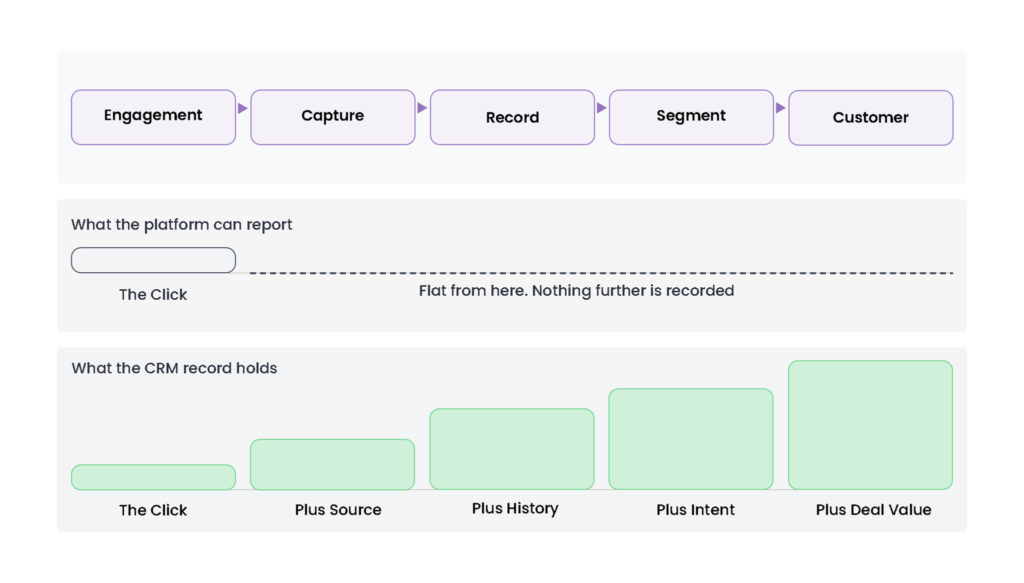
To your social media platform, that’s just a single, isolated click. To your business, it’s a high-value customer. Without a unified system connecting those two moments, the entire buyer journey disappears into a reporting black hole.
This friction highlights a common measurement limitation: social teams can easily showcase reach, impressions, and follower growth, but struggle to prove direct contribution to revenue. The issue isn’t that social media isn’t working—it’s that the evidence is trapped in a silo.
A CRM bridge closes this gap by transforming passive social engagement into actionable customer records. By tracking initial touchpoints, enriching lead profiles, and automating post-click nurture streams, a CRM ties social strategy directly to pipeline generation.
The focus shifts from measuring who double-tapped your post to understanding who actually converted—and why.
What Is Social Media Marketing?
Social media marketing uses social media platforms to build brand awareness, generate demand, and acquire customers through both organic and paid channels.
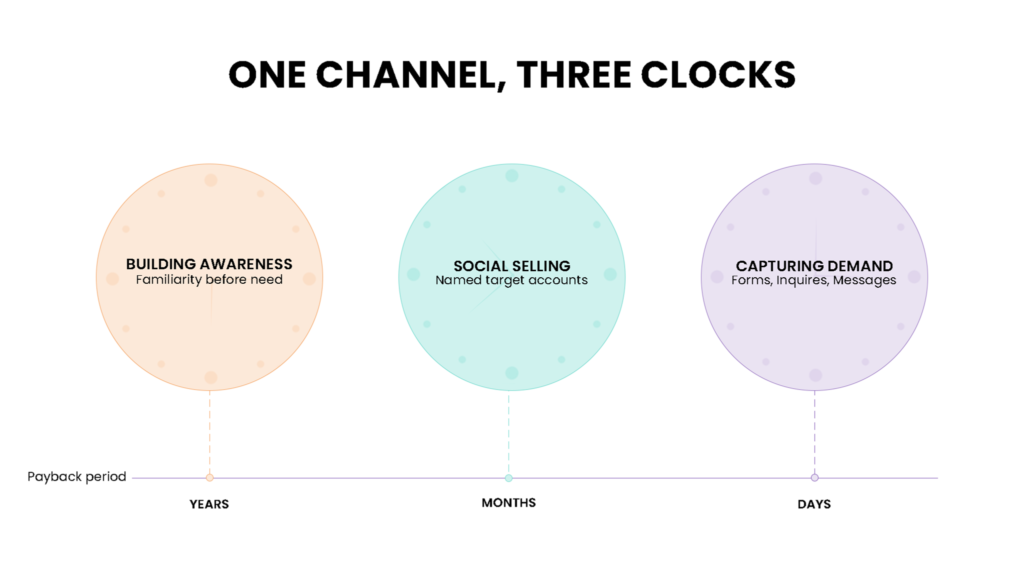
That definition is standard but practically useless because it hides three completely different functions under a single label.
- Building awareness: Content aimed at people who do not need you yet, so your name feels familiar when they finally do. Pays back over years.
- Capturing demand: Lead-form ads, profile inquiries, and direct messages from people already shopping. Pays back in days.
- Social selling: A salesperson building relationships with a short list of target companies from their own account. Pays back over months.
The three have different payback periods, so they need different measures; confusing them costs money in a predictable way.
When teams focus strictly on awareness, they chase viral views and forget to collect contact details. When teams focus only on quick leads, they push aggressive sales pitches that drive the audience away. Both mistakes end up emptying the sales pipeline.
None of this means the channel is weak. Deloitte’s 19th annual Digital Media Trends survey asked what most influences buying decisions. Social ads and product reviews came top for 63% of Gen Z and 49% of millennials, against 28% and 25% for streaming video ads. The audience is there, and it is paying attention.
So the channel works. The measurement is what breaks.
Why Social Media Followers Don’t Automatically Become Customers
Ask ten marketers why their follower growth is not driving revenue, and nine will point to the content. While creative quality matters, the issue is more often a broken measurement system than weak messaging. Marketing science established long ago that audience reach and commercial conversion operate on entirely different frameworks.
Two Different Payback Timescales
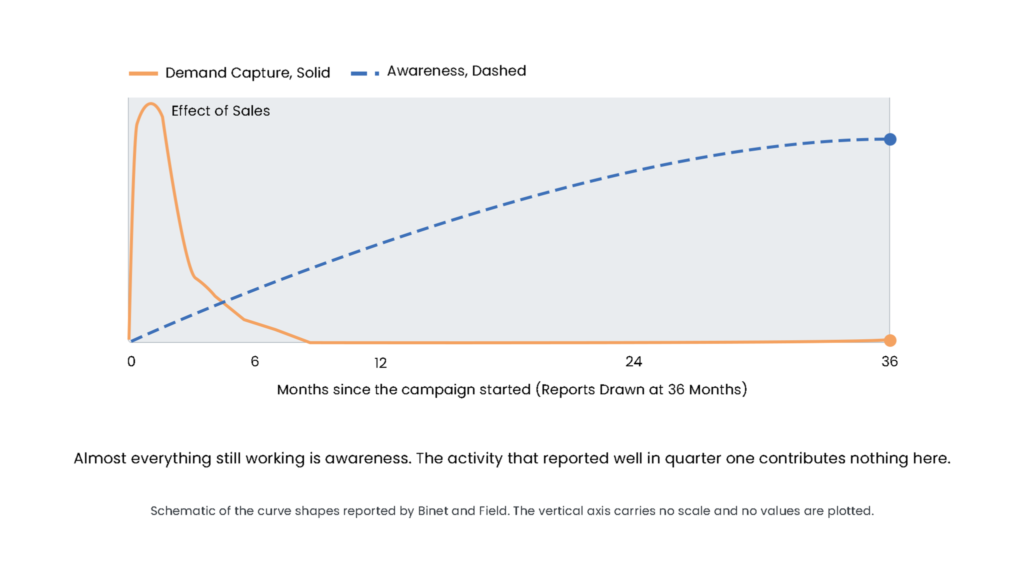
Research by Les Binet and Peter Field (analyzed nearly 966 campaign case studies from the Institute of Practitioners in Advertising) shows that marketing operates on two distinct clocks:
| Metric | Activation Marketing | Brand Building |
| Primary Goal | Trigger immediate action now | Build long-term familiarity and trust |
| Sales Impact | Sharp, immediate lift | Gradual, compounding growth |
| Duration | Fades quickly, often within weeks | Influences demand long after the campaign ends |
Both matter, but they cannot be judged by the same clock. A three-month report may show strong activation results while making brand building look ineffective simply because its effects have not surfaced yet.
The IPA research also found that relying too heavily on activation can weaken long-term performance as the pool of people familiar with the brand shrinks.
Follower growth belongs to this slower cycle. It may not translate into an immediate pipeline because familiarity takes time to influence buying decisions. Judging follower growth against quarterly revenue therefore uses the wrong measure.
This mismatch can make social programs look unproductive even when future demand is still building.
Three Consequences For Marketers
The disconnect between social media metrics and business revenue creates three critical hurdles:
1. Engagement Metrics Mask True Intent
Platform feeds treat every interaction the same. A follower who likes every post may have zero buying authority, while a silent observer is actively evaluating your product. Social analytics track public activity rather than commercial intent, making passive views look identical to real sales leads.
2. Buyers Research in the Dark
A Gartner survey of 646 business buyers found that 67% prefer to research and purchase without speaking to a salesperson. By the time a lead reaches out, the choice is already made. Your content did the selling long before a salesperson ever spoke to them.
3. Buying Influence Has Shifted to Creators
Deloitte reports that 52% of Gen Z and 45% of millennials feel closer to social creators than to television personalities. Modern buyers trust creators’ recommendations to guide their purchases well before they visit your website or see your product marketing.
Which is why the same message usually performs better from a salesperson’s own profile than from the company account. People trust people, and that preference has now been measured, not assumed.
None of these three is solved by posting more. All three are solved by keeping a record.
What Is Social Media CRM?
Social media CRM connects your social platforms directly to your customer database. It automatically captures comments, direct messages, and form fills as clear lead profiles, complete with the exact platform and campaign that brought them in.
It sounds like basic data entry, but it gives your entire team a clear memory of every buyer interaction.
Social CRM Versus Social Listening
Most explanations of this idea stop at watching mentions and tracking whether people sound happy about you. That was genuinely useful when the question marketers needed answered was whether people liked them. The question has since changed to which of them bought something, and the two systems answer very different things.
- Listening Tracks Mentions
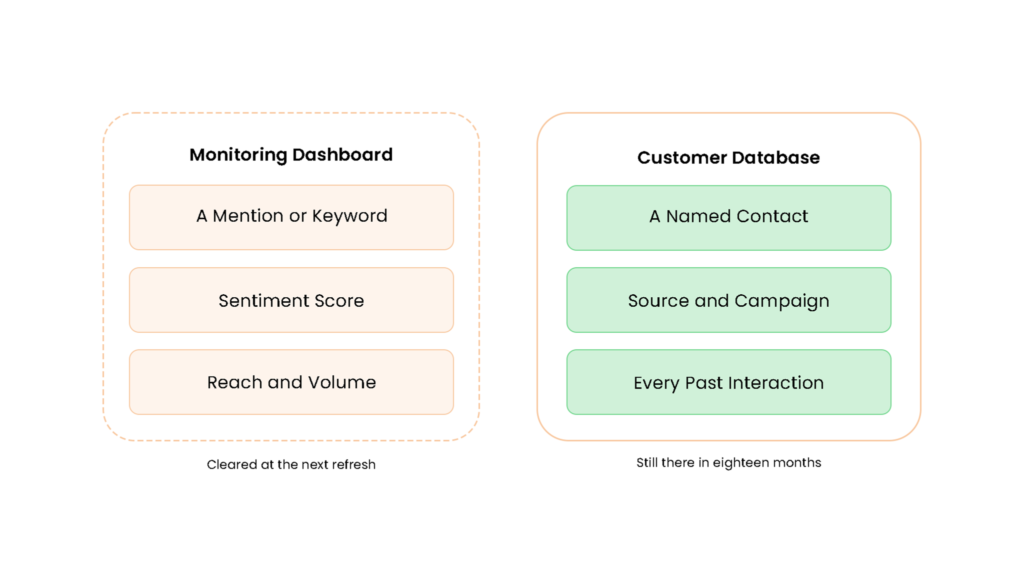
A mention or a keyword sits in a monitoring dashboard until the next refresh cycle clears it. Listening answers what people are saying about you, reports in sentiment, and holds no memory of any individual beyond the current window. Ask it about a named account eighteen months later, and it has nothing to offer.
- CRM Tracks People
A named lead or contact sits permanently in the customer database alongside everything else you know about them. It answers who this person is and what happened to them afterward, and it reports in pipeline and revenue rather than mood.
That asymmetry decides which system your sales team will actually open. A dashboard nobody can search afterward becomes something marketing looks at alone. A record attached to an account gets opened by whoever is about to speak to it. Adoption follows usefulness, and usefulness here means the information survives long enough to matter.
The Budget Consequence
The gap shows up most painfully when budgets are set. A monitoring dashboard can show people warming to you across a quarter in which social media produced no deals. It can show them flat across a quarter in which social sourced a third of new pipeline.
Neither reading is wrong. Both are answering a question finance did not ask, and the team holding sentiment charts loses to the team holding a revenue column every time. Not because sentiment is worthless, but because nobody has ever cut the budget of a channel that could name the deals it produced.
The Lead Capture Process on Social Media
Lead capture is the part most guides skip, and it is what decides whether everything above becomes measurable or stays anecdotal. Three things have to happen in order, and skipping any one of them quietly disables the two that follow.
Capture The Lead Source
A form submission, a profile inquiry, or a direct message creates a lead record. The platform and campaign are written onto it as it is created, before anyone touches it.
That sounds like a small configuration choice. It is the highest-leverage decision in the process, because every report you run for two years can only be as accurate as what was written in that instant.
Source is worth defining properly before you build it, since platform alone is too coarse to act on. One platform might be running brand content, a lead form, and a retargeting campaign at once. Recording the platform, the campaign, and the specific ad gives you something to optimize against rather than merely count.
The alternative is what most teams are living with now. A salesperson types the source in by hand three days later and puts “social” because that feels about right, and honestly it probably is.
The quarterly report then arrives looking complete. Every row filled, no visible gaps. Nobody reading it can tell which entries were recorded at the time and which were reconstructed afterwards. The table looks identical either way, which is why the error survives review year after year.
Build The Full Profile
Once the record exists, it starts gathering everything that has ever happened with that person, which is where the value compounds. Past emails, earlier website visits, previous orders, renewal dates, and any support ticket raised all attach to the same place.
This is ordinary lead management process work, and it becomes possible only because the first step happened.
The practical difference shows up on the call itself. A salesperson working from a bare name opens with discovery questions the company has answered twice. One working from a full record opens by mentioning the renewal that lapsed in March. Same lead, same product, entirely different first ninety seconds.
Segment By Buying Intent
With the profile in place, customer segmentation models can sort social leads by what each person actually did rather than how loudly they did it.
Someone who opened a pricing page is close to buying. Someone who liked a hiring post may simply be job-hunting. Both count as engagement, only one is a lead, and no engagement metric will ever tell them apart.
Most teams find three or four groups are enough to begin with. People who showed commercial intent, people who showed professional interest without it, people engaging for reasons unrelated to buying, and existing customers who happen to follow you.
Each needs different follow-up, and that last group needs protecting from sales sequences altogether. Worth writing down as a rule before anyone builds a campaign.
Social Media Marketing Automation
Marketing automation on social is usually sold as a way of sending more messages to more people, which is the least interesting thing it does. Its real value is that it removes a dependency, and the dependency it removes is human availability.
Speed Without Staffing
Social inquiries arrive on Saturday evenings and during public holidays far more often than website forms do, because social is where people are when they are not working. A lead from a social campaign enters a follow-up sequence the moment the record exists. First reply time becomes a number you set rather than one you discover afterwards.
The commercial argument for this gets overlooked. Somebody who messages you on a Saturday is usually mid-comparison, working through options while they have time to think about it. A reply on Monday morning arrives after that comparison has finished, into a decision already made without you in it.
Scoring The Queue
Speed alone still leaves the question of who to call first, which is where scoring comes in. Calculus AI weighs how deeply someone engaged, what they engaged with, and how closely their company resembles your existing customers.
The output is a queue rather than a verdict. AI lead scoring separates the ten inquiries worth a call today from the ninety worth an email, and the salesperson still decides what to do about it.
That distinction is not cosmetic. A scoring model that makes decisions gets switched off the first time it is wrong about an important account. One that ranks a queue survives being wrong, because a person was always going to check.
Scores also need a visible reason attached to them. A number on its own invites argument, and a salesperson who disagrees with an unexplained ranking simply ignores it. A number with the three signals behind it invites a conversation instead. That conversation is usually where the model gets better.
Nurture And Re-engagement
The leads who do not make the top of the queue still need somewhere to go. Lead nurturing sequences keep in touch with accounts that are interested but not ready. Quiet social leads come back around on a defined schedule instead of being dropped whenever the pipeline gets busy.
One warning on sequencing, and it is the mistake teams make most often. Automation switched on before segmentation sends identical follow-up to a pricing-page visitor and someone who liked a culture post, and both learn to ignore you within two weeks.
Configure a marketing automation platform in that order, or spend the next quarter rebuilding a list you already had.
Social Selling Versus Brand Posting
Social Selling
- Execution: Individual sales reps use their personal profiles to engage a focused list of target companies (~40 accounts) rather than broadcasting broadly.
- Core Activity: Building direct relationships through genuine commentary and two-way conversations instead of cold pitching.
- Key Metrics: Measured by direct conversation volume (~30 per quarter) and pipeline value, consistently outperforming broad posts on actual sales.
- Buyer Trust: Leverages personal profiles, driving higher trust because buyers connect with individual people rather than corporate logos.
- Data Retention: Interactions occur in private inboxes. Logging any conversation reaching a second exchange into the CRM ensures customer history stays with the company if a rep leaves.
Brand Posting
- Execution: A single corporate account broadcasts one message out to a mass audience of thousands of followers.
- Core Activity: Publishing general marketing content to maintain brand presence across social platforms.
- Key Metrics: Evaluated using public engagement rates, impressions, and reach percentages.
- Buyer Trust: Generates broader brand awareness, but yields lower buyer trust compared to direct human interactions.
- Data Retention: Activity remains visible on public brand channels, requiring no account-level CRM tracking.
Consent Rules For Social Media Leads
Following a brand account is not permission to be contacted. This is the step most social lead generation advice bypasses completely, and it is the one carrying legal exposure rather than merely commercial disappointment.
Where the law requires consent, the business collecting the data has to prove it was given. The platform that hosted the interaction carries none of that responsibility on your behalf.
A scraped follower list is therefore not a lead list. Import one and you have created records you are not permitted to email, which is worse than not having them.
The good news is that people are less resistant than the compliance conversation suggests. Deloitte’s 2026 Digital Media Trends research asked about the trade directly. Roughly 70% of Gen Z and millennials would share browsing data, purchase history, and app usage in return for a more useful, more personalized experience. They will trade, provided something comes back.
That reframes the design problem from extraction to exchange. Consent collected as a checkbox at the bottom of a form gets the lowest agreement rate and the weakest record. Consent collected as an explicit offer, naming what you will send and how often, gets a higher rate and a record you can defend.
Four things then belong on that record for every social lead:
- Consent as a field: Kept somewhere the software can read it, so anyone who never agreed is excluded from the send automatically rather than by a colleague remembering.
- Wording and date: The exact text shown at the time, plus when they saw it. Proving consent later means producing what the person actually agreed to.
- Source platform: Recorded at capture, so when someone asks what data you hold on them you can answer without piecing it together from three systems.
- Universal opt-out: One unsubscribe applying to every campaign you run, not only the one they happened to reply to.
The distinction underneath all four is simple enough. Consent kept as a page on your website proves nothing about any person. Consent kept as a field on a record proves everything about that one, which is why CRM security controls belong in a social media conversation at all.
Social Media ROI Measurement
Platform analytics report how content performed. They cannot report what it earned, because the earning happens in a different system several weeks later, and the two systems have never been introduced.
Platform Reporting Limits
| Metric | Platform reports | CRM reports |
| Reach and impressions | Yes | No |
| Engagement rate | Yes | No |
| Leads generated | Form fills only | Every source, duplicates merged |
| Lead quality | No | Score, stage, fit |
| Pipeline created | No | Yes, by campaign |
| Closed revenue | No | Yes, by campaign |
| Cost per acquired customer | No | Yes |
Every row that matters in a budget conversation sits in the right-hand column. Getting them requires CRM analytics reporting run against the campaign behind each lead. The left-hand column is not wrong; it simply stops where the interesting part begins.
Cost Per Acquired Customer
The most useful number in that right-hand column is the last one, and it is the one almost nobody calculates for social. Take everything spent on a campaign, including the time cost of the people running it, then divide by the number of customers traceable back to it.
The figure is usually uncomfortable the first quarter you produce it, then improves quickly. Measuring a channel properly turns out to be the intervention that improves it.
The Honest Attribution Range
One caution before you present any of this, and it returns to the two clocks from earlier. Last-touch attribution credits the final interaction before the deal, which is nearly always a sales call, so social rarely wins it. First-touch credits the opening interaction, which social often does win, and overstates the channel just as badly in the other direction.
Neither number is the truth. The truth resides between them and moves depending on the deal. Report both, and present the distance between them as a range.
A marketing team that volunteers that range before finance asks for it is a team finance starts trusting. Over a year, that is worth more than winning one quarterly argument with a flattering number.
CRM For Social Media Marketing
Everything above describes one requirement in different forms. A social interaction has to become a record before it can be measured, followed up, segmented, or defended. Platform tools cannot hold that record, because the notification is the only thing they store.
Vtiger One picks the story up at exactly that handover point. A social lead arrives with its source and campaign already attached and joins the same contact database as leads from email, referral, and events. It then moves through the same sales funnel stages as any of them, so social stops being reported separately.
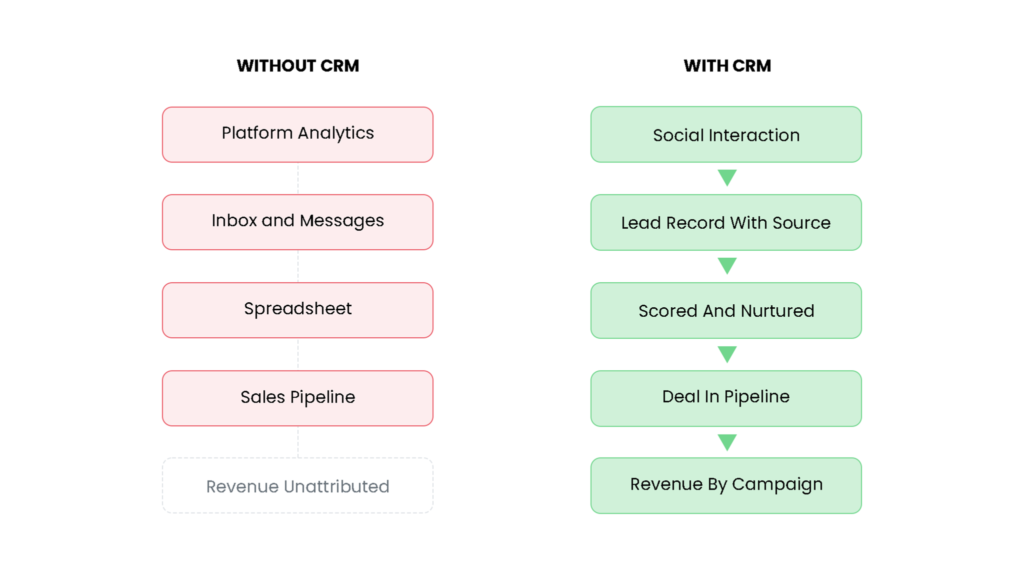
That single database is what makes the rest possible. Campaign reporting can connect what you spent to the pipeline and revenue it produced, which is the number revenue operations teams keep asking for.
Teams running social alongside email find the same records feeding their marketing CRM software sequences. Nobody imports a list twice or reconciles two versions of the same person.
None of this asks the social team to work differently. The posting, the community management and the conversations all carry on as they were. The only change is that they now leave a trace behind them.
Which brings the three moments from the opening back together. Somebody clicked in January, a form arrived in February under a name nobody recognized, and finance booked revenue in March. With a record joining them, that is one customer with a history rather than three unrelated events, and you can finally say what the post earned.
Frequently Asked Questions
What is social media marketing?
Social media marketing is the use of social platforms to reach an audience, build brand familiarity, generate demand, and acquire customers. It covers unpaid activity such as posting and community management, alongside paid activity including promoted posts, lead form ads, and retargeting aimed at defined audience segments.
How does CRM help social media marketing?
A CRM turns engagement into records that survive after the notification disappears. That makes interaction history visible to sales, lets leads be scored and sorted by intent, allows follow-up to run automatically, and connects campaign spend to pipeline and closed revenue rather than stopping at engagement.
How do you convert social media followers into customers?
Separate audience from intent, since the two overlap only partly. Save interactions as records rather than leaving them in notification feeds, sort them by what people actually did instead of how often they engaged, automate follow-up so reply speed does not depend on staffing, and measure by pipeline.
What is social media lead generation?
Social media lead generation is collecting contact details and qualifying interest from social platform activity, through lead form ads, profile inquiries, message conversations, and content downloads. It becomes measurable only once the resulting contact enters a system that records what happened next.
What is social selling?
Social selling is a salesperson using their own profile to build relationships with a defined list of target companies, rather than broadcasting from a brand account. It produces few interactions of high value, so it looks weak on engagement metrics and often outperforms brand posting on pipeline.
Do you need consent to contact a social media lead?
Following or engaging with a brand account is not consent to be contacted. Where the law requires consent, the business must be able to prove it was given, so the record should hold whether they agreed, the wording and date, the source platform, and an unsubscribe covering every campaign.
How does marketing automation help social leads?
It removes the dependency on someone being available. Leads from social campaigns enter follow-up on creation, get scored so the most interested reach a salesperson first, receive nurturing while undecided, and come back around on a schedule instead of being dropped when pipelines get busy.
How do you measure social media marketing ROI?
Track leads by campaign source, then pipeline value and closed revenue against that same source, and divide by campaign cost. Platform analytics cannot supply the later stages. Report first-touch and last-touch attribution together and present the gap between them as the honest range.