CRM has never been a static technology. It has evolved alongside the way businesses manage customer relationships—from simple databases that stored contact information to platforms that automate processes, generate insights, and assist employees.
Now, another shift is taking place. AI is changing CRM from a system that primarily responds to users into one that can increasingly understand context, identify the next best action, and execute parts of a workflow.
This evolution is often described as the shift from CRM automation to agentic CRM. However, it is not about replacing automation with AI agents. It is about combining automation, AI, customer data, workflows, and human judgment to support more intelligent business operations.
The future of CRM will be defined less by the number of tasks it can automate and more by how intelligently it can support the entire customer journey.
Evolution of CRM
CRM initially served as a system of record, helping businesses maintain customer profiles, track opportunities, record interactions, and provide teams with a centralized view of customer information.
As CRM adoption grew, businesses wanted these systems to do more than store information. Automation became an important part of CRM, allowing organizations to trigger actions based on predefined conditions.
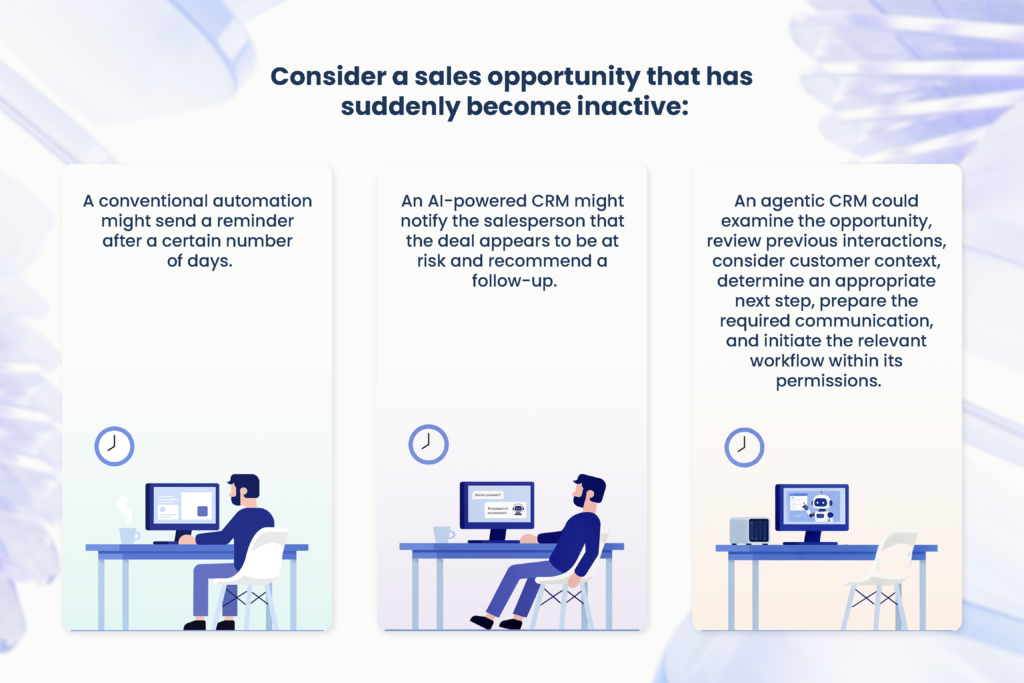
For example, when a new lead enters the CRM, a workflow can automatically assign it to a sales representative and create a follow-up task. This reduces repetitive manual work and helps teams respond more consistently. However, rule-based automation is limited to the conditions and logic defined for it. It cannot independently interpret situations beyond those predefined rules.
Customer journeys are rarely that predictable. A customer may interact with sales, marketing, and support across multiple channels, and the meaning of those interactions can change depending on context.
This is where AI begins to change the role of CRM
AI introduces a new layer of intelligence, helping CRM systems move beyond predefined rules to interpret customer signals and support more informed decisions.
From Automation to AI-Powered CRM
AI can analyze customer information, identify patterns, generate content, make predictions, and recommend actions.
For example, an AI-powered CRM can analyze a deal’s history and engagement signals and indicate that the opportunity may be at risk. It can also summarize customer conversations or suggest a follow-up email.
Vtiger’s 10 Practical Ways AI Can Improve CRM explores this shift and how AI in CRM can carry out sales, marketing, and customer service activities effectively.
Read More: Traditional CRM vs AI CRM
From AI-Powered to Agentic CRM
With agentic CRM, the key difference isn’t simply using AI. It is the ability of AI agents to work toward a defined objective by interpreting information, determining appropriate next steps, and coordinating multiple actions within defined boundaries.
5 Key Future Predictions with Agentic CRM
Here are the important transformations that you may expect in the years to come after implementing an agentic CRM
1. The Future of CRM Will Be More Proactive
One of the biggest changes will be the move from reactive CRM to proactive CRM.
Traditional CRM generally depends on employees to review records, identify problems, and initiate actions. Automation improves this by responding to predefined events. Agentic systems can potentially take this further by continuously interpreting customer and business signals.
Imagine a customer who has reduced their product usage, opened several support cases, and stopped engaging with recent communications. Instead of waiting for a customer success manager to spot this pattern, an intelligent CRM could identify the combination of signals and flag it.
The important change is that CRM begins to help businesses anticipate situations rather than simply record them. This could affect everything from sales opportunities and customer retention to service issues and account management.
2. CRM Will Become More Context-Aware
For AI to make useful decisions, access to data alone is not enough. It needs context.
A customer’s CRM record may include contact information and purchase history, but broader context could also include emails, meetings, support interactions, previous commitments, marketing engagement, and ongoing opportunities.
The future CRM will increasingly need to connect these pieces of information.
This makes CRM data quality more important than ever. Poor data no longer simply creates inaccurate reports. It can also affect the recommendations and actions AI systems produce.
In other words, better AI requires better business context.
That is also why data quality is becoming a strategic consideration in AI adoption, not just a CRM administration task.
3. AI Agents Will Work Across Business Functions
As AI agents become more capable, CRM will increasingly connect activities across sales, marketing, customer service, and other business functions. Instead of operating as isolated tools, agents could coordinate workflows, share relevant context, and take action across multiple systems.
Businesses are already exploring this shift. McKinsey estimates that agentic AI will power more than 60 percent of the increased value that AI is expected to generate from deployments in marketing and sales.
4. The Role of Employees Will Change
The rise of AI agents does not necessarily mean removing people from CRM processes.
Instead, teams may spend less time performing repetitive operational tasks and more time managing exceptions, making decisions, and building relationships.
For example, instead of manually reviewing every opportunity, a sales manager could focus on opportunities that require human intervention. AI can handle routine monitoring and situations that need attention.
The same principle can apply to customer service. Agents may handle routine steps while human reps can focus on complex or sensitive customer situations.
5. CRM Will Become More Than a Customer Database
CRM is likely to extend beyond managing customer records and supporting traditional sales, marketing, and service functions. As businesses adopt AI across different processes, they will need systems that can connect data, workflows, applications, and intelligent actions in a more flexible way.
What Businesses Need to Prepare for Agentic CRM
The transition to agentic CRM should not begin with the question, “What can we give an AI agent to do?”
A better starting point is understanding which business processes are suitable for increased intelligence and automation.
Businesses need reliable data, clearly defined workflows, connected systems, and appropriate access controls. They also need to determine which actions can happen automatically and which require human approval.
Governance becomes particularly important as AI systems move from providing recommendations to taking actions. Organizations need visibility into what an agent is doing, what information it can access, and when a human should intervene.
Not every process needs an AI agent. Predictable activities may continue to be handled more efficiently through traditional automation. Agentic capabilities matter more when a process requires context, multiple steps, and some decision-making.
This means the future of CRM will not be automation versus agents. It will be a combination of both.
CRM Automation vs. AI-Powered CRM vs. Agentic CRM
| Aspect | CRM Automation | AI-Powered CRM | Agentic CRM |
|---|---|---|---|
| Primary purpose | Automate repetitive tasks | Analyze data, generate insights, and assist users | Achieve defined goals by reasoning, coordinating, and executing multiple actions |
| How it works | Follows predefined rules and workflows | Uses AI models to analyze data and generate recommendations or outputs | Uses AI agents to interpret context, determine next steps, and execute actions within defined boundaries |
| Decision-making | Rule-based | AI-assisted | Goal-and context-oriented |
| Level of flexibility | Low to moderate | Moderate | Higher, depending on permissions and agent capabilities |
| Initiated by | Trigger or predefined event | User request, trigger, or AI-generated insight | Goal, trigger, event, or business condition |
| Can it take action? | Yes, but only predefined actions | Usually assists users or performs specific AI-enabled actions | Can coordinate multiple actions as part of a larger task |
How Vtiger CRM Is Preparing for the Next Generation of CRM
Vtiger is preparing for the next generation of CRM with Vtiger NextGen. It is an AI-native, meta-data driven platform that gives businesses a foundation to build applications around their specific requirements.
With NextGen, businesses can build composable applications such as CRM systems, employee portals, after-sales operations, recruitment, real estate, and other industry-specific requirements. These applications can use existing business data and workflows while extending them with AI-powered capabilities.
As AI agents become better at understanding context, making decisions, and taking action, platforms need to provide more than customer data and predefined workflows. Vtiger NextGen brings together the building blocks needed to create AI-native applications, giving businesses the flexibility to shape their systems around evolving processes and customer needs.
Frequently Asked Questions (FAQs)
What is the future of CRM?
The future of CRM is moving beyond managing customer data and automating predefined workflows toward systems that can understand context, provide intelligence, and take action. AI agents are expected to play a larger role in coordinating tasks and workflows while keeping people involved where human judgment is needed.
What is the difference between CRM automation, AI-powered CRM, and agentic CRM?
CRM automation follows predefined rules to execute repetitive tasks. AI-powered CRM uses AI to analyze data, generate insights, and recommend actions. Agentic CRM takes this further by allowing AI agents to understand a goal or context, determine the steps required, and execute permitted actions across workflows.
Why will CRM become more context-aware?
Traditional CRM systems often rely on structured customer records and predefined workflows. Future CRM systems can combine customer data with conversations, activities, business rules, workflows, and other relevant information to understand the broader context before recommending or taking action.
How should businesses prepare for the future of CRM?
Businesses can start by improving data quality, connecting relevant business processes, defining clear permissions and governance, and identifying workflows where AI can safely assist or take action. Establishing governance and human oversight will also help organizations adopt agentic capabilities responsibly.