CRM systems have become central to how businesses manage leads, sales opportunities, customer conversations, support requests, and marketing activities. But as customer interactions increase across channels, teams often find themselves spending more time managing CRM data than acting on it.
This is where AI can make a practical difference.
Instead of treating AI as a separate technology or repeatedly explaining what an AI-powered CRM is, it is more useful to focus on the specific CRM activities AI can improve. From prioritizing leads and forecasting sales to summarizing conversations and helping teams respond faster, AI can reduce manual work and make customer data more actionable.
IBM identifies practical AI applications in CRM, including predictive analytics, personalization, sentiment analysis, lead scoring, and process optimization.
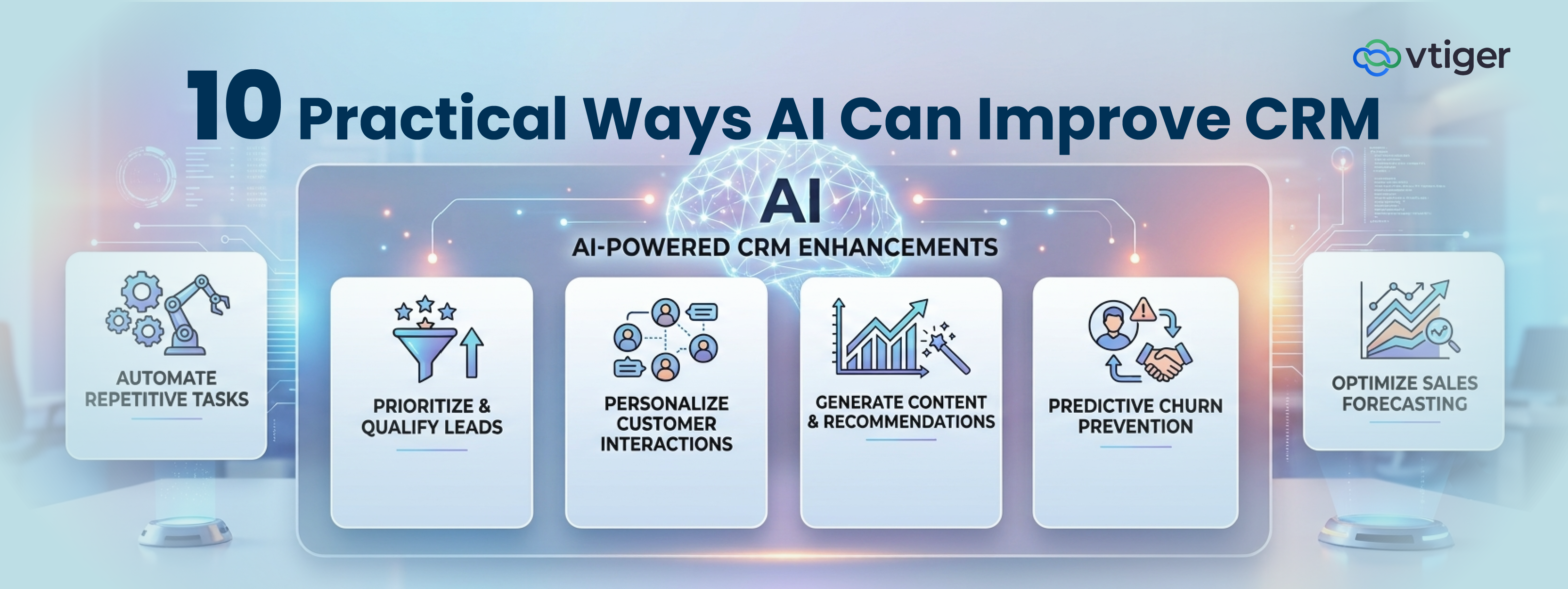
Here are 10 practical ways businesses can use AI to get more value from their CRM.
1. Automate Repetitive CRM Tasks
One of the simplest ways AI can improve CRM is by reducing repetitive admin work.
Sales reps, marketers, and customer service teams often spend a significant part of their day on activities such as:
- Entering or updating customer information
- Recording meeting notes
- Summarizing conversations
- Creating follow-up tasks
- Categorizing inquiries
- Writing routine emails
- Preparing reports
- Updating records after customer interactions
Individually, these tasks may take only a few minutes. But across hundreds of interactions, they can consume hours of productive time.
AI can help automate many of these activities. For example, after a sales call, it can generate a summary, identify action items, and capture important details from the conversation. Similarly, AI can help classify incoming requests and route them to the appropriate team.
This allows employees to spend less time on data entry and more time on activities that require human judgment, ultimately improving productivity.
2. Prioritize and Qualify Leads
Not every lead deserves the same level of attention.
A sales team may have hundreds of leads in its CRM, but only a portion may be ready to engage. Traditionally, reps have had to review lead information manually or rely on predefined scoring rules.
AI can make lead prioritization more dynamic.
By analyzing historical interactions and customer behavior, AI can identify patterns associated with successful conversions. It can consider factors such as:
- Email engagement
- Website activity
- Previous interactions
- Lead source
- Customer profile
- Purchase history
- Engagement frequency
- Deal history
The result is a more informed view of which prospects deserve immediate attention.
AI-based lead scoring does not eliminate the salesperson’s role. Instead, it helps answer a practical question: Which leads should I focus on first?
Vtiger’s Lead Management with AI explains how smart scoring can help reps better understand the likelihood of closing a lead.
3. Improve Sales Forecasting
Sales forecasting is another area where AI can make CRM data more useful.
Traditional forecasting often depends on historical performance, pipeline stages, salesperson estimates, and manually prepared reports. While these methods can work, they may not always capture changes happening within the pipeline.
AI can analyze historical sales data alongside current pipeline activity to identify patterns and potential risks.
It can help sales managers understand:
- Which deals are likely to close
- Which opportunities may be at risk
- Where the pipeline is weakening
- What revenue could potentially be generated
- Which opportunities need attention
The advantage is that forecasts can be updated as new information becomes available.
For example, if an opportunity that was previously progressing suddenly becomes inactive, AI in CRM can identify the change and flag it for review.
4. Personalize Customer Interactions
Personalization becomes difficult when businesses manage thousands of customers.
A sales rep may know an individual customer’s history, but a marketing team cannot manually create a unique message for every contact. AI can help bridge this gap by analyzing customer information and identifying relevant patterns.
It can use information such as:
- Purchase history
- Previous conversations
- Customer preferences
- Engagement behavior
- Product usage
- Demographic information
- Website activity
This information can then support more relevant emails, recommendations, offers, and follow-ups.
5. Generate Emails and Other CRM Content
Writing customer-facing content can take up a surprising amount of time.
Sales reps need follow-up emails. Customer service teams need responses. Marketing teams need campaign messages. Managers need summaries and reports.
Generative AI can help speed up these activities.
Depending on the information available, AI can assist with:
- Follow-up emails
- Email subject lines
- Customer responses
- Meeting summaries
- Case summaries
- Sales messages
- Internal notes
- Reports
- Product recommendations
The important difference is that AI working alongside CRM data can use existing customer context when generating content.
For example, instead of asking AI to write a generic follow-up email, a salesperson can use the customer’s previous conversation, deal stage, and specific requirements as context.
Vtiger’s Calculus AI and GPT integration enables teams to generate customer-facing content with CRM context. However, generated content should still be reviewed before being sent. AI-powered CRMs can accelerate writing, but employees remain responsible for accuracy, context, and tone.
6. Turn Customer Conversations Into Insights
Customer conversations contain information that can easily get buried in emails, calls, chats, and meeting notes.
AI can help extract useful information from these interactions.
For example, conversation analysis can identify:
- Customer sentiment
- Competitor mentions
- Buying signals
- Customer concerns
- Frequently discussed topics
- Follow-up requirements
- Important action items
This can give sales managers and customer service leaders a broader understanding of what customers are saying.
Instead of manually listening to every sales call or reading every conversation, managers can focus on the insights that require their attention.
7. Speed Up Customer Service
Customer service teams deal with a constant flow of questions, requests, and support tickets.
Many of these interactions are repetitive. Customers may ask similar questions about products, orders, account settings, or common issues.
AI in CRM can help customer service teams handle these interactions more efficiently by:
- Answering common questions
- Summarizing customer histories
- Routing requests
- Suggesting responses
- Helping agents find relevant information
Simple requests can potentially be handled automatically, while more complex issues can be routed to human agents with relevant customer context already available.
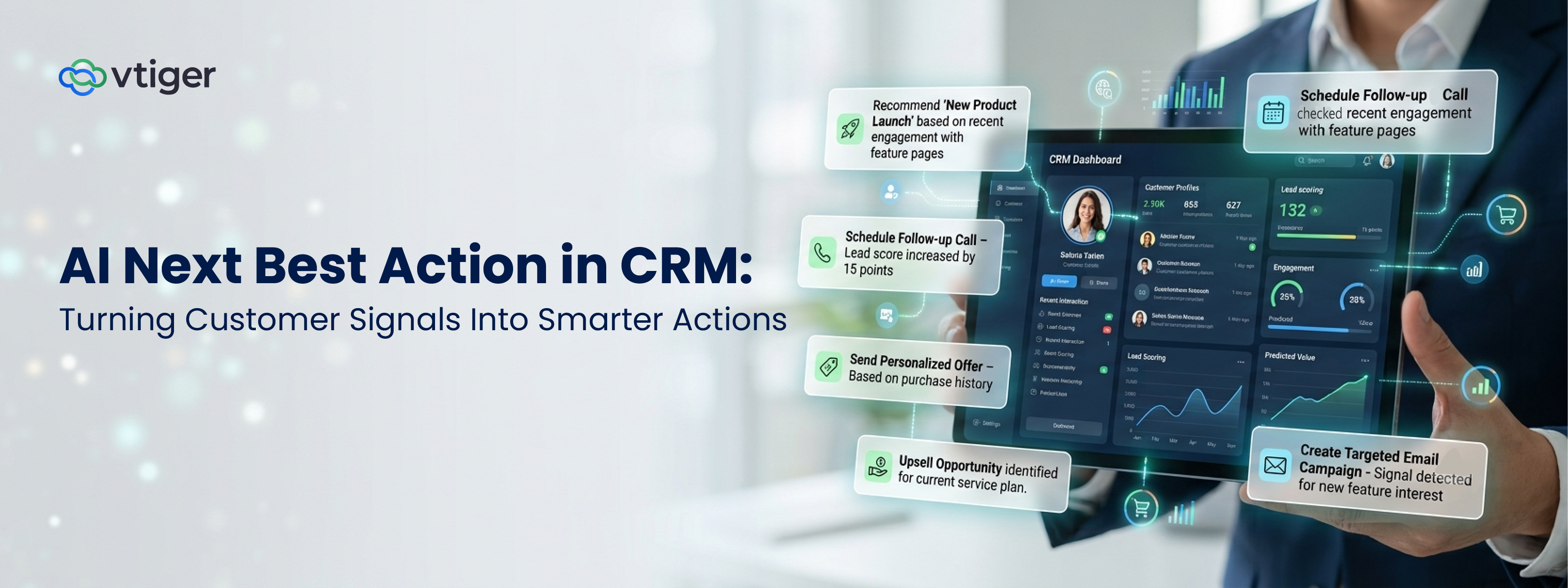
8. Recommend the Next Best Action
A CRM can contain plenty of information, but having it doesn’t always tell employees what to do next.
AI-powered CRMs can fix this by analyzing customer activity and historical patterns; AI can recommend actions such as:
- Follow-up with a prospect
- Contact an inactive customer
- Review a stalled opportunity
- Send relevant content
- Schedule a meeting
- Escalate a support issue
- Recommend a product
This is particularly useful for sales teams managing multiple opportunities simultaneously.
9. Analyze CRM Data Using Natural Language
CRM systems can contain enormous amounts of information. But employees do not always have the time or technical knowledge to build reports and analyze every data point.
Natural language interaction can make this information easier to access.
Instead of navigating several reports, users could ask questions such as:
- Which deals are most likely to close this month?
- Which customers haven’t interacted with us recently?
- What are the main reasons these deals are being lost?
AI can interpret the question and provide relevant information from available CRM data.
This makes CRM analytics more accessible to people who may not be comfortable creating complex reports or querying databases.
10. Automate Multi-Step CRM Workflows With AI Agents
AI can go beyond individual tasks by helping with workflows that involve several steps
For example, consider a lead that shows strong buying intent.
A traditional workflow may require different actions:
- Identify the lead.
- Review the lead’s history.
- Qualify the lead.
- Assign it to a salesperson.
- Draft an outreach email.
- Create a follow-up task.
- Update the CRM record.
AI agents can coordinate multiple steps like these based on defined goals, permissions, and business rules. This is particularly useful for processes where employees repeatedly perform the same sequence of activities.
Vtiger’s Agent Builder can take over everyday tasks by building different agents for various business functions.
How to Get the Most From AI in CRM
Implementing AI successfully is not simply about switching on every available feature. Businesses should start with specific problems and measurable outcomes.
Start with a real business problem
Identify activities that consume significant employee time or create bottlenecks. For example, if sales reps spend hours writing follow-up emails, content generation may be a useful starting point.
Focus on data quality
AI is only as useful as the information it works with. Inaccurate, incomplete, or outdated customer records can affect the quality of insights and recommendations.
Keep people involved
AI-generated recommendations and content should not always be accepted without review. Human oversight remains important when decisions involve customer relationships, sensitive information, or significant financial consequences.
Measure the results
Track practical outcomes such as lead conversion rates, team productivity, time taken to complete tasks, response time, and customer satisfaction. This helps organizations determine whether AI is solving the business problems they aimed to address.
How Vtiger Is Helping Businesses Improve CRM With AI
Vtiger CRM is taking this approach a step further with NextGen, its AI-native, composable platform. It allows businesses to build custom apps, including CRMs, and activate AI on the same platform. Its AI capabilities are embedded across workflows, including predictive scoring and forecasting, next-best-action recommendations, conversational assistants, and agentic capabilities.
Frequently Asked Questions (FAQs)
How can AI improve CRM?
AI can improve CRM by automating repetitive tasks, prioritizing leads, improving sales forecasting, personalizing customer interactions, generating content, analyzing conversations, assisting customer service teams, recommending next actions, simplifying data analysis, and automating multi-step workflows.
What CRM tasks can AI automate?
AI can assist with tasks such as data entry, record updates, email drafting, conversation summaries, lead qualification, ticket classification, follow-up reminders, reporting, and workflow execution.
How does AI help sales teams?
AI can help sales teams prioritize leads, identify sales opportunities, forecast revenue, analyze customer conversations, generate follow-up content, and recommend next steps.
Can AI improve customer service?
Yes. AI can help customer service teams answer routine questions, summarize customer histories, classify and route tickets, suggest responses, identify sentiment, and provide agents with relevant information.
How does AI personalize customer interactions?
AI can analyze customer data such as purchase history, engagement, preferences, and previous interactions to help businesses create more relevant messages, recommendations, offers, and follow-ups.
Is human involvement still important when using AI?
Yes. AI can automate repetitive activities and provide recommendations, but human judgment remains important for making complex decisions.