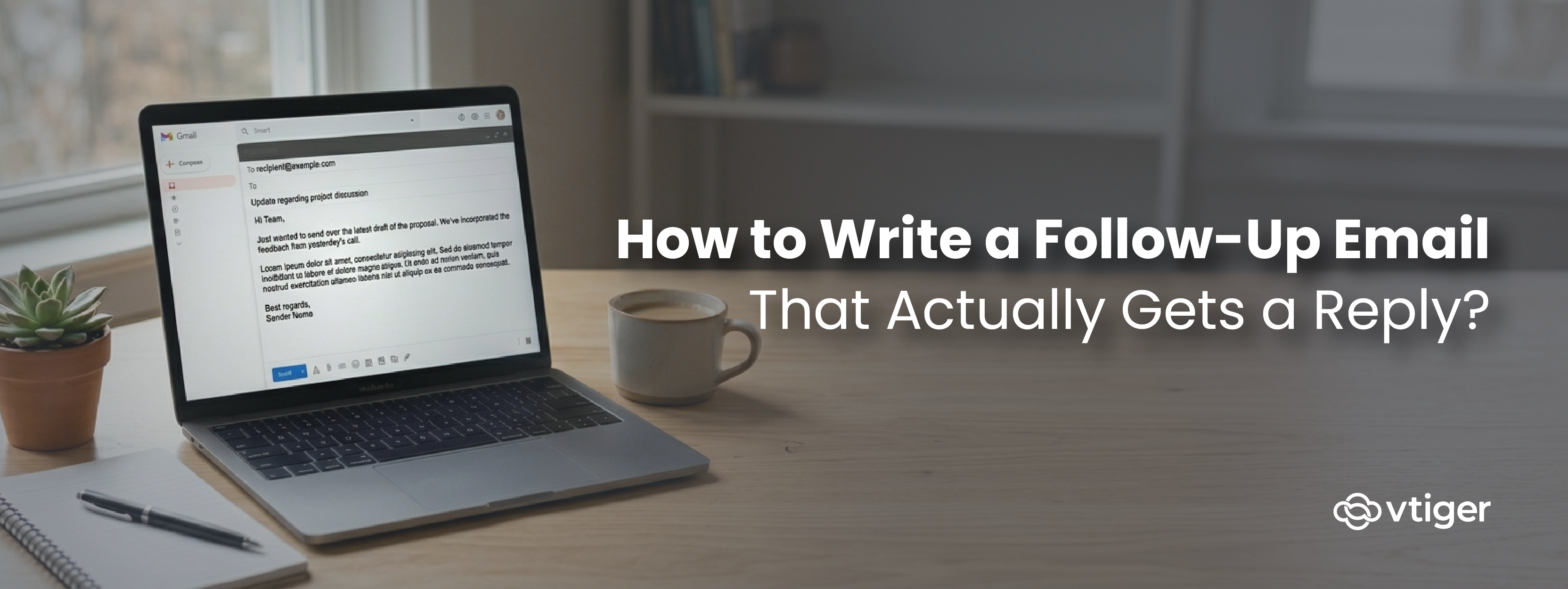
A follow-up email is a structured message sent after an initial email goes unanswered, used to remind the recipient, add new context, or move a conversation forward. The follow-ups that get replies are short, personalized, useful, and timed correctly. The ones that get ignored are long, generic, pushy, or sent the day after the original message, before the recipient has had time to respond.
Half of all professional emails go unanswered on the first send. The follow-up is what turns a meaningful share of those silences into actual conversations, and the difference between a follow-up that lands a reply and one that gets deleted comes down to a small set of writing decisions made in the right order. Most professionals know they should follow up; almost none have a playbook for doing it well.
The cost of weak follow-up is higher than most teams realize. 60% of customers say no four times before eventually saying yes, yet 48% of salespeople never make a second follow-up attempt. That gap between buyer behaviour and seller persistence shows up directly as missed revenue, slow recruiting, abandoned partnerships, and conversations that quietly die in inboxes.
What Is a Follow-Up Email
A follow-up email is a message sent after an earlier email or interaction to continue, advance, or revive a conversation. It can be a polite reminder, a value-add nudge, or a structured next-step request. The form depends on the context (sales, hiring, networking, client work, partnership outreach), but the underlying purpose stays the same: keep the conversation alive without making the recipient feel pestered.
The most useful distinction is between a reminder follow-up and a value-driven follow-up. A reminder asks the recipient to revisit the original ask without offering anything new, which works in low-stakes contexts but rarely revives a stalled thread. A value-driven follow-up adds new information, an article, a relevant case study, or a fresh perspective that gives the recipient a reason to engage even if the original message did not get a reply.
Follow-ups appear in almost every professional context: sales reps following up on outbound emails, recruiters checking in after interviews, account managers nudging clients toward action, partners revisiting stalled deals, and freelancers chasing invoices. The medium and tone shift, but the writing principles below apply across all of them. Mastering the structure once pays back across every professional relationship a person manages.
Why Follow-Up Emails Matter for Response Rates
Follow-up emails do meaningful work that the first message rarely accomplishes on its own. They keep conversations alive when the recipient is busy, remind buyers about decisions they meant to make, and signal professionalism that builds trust over time. They also act as a quiet quality filter on outreach, since recipients who repeatedly ignore well-written, well-timed follow-ups are usually not the right fit anyway.
The ways follow-ups improve professional communication:
- Lift response rates by reaching the recipient at a different time of day or week than the original sent time.
- Keep conversations active until the recipient is ready to engage, rather than letting threads quietly die.
- Build relationships and trust with prospects, candidates, and partners through consistent communication.
- Filter out low-fit recipients efficiently, leaving the team focused on conversations worth advancing.
According to Gartner, B2B email response rates climb by 21% on average between the first and second reach and by another 17% on the third reach. Teams that send three to five follow-ups consistently outperform teams that stop after the initial outreach.
The compounding effect means that doubling the average touch count from two to four can produce significantly more replies than running the same number of fresh outbound sequences.
When to Send a Follow-Up Email
Timing is half the battle. A follow-up sent the day after the original lands as impatient; a follow-up sent three weeks later has lost the thread the original message tried to start. The right timing depends on context, but a few rules of thumb apply across most use cases.
After Cold Outreach or Sales Email
Wait three to five business days before the first follow-up on cold outbound. The recipient has not committed to the conversation yet, so a same-day or next-day nudge reads as desperate. After the first follow-up, space subsequent messages 5 to 7 days apart, and stop after 4 to 5 total touches if there has been no engagement at all.
After a Meeting or Demo
Send the follow-up within 24 hours of the meeting while the conversation is still fresh. This message should summarize what was agreed, attach any promised resources, and propose the next step with a specific date.
After Quotes, Proposals, or Contracts
Send the first follow-up 2 to 3 days after the proposal or quote, before the recipient has gone cold on the offer. Use the message to confirm receipt, offer to walk through any questions, and propose a decision-call timeline. Subsequent follow-ups should be spaced 5 to 7 days apart and add value rather than just repeating the original ask.
How to Write a Follow-Up Email That Gets Replies
The 4 steps below cover the writing decisions that drive response rates. Follow them in order; skipping any one of them tends to produce a follow-up that reads like every other one in the recipient’s inbox.
Write a Subject Line That Earns the Open
The subject line decides whether the follow-up gets opened at all. Replies on the same thread (re: original subject) maintain context for the recipient and tend to perform better than fresh subjects in most professional contexts.
When starting a new thread, keep subject lines under eight words, mention something specific from the previous interaction, and avoid clickbait phrasing that signals automation.
Subject lines like “Quick question about [specific project]” or “Following up on our [date] call” outperform generic phrases like “Touching base” or “Just checking in.”
Keep the Message Short and Focused
The recipient is busy. Long follow-ups, no matter how well-written, get scanned and deferred. Cap the body at three short paragraphs (or 4 to 6 sentences total). Lead with the reason for writing, add the specific ask or update, and close with the next step.
Anything that does not advance the conversation or deliver value can be trimmed, and a second pass through the draft usually finds two or three sentences that should not have made it into the first version.
Personalize Beyond a First Name
Personalization that goes beyond merge fields is what separates follow-ups that get read from those that get archived. Reference something specific from the previous interaction, a recent post the recipient shared, a milestone their company hit, or a question they raised in the original conversation.
A single, specific detail drives response rates more than three paragraphs of generic context, and it shows in customer engagement metrics across every channel where personalization is applied consistently.
Add Value or a Clear Next Step
Every follow-up should give the recipient a reason to reply.
The reason can be new information (a relevant article, a case study, an updated proposal), a useful resource (a template, a checklist, an introduction to someone helpful), or a precise call to action (a 15-minute call on a specific date, a yes-or-no decision on a specific item).
Vague closings like “let me know your thoughts” produce vague responses or none at all. The most reliable structure is one specific question the recipient can answer in 30 seconds.
Follow-Up Email Examples by Use Case
The four examples below cover the most common follow-up scenarios. Each follows the writing principles above; adapt the wording to the specific situation rather than copying the templates verbatim.
After No Response (Generic)
Subject: Following up on my note from [date]
Hi [Name], I wanted to circle back on my email from [date] about [specific topic].
Inboxes get full, so I figured a quick nudge might help. If [the original ask] still makes sense, would Thursday or Friday this week work for a 15-minute call?
If the timing is off or the topic is no longer relevant, just say the word, and I will not chase further.
Best, [Your name]
After a Meeting
Subject: Notes and next steps from our [date] call
Hi [Name], thanks for your time on [day].
Quick recap of what we covered: [point one], [point two], [action item with owner and date]. I have attached the [resource] we discussed.
Let me know if anything is off, and I will plan to follow up on [next step] by [date].
Best, [Your name]
Sales Follow-Up After a Proposal
Subject: Quick question on the [project] proposal
Hi [Name], following up on the proposal I sent on [date] for the [project].
Wanted to share a quick update: [a relevant case study, a new feature, a piece of context that strengthens the proposal]. Happy to walk through any questions, adjust the scope, or set up a call with [name of relevant team member] if helpful.
Would early next week work for a 20-minute call?
Best, [Your name]
Common Mistakes to Avoid in Follow-Up Emails
Most follow-up emails don’t fail because the prospect lost interest. They fail because of small, fixable errors in how the message was written or timed. The mistakes below are the ones that most often turn a follow-up into a lost conversation, and each comes with a specific fix your team can apply on the next send:
- Sending the follow-up too soon after the original, which reads as impatient and damages the relationship
- Writing long, multi-paragraph emails that the recipient cannot scan in 15 seconds
- Using generic templates that signal automation and trigger reflex deletion
- Following up too frequently (more than once a week in most contexts) and crossing into pushy territory.
- Closing with vague calls to action like “let me know” instead of a specific yes/no question.
- Forgetting to add value on subsequent touches leaves the recipient with no reason to engage.
- Continuing past 4 or 5 follow-ups without engagement, which damages the brand more than the deal
Pacing and value matter as much as the writing itself. A follow-up that adds a new resource is welcomed; a follow-up that simply repeats the original ask three days later is the fastest way to land on a recipient’s blocked list.
Best Practices for Effective Follow-Ups
Good follow-ups are not complicated, but they do require consistency. The key is doing the small things right every single time.
Here’s what works:
- Use clear subject lines so the person instantly knows what your email is about.
- Keep your message short enough to read in 15 seconds.
- Add a personal touch by mentioning something specific about the person or your last interaction.
- Space your follow-ups 3 to 7 days apart, depending on the situation.
- Track opens and replies using crm software, so you know when to follow up again or when to stop.
- Use email automation to handle repetitive follow-ups, while still keeping messages personal.
Also, set a clear stop point. If someone hasn’t responded after a certain number of follow-ups, don’t keep chasing them. It keeps your outreach clean and professional.
Tools to Improve Follow-Up Emails
Follow-up at scale needs tools, but tools without a writing playbook produce automated noise that damages relationships. The categories below cover what most professionals use to send follow-ups that actually get read, with the CRM holding the conversation history and supporting tools handling tracking and automation.
Sales and Revenue Teams
Sales teams depend on a central system to track conversations, deal progress, and past interactions. Engagement data, such as opens, clicks, and replies, helps them decide when to follow-up and when to step back. Sequencing tools handle timing so outreach stays consistent, while workflow automation ensures replies instantly pause sequences, update deal status, and assign next steps without delay.
Marketing Teams
Marketing focuses on nurturing rather than immediate conversion. Behaviour-based journeys are built using automation and triggered by actions such as downloads or site visits. Pre-built templates maintain consistency across campaigns. Alignment with lead management ensures that when a prospect shows intent, the transition to sales occurs with full context rather than a cold handoff.
Customer Success and Support
These teams use follow-ups to maintain relationships and resolve issues. Interaction history helps them respond with context rather than repetition. Meeting tools simplify check-ins, while automated triggers can prompt follow-ups after onboarding milestones, support closures, or periods of inactivity.
Operations and Process Management
Operations teams focus on coordination and system reliability. They design processes where tools work together without manual intervention. A single action, such as a customer response, can trigger updates across systems, assign ownership, and ensure the next step is executed correctly.
Quality Control and Compliance
QC teams use communication data to review consistency and adherence to standards. Message logs and response timelines make it easier to audit the quality of follow-up. Standardized templates reduce variability, while automated checks ensure required steps are not skipped.
Leadership and Strategy
Leadership looks at aggregated data to understand what is working. Response patterns, timing effectiveness, and conversion trends highlight where improvements are needed. These insights help refine messaging, cadence, and overall follow-up strategy across teams.
Why Follow-Up Discipline Pays Off Over Time
The compounding effect of disciplined follow-up shows up across every revenue role. Sales teams with structured sequences close more deals at the same lead volume than teams that improvise. Recruiters with consistent post-interview communication land stronger candidates because applicants notice the professionalism and the consistency.
Account managers who follow up on stalled commitments retain customers who would otherwise quietly churn out. Freelancers who follow up on invoices on a defined cadence get paid faster, and partners who follow up on stalled introductions resurface deals that everyone else has forgotten. The discipline is the same across all of these contexts: write less, time it better, add value, and stop when the data says the recipient is not coming back.
FAQs
What is a follow-up email?
A message sent after an earlier email or interaction to continue, remind, or revive a conversation when the original did not get a response.
How long should I wait before sending a follow-up email?
Three to five days for cold outbound, 24 hours after a meeting, one week after a job application, and two days after a proposal.
How do I write a polite follow-up email?
Reference the previous interaction, keep it short, add new value or context, ask one specific question, and offer a clear opt-out.
What should I include in a follow-up email?
A subject line tied to the original thread, a personalized opener, a brief reason for writing, new value, and a specific next step.
How many follow-ups should I send?
Four to five total touches across two to three weeks for sales outreach. Stop earlier if the recipient asks or shows zero engagement.
What is a good subject line for a follow-up email?
Specific, short, and tied to the previous interaction. Examples include “Following up on our [date] call” or “Quick question about [project].”
Do follow-up emails really work?
Yes. Most B2B deals close after three or more touches, and response rates climb meaningfully between the first and third follow-up.