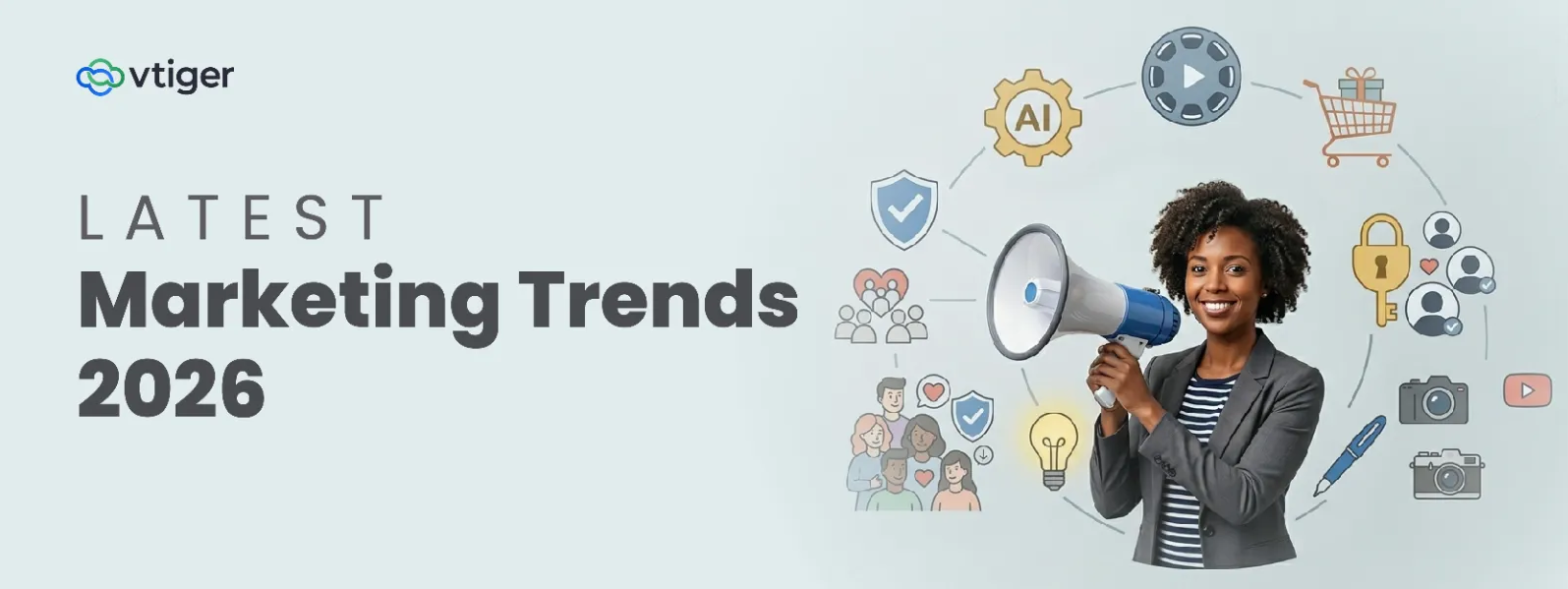
Marketing teams in 2026 are contending with a concrete set of shifts. Generative AI has changed how content is discovered and evaluated; third-party cookies are no longer a dependable targeting foundation; and buyer behaviour across B2B and B2C has shifted toward peer validation and community-driven decisions. Campaign strategy, content investment, and channel priorities are all being recalibrated in response. The brands gaining ground are those that have already adapted their processes, measurement models, and channel strategies to reflect these changes.
Why Marketing Trends Matter in 2026
The pace of change in marketing has accelerated to the point where strategies built on 2023 assumptions are already producing diminishing returns. Several structural forces are converging simultaneously. AI tools are changing how content is created, distributed, and discovered at a fundamental level. Consumer expectations for relevance and personalisation are rising faster than most marketing operations can currently meet. And the technical infrastructure that powered third-party targeting for two decades is being dismantled by browser policy changes and privacy regulations.
The marketing teams gaining a competitive advantage in 2026 are those that moved early on two fronts: building owned data assets to replace third-party reliance, and deploying AI tools to close the gap between what personalisation requires and what manual execution can deliver. The top marketing trends covered in this guide address both.
Key signals that define the 2026 marketing space:
• Consumer behaviour is shifting faster than annual planning cycles can accommodate
• AI is changing how content is created, ranked, distributed, and discovered across every major platform
• Traditional SEO and third-party targeting are being disrupted by AI-powered search and cookie deprecation
• Brands that adopt the latest marketing trends 2026 early gain a compounding competitive edge that widens each quarter
Top Marketing Trends of 2026
The table below summarises all ten of the latest marketing trends 2026, each with a one-line description and the primary reason it belongs in every marketing strategy 2026 planning conversation.
1. Generative Engine Optimization (GEO)
Generative Engine Optimization, or GEO, is the practice of structuring content so that AI-powered tools including Google Gemini, ChatGPT, and Perplexity cite it directly in their generated responses rather than linking to it in a traditional search results page.
As AI tools handle a growing share of information queries that previously drove organic search traffic, optimising for AI citation has become one of the most important digital marketing trends of the year.
Gartner projects a 50 % decrease in organic search traffic to websites by 2028 as AI-generated answers increasingly satisfy queries that would previously have driven clicks. Marketers who continue building content only for traditional keyword ranking are building on an infrastructure that is visibly eroding.
GEO strategy requires clear, authoritative definitions, structured FAQ formats, cited sources, and content that answers specific questions in a form that AI tools can reference directly.
How to act on GEO in your marketing strategy 2026:
• Structure every key content page with a clear, concise definition in the opening paragraph that AI tools can extract and cite directly
• Use FAQ sections with question-and-answer formatting throughout content, as these are the most commonly cited structures in AI-generated responses
• Build authority through original data, expert attribution, and trusted external source citations to signal credibility to both human readers and AI systems
• Audit current top-performing pages for GEO-readiness and restructure those that rely on keyword density without clear definitions or citable claims
2. AI-Powered Personalization and Efficiency
AI-powered personalisation is the use of machine learning to deliver tailored content, product recommendations, offers, and experiences to individual customers in real time at a scale that manual segmentation cannot achieve. Of all the AI marketing trends shaping 2026, personalisation at scale has the widest reach across marketing functions because it applies to email, web, paid, and social channels simultaneously.
The personalisation gap is one of the clearest commercial opportunities in current marketing. Research shows that 96 % of marketers agree personalisation leads to increased sales, yet only 31 % currently personalise offers at the individual level. The gap exists because personalisation at scale requires AI infrastructure that most teams are still building.
One in five marketers now plans to use AI agents to automate marketing strategies entirely, moving beyond content creation to autonomous campaign management.
How to act on AI personalisation as part of your marketing strategy 2026: invest in AI CRM tools that connect behavioural data, purchase history, and engagement patterns to dynamic campaign triggers. Segment beyond demographics into behavioural and intent-based groups.
Automate the personalisation of email sequences, landing page content, and product recommendations using machine learning models trained on first-party customer data.
3. Short-Form Video Dominance
Short-form video has the highest return on investment of any content type. Platforms including TikTok, YouTube Shorts, and Instagram Reels continue to expand their reach and advertising inventory, making short-form video a central component of any digital marketing strategy 2026.
The key insight driving this trend is that authentic, unpolished video consistently outperforms high-production content for discovery and engagement. Platform algorithms on all three major short-form video channels favour content that generates immediate engagement signals, including watch completion, shares, and comments, not production value. SEO and content teams are expanding into video and image search to capture multi-format visibility, treating video as a primary content type rather than a supplemental channel.
How to act on short-form video as one of the defining social media marketing trends 2026: create a dedicated short-form video production cadence with at least one video per campaign. Use the first two seconds to communicate value clearly. Repurpose long-form content into short-form clips. Track watch completion rates and engagement-to-follower ratios rather than raw view counts as your primary performance signals.
4. Community-First and Authentic Branding
As AI-generated content continues to flood digital channels, the differentiator for brand discovery and loyalty is shifting toward authentic, human-led brand voices and owned community spaces where real engagement happens. Gartner research identifies authenticity as the third-highest value that US consumers associate with trusted brands. Among the top marketing trends of 2026, community-first branding has the strongest long-term retention impact.
According to TINT’s 2024 research, 70 % of marketers agree that community building is critical for customer retention. Separately, 82 % of consumers say they are more likely to purchase from brands with an active online community. These numbers reflect a broader shift in how trust is built. Mass advertising creates awareness; community creates loyalty that compounds over time. For businesses tracking the factors shaping marketing strategy 2026, owned community development represents a durable competitive asset.
How to act on community-first branding: build or activate a branded online community using an owned platform or a dedicated social group. Develop user story campaigns, behind-the-scenes content, and employee advocacy programmes that create genuinely human brand signals. Measure community engagement quality, not just size.
5. Social Commerce and Treatonomics
Social commerce is the integration of direct purchasing capability into social media platforms, turning content discovery into a single-session buying experience. Instagram Shops, TikTok Shop, and Pinterest’s shoppable pins are removing the friction between product discovery and purchase completion. This makes social commerce one of the most commercially significant social media marketing trends for consumer-facing brands in 2026. Among all social media marketing trends for 2026, social commerce offers the most direct path from content to revenue by removing the redirect step between discovery and purchase.
Alongside social commerce, the concept of treatonomics, a term coined by Kantar and Deloitte Digital, describes consumer behaviour around small, emotionally satisfying purchases during periods of economic uncertainty. Consumers facing financial pressure do not stop spending. They shift toward affordable indulgences that deliver an emotional reward. Brands that frame products and campaigns around accessible treat moments, rather than premium aspiration, are seeing stronger conversion rates across social commerce channels.
How to act on social commerce and treatonomics: set up product catalogues on Instagram and TikTok Shop. Create content that frames everyday products as deserved, emotionally resonant choices. Test shoppable post formats alongside standard content to measure incremental conversion from in-platform purchasing.
6. User-Generated Content (UGC)
User-generated content refers to any brand-related content created and published by customers rather than the brand itself. It functions as word-of-mouth marketing at scale, combining organic discovery, social proof, and authentic credibility into a single content asset. According to Gartner, over 80 % of consumers believe UGC improves product discovery, brand trust, and the overall buying experience.
UGC is consistently more cost-effective than influencer marketing for building sustained brand awareness because it produces ongoing content volume without per-post fees. Among the latest marketing trends 2026, UGC also has a direct positive effect on GEO performance. Customer reviews, testimonials, and community posts that reference brand claims provide the kind of distributed, third-party validation that AI citation tools use as credibility signals when generating responses about products and services.
How to activate UGC in your marketing strategy 2026: run structured social sharing campaigns with a clear community hashtag. Build customer spotlight features into regular content calendars. Create a giveaway or reward mechanism for customers who share product content publicly. Embed customer reviews and testimonials prominently in conversion-critical content.
7. Privacy-First Data Strategy and First-Party Data
Third-party cookies are being phased out by Apple and Google across their respective browser and advertising ecosystems. This is not a future event marketers can continue to defer planning for. It is an infrastructure change already affecting targeting accuracy, audience segmentation precision, and attribution modelling in live campaigns today. For any marketing team building a durable strategy for 2026, first-party data is the only reliable replacement.
First-party data includes CRM records, email subscriber behaviour, website interaction data collected with user consent, purchase history, and in-app engagement signals. It is privacy-compliant, brand-owned, and continuously enriched by every customer interaction. A 2024 report by Anthropic and the Work Innovation Lab found that 30 % of workers now use generative AI for data analysis, indicating the tools for activating first-party data at scale are becoming widely accessible.
How to build a first-party data strategy for your marketing strategy 2026: audit all current data collection touchpoints and identify where first-party consent can be obtained. Invest in CRM infrastructure that consolidates behavioural, transactional, and interaction data in one record per customer. Tools like Vtiger’s marketing automation and AI CRM are designed specifically to activate first-party CRM data in personalised campaign execution without reliance on third-party sources. Treat transparent data collection practices as a brand trust signal rather than a compliance obligation.
8. AI-Powered Chatbots and Conversational Marketing
Conversational marketing uses real-time, AI-powered dialogue to qualify leads, answer questions, guide purchasing decisions, and handle support queries without requiring a human agent at every touchpoint. As one of the most operationally impactful AI marketing trends of 2026, chatbot deployment is accelerating rapidly. Grand View Research projects the global chatbot market will grow at a 23.3 % CAGR from 2025 to 2030.
Conversational AI is one of the AI marketing trends with the clearest ROI path because it directly reduces cost-per-lead while improving engagement quality. Advances in NLP have made modern chatbots significantly more context-aware and human-like than the rule-based systems that gave conversational marketing a poor reputation in earlier years.
Current AI chatbots can maintain conversation context across multiple messages, escalate to human agents at the right moment, and personalise responses based on the visitor’s CRM record or browsing history. Key deployment use cases include lead qualification, support deflection, onboarding sequences, and product recommendation engines.
How to act on conversational marketing as part of your digital marketing trends implementation: chatbots are one of the digital marketing trends with the lowest barrier to entry and the most immediate operational return. Deploy a context-aware chatbot on high-traffic pages including pricing, product, and contact pages. Connect the chatbot to your CRM so that interactions are logged and visible to sales and support teams. Train the bot on your actual product documentation, FAQ content, and customer service history.
9. Quality Editorial Content and Thought Leadership
As AI tools make low-quality content trivially easy to produce at scale, the value of genuinely authoritative, well-researched editorial content has increased. Thought leadership content, including in-depth long-form blogs, case studies, whitepapers, and podcast series, builds the kind of domain authority and audience trust that AI-generated commodity content cannot replicate.
How to invest in editorial content as part of marketing strategy 2026: establish a content calendar that reserves space for long-form pieces, including original research, customer stories, and expert perspectives. Treat case studies as a dedicated content programme rather than an ad hoc output. Invest in podcast production as a trust-building and audience-retention channel. Track content authority signals, including backlinks, dwell time, and return visitor rates, alongside traffic volume.
10. Micro-Moment Marketing and Inchstones
Micro-moment marketing is the practice of engaging customers at small, personally significant points in their journey with a brand rather than only at major purchase or renewal milestones. The concept of inchstones refers specifically to minor consumer milestones that brands celebrate to create an emotional connection at scale. Examples include progress notifications in apps, loyalty tier upgrades, personalised anniversary messages, and usage celebration prompts.
As one of the more differentiated latest marketing trends 2026, inchstone marketing works because it feels personal and timely in a way that broadcast campaigns fundamentally cannot. A message that acknowledges a specific customer action or milestone requires the same data infrastructure as any personalised marketing campaign, but it delivers a relationship signal rather than a commercial one. Brands that get this right consistently see higher retention rates and stronger word-of-mouth amplification than those that only engage customers during purchase cycles.
How to implement micro-moment marketing: map the key progress points in your customer’s journey with the product or service. Build automated triggers for milestone recognition messages. Keep the content of these messages genuine and customer-centric. Measure their impact on repeat engagement, session depth, and churn signals rather than direct conversion.
How These Top Marketing Trends Shape Your 2026 Marketing Strategy
The latest marketing trends 2026 share a common thread: they all require owned data, AI capability, and audience trust to execute at a meaningful level. Brands that have invested in building these three assets are positioned to act on all ten trends. Brands still relying on third-party data, manual campaign management, and generic content creation will find execution increasingly difficult.
The social media marketing trends 2026 covered above, particularly short-form video, social commerce, UGC, and community building, each require their own execution plan within a broader strategy. A practical 2026 marketing strategy audit checklist:
• Audit current content for GEO-readiness. Does AI cite any of it in generated responses?
• Assess first-party data coverage. What percentage of your active audience has consented to direct communication?
• Evaluate AI tool adoption. Which parts of the campaign workflow can be automated without reducing quality?
• Plan short-form video production. Is video present in at least one campaign per quarter?
• Build or reactivate a brand community. Do customers have a place to engage with each other and with the brand?
• Review chatbot deployment. Are high-traffic conversion pages covered by a context-aware conversational tool?
• Schedule long-form editorial. Is there one case study, one deep-dive blog, or one podcast episode planned for this quarter?
• Map customer journey milestones. Which meaningful moments are currently going unacknowledged by the brand?
Frequently Asked Questions (FAQs)
Q1. What Are the Top Marketing Trends in 2026?
The top marketing trends in 2026 are GEO, AI-powered personalisation, short-form video, community-first branding, social commerce, user-generated content, privacy-first data strategy, AI chatbots, quality editorial content, and micro-moment marketing. Each reflects a structural shift in how audiences are reached, how content is discovered, and how customer relationships are built at scale.
Q2. How Is AI Changing Marketing in 2026?
AI is changing marketing in 2026 by enabling personalisation at a scale manual operations cannot match, automating content production and campaign optimisation, powering conversational chatbots that qualify leads and handle support queries, and driving predictive analytics that improve audience targeting precision and budget allocation. Among the AI marketing trends of 2026, personalisation at scale and autonomous campaign management have the widest immediate commercial impact.
Q3. What Is Generative Engine Optimization (GEO)?
GEO is the practice of structuring website and blog content so that AI search tools, including Google Gemini, ChatGPT, and Perplexity, cite it in their generated answers. As AI handles a growing share of queries that previously drove organic search clicks, GEO is becoming a foundational component of any digital marketing strategy in 2026. It requires clear definitions, FAQ formatting, authoritative sources, and structured content that AI tools can extract and reference.
Q4. Why Is First-Party Data Important for Marketers in 2026?
First-party data is the only privacy-compliant, durable replacement for third-party cookies, which are being phased out by Apple and Google. CRM records, email engagement data, website behaviour, and purchase history give marketers an owned audience targeting asset that is not subject to external platform policy changes. Building first-party data infrastructure is one of the most urgent priorities in any marketing strategy 2026 planning process.
Q5. What Is the Best Content Type for ROI in 2026?
Short-form video delivers the highest ROI of any content type in 2026. User-generated content and AI-personalised email campaigns rank closely behind. The highest-performing digital marketing strategies in 2026 combine all three as complementary content types across different stages of the customer journey.
Q6. How Do Short-Form Videos Help Marketing Strategy?
Short-form videos help marketing strategy 2026 by generating strong organic discovery signals on TikTok, YouTube Shorts, and Instagram Reels through completion rate and engagement-based algorithms. They build brand awareness and product understanding faster than text or image content for most audiences. Authentic, unpolished short-form video consistently outperforms high-production content for discovery, making it accessible for brands of all sizes.
Q7. What Is Community-First Marketing?
Community-first marketing is a strategy that prioritises building owned brand communities as a primary channel for engagement, retention, and word-of-mouth growth rather than relying exclusively on paid or algorithmic reach. It involves creating spaces where customers interact with each other and with the brand through shared interest or identity. As AI content floods public digital channels, owned community spaces provide a differentiated and durable engagement channel.
Q8. How Can CRM Support Modern Marketing Trends?
CRM supports modern marketing trends by consolidating first-party customer data that enables personalisation at scale, connecting campaign execution to real behavioural signals rather than third-party proxies, and automating engagement workflows that maintain consistency across every stage of the customer journey. Vtiger’s marketing automation capabilities and AI CRM platform connect data, campaigns, and customer records in one place, making it operationally practical to execute every trend covered in this guide.