What Is Customer Lifetime Value (CLV)?
Businesses that focus only on one-time sales often misjudge their true performance. A single transaction shows immediate revenue, but it does not reflect the full economic value of a customer relationship. Many customers buy repeatedly, upgrade over time, or cost less to serve as familiarity increases. Others churn early or generate high support costs that reduce profitability. Looking at sales in isolation hides these differences.
Customer Lifetime Value, commonly referred to as CLV or LTV, addresses this gap. It measures how much value a customer contributes over the entire relationship, not just at the point of purchase. By shifting focus from transactions to long-term contribution, businesses gain a clearer view of profitability, retention health, and growth sustainability.
What Is Customer Lifetime Value? (Definition & Meaning)
Customer Lifetime Value (CLV or LTV) is the total net profit a business expects to earn from a customer over the entire duration of their relationship, rather than from a single transaction.
- Helps businesses understand long-term customer worth
- Guides acquisition spending and retention investments
- Predicts future revenue and profitability
- Identifies high-value customer segments
Customer lifetime value reflects a relationship view of revenue. Instead of asking how much a customer spent today, CLV asks how much that customer is expected to contribute over time. This includes repeat purchases, renewals, upgrades, and margin contribution, while accounting for costs associated with serving the customer.
A key distinction in CLV is the difference between revenue and profit. Two customers may generate the same revenue, yet one may require frequent support, discounts, or incentives that reduce net value. CLV focuses on profitability, not just top-line numbers.
CLV is also predictive by nature. It relies on historical patterns such as purchase frequency and retention behavior to estimate future contribution. This forward-looking quality makes CLV useful for planning, forecasting, and investment decisions aimed at sustainable growth rather than short-term volume.
Why Customer Lifetime Value Matters
Understanding what customer lifetime value is matters because it turns revenue from a historical record into a forward-looking signal. One-time sales show what already happened. Customer lifetime value explains what is likely to happen next and whether that future revenue is stable, repeatable, and profitable.
Sets realistic acquisition limits
CLV defines how much revenue a customer is expected to generate over time. This creates a hard ceiling on how much can be spent on acquisition without damaging profitability. Without CLV, acquisition decisions rely on short-term conversion metrics rather than long-term contribution.
Improves revenue forecasting accuracy
Traditional forecasting relies on past revenue averages or pipeline totals. CLV improves forecasting by including retention duration, repeat purchase behavior, and churn probability. Instead of assuming all customers will continue buying, forecasts weighted by CLV adjust revenue expectations based on how long customers typically stay active and how their value changes over time. This reduces overestimation caused by early churn and underestimation of high-retention segments.
Strengthens customer retention prioritization
CLV highlights which customers generate sustained value and which ones exit early. This allows retention efforts to focus on relationships that materially affect future revenue rather than spreading resources evenly. Higher customer retention directly extends customer lifespan, which increases CLV and stabilizes long-term revenue streams.
Aligns sales activity with long-term value
Customers may convert quickly through the sales funnel, but fast conversions do not guarantee durable revenue. CLV reveals whether acquired customers continue buying, expand usage, or require high servicing costs. This insight helps sales teams focus on customer profiles that support predictable revenue rather than short-term deal volume.
Improves investment decisions across teams
When CLV is understood, marketing, sales, and service teams share a common financial language. Acquisition, lead management, and post-sale engagement decisions are evaluated based on their impact on lifetime contribution, not just immediate revenue.
Supports sustainable growth planning
Businesses that forecast revenue using CLV are better equipped to plan hiring, inventory, expansion, and capital allocation. Since CLV incorporates customer behavior over time, revenue projections are grounded in relationship economics rather than optimistic assumptions.
Key Components of Customer Lifetime Value
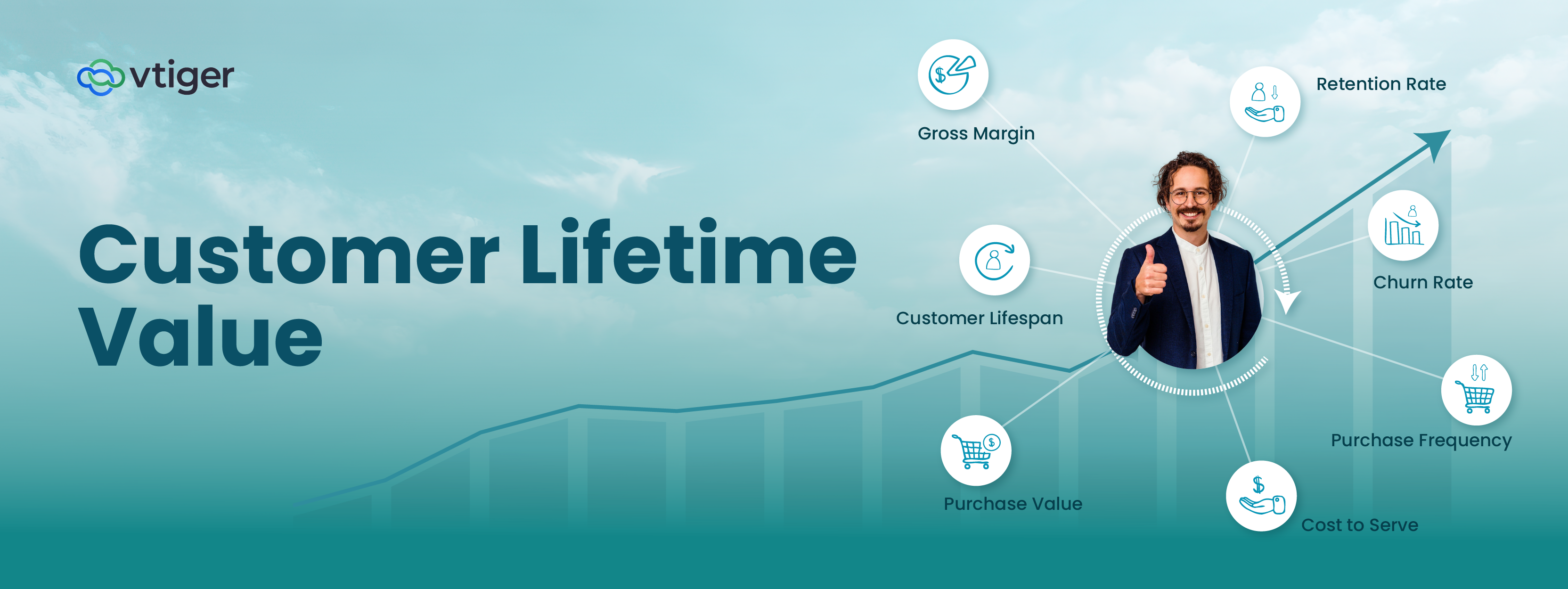
Customer lifetime value is shaped by how customers buy, how long they stay, and how efficiently the business serves them. Each component represents a pressure point in the customer relationship where value is either compounded or lost. Looking at these inputs individually helps identify which levers actually improve long-term profitability.
The following core inputs shape CLV:
1) Average purchase value
- Reflects revenue generated per transaction
- Influenced by pricing discipline, perceived value, and discounting
- Inflated order values driven by discounts often reduce net CLV
2) Purchase frequency
- Indicates how often customers return voluntarily
- Strong signal of habit formation and product fit
- More stable driver of CLV than one-time high purchases
3) Customer lifespan
- Measures how long customers remain active
- Small increases in lifespan often produce large CLV gains
- Closely tied to onboarding quality and ongoing value delivery
3) Gross margin
- Determines how much revenue contributes to profit
- Low margins weaken CLV even when revenue appears strong
- Critical for separating growth from sustainable growth
4) Cost to serve
- Includes support effort, onboarding, discounts, and manual work
- High service dependency erodes lifetime value
- Often overlooked in early CLV calculations
5) Retention rate
- Reflects the percentage of customers who continue over time
- One of the most powerful CLV multipliers
- Directly improves revenue predictability
6) Churn rate
- Shows how quickly customers exit
- Shortens customer lifespan
- Introduces instability into long-term revenue projections
How to Calculate Customer Lifetime Value
Calculating customer lifetime value translates customer behavior into a financial expectation. The objective is not to reach a perfectly precise number. The goal is to arrive at a directionally reliable metric that improves decisions around acquisition, retention, and long-term planning.
CLV works best when it mirrors how customers actually behave over time. When treated like a rigid accounting formula, it loses practical value. When treated as a behavioral lens, it becomes a strong planning tool.
Basic CLV Formula
At its simplest level, customer lifetime value is calculated using the following formula:
CLV = (Average Purchase Value × Purchase Frequency × Customer Lifespan) − Cost to Serve
Each element represents a real business dynamic.
Average purchase value reflects the revenue generated per transaction. Purchase frequency shows how often that transaction repeats, which often matters more than a single high-value order. Customer lifespan estimates how long the relationship lasts before churn. Cost to serve accounts for onboarding effort, support load, discounts, and operational overhead.
Together, these inputs balance revenue potential with the cost of maintaining the relationship.
Simple CLV Example
Consider a customer who spends $5,000 per purchase and buys four times a year. That customer generates $20,000 annually.
If the relationship lasts five years, total revenue equals $100,000.
Now factor in a cost to serve of $20,000 over the same period. The resulting customer lifetime value is $80,000.
This example shows why CLV often tells a different story than short-term sales data. Customers with modest monthly revenue can become highly valuable over time. Others may generate strong early revenue but fail to sustain value.
Advanced CLV Models
As businesses grow, simple CLV calculations are often expanded.
Predictive CLV uses historical patterns to estimate future customer behavior. This approach is common in subscription and high-volume models.
Cohort-based CLV compares customers acquired in different time periods. It helps reveal changes in retention quality and value trends over time.
Discounted cash flow CLV adjusts future revenue for the time value of money. This model is typically used for long-term financial planning rather than day-to-day decisions.
All advanced models build on the same principle. Customer value is created through repeat behavior over time, not isolated transactions.
Gross CLV vs Net CLV
Not all Customer Lifetime Value calculations answer the same question. Gross CLV and Net CLV exist because businesses need to look at customer value from two very different angles. One looks at potential. The other looks at reality.
Gross CLV focuses only on revenue generated by a customer over time. It ignores the cost to acquire, serve, and retain that customer. Because of this, gross CLV is useful early on when businesses are trying to understand market size, demand strength, or revenue upside.
Net CLV, on the other hand, accounts for costs. It subtracts expenses such as onboarding effort, customer support, discounts, operational overhead, and service delivery. This makes net CLV a profitability metric rather than a revenue estimate.
The difference matters because revenue alone does not fund growth. Profit does.
How Gross and Net CLV Differ
| Metric | Gross CLV | Net CLV |
| Includes costs | No | Yes |
| Purpose | Revenue potential | True profitability |
| Accuracy | Directional | Strategic |
| Use case | Growth estimation | Investment decisions |
Gross CLV answers the question: How much could this customer spend if everything goes right?
Net CLV answers a more important question: How much value does this customer actually leave behind after costs?
When teams rely only on gross CLV, they often overestimate growth capacity. Marketing budgets expand, acquisition accelerates, and support load increases, but margins quietly shrink. Net CLV prevents this by forcing cost awareness into every growth decision.
CLV vs CAC (Customer Acquisition Cost)
Customer Lifetime Value becomes meaningful only when it is evaluated alongside Customer Acquisition Cost. Looking at either number in isolation gives an incomplete picture of growth health.
CLV measures how much value a customer contributes over time. CAC measures how much it costs to acquire that customer in the first place. The relationship between the two determines whether growth creates value or destroys it.
Key Differences Between CLV and CAC
| Metric | CLV | CAC |
| Measures | Long-term customer value | Cost to acquire |
| Time horizon | Long-term | Short-term |
| Purpose | Profitability | Efficiency |
| Relationship | CLV should exceed CAC | CAC should stay controlled |
If CAC approaches or exceeds CLV, the business is effectively buying revenue rather than earning it. Growth may look strong on the surface, but it is unsustainable because each new customer adds less value than it costs to acquire them.
A commonly used benchmark is a CLV: CAC ratio of 3:1. This does not mean every business must hit this exact number, but it provides a safety margin. It ensures there is enough lifetime value left after acquisition to cover operating costs, reinvestment, and profit.
Ratios below this level signal fragile growth. Small changes in churn, pricing, or acquisition costs can quickly push the business into losses. Healthy CLV: CAC ratios, by contrast, give businesses room to reinvest, improve customer experience, and absorb market fluctuations without eroding margins.
How Businesses Use Customer Lifetime Value
Customer lifetime value becomes useful only when it shapes decisions across teams. Its role is not retrospective reporting. It exists to align acquisition, conversion, retention, and planning around the economic reality of customer relationships.
CLV in Marketing and Acquisition Decisions
Marketing teams often default to volume because volume is easy to measure. CLV interrupts this habit by forcing acquisition decisions to account for long-term contribution rather than short-term conversions.
This shift enables smarter targeting. Instead of treating all leads as equal, teams apply customer segmentation to prioritize profiles that historically stay longer, expand more, and require less ongoing effort. Over time, this reduces unnecessary costs and stabilizes growth quality.
CLV in Sales Prioritization and Deal Quality
Sales results can look strong while long-term value quietly declines. CLV reveals this mismatch. Deals that close quickly but churn early inflate short-term revenue while weakening future performance.
Reframing what sales is through CLV changes how success is defined. Closing activity matters, but relationship durability matters more. When CLV insights are paired with sales automation, teams can focus on accounts with higher expansion potential and healthier post-sale behavior rather than chasing velocity alone.
CLV in Retention and Account Management
Retention strategies become more disciplined when guided by CLV. High-value customers justify proactive engagement, deeper relationship management, and tailored lifecycle planning. Lower-value or declining segments highlight onboarding gaps, expectation mismatches, or product fit issues.
CLV also brings structure to customer service decisions. Support effort is no longer distributed evenly by default. Instead, resources are aligned with customer value and risk, ensuring that effort protects long-term contribution rather than reacting to noise.
CLV in Financial Planning and Forecasting
From a financial perspective, CLV strengthens planning by grounding projections in behavior rather than averages. Forecasts based on CLV account for churn likelihood, retention duration, and expansion probability instead of assuming linear growth.
Using customer analytics, leadership teams gain clearer visibility into how different customer groups contribute to future revenue streams, making plans more resilient to volatility and change.
Factors That Influence Customer Lifetime Value
Customer lifetime value is shaped continuously by how customers experience value, friction, and trust across the relationship. These influences are cumulative rather than isolated.
- Customer satisfaction and perceived value
- Product adoption depth and usage consistency
- Pricing strategy and discount discipline
- Engagement relevance over time
- Renewal and repurchase behavior
- Brand trust and loyalty
- Ease of switching to alternatives
Weakness in one area often amplifies losses in others, reducing lifetime contribution.
How to Increase Customer Lifetime Value
Improving CLV is less about selling more and more about reducing reasons to leave. Most gains come from consistency, clarity, and relevance over time.
Actions That Strengthen Long-Term Value
- Improve onboarding so customers reach meaningful outcomes early
- Deliver consistent experiences across all touchpoints
- Engage customers around usage milestones rather than promotions
- Cross-sell and upsell only when aligned with real needs
- Identify churn drivers before they become exits
- Personalize communication without overwhelming customers
- Use marketing automation selectively to maintain continuity rather than noise
These actions extend customer lifespan and stabilize contribution without inflating cost to serve.
Common Mistakes When Measuring CLV
Customer lifetime value loses reliability when treated as static or purely mathematical. Most errors stem from oversimplification rather than incorrect formulas.
Ignoring Cost and Profit Realities
Focusing only on revenue while ignoring cost to serve inflates CLV and leads to poor investment decisions, especially in high-touch models.
Relying on Short-Term or Aggregated Data
Using limited historical data or averaging all customers together hides churn risk and meaningful differences between customer groups.
Treating CLV as Fixed
Customer behavior evolves as products, pricing, and expectations change. Static CLV models quickly lose relevance.
Overestimating Retention
Small errors in retention assumptions compound over time, distorting lifetime value projections and weakening planning accuracy.
FAQs
What is customer lifetime value in simple terms?
Customer lifetime value is an estimate of how much profit a customer generates over the entire relationship, not just the first purchase. It combines buying frequency, retention duration, and margin while accounting for service and support costs. In simple terms, CLV answers whether a customer becomes more valuable as time passes.
How is customer lifetime value calculated?
Customer lifetime value is calculated by multiplying average purchase value, purchase frequency, and expected customer lifespan, then subtracting the cost to serve. This approach connects revenue behavior with operational reality. More advanced calculations refine the estimate using churn probability, margins, and cohort behavior, but the core logic remains focused on profit over time.
What is a good CLV ratio?
A commonly accepted benchmark is a CLV to acquisition cost ratio of around 3:1. This means the customer generates roughly three times the value it costs to acquire them. Ratios below this suggest fragile growth, while higher ratios indicate room for reinvestment, retention initiatives, and margin protection.
What is the difference between CLV and LTV?
CLV and LTV are often used interchangeably, but CLV typically emphasizes profitability rather than raw revenue. LTV is sometimes calculated as total revenue over a customer’s lifespan, while CLV explicitly factors in costs, margins, and retention behavior. In practice, CLV provides a more decision-ready metric for planning.
How does CLV help marketing teams?
CLV helps marketing teams move beyond lead volume and conversion rates. By tying campaigns to lifetime contribution, teams can prioritize channels that attract customers who retain longer and expand more. This prevents overinvestment in sources that convert quickly but churn early, improving long-term return on marketing spend.
Why is CLV more important than one-time sales?
One-time sales show activity, not sustainability. CLV reveals whether customers continue buying, renew, or expand after the initial transaction. Businesses that focus only on first-sale revenue often grow volume while eroding margins. CLV highlights long-term contribution, making it a better indicator of durable and predictable growth.
What factors increase customer lifetime value?
Customer lifetime value increases when customers stay longer, buy more consistently, and cost less to serve. Key drivers include effective onboarding, strong product adoption, pricing discipline, responsive support, and meaningful engagement. Improvements in retention and usage depth usually have a larger CLV impact than increasing order size alone.
How often should CLV be calculated?
CLV should be reviewed regularly, not treated as a one-time calculation. Businesses typically recalculate it quarterly or when major changes occur in pricing, retention, acquisition strategy, or cost structure. Regular updates ensure CLV reflects current customer behavior rather than outdated assumptions.
Can small businesses use CLV effectively?
Yes. Small businesses often benefit more from CLV because resources are limited. Even a simple CLV model helps identify which customers are worth retaining, which acquisition efforts pay off, and where costs quietly reduce profitability. CLV does not require complex tools to provide meaningful strategic guidance.
How does CLV relate to customer retention?
Retention directly influences customer lifespan, which is one of the strongest drivers of CLV. Small improvements in retention compound lifetime value far more predictably than acquiring new customers. When customers stay longer, revenue becomes more stable, acquisition pressure decreases, and forecasting accuracy improves significantly.