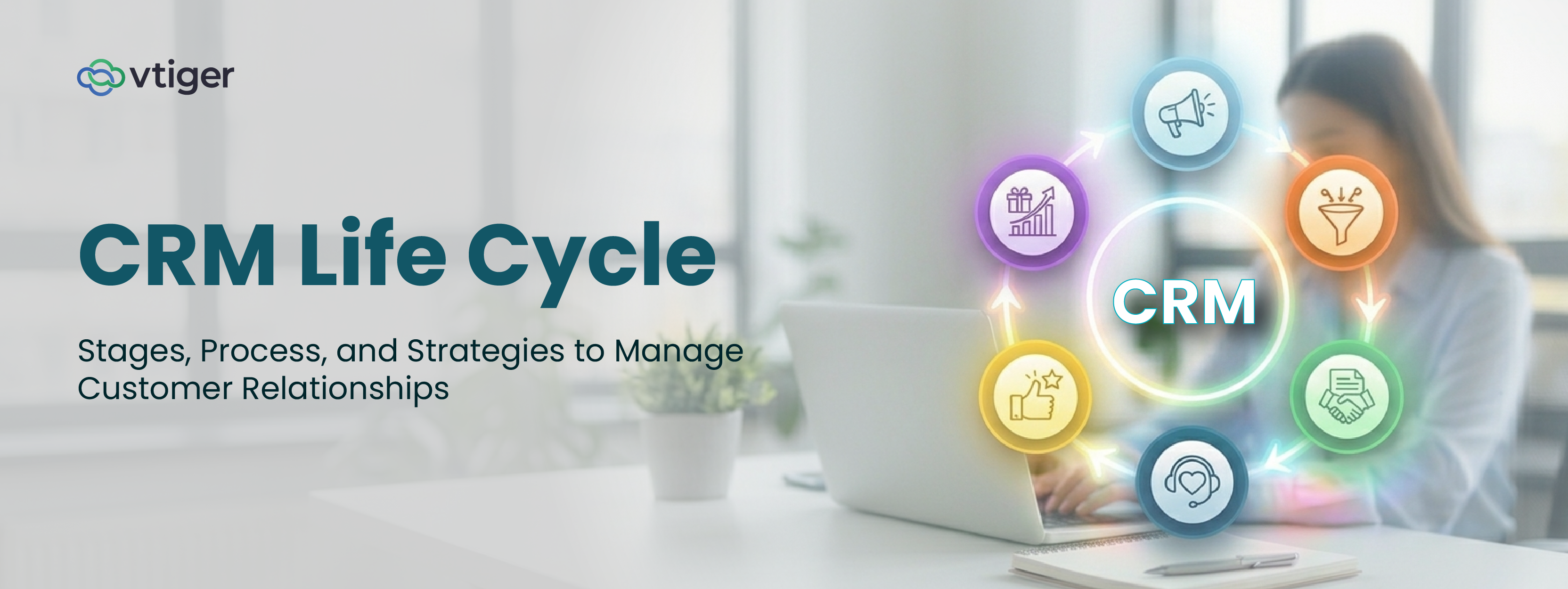
The CRM life cycle is an operational process businesses follow to manage customer relationships from first contact through long-term retention. It includes stages such as lead generation, qualification, acquisition, retention, and loyalty. Managing each stage with the right CRM tools improves customer experience, increases conversion rates, and supports predictable revenue across sales, marketing, and support teams.
Customer relationships rarely follow a single transaction path anymore. Modern buyers research independently, compare options across review sites, engage with content over weeks or months, and expect personalized follow-up at every touchpoint.
Businesses that map every stage of the customer journey retain more customers and grow faster than those operating in disconnected campaigns. According to Forrester, Customer-obsessed companies, those that centre their revenue process on a unified view of the customer; grow revenue 28% faster and achieve 43% better customer retention than those that don’t. The CRM life cycle provides the framework for that alignment.
What is the CRM Life Cycle?
The CRM life cycle is the end-to-end process by which a business identifies, engages, converts, retains, and grows customer relationships using a Customer Relationship Management system. It maps the operational steps that move a stranger into a lead, a lead into a customer, and a customer into a long-term account. Each stage produces data that feeds the next, which is why the life cycle operates as a continuous loop rather than a fixed sequence.
The framework reflects how customer relationships develop in practice. Leads enter the system at different awareness levels, qualified contacts move through pipeline stages at different speeds, and existing customers generate expansion revenue through renewals, upsells, and referrals. CRM lifecycle management organizes these movements into measurable stages so revenue teams can see where deals progress, where they stall, and where intervention will produce results.
Stages of the CRM Life Cycle
The CRM life cycle consists of five distinct stages that move a prospect from initial awareness to long-term advocacy. Each stage has its own metrics, owners, and tools, and the transition between stages is where most pipeline leakage occurs. Understanding the CRM lifecycle stages individually helps teams locate where their process breaks down.
Lead Generation
Lead generation is the activity of attracting potential customers who match the business’s ideal customer profile. It draws prospects from advertising, content, search results, social campaigns, events, partnerships, and outbound prospecting. The output is a stream of contacts who have shown interest but have not yet been assessed for fit or buying intent.
Effective lead generation depends more on targeting accuracy than on volume. A campaign that produces 1,000 leads outside the ideal customer profile creates more downstream work than a campaign that produces 100 leads with a strong fit. CRM systems support this stage by capturing form submissions, syncing with marketing automation tools, and routing new leads to the correct owner based on segmentation rules. Teams scaling this work often connect campaign sources to the CRM through structured lead generation workflows that feed every interaction back into the customer record.
Lead Qualification
Lead qualification separates contacts who are likely to buy from those unlikely to convert in a reasonable timeframe. Sales and marketing teams typically combine demographic fit (industry, role, company size) with behavioural signals (page views, email engagement, demo requests) to score each lead. The output is a ranked list of leads ready for sales follow-up.
Lead scoring is the most common qualification mechanism in modern CRMs. Each behaviour or attribute carries a numerical weight and leads above a defined threshold to route sales reps automatically. According to Gartner, companies with high conversion rates use an average of four criteria to score leads, combining profile fit like covering demographics, firmographics, and technographics; with behavioural fit, which captures signals such as content engagement, site visits, and buying job completion.
This disciplined scoring approach reduces the volume of unqualified leads passed to sales and increases the proportion of opportunities that reach later pipeline stages.
Customer Acquisition
Customer acquisition, also called conversion, is the stage where a qualified lead becomes a paying customer. It covers discovery calls, demos, proposal preparation, negotiation, and contract signature. Pipeline stages within the CRM track each opportunity through to closed won or closed lost, and conversion rates between stages reveal where deals slow or fall off.
Sales teams often use structured deal-stage task sequences during the acquisition process. The Playbooks feature enforces this structure by assigning specific tasks at each pipeline stage, ensuring that demos, proposals, and procurement steps occur in the correct order. Conversion is when pricing, sales enablement, and competitive positioning carry the most weight in the CRM customer lifecycle.
Customer Retention
Customer retention covers everything that happens after a deal closes, including onboarding, product adoption, ongoing support, account reviews, and renewal management. Retention is operationally distinct from acquisition because the success metric shifts from new revenue to recurring revenue. The team responsible also shifts from sales to customer success and support.
A retention-focused CRM life cycle uses one customer record across sales, support, and account management, so no team has to re-learn the customer’s history. The One View feature consolidates conversation history, support tickets, contracts, and product usage into a single profile. This reduces the time that customer-facing teams spend gathering context before each conversation.
Customer Loyalty and Advocacy
The final stage is loyalty and advocacy, where retained customers become repeat buyers, referral sources, and case study providers. This stage matters because acquiring a new customer costs meaningfully more than expanding an existing one. Customers who stay long enough to refer others increase the lifetime value of every original acquisition spent.
Loyalty programs, structured account reviews, NPS surveys, and customer advisory boards all support this stage. CRM systems track referral sources, record case study participation, and identify customers whose engagement patterns indicate potential for testimonials or expansion offers. Treating advocacy as a measured program rather than an incidental outcome is what turns retention into compounding growth.
CRM Life Cycle Process Explained
The CRM life cycle process is the operational sequence that turns the five stages into a repeatable workflow. Each step produces an output that the next step requires, and breaking the process into numbered steps makes it easier to identify where automation replaces manual work. The standard CRM process stages run as follows:
- Attract potential customers through marketing campaigns, content, and outbound prospecting that target the defined ideal customer profile.
- Capture and store every interaction (form submissions, email opens, meeting bookings, support inquiries) inside the CRM record so no signal is lost.
- Nurture leads through automated email sequences, retargeting campaigns, and timely sales outreach based on behavioural engagement signals.
- Convert qualified leads into customers using structured pipeline stages, sales playbooks, and proposal workflows that move opportunities to closed won.
- Retain customers through onboarding, support SLAs, account reviews, and proactive check-ins that prevent churn before it happens.
- Convert loyal customers into advocates by capturing referrals, identifying expansion opportunities, and inviting them to participate in case studies or advisory boards.
Importance of CRM Life Cycle Management
CRM lifecycle management helps businesses track and manage every customer interaction from first contact to long-term retention. Its impact is evident in key metrics such as conversion rates, customer acquisition cost, retention, and revenue growth. Instead of working in silos, teams use a shared system that keeps all customer data in one place, making decisions more accurate and timely.
Better customer experience
All teams can see the same customer history, including past conversations and issues. This avoids repetition and makes interactions smoother and faster.
Improved conversion rates
Sales teams can use customer behaviour data, such as email clicks or product interest, to follow up at the right time, increasing chances of closing deals.
Early churn detection
The system flags risks like low usage or delayed renewals, helping teams act before customers leave.
Clear marketing performance
Campaigns can be tracked from lead to sale, helping businesses spend on channels that actually drive revenue.
How to Optimize Each Stage of the CRM Life Cycle
The CRM journey stages produce different outcomes depending on how each stage is operationalized. Optimization is not about adding more activity. It is about removing the friction that prevents leads from moving forward, customers from staying engaged, and data from informing decisions. The tactics below address the specific operational levers within each phase.
Optimize Lead Generation
Lead generation improves when targeting accuracy goes up and when the channels that produce the highest-fit leads receive proportionally more investment. Tracking source-level attribution inside the CRM allows revenue leaders to see which campaigns produce leads that actually convert, not just leads that fill the database.
Specific tactics that improve lead generation include:
- Define ideal customer profile criteria and use them as filters on every campaign source before leads enter the CRM
- Track campaign source on every lead record and connect that source to revenue closed downstream
- Test outbound prospecting against inbound channels with equal effort to identify which produces better unit economics
- Choose CRM software that captures leads from website forms, paid ads, and event platforms in real time
Improve Lead Qualification
Lead qualification improves when scoring criteria reflect what closed customers actually look like, not what the marketing team assumes about a good fit. Reviewing closed won and closed lost data quarterly keeps the scoring model aligned with sales outcomes and prevents the qualification system from becoming inaccurate over time.
Specific tactics that improve lead qualification include:
- Use behavioural signals (email engagement, meeting acceptance, content downloads) alongside demographic fit
- Set a clear score threshold above which leads the route to sales automatically, and below which they remain in nurture
- Review lead score performance against actual close rates every quarter and adjust weighting where needed
- Apply CRM automation so scoring updates run continuously across the qualification workflow
Enhance Conversion Rates
Conversion improves when each pipeline stage has clear exit criteria, when sales reps have the materials they need at the moment they need them, and when forecast accuracy holds up against actual close data. Pipeline stage definitions should be operational, not aspirational.
Specific tactics that improve conversion rates include:
- Define exit criteria for every pipeline stage in observable terms (proposal sent, security review complete, procurement approved)
- Use deal-stage task sequences, such as Playbooks, to enforce consistent rep behaviour across opportunities
- Apply Calculus AI’s next best action recommendations to identify which deal needs attention next based on engagement and stage age
- Run weekly pipeline reviews against historical close rates to identify forecast risk early
Strengthen Customer Retention and Loyalty
Retention and loyalty improve when customer health signals are visible to the team responsible for renewal, when proactive outreach happens before issues compound, and when product usage data feeds account reviews. Reactive support cannot replace structured retention work, and incidental testimonial requests cannot replace a deliberate advocacy program.
Specific tactics that improve retention and loyalty include:
- Track product adoption on every account record alongside ticket volume and resolution time
- Schedule structured account reviews at defined intervals (30 days post-onboarding, 90 days, renewal-60 days)
- Use sales CRM workflows to trigger renewal sequences with enough lead time for negotiation
- Run quarterly NPS surveys and tie referral attribution into the customer record so loyalty gets measured
Tools Used in CRM Life Cycle Management
CRM lifecycle management depends on a connected stack of tools, not a single application. The CRM platform is the central record, but it works alongside marketing, support, and analytics systems that feed it data and consume its outputs. Choosing the right combination depends on team size, complexity, and the stages where the most leverage exists.
The core tool categories that support the CRM strategy lifecycle include:
- CRM platforms that hold the unified customer record across sales, marketing, and support, with pipeline tracking, contact management, and reporting built in
- Marketing automation tools that handle email nurture, campaign segmentation, and behavioural tracking, syncing every interaction back to the CRM record
- Lead enrichment tools that append firmographic and behavioural data to incoming leads, so qualification scoring works on complete information
- Customer support platforms with SLA management, ticketing workflows, and integrated knowledge bases that share history with the CRM
- Analytics tools that surface pipeline velocity, conversion rates by stage, retention metrics, and revenue attribution across channels
- AI-assisted recommendation systems, such as Calculus AI, that analyze conversation history and pipeline patterns to identify the next best action for each deal
Best Practices for Managing CRM Life Cycle
Effective CRM lifecycle management depends on consistent execution rather than periodic redesign. Teams that get the most value from their CRM operate from a small set of disciplined principles applied daily across the customer journey.
The practices below cover the operational habits that produce reliable lifecycle outcomes:
- Make customer-centricity operational by designing every workflow around what the customer experiences, and connect customer experience management processes to the CRM so feedback closes in the same system.
- Maintain data discipline through automated capture, defined record ownership, and quarterly quality reviews, since stage hygiene and contact accuracy matter more than feature count.
- Align sales, marketing, and support on shared definitions of a qualified lead, a healthy customer, and the triggers for handover between teams.
- Hold all customer data in one system rather than syncing fragments between tools, which is the operational requirement. Effective CRM life cycle management cannot work without it, and the reason Vtiger consolidates sales, marketing, and support data.
- Test every automation, pipeline rule, and routing decision against the customer outcome it produces, so changes get evaluated on retention and conversion impact, not internal convenience.
- Review CRM performance on a defined cadence (monthly for pipeline health, quarterly for retention, annually for lifecycle attribution), so optimizations get prioritized by data.
FAQs
What is the CRM life cycle?
The CRM life cycle is the structured process businesses use to manage customer relationships from first contact to long-term retention and advocacy. It typically includes lead generation, lead qualification, customer acquisition, customer retention, and customer loyalty stages. Each stage produces data that informs the next, which is why the life cycle operates as a continuous process rather than a one-time sequence.
What are the stages of the CRM life cycle?
The CRM life cycle has five core stages: lead generation, where prospects enter the system; lead qualification, where leads are scored for fit and intent; customer acquisition, where qualified leads convert into paying customers; customer retention, which covers onboarding, support, and renewals; and customer loyalty and advocacy, where existing customers become repeat buyers and referral sources.
Why is the CRM life cycle important?
The CRM life cycle provides revenue teams with a shared framework for managing every stage of the customer relationship, using the same data and definitions. It improves customer experience, raises conversion rates, increases retention, and produces clearer marketing ROI. Without it, teams operate in disconnected campaigns, and interactions lose the context that makes follow-up effective.
How does CRM help in customer retention?
CRM systems support retention by storing the full customer history in a single record, so sales, support, marketing, and account management teams all work from the same context. The system tracks adoption metrics, tickets, renewal dates, and engagement patterns, enabling account managers to act on early churn signals before customers decide to leave.
What tools are used in CRM life cycle management?
CRM lifecycle management uses a connected stack: a CRM platform as the central customer record, marketing automation for nurture campaigns, lead enrichment tools for data quality, support platforms for SLA and ticket management, analytics tools for pipeline reporting, and AI-assisted recommendation systems. Integration matters more than tool count, since disconnected systems create the data gaps the life cycle is meant to remove.
How can businesses optimize the CRM life cycle?
Businesses optimize the CRM life cycle by targeting lead generation, scoring leads against behavioural data, defining exit criteria for every pipeline stage, using structured task sequences during acquisition, tracking customer health signals during retention, and running deliberate advocacy programs.
What is the difference between the customer journey and the CRM life cycle?
The customer journey describes the experience from the customer’s view: how they discover a product, evaluate it, purchase it, and continue using it. The CRM life cycle describes the same path from the business’s operational view: the stages, data, workflows, and handovers that produce that experience. The journey is what the customer feels; the life cycle is what the business does to support it.