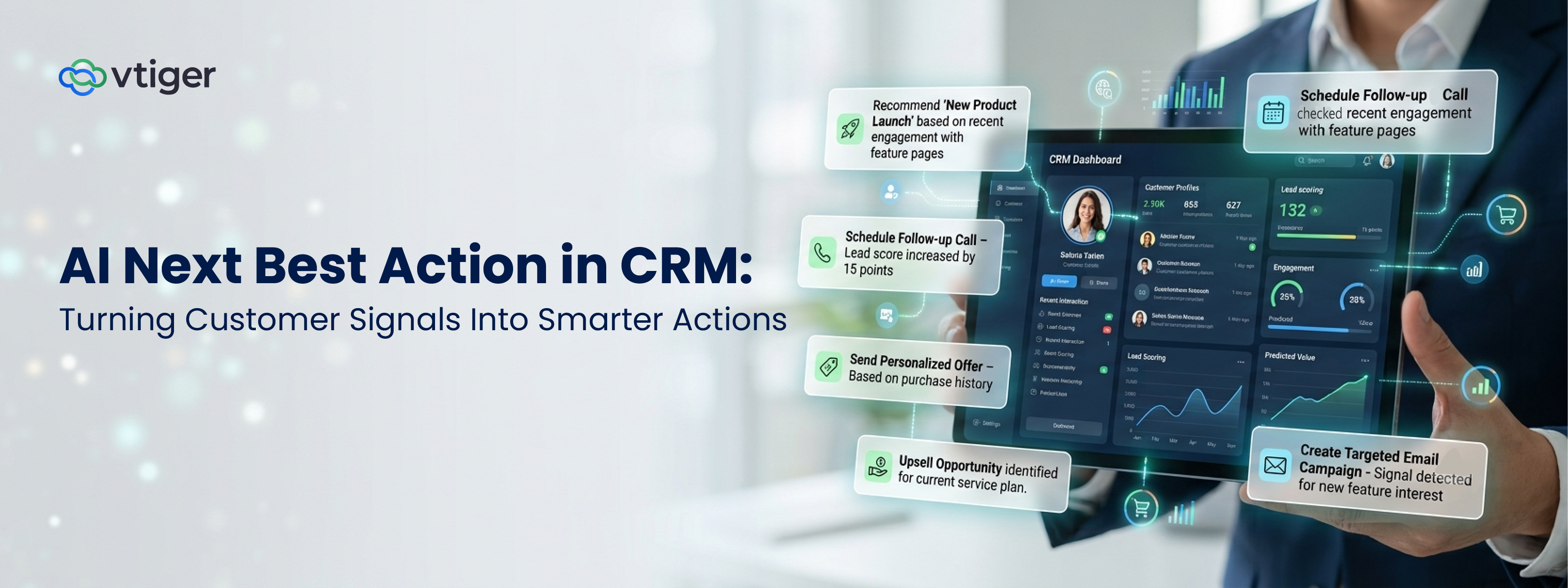
AI systems use rules, statistical methods, or machine learning models to process information and produce outputs such as predictions, classifications, recommendations, or generated content. Modern business AI often learns patterns from historical data rather than relying only on manually written rules. In CRM, these capabilities can help score leads, forecast deals, analyze conversations, summarise records, and recommend next actions.
AI has moved from specialist technology into everyday business software. It can now appear in a CRM as a lead score, forecast, conversation summary, recommended action, or generated email. The interface can make these features look simple even though very different processes may sit behind them.
A prediction based on historical CRM records is not the same as a generative model writing an email, and neither should be treated as an independent decision maker. This guide explains how modern business AI works, what happens when a model produces an answer, and how these capabilities are applied to day-to-day business activities.
What Is Artificial Intelligence?
Artificial intelligence is a broad field concerned with building systems that can perform tasks associated with human intelligence, such as recognizing patterns, understanding language, making predictions, or generating content.
Not every AI system works in the same way. Some use explicit rules, while many modern business applications rely on machine learning, where models identify patterns from examples.
Consider invoice anomaly detection. A conventional program could flag every invoice above a fixed amount because a developer wrote that rule. A machine learning model can instead examine historical invoices and learn which combinations of amount, vendor, timing, category, and other signals tend to be unusual.
The difference becomes useful when a business problem has too many variables for practical rule writing. Customer churn is one example. A fixed rule might flag a customer after two unanswered emails. A model can consider that signal alongside product usage, support history, purchase frequency, renewal timing, and other available information.
What AI Is Not
AI does not automatically understand business context simply because it can recognize patterns or generate fluent language.
A churn model may identify a customer as high risk because their behavior resembles previous customers who left. It may not know that the customer has already agreed to renew if that information is absent from the data it receives.
AI also does not become accurate merely because more data is added. Missing fields, duplicate records, inconsistent labels, outdated information, or biased historical decisions can affect the output.
The practical lesson is that AI quality depends on the task, the data, the model, and how the output is used.
How Does AI Work?
For most modern businesses, AI can be understood as a sequence from data to model to output.
- Collect relevant data: The system gathers information connected to the task, such as closed deals, customer interactions, transactions, support tickets, or product activity.
- Prepare the data: Records may need to be cleaned, labeled, standardized, joined, or checked for missing information.
- Train a model: In machine learning, the system processes historical examples and adjusts internal parameters to improve performance against a defined objective.
- Apply the model: During inference, the trained model receives new information and produces an output such as a probability, classification, prediction, recommendation, or generated response.
- Evaluate and update: Actual outcomes can be compared with predictions. When performance changes, the model can be evaluated, retrained, or replaced.
For example, a lead scoring model might learn from previous leads that became customers and those that did not. It can examine engagement, company characteristics, previous interactions, and other available signals. When a new lead arrives, the model uses those patterns to estimate how closely the record resembles successful historical cases.
The result is useful because it turns a large pool of records into a prioritization problem. It does not turn a prediction into a certainty.
In plain terms: AI is less like giving a computer a giant rulebook and more like training it to recognize useful patterns from many examples. The model can apply those patterns to new cases, but its output still depends on what it learned and what information it receives.
Key AI Technologies
AI is not one technology doing one job. It is a broad field that includes different approaches for learning from data, processing language, recognizing complex patterns, and generating content.
| Technology | What it does | CRM example |
| Machine learning | Learns patterns from historical data | Lead scoring or churn prediction |
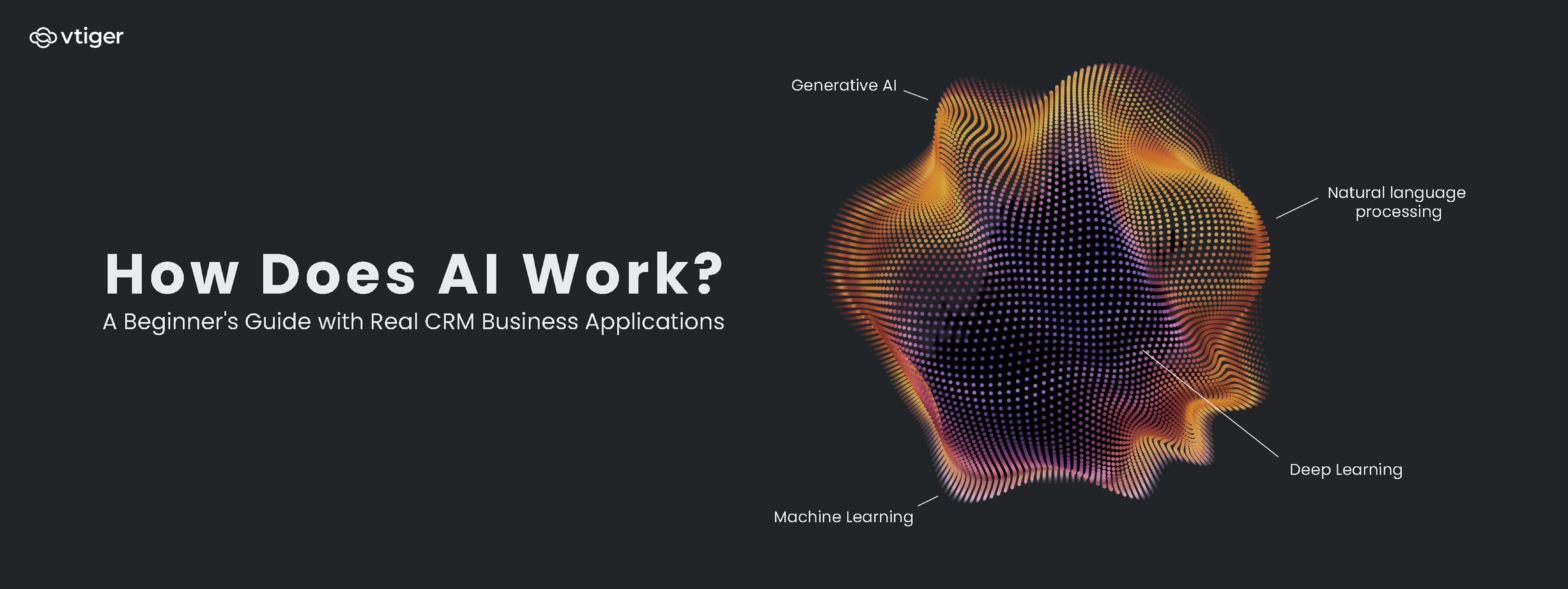
| Deep learning | Handles complex patterns using layered neural networks | Speech or image analysis |
| Natural language processing | Processes human language | Email and conversation analysis |
| Generative AI | Produces new content | Drafting replies or summarising calls |
The distinction matters because two products can both be marketed as “AI” while doing very different things. A predictive model may return a probability, while a generative model produces text. Their data requirements and failure modes are different.
These technologies can also work together. A CRM could use machine learning to score a deal, natural language processing to analyze a customer conversation, and generative AI to prepare a follow-up message.
How AI Learns and Decides Its Further Actions
AI training and AI usage are separate stages. A model learns from historical data during training, then applies what it has learned to new information during inference.
Training, Inference, and Updating
During training, a machine learning model processes historical examples and adjusts its internal parameters to improve against a defined objective. Once deployed, the model uses those parameters to produce predictions, classifications, recommendations, or other outputs from new data.
Using an AI feature does not mean the model is learning from every interaction. A deployed model can make predictions repeatedly without changing its underlying parameters. Improving it requires deliberate evaluation: teams compare predictions with actual outcomes, identify where the model performs poorly, collect new examples, and retrain or update the model.
This matters because business conditions change. A sales model trained on last year’s buying behavior may become less useful when pricing, products, competitors, or customer expectations shift.
From Prediction to Action
Predictive AI is most useful when its output helps someone make a better decision. Many systems return a probability or confidence score rather than a guaranteed outcome.
Consider a salesperson with 40 new inquiries but enough time to contact only 10. A lead score can help prioritise enquiries with stronger evidence of conversion. The score does not guarantee that a lead will convert, however, and human judgment still matters. The salesperson may know about a budget freeze, referral, competitor relationship, or recent conversation that is not recorded in the CRM.
AI Applications in CRM Systems
CRM systems give AI access to customer records connected to real business outcomes. That makes them useful for identifying patterns across sales, marketing, and service interactions.
Lead Scoring: Prioritizing the Right Inquiries
AI lead scoring analyses historical lead information to identify characteristics and behaviours associated with conversion.
A model might consider engagement, company characteristics, previous interactions, and other available signals. When a new lead enters the CRM, those signals can be compared with historical patterns and converted into a score.
For sales teams, the benefit is practical: instead of treating every enquiry as equally urgent, representatives can focus first on leads showing stronger evidence of conversion. The score remains a decision aid because a salesperson may have context that the model cannot see.
Customer Insights: Spotting Risk Earlier
The same pattern-based approach can be applied beyond lead conversion. Predictive AI models can identify signals associated with outcomes such as churn, renewal, conversion, or expansion.
For example, product usage may fall while support contacts increase and renewal communications receive less engagement. Each signal may be weak on its own, but together they can resemble the behavior of customers who previously churned.
That pattern gives the business an earlier warning. An account manager can investigate the cause, speak with the customer, and potentially intervene before the renewal is lost.
Sales and Marketing: Turning Data Into Assistance
AI can reduce manual work across sales and marketing by summarising calls, extracting important details, drafting follow-ups, and helping teams review large volumes of pipeline information.
AI sales forecasting can compare current opportunities with historical patterns to give managers another evidence source alongside deal stage, representative judgment, and pipeline value. Marketing teams can similarly use AI for segmentation, content variations, campaign analysis, and personalization, particularly when managing many audiences at scale.
Customer Service: Bringing Context to Every Interaction
Customer service creates another rich source of information. Tickets, emails, chats, and calls can contain details about the customer’s issue, previous attempts to resolve it, product usage, and sentiment.
AI can classify requests, route cases, summarise conversations, suggest responses, and surface relevant information for agents. For example, an agent taking over a complex case can review a concise summary of previous interactions instead of manually reconstructing the entire history.
That is where AI customer experience becomes practical: AI does not replace the agent’s judgement; it gives the agent more context with less manual searching.
Limits And Risks Of AI
AI’s strength is pattern recognition, but that also creates predictable failure points.
| Risk | What causes it | What businesses should do |
| Poor data | Missing, duplicate, outdated, or inconsistent records | Improve data quality before deployment |
| Incorrect output | The model predicts or generates unsupported information | Review high-impact outputs |
| Bias | Historical decisions contain unwanted patterns | Test outcomes across relevant groups |
| Privacy | Customer information enters AI workflows | Apply access and security controls |
| Model drift | Customer behavior changes after training | Monitor performance and retrain when needed |
Generative AI creates a particular risk because fluent language can make an incorrect answer appear authoritative. Predictive AI has a different problem: a numerical score can create false precision when the underlying data is incomplete.
These risks do not mean AI should be avoided. They mean businesses need to decide which outputs can be automated, which require human approval, and which should remain informational.
Getting Started With AI: Best Practices
The strongest AI implementations treat adoption as a business improvement exercise. The difference comes from choosing the right starting point, validating feasibility, and defining value clearly.
Start With One Workflow
Choose a process where the current cost is visible:
- Sales teams spend too much time prioritizing leads.
- Support agents spend too long reading case histories.
- Managers lack consistent pipeline forecasts.
- Marketing teams cannot personalize campaigns at scale.
A defined workflow gives the project a baseline and makes improvement easier to measure.
Check The Data
Before evaluating vendors, inspect whether the relevant CRM records are complete, consistent, and connected to the outcome you want to predict or improve.
If customer identities are duplicated or activities are rarely logged, an AI system may have too little reliable information to work with. Improving that data can also improve reporting and automation even if the AI project is postponed.
Test On Real Cases
A vendor demonstration shows what a feature can do in a controlled setting. A stronger test uses your own records, terminology, edge cases, and historical outcomes.
Evaluate not only where the system is correct, but also how it fails. An AI feature that is transparent and easy for employees to correct may be more useful than one that produces impressive scores but gives little context.
Measure Business Outcomes
Track measures that matter to the team using the system, such as response time, conversion rate, forecast accuracy, handling time, or hours saved.
Model accuracy is useful for technical evaluation, but it is not the final business result. An AI model can become more accurate without making the workflow faster or more profitable.
How Vtiger Applies AI To CRM
Vtiger places AI capabilities inside its CRM workflows, where sales, marketing, and support teams can use predictions, analysis, and generated assistance alongside the customer records they already manage.
What Calculus AI Does
Calculus AI analyses CRM data and sales interactions to provide predictive insights and recommendations. Vtiger describes capabilities including predictive lead scoring, personalized recommendations, sales forecasting, and conversation analysis. Its Conversation Insights can surface information such as sentiment, competitor mentions, deal score, predicted close date, and touchpoint summaries.
For a sales representative, the important part is where those insights appear. A deal score or conversation insight can help the representative decide which opportunity needs attention, what risk to investigate, or which follow-up may be appropriate.
AI Across The CRM
Vtiger also provides Predictive AI Designer for creating prediction models from historical CRM data, alongside generative AI, prompt building, chatbot, and AI agent capabilities. Its AI agents can be configured around defined topics and actions rather than treated as unrestricted autonomous workers.
Vtiger One positions these capabilities within an all in one CRM where sales, marketing, support, and other applications work from shared customer information. This matters because an AI output becomes more useful when the employee receiving it can immediately act on the relevant customer or deal record.
The broader principle is straightforward: AI creates business value when its output reaches the workflow that can act on it. A prediction sitting in an analytics dashboard may be interesting. The same prediction delivered to the salesperson managing the account can change what happens next.
Frequently Asked Questions (FAQs)
How does AI learn from data?
Machine learning models process examples and adjust internal parameters to improve performance against a defined objective. Once trained, the model can apply those learned patterns to new information.
What is the difference between AI and machine learning?
AI is the broader field of systems performing tasks associated with human intelligence. Machine learning is a major approach to AI that learns patterns from data rather than relying entirely on predefined rules.
How is AI used in business?
Common uses include lead scoring, sales forecasting, customer segmentation, conversation analysis, content generation, support routing, recommendations, anomaly detection, and workflow automation.
How does AI work in CRM?
AI can analyze historical CRM records to identify patterns associated with conversion, churn, renewal, or other outcomes. It can then score leads, flag risks, summarise interactions, and recommend actions.
Can AI replace human decision-making?
AI can automate some low-risk, repetitive decisions, but human review remains important when context, customer relationships, fairness, or the cost of an incorrect decision matter.
Does AI keep learning while I use it?
Not necessarily. A deployed model generally applies its existing parameters to new information. Improving it usually requires deliberate evaluation, new training data, and a retraining or update process.
What data does AI need to work well?
AI needs data that is relevant to the task and sufficiently accurate, complete, and consistent to reveal useful patterns. The exact requirements depend on the application and model.