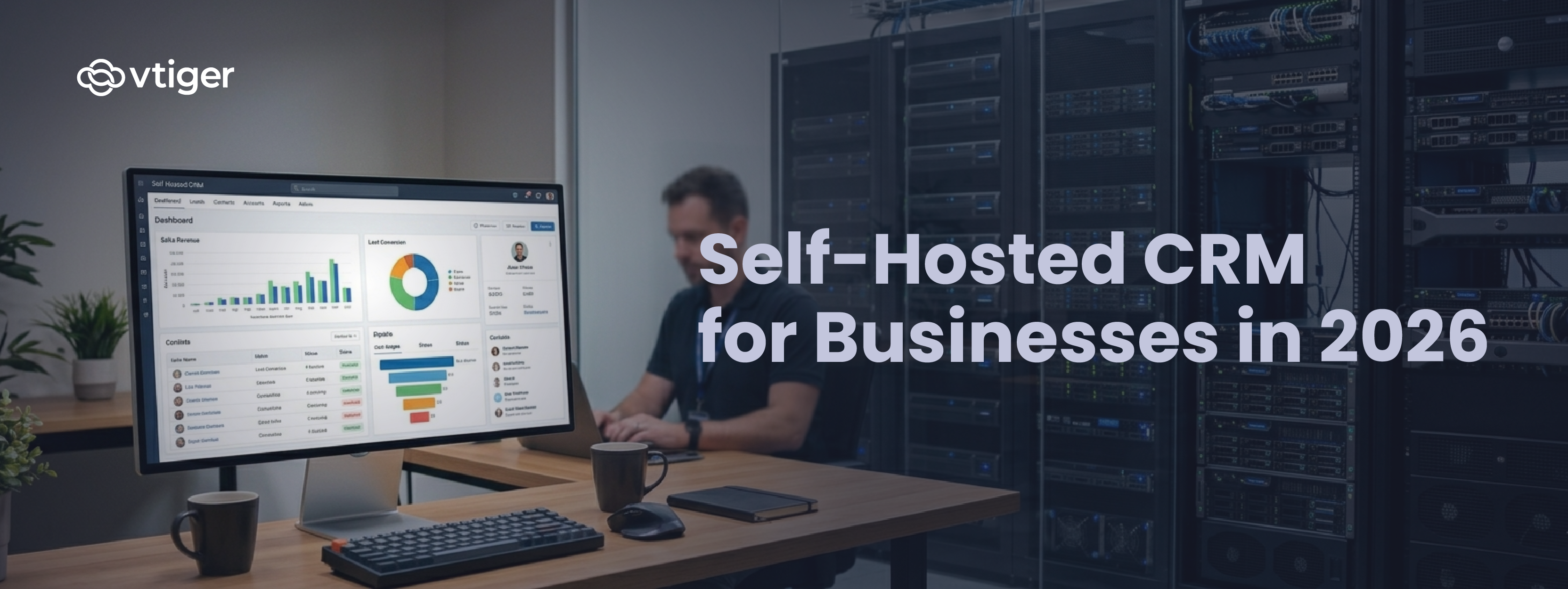
A self-hosted CRM is a customer relationship management system that runs on a company’s own servers or private infrastructure rather than on the vendor’s multi-tenant cloud. It gives the business full control over the data, the customisation surface, the upgrade timeline, and the security configuration. Self-hosted deployments fit organizations with strict compliance needs, deep customisation requirements, or in-house IT teams capable of managing the stack.
The cloud-versus-self-hosted decision is no longer a technology preference. It is a question of which combination of control, compliance, and total cost matches the way the business actually operates. Some businesses get more value from a multi-tenant cloud CRM. Others run into compliance ceilings, customisation limits, or data residency requirements that only a self-hosted deployment can satisfy.
The relevant comparison is operational, not philosophical. According to a Forrester Consulting study, 85% of firms identify on-premises infrastructure as a critical part of their overall IT strategy with data residency, regulatory requirements, and security cited as the specific needs it continues to address and the share is higher in regulated industries such as financial services, healthcare, and government. Cloud is the default; self-hosted is the deliberate choice for specific workloads.
What Is a Self-Hosted CRM
A self-hosted CRM is software that the business installs and operates on its own servers, virtual machines, or private cloud infrastructure rather than consuming as a multi-tenant SaaS product from the vendor’s cloud. The business controls the operating system, the database, the network configuration, the upgrade schedule, and every piece of integration glue between the CRM and the rest of the stack. The CRM vendor provides the codebase and (optionally) support, but the responsibility for running the system stays inside the business.
The model splits into two related categories. Open-source self-hosted CRMs use community-licensed code that any business can download, run, and modify; the vendor sells optional support and add-ons but the core software is free. Commercial self-hosted CRMs are licensed products the business buys for installation on its own servers, typically with annual support contracts.
The choice is operational. Cloud CRMs trade control for convenience: someone else handles infrastructure, but customisation and compliance happen within the boundaries the vendor sets. Self-hosted CRMs trade convenience for control: the team handles every layer, including patching, backups, and disaster recovery, but the customisation and compliance limits are defined by the team rather than the vendor.
10+ Benefits of Self-Hosted CRM
The benefits below cover the eleven specific reasons businesses choose a self-hosted CRM over a cloud product. They are grouped by theme rather than listed flat, since most decisions weigh several related benefits together rather than picking one in isolation.
Data Control and Compliance Benefits
Self-hosted deployments give the business complete authority over where customer data lives, how it is encrypted, who accesses it, and how long it is retained. This authority matters most in regulated industries and in jurisdictions with data residency requirements. Cloud CRMs offer compliance certifications, but the data still sits on the vendor’s infrastructure, which is a non-starter in some operational and legal contexts.
Specific data and compliance benefits:
- Full data ownership with no reliance on third-party storage or vendor data centres
- Compliance with industry-specific regulations including GDPR data residency, HIPAA, PCI DSS, and SOC 2 controls defined by the business
- Custom data retention and deletion policies that match internal legal and audit requirements
- Internal access controls without depending on the vendor’s role-based permission model
Customisation and Integration Benefits
Self-hosted CRMs sit on infrastructure the team controls, which removes the customisation ceiling cloud products impose on shared tenants. Custom modules, deep schema changes, and direct database access become possible in ways cloud APIs do not always support.
Specific customisation and integration benefits:
- Complete control over feature modules, workflows, and data schemas
- Direct database access for complex reporting, analytics, and data warehouse pipelines
- Custom integrations with internal systems including ERPs, HRMs, and proprietary line-of-business apps
- Ability to modify the codebase itself when the platform is open source, which extends sales automation beyond what multi-tenant SaaS allows
Cost and Performance Benefits
Self-hosted economics flip the cost curve from operational expense to capital expense. Subscription fees disappear, replaced by infrastructure, licensing, and operations costs that scale differently. For some workloads, especially those running for many years at predictable user counts, self-hosted total cost of ownership can be meaningfully lower than equivalent cloud spend.
Specific cost and performance benefits:
- No recurring per-user subscription fees, replaced by infrastructure and (where relevant) licensing costs
- Lower long-term total cost of ownership for stable user counts and long deployment lifetimes
- Dedicated infrastructure rather than shared multi-tenant resources, which produces predictable performance under load
- Control over resource allocation as the business scales, with the ability to add capacity without renegotiating SaaS tiers
System and Security Benefits
Running the CRM on owned infrastructure puts the security and operational policy in the business’s hands. The team decides when to patch, how to configure access, what to log, and how to respond to incidents.
Specific system and security benefits:
- Full administrative access to operating system, database, and application configuration
- Control over the upgrade timeline, including the ability to defer or skip releases that introduce regressions
- Custom security policies including network segmentation, encryption at rest, and audit logging tailored to internal requirements
- Offline or air-gapped operation in environments (defence, certain healthcare contexts) where external connectivity is restricted
Self-Hosted CRM vs Cloud CRM
The comparison below covers the operational dimensions buyers should weigh when choosing between deployment models. The right choice depends on which dimensions matter most for the specific business.
| Dimension | Self-Hosted CRM | Cloud CRM |
| Deployment model | Installed on owned servers or private cloud | SaaS hosted by vendor |
| Cost structure | Capex-heavy upfront, lower ongoing subscription | Recurring per-user subscription |
| Setup time | Weeks to months for production-ready deployment | Hours to days |
| Maintenance responsibility | Internal IT team | Vendor handles infrastructure and updates |
| Customisation depth | Unlimited, including codebase changes | Limited to vendor-supported APIs and configuration |
| Data control | Full ownership and residency control | Vendor-controlled with compliance certifications |
| Scalability | Manual capacity planning and infrastructure scaling | Vendor scales transparently with usage |
| Required expertise | DevOps, sysadmin, database, application | CRM admin and end users only |
| Best fit for | Regulated industries, deep customisation, data sovereignty | SMB/mid-market, fast deployment, low IT overhead |
Who Should use a Self-Hosted CRM
Self-hosted CRM is the right choice for a specific set of businesses, not for every team that wants more control. The signals below indicate that self-hosted economics and operational fit work; in their absence, cloud is usually the more pragmatic choice.
The businesses that benefit most from self-hosted CRM:
- Large enterprises with established IT operations, dedicated DBAs, and security teams capable of running production applications
- Regulated industries (financial services, healthcare, government, defence) with compliance requirements cloud CRMs cannot meet without significant compromise
- Businesses with strict data residency requirements where the data must stay inside specific geographic boundaries
- Organizations requiring deep customization that exceeds what cloud CRMs allow through APIs and configuration
- Companies with predictable, long-term user counts where subscription economics produce higher total cost over a 5-to-10-year horizon
- Open-source-aligned organizations that want to read, modify, and contribute to the codebase rather than rely on a vendor’s release cycle
Common Challenges of Self-Hosted CRM
Self-hosted comes with operational responsibilities cloud customers do not have to think about. The challenges below are the ones that sink first-time deployments most often, and each has a specific mitigation that experienced teams build into their plan, including any customer relationship management project that needs internal compliance certification before launch.
Higher Setup Cost and Complexity
Self-hosted CRMs typically take weeks to months to reach production-ready state, with infrastructure provisioning, database tuning, application installation, integration work, and security hardening all happening before the first user logs in. Budget the setup honestly, including the time of internal staff, and avoid the common trap of underestimating integration work that cloud SaaS handles invisibly.
Ongoing Maintenance and Updates
Patching the operating system, applying CRM upgrades, monitoring performance, and handling backups become recurring responsibilities the team owns. Plan for at least 0.5 to 1 full-time engineer’s worth of ongoing maintenance for a production self-hosted CRM at mid-sized scale, more if the deployment runs across multiple data centres or strict change-control processes.
Required Technical Expertise
Self-hosted CRMs need DevOps, database, and application skills the team must already have or be willing to hire. Forrester research found that 22% of all reported CRM implementation problems are people-related or linked to user adoption; making internal capability the second largest category of failure after technology issues, ahead of vendor or product problems. Audit the team’s actual skills against the deployment requirements before committing.
Infrastructure Management
The team owns capacity planning, scaling, redundancy, and disaster recovery in ways cloud customers do not. Build the infrastructure with the user count and data growth at three to five years out in mind, not just today’s requirements, and document the runbooks for the operations team to reduce dependence on individuals.
Best Practices for Implementing a Self-Hosted CRM
The practices below cover what successful self-hosted deployments do consistently. They look obvious in isolation, but the projects that skip three of them are the projects that struggle to reach production stability inside the planned window.
The practices that produce successful self-hosted CRM deployments:
- Document infrastructure requirements (CPU, RAM, storage, network) for production, staging, and development environments before purchasing hardware
- Define security measures upfront, including encryption at rest, access controls, audit logging, and network segmentation
- Schedule regular backups (daily incremental, weekly full) with documented restore procedures tested at least quarterly
- Train internal teams on the platform, the runbooks, and the escalation paths before go-live, not after the first incident
- Monitor system performance with metrics that surface issues before users notice (CPU, database query time, error rates)
- Build workflow automation into the deployment so the operational tasks that scale with user count run automatically rather than manually
Tools and Platforms for Self-Hosted CRM
The self-hosted CRM Software landscape includes both open-source and commercial options, with the right choice depending on the team’s technical depth, budget, and customization requirements.
Evaluation tends to split quickly between platforms that trade licence cost for maintenance responsibility and platforms that charge for support and features in exchange for a more managed experience. The categories below cover the options that come up most consistently when businesses shortlist self-hosted candidates.
Open-Source Self-Hosted CRMs
Open-source platforms carry no licence cost but place the full responsibility for hosting, maintenance, upgrades, and security on the team running them. They suit organizations with in-house technical capacity that want maximum control over the codebase and the flexibility to modify the platform without vendor permission.
The open-source self-hosted category includes platforms built around different priorities and deployment profiles:
- Community-edition platforms with large developer ecosystems, regular core releases, and extensive third-party plugin libraries, suited to teams that want both flexibility and an active support community
- Lightweight modular platforms designed for simpler deployments where ease of setup and low resource consumption matter more than feature breadth
- CRM modules embedded within broader open-source ERP suites, suited to businesses that need customer management alongside inventory, accounting, or operations in a single self-hosted environment
- Fork-based platforms built on older commercial codebases, offering familiarity for teams migrating from legacy systems while retaining full ownership of the installation
Vtiger Open Source CRM sits in the first category, the community edition of Vtiger One, with an active developer community and a regular release cadence that keeps the core platform current.
Commercial Self-Hosted CRMs
Commercial self-hosted CRMs combine on-premise deployment with vendor-backed licencing, support contracts, and managed upgrade paths. They suit organizations that need self-hosted control but cannot absorb the operational overhead of maintaining an open-source platform without vendor assistance.
The commercial self-hosted category breaks along a few consistent dimensions:
- Enterprise on-premise platforms from established vendors, offering deep customization, dedicated support tiers, and compliance documentation suited to regulated industries
- Mid-market commercial platforms with annual licence and support fees, providing more implementation guardrails than open-source options without full cloud dependency
- Hybrid vendor-managed private cloud models, where the CRM software runs in infrastructure the vendor operates but the customer controls, reducing the operational burden while preserving data residency and some degree of deployment control
- On-premise editions of platforms that also offer cloud versions, giving businesses the option to migrate between deployment models as their requirements change
The self-hosted CRM landscape includes both open-source and commercial options, with the right choice depending on the team’s technical depth, budget, and customization requirements. The platforms below are the most common candidates in the category.
Why Self-Hosted CRM Matters for Long-Term Operations
Self-hosted CRM matters because it preserves choices the business may need later. Once data, workflows, and integrations settle into a specific vendor’s environment, moving away becomes a multi-year project with migration costs that rarely appear in the original procurement conversation. Self-hosted deployments keep the option open to change vendors, modify the platform, or move the data without negotiating access to infrastructure the business does not own.
Data Ownership as Operational Leverage
Data ownership is not just a compliance talking point, it becomes a meaningful operational asset as the business grows. When integrations multiply, when M&A activity introduces new entities and obligations, or when regulatory requirements shift in ways that affect where data can live, a self-hosted deployment gives the business direct control over what happens next rather than waiting on a vendor’s compliance roadmap.
The practical advantages of owning the data layer include:
- Full control over data residency, allowing the business to meet jurisdiction-specific storage requirements without relying on a vendor’s regional infrastructure commitments
- Direct access to the underlying crm database for custom reporting, audit exports, and integration builds that cloud APIs would rate-limit or restrict
- Ability to snapshot, archive, or migrate data on the business’s own schedule rather than within the constraints of a vendor’s export tooling
- Reduced exposure to vendor-side data breaches, policy changes, or acquisition events that alter the terms under which the data is held
Customization Depth Over Time
Business models evolve in ways that are difficult to anticipate at the point of CRM selection. Self-hosted platforms allow the team to modify workflows, data models, and integrations at the code level, an option that cloud CRMs either do not offer or gate behind enterprise tiers with significant price increases. The customization advantages that drive those decisions include:
- Unrestricted access to the codebase for building functionality the vendor has not prioritized on their product roadmap
- Custom field structures, object relationships, and workflow logic that go beyond what configuration interfaces allow
- Integration patterns with legacy or proprietary internal systems that require direct database access rather than API calls
- UI and process modifications that match the team’s exact sales motion rather than the generalized workflow the vendor ships by default
Long-Term Cost Control
Subscription pricing scales linearly with users. Infrastructure costs scale with usage but tend to flatten as utilisation stabilises, particularly for businesses that already operate production infrastructure for other applications. Over five to ten years at a consistent user count, the total cost of ownership gap between self-hosted and cloud can be substantial and it widens further when the business has existing infrastructure capacity to absorb the CRM workload without additional spend.
The cost dynamics that make self-hosting financially attractive over time include:
- Fixed infrastructure costs that do not grow automatically as the user base expands, unlike per-seat SaaS pricing
- Elimination of per-user licence fees on open-source platforms, with cost shifting entirely to hosting, maintenance, and internal administration
- Leverage of existing server, database, and DevOps capacity the business already pays for across other applications
- Avoid forced tier upgrades when feature requirements grow, since the platform can be extended through configuration or custom development rather than a more expensive plan
Frequently Asked Questions (FAQs)
Q1. What is a self-hosted CRM?
A self-hosted CRM is software installed and run on a company’s own servers or private infrastructure rather than consumed as a SaaS product from the vendor’s cloud. The business controls the data, the configuration, the upgrade schedule, and the security policies, while taking on the operational responsibility of running the platform.
Q2. What is the difference between self-hosted and cloud CRM?
A self-hosted CRM runs on infrastructure the business owns and operates, with full control over data and configuration. A cloud CRM runs as a SaaS product on the vendor’s infrastructure, with the vendor handling maintenance and scaling. Self-hosted offers more control but requires technical expertise; cloud is faster to deploy but constrained by vendor-defined limits.
Q3. Is self-hosted CRM secure?
Self-hosted CRM can be more secure than cloud, but only if the team running it has the security expertise to harden the deployment. Security depends on patching, access controls, encryption, network configuration, and monitoring. Cloud CRMs benefit from vendor-managed security at scale; self-hosted security is only as strong as the team operating the system.
Q4. Who should use a self-hosted CRM?
Large enterprises, regulated industries (finance, healthcare, government), companies with strict data residency requirements, organizations needing deep customization beyond cloud API limits, and businesses with capable in-house IT teams. Small businesses without dedicated IT operations are usually better served by cloud CRM.
Q5. What are the costs of self-hosted CRM?
Self-hosted CRM costs include infrastructure (servers, storage, networking), licensing if the platform is commercial, implementation services, and ongoing operations staff. Total cost of ownership over five to ten years can be lower than cloud for stable user counts, but upfront costs and operational complexity are higher. Open-source platforms reduce licence costs but not operational ones.
Q6. Can a self-hosted CRM scale with business growth?
Yes, but the scaling is manual rather than automatic. The team handles capacity planning, infrastructure provisioning, and performance tuning as user counts and data volumes grow. Cloud CRMs scale transparently; self-hosted CRMs scale on the team’s planning horizon. Plan capacity for three to five years out to avoid emergency scaling exercises mid-quarter.
Q7. Is technical expertise required?
Yes. Self-hosted CRM requires DevOps, database administration, and application skills inside the team. The complexity ranges from manageable (small open-source deployment) to substantial (multi-region, high-availability commercial deployment). Without these skills internally or through a partner, a self-hosted project carries meaningful execution risk and is rarely the right choice.