Most businesses can tell you what they sold last month. Far fewer can tell you what a single customer is actually worth to them over the years they stay. That gap matters, because a one-time sale only shows the revenue in front of you. It says nothing about whether that customer will come back, spend more, refer a friend, or quietly disappear after their first purchase.
Some customers buy again and again, cost less to serve as they get familiar with you, and become more profitable every year. Others churn early or run up support and discount costs that eat into the margin. Looking at sales alone completely hides these differences.
Customer lifetime value (CLV) helps businesses measure how much value a customer contributes across the entire relationship, not just at the moment of purchase. Once you shift your focus from single transactions to long-term contribution, you get a much clearer read on profitability, retention health, and whether your growth is actually sustainable.
“Customer lifetime value should be a corporate-wide strategy,” says Wharton marketing professor Peter Fader, who co-directs the Wharton Customer Analytics initiative. In his words, it is much more than just a “marketing flavor of the month.” Source: Knowledge at Wharton
What Is Customer Lifetime Value? (Definition & Meaning)
Customer lifetime value (CLV or LTV) is the total net profit a business expects to earn from a customer over the full duration of their relationship, rather than from any single order.
In practice, CLV helps you:
- Understand the true long-term worth of a customer
- Set sensible limits on acquisition spending
- Forecast future revenue and customer profitability with more confidence
- Identify the high-value segments worth protecting
CLV Meaning: Revenue vs Profit
The most important part of the CLV meaning is the distinction between revenue and profit. Two customers can generate identical revenue, yet one demands constant support, discounts, and hand-holding that quietly erodes their real value. Good CLV thinking looks past top-line revenue and focuses on customer profitability, or what’s actually left after the cost of serving that customer.
CLV is also forward-looking by nature. It uses past behaviour, such as how often someone buys and how long they stay, to estimate future contribution. That predictive quality is what makes the metric so useful for planning, forecasting, and deciding where to invest.
CLV vs LTV: Are They the Same?
You’ll see CLV and LTV used interchangeably, and most of the time that’s fine, since both describe the lifetime value of a customer. The subtle difference is emphasis. LTV is often used loosely to mean total revenue over a customer’s lifespan, while CLV usually implies you’ve factored in margins and costs to get to profit. Whenever a decision hinges on profitability, it’s worth being explicit about which one you mean.
Why Customer Lifetime Value Matters
Understanding what customer lifetime value is turns revenue from a rear-view mirror into a forward-looking signal. A one-time sale tells you what already happened. CLV tells you what’s likely to happen next, and whether that future revenue is stable, repeatable, and profitable.
- It sets a realistic ceiling: Once you know what a typical customer contributes over time, you know how much you can afford to spend winning one. Without CLV, acquisition decisions rely on short-term conversion metrics rather than long-term value. (This is also where a well-managed sales funnel can be misleading, because fast conversions don’t guarantee durable revenue.)
- It makes forecasting more honest: Forecasts built on past averages assume everyone keeps buying. CLV-weighted forecasts factor in retention length and churn probability, so you stop overestimating revenue from customers who leave early and stop undervaluing your most loyal segments.
- It prioritizes the right retention efforts: CLV shows which relationships genuinely drive future revenue, so retention spend goes where it counts rather than being spread evenly across everyone.
- It gives every team a shared language: When marketing, sales, and service all evaluate decisions by their impact on lifetime contribution, the whole business starts optimizing for the same thing.
The economics back this up. Forrester’s US Customer Experience Index found that customer-obsessed organizations report 41% faster revenue growth, 49% faster profit growth, and 51% better customer retention than their peers, which is strong evidence that retention and long-term value move together.
How CLV Compares to Other Customer Metrics
CLV rarely works alone. It sits alongside other customer retention metrics and satisfaction scores, and knowing how they differ keeps you from using the wrong tool for the job.
- Net Promoter Score (NPS) measures how likely a customer is to recommend you, based on a single-question survey. It signals sentiment, not money.
- Customer Satisfaction (CSAT) captures how a customer felt about one specific interaction or moment.
- Customer Lifetime Value is the customer value metric that ties everything back to profit over the whole relationship.
Think of NPS and CSAT as early indicators of how a customer feels, and CLV as the outcome those feelings eventually produce. Rising satisfaction with flat or falling CLV is a useful warning sign that goodwill isn’t converting into durable value.
Key Components of Customer Lifetime Value
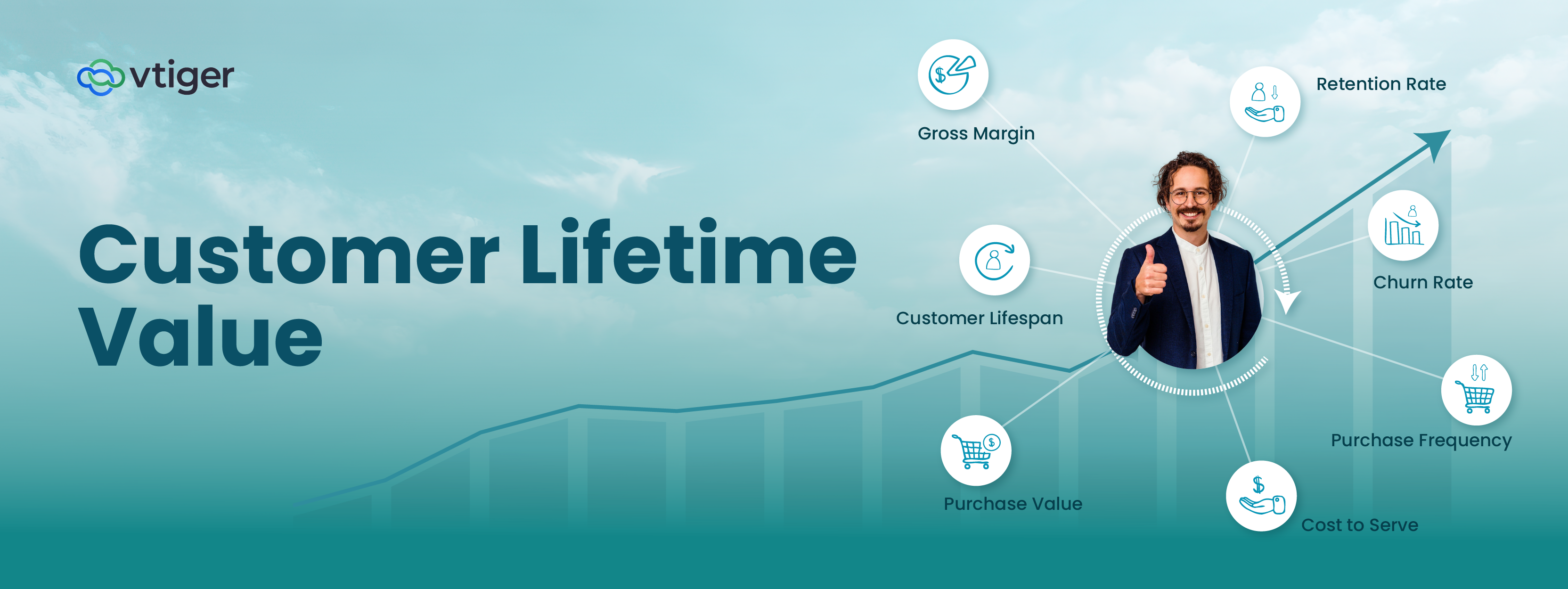
CLV is shaped by how customers buy, how long they stay, and how efficiently you serve them. Each input is a lever you can actually pull.
- Average purchase value: revenue per transaction. Watch for order values inflated by heavy discounting; they can quietly reduce net CLV.
- Purchase frequency: how often customers come back on their own. A steadier driver of value than the occasional big order.
- Customer lifespan: how long the relationship lasts. Small increases here often produce outsized CLV gains, and it’s closely tied to onboarding quality.
- Gross margin: how much revenue actually becomes profit. Thin margins weaken CLV even when revenue looks healthy.
- Cost to serve: support effort, onboarding, discounts, and manual work. Easy to overlook, and a common reason “high-revenue” customers aren’t as valuable as they seem.
- Retention rate: the share of customers who stick around. One of the most powerful CLV multipliers.
- Churn rate: how quickly customers leave. It shortens lifespan and injects instability into every long-term projection.
How to Calculate Customer Lifetime Value
The goal when you calculate customer lifetime value isn’t a perfect number. It’s a directionally reliable one that improves decisions about acquisition, retention, and planning. CLV works best when it mirrors how customers actually behave, not when it’s treated as a rigid accounting exercise.
Basic CLV Formula
At its simplest, the customer lifetime value formula is:
CLV = (Average Purchase Value × Purchase Frequency × Customer Lifespan) − Cost to Serve
- Average purchase value is the revenue per order.
- Purchase frequency is how often that order repeats.
- Customer lifespan estimates how long the relationship lasts before churn.
- Cost to serve covers onboarding, support, discounts, and overhead.
Together, they balance revenue potential against the cost of keeping the relationship alive.
A Simple CLV Example
Say a customer spends $5,000 per purchase and buys four times a year, which is $20,000 annually. Over a five-year relationship, they generate $100,000 in revenue. Now subtract $20,000 in cost to serve over that period, and their customer lifetime value lands at $80,000.
This is exactly why CLV often tells a different story than a sales report. A customer with modest monthly spend can turn out to be highly valuable, while a big early spender can fail to sustain value.
CLV Examples Across Different Business Models
The same formula behaves very differently depending on how a business makes money. Here’s how it plays out across three common models.
Retail / high-frequency (a coffee shop): Low ticket, high repeat. A regular spends about $5 a visit, comes in twice a week for 50 weeks a year, and stays loyal for five years.
CLV ≈ $5 × 100 visits × 5 years = $2,500 (before cost to serve).
Here, small improvements in frequency or lifespan matter more than raising prices.
Subscription / SaaS (a software tool): Predictable, recurring, adoption-driven. The average customer pays $20 a month and stays subscribed for four years.
CLV ≈ $20 × 12 × 4 = $960 (before cost to serve). In this model, onboarding and product adoption are the biggest levers.
A customer who never fully adopts the product churns long before they reach that four-year lifespan.
High-ticket / low-frequency (a car dealership): Big purchases, rare transactions, brand loyalty over years. A customer buys a $40,000 car every five years (0.2 purchases per year) and stays loyal for 15 years.
CLV ≈ $40,000 × 0.2 × 15 = $120,000 (before cost to serve). Frequency is tiny, so lifespan and repeat loyalty do almost all the work.
The takeaway: don’t lift a benchmark from another industry and expect it to fit yours. What “good” CLV looks like depends entirely on your model, margins, and buying cadence. Breaking CLV down by customer segmentation usually reveals far more than a single company-wide average.
Advanced CLV Models
As businesses grow, the basic formula gets extended:
- Predictive CLV uses historical patterns (and often machine learning) to forecast future behaviour. Common in subscription and high-volume models, but meaningful analysis needs enough data and some specialized tooling to be reliable.
- Cohort-based CLV compares customers acquired in different periods, revealing whether retention quality is improving or slipping over time.
- Discounted cash flow CLV adjusts future revenue for the time value of money, which is useful for long-term financial planning rather than day-to-day calls.
All of them rest on the same principle: value is created through repeat behaviour over time, not isolated transactions. And all of them share the same weakness: thin or messy data produces confident-looking numbers that quietly mislead. Garbage in, garbage out applies fully to CLV.
Gross CLV vs Net CLV
Not every CLV calculation answers the same question. Gross CLV looks at potential; net CLV looks at reality.
Gross CLV counts only the revenue a customer generates over time, ignoring the costs of acquiring, serving, and retaining them. It’s useful early on for sizing demand and revenue upside. Net CLV subtracts those costs, such as onboarding, support, discounts, and overhead, which turns it into a genuine customer profitability metric rather than a revenue estimate.
| Metric | Gross CLV | Net CLV |
| Includes costs | No | Yes |
| Purpose | Revenue potential | True profitability |
| Accuracy | Directional | Strategic |
| Best used for | Growth estimation | Investment decisions |
The distinction matters because revenue doesn’t fund a business; profit does. Teams that lean only on gross CLV tend to overestimate their capacity to grow: budgets expand, acquisition accelerates, support load climbs, and margins shrink without anyone noticing. Net CLV forces cost awareness into every growth decision.
Customer Acquisition Cost vs CLV
CLV only becomes actionable when you weigh it against customer acquisition cost (CAC), which is how much it costs to win a customer in the first place. Looking at either number alone gives you half the picture.
| Metric | CLV | CAC |
| Measures | Long-term customer value | Cost to acquire |
| Time horizon | Long-term | Short-term |
| Purpose | Profitability | Efficiency |
| Healthy relationship | Should comfortably exceed CAC | Should stay controlled |
If CAC creeps toward or past CLV, you’re effectively buying revenue rather than earning it. Growth can look impressive while every new customer costs more than they return.
A commonly used industry benchmark is a CLV: CAC ratio of roughly 3:1, meaning a customer should return about three times what it costs to acquire them. Treat this as a guideline, not a law. The right ratio shifts with your margins, industry, and growth stage.
A very high ratio (say, 5:1 or beyond) isn’t automatically good news either. It can signal that you’re underinvesting in acquisition and leaving growth on the table. Ratios well below 3:1, on the other hand, tend to flag fragile growth, where a small rise in churn or ad costs can tip the business into losses.
Getting this right starts upstream, with cleaner lead management so acquisition spend flows toward the profiles that actually retain.
How Businesses Use Customer Lifetime Value
CLV earns its keep only when it shapes decisions across teams. Its job isn’t retrospective reporting. It’s aligning acquisition, sales, retention, and planning around the real economics of customer relationships.
CLV in Marketing and Acquisition
Marketing defaults to volume because volume is easy to measure. CLV interrupts that habit, pushing teams to target profiles that historically stay longer, expand more, and cost less to serve, rather than treating every lead as equal.
CLV in Sales Prioritization
Sales numbers can look strong while long-term value quietly erodes. Deals that close fast but churn early inflate this quarter and weaken the next. Reframing success through CLV means valuing relationship durability alongside closing speed. Paired with sales automation, teams can steer effort toward accounts with real expansion potential rather than chasing velocity alone.
CLV in Retention and Account Management
Retention gets more disciplined when guided by CLV. High-value customers justify proactive engagement and tailored lifecycle planning; declining segments expose onboarding gaps or product-fit issues early. Support effort stops being distributed evenly by default and starts protecting long-term contribution. Strengthening the customer experience at the moments that matter most is where a lot of CLV is won or lost.
CLV in Financial Planning and Forecasting
For finance, CLV grounds projections in behaviour rather than averages, accounting for churn likelihood, retention length, and expansion probability instead of assuming everyone grows in a straight line. That makes plans for hiring, inventory, and capital far more resilient.
Turning CLV Into Action With a CRM
Here’s where most CLV projects stall: the math is fine, but the data lives in five disconnected places. This is where a CRM does the heavy lifting.
Because a CRM already tracks purchases, renewals, support history, and engagement in one place, it turns CLV from a spreadsheet exercise into a living metric. In practice, teams use it to:
- Unify the data: pull revenue, purchase frequency, and cost-to-serve signals into a single customer record instead of stitching together exports.
- Segment by value: group customers from highest to lowest CLV so outreach, service levels, and renewals can be tailored to each tier.
- Surface CLV where work happens: build value signals into renewal workflows and account reviews, so a rep knows who they’re talking to before they pick up the phone.
- Spot trends early: use customer analytics and dashboards to watch CLV move over time, by segment, rather than recalculating it once a year.
The difference is simple: without a system, CLV is a number you look up occasionally; with one, it’s a lens your teams act on every day.
Factors That Influence Customer Lifetime Value
CLV is shaped continuously by how customers experience value, friction, and trust. These influences stack, and weakness in one area tends to amplify losses elsewhere.
- Customer satisfaction and perceived value
- Depth of product adoption and consistency of usage
- Pricing strategy and discount discipline
- Relevance of your engagement over time
- Renewal and repurchase behavior
- Brand trust and loyalty
- How easy (or hard) it is to switch to a competitor
How to Increase Customer Lifetime Value
Improving CLV is less about selling more and more about removing reasons to leave. Most gains come from consistency, clarity, and relevance over time.
- Fix onboarding first so customers reach a meaningful outcome early. This is the single biggest lever in subscription models.
- Keep the experience consistent across every touchpoint, from ad to checkout to support.
- Engage around real usage milestones, not just promotions.
- Cross-sell and upsell only when it fits a genuine need. Misaligned offers erode trust faster than they add revenue.
- Personalize communication without overwhelming people, using marketing automation to maintain continuity rather than noise.
- Reward loyalty in ways that encourage the behaviours that actually drive CLV (frequency and lifespan), not just discounts.
Early Warning Signs That CLV Is Slipping
The best way to protect CLV is to catch a customer before they leave. Some churn signals are obvious; others hide behind an account that still looks active on paper. Watch for:
- Declining spend or stalled renewals from a customer who used to expand.
- Falling usage or engagement: fewer logins, dropped feature adoption, skipped events.
- Sudden silence from someone who used to respond to outreach.
- A spike in support cases or complaints, especially if issues go unresolved.
- Major changes on the customer’s side: a merger, acquisition, or new leadership can quietly reset their priorities.
Building these signals into your customer retention process so they trigger a check-in rather than a post-mortem is one of the highest-return moves for lifting CLV.
Common Mistakes When Measuring CLV
CLV loses reliability when it’s treated as static or purely mathematical. Most errors come from oversimplification, not bad formulas.
- Ignoring cost and profit: Counting only revenue while ignoring cost-to-serve inflates CLV and leads to poor investment decisions, especially in high-touch models.
- Relying on thin or averaged data: Limited history, or blending every customer into one average, hides churn risk and masks the real differences between segments.
- Treating CLV as fixed: Customer behaviour shifts as products, pricing, and expectations change. A model you never revisit slowly drifts from reality.
- Overestimating retention: Small errors in retention assumptions compound over years, quietly distorting every downstream projection.
Frequently Asked Questions (FAQs)
Q1. What is customer lifetime value in simple terms?
Customer lifetime value is an estimate of how much profit a customer generates over the entire relationship, not just the first purchase. It combines buying frequency, retention length, and margin while accounting for the cost to serve. In plain terms, CLV answers whether a customer becomes more valuable the longer they stay.
Q2. How is customer lifetime value calculated?
The basic customer lifetime value formula multiplies average purchase value, purchase frequency, and expected customer lifespan, then subtracts the cost to serve. More advanced approaches refine it with churn probability, margins, and cohort behavior, but the core logic stays focused on profit over time.
Q3. What is a good CLV:CAC ratio?
A commonly cited benchmark is around 3:1, where the customer returns roughly three times what they cost to acquire. Ratios below that suggest fragile growth; ratios far above it can mean you’re underinvesting in acquisition. The right number depends on your industry, margins, and stage.
Q4. What is the difference between CLV and LTV?
They’re often used interchangeably, but CLV usually emphasizes profitability, while LTV is sometimes just total revenue over a customer’s lifespan. In practice, CLV, with costs and margins factored in, is the more decision-ready metric.
Q5. How does CLV help marketing teams?
It moves marketing beyond lead volume. By tying campaigns to lifetime contribution, teams can favor channels that attract customers who retain and expand, instead of over-investing in sources that convert quickly but churn early.
Q6. Why is CLV more important than one-time sales?
One-time sales show activity, not sustainability. CLV reveals whether customers renew, expand, or leave after the first purchase, making it a far better indicator of durable, predictable growth.
Q7. What factors increase customer lifetime value?
Customers stay longer, buy more consistently, and cost less to serve. The biggest drivers are strong onboarding, deep product adoption, pricing discipline, responsive support, and relevant engagement. Improving retention and usage depth usually beats simply raising order size.
Q8. How often should CLV be calculated?
Review it regularly rather than once. Most businesses recalculate quarterly, or whenever pricing, retention, acquisition strategy, or cost structure changes meaningfully.
Q9. Can small businesses use CLV effectively?
Yes, often more so, because resources are tighter. Even a simple CLV model helps a small business see which customers are worth retaining and where costs quietly reduce profitability. It doesn’t require complex tooling to be useful.
Q10. How does CLV relate to customer retention?
Retention directly drives customer lifespan, one of the strongest CLV levers. Small, steady improvements in retention compound lifetime value far more predictably than constantly acquiring new customers.