The shape of the modern sales cycle has changed faster than most operating documents acknowledge. Buyers research independently for longer, involve more internal stakeholders before engaging, and expect digital self-service for parts of the cycle that used to depend on a sales rep.
The data supports the structural change. McKinsey research on B2B buying behaviour found that 70% to 80% of B2B decision makers prefer remote human interactions or digital self-service over traditional in-person sales meetings, a preference that has held steady since 2020 and continued strengthening as digital sales channels matured. Sales cycles built on assumed in-person availability now miss most of the buyer journey, and the cycles that capture revenue at higher rates are designed around the channels buyers actually use.
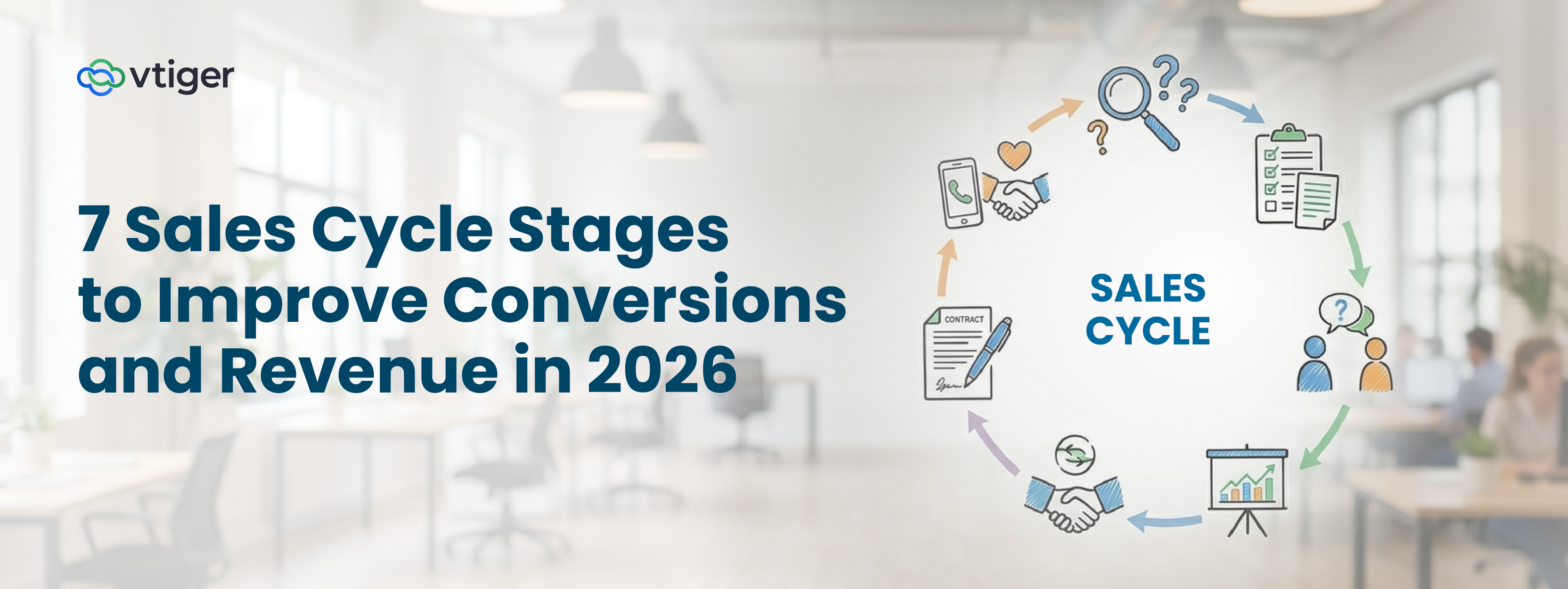
What follows covers what a sales cycle is, why it matters in 2026, the seven operational stages most B2B sales teams run through, how CRM and AI tooling improve the cycle, the distinction between sales cycle and sales funnel, a step-by-step optimization approach, the practices that consistently produce better conversion, the common mistakes that drag conversion down, and where the function is heading.
What Is a Sales Cycle
A sales cycle is the defined sequence of stages a sales organization moves prospects through to convert them into customers. The cycle starts when a potential buyer is identified and ends when the deal closes, with post-sale stages often included to capture renewal and expansion activity. Each stage has specific entry criteria, exit criteria, expected activities from the sales rep, and supporting workflows that move the deal forward.
The sales cycle is operational infrastructure, not a marketing concept. Its purpose is to make sales activity repeatable across reps, predictable in volume and conversion at each stage, and improvable through measurement. Without a defined cycle, sales become individual reps running personal playbooks, and forecasting becomes guesswork. With a defined cycle, the same input volume produces the same output revenue at predictable rates, and the cycle itself becomes a system that can be tuned.
The distinction from a sales pipeline matters operationally. A sales cycle is the process. A sales pipeline is the set of deals currently moving through that process. The cycle describes the stages and the rules. The pipeline describes the inventory of deals at each stage at a point in time. Confusing the two leads to operational mistakes such as treating pipeline expansion as cycle improvement, when in fact a longer cycle with more deals in it can produce less revenue than a shorter cycle with fewer.
Why the Sales Cycle Matters in 2026
The sales cycle has always mattered, but the reasons it matters now are different from a decade ago. Three concurrent shifts have raised the stakes on getting the cycle right.
Buyers Expect Faster and More Personalized Interactions
Response time tolerance has compressed across B2B segments. A buyer who fills out a contact form and receives a response 24 hours later is now usually a buyer who has already shortlisted a competitor. The sales cycle has to be built around response speed at every stage, not just the first touch, with structured handoffs that prevent deals from sitting unattended between stages.
The personalization expectation has grown alongside the speed expectation. Generic outreach at any stage of the cycle reduces conversion. Buyers expect outreach to reference what they have already done in their journey, what their company does, and what they specifically have said they need. The personalization depth depends on the data infrastructure behind the cycle, which is where pipeline management tooling produces its largest returns.
Competition Has Expanded Across Digital Channels
The sales cycle no longer runs in isolation. Buyers see competing solutions at every stage of their decision journey, often through channels the sales rep does not control. The cycle that drives higher conversion rates is the one designed around visibility into the buyer’s parallel research, not the one that assumes the prospect is only engaging with the seller.
Data-Driven Decisions Have Become Operational
Sales decisions historically depended on rep intuition combined with manager experience. The shift toward data-driven sales operations has changed expectations for the sales cycle, including stage-level conversion data, deal velocity tracking, and forecast accuracy benchmarks. Gartner projected in 2022 that through 2026, 65% of B2B sales organizations would transition from intuition-based decision making to data-driven decision making, a shift that requires the underlying CRM data to be clean, current, and consistently captured across the cycle.
The 7 Stages of a Standard Sales Cycle
The cycle below is the seven-stage model most B2B sales organizations operate, with variations for industry and deal complexity. Each stage has its own activities, exit criteria, and typical conversion rate.
Prospecting
Prospecting identifies potential buyers who fit the ideal customer profile and adds them to the top of the pipeline as leads. The activities at this stage establish the volume that flows through the rest of the cycle, so prospecting quality compounds across every downstream stage.
- Identify target accounts and contacts that match the defined ICP.
- Use lead scoring to rank prospects by fit and engagement signals.
- Capture lead source, interaction history, and qualification data into the CRM record.
- Route qualified leads to the right sales development rep based on territory and account tier.
Qualification
Qualification assesses whether the prospect has the budget, authority, need, and timeline to become a customer. Cycles that under-qualify produce inflated pipelines that fail to convert. Cycles that over-qualify reject prospects who would have closed.
- Apply a defined qualification framework consistently across all leads.
- Score lead intent based on engagement signals such as page visits, content downloads, and email interactions.
- Confirm budget range and decision authority through direct conversation, not assumption.
- Record disqualification reasons for cycle analytics, not just qualified deals.
Initial Outreach
Initial outreach makes first contact with the qualified prospect to schedule a conversation. The channel mix, message specificity, and timing determine response rates at this stage.
- Personalize outreach to the prospect’s role, company, and known business context.
- Sequence multi-touch outreach across email, phone, and social channels.
- Use AI-assisted communication tools to refine timing and message variants.
- Track outreach response data to inform improvements in future cycles.
Needs Assessment and Presentation
Needs assessment confirms the specific operational problems the prospect is trying to solve, and the presentation demonstrates how the offering addresses them. Cycles that skip directly from outreach to demo without a structured needs conversation produce lower close rates than cycles that invest time in the discovery.
- Run a structured discovery conversation before any product demonstration.
- Document the prospect’s pain points, current state, and desired outcomes.
- Tailor the product demonstration to the prospect’s specific situation.
- Confirm alignment with the prospect’s stakeholders before moving to the proposal.
Proposal and Negotiation
The proposal stage formalizes the offer in writing, with pricing, terms, scope, and implementation timeline. Negotiation handles the back-and-forth on specifics before the prospect commits.
- Present a proposal that reflects the discovery conversation, not a generic template.
- Address objections directly with documented responses rather than improvised handling.
- Use approval workflows to keep internal stakeholders aligned during pricing discussions.
- Track proposal-to-close conversion rates by deal size and segment.
Closing the Deal
The close converts the proposal into a signed contract and triggers the handover from sales to onboarding. Friction at this stage frequently delays revenue recognition more than the actual customer decision time.
- Use e-signature and contract automation to remove process friction.
- Trigger onboarding workflows the moment the contract is signed.
- Capture closed-won and closed-lost reasons for cycle analytics.
- Notify customer success and finance teams through CRM-driven workflows.
Post-Sale Relationship Management
Post-sale management captures the renewal, expansion, and advocacy value that the cycle generates beyond the initial deal. Cycles that end at the close leave the majority of customer lifetime value unmanaged.
- Trigger structured onboarding workflows tied to the customer success function.
- Identify upsell and cross-sell opportunities based on usage and engagement signals.
- Schedule renewal conversations 90 to 120 days before contract expiry.
- Build long-term engagement through value-based check-ins rather than transactional follow-ups.
How CRM and AI Improve the Sales Cycle
CRM and AI tooling have changed what is operationally possible at every stage of the sales cycle. The improvements compound across stages, which is why mature sales operations now treat the underlying tooling as central infrastructure rather than rep-level productivity tools.
Automated Lead Management and Scoring
Lead management automation captures inbound prospects, scores them by fit and intent, and routes them to the right rep without manual handling. The lift comes from removing the latency between lead capture and rep contact, which historically was where most inbound leads cooled off.
- Auto-capture inbound leads from web forms, chat, and partner channels.
- Apply scoring rules that weight engagement signals against ICP fit.
- Route scored leads to the right rep based on territory and account assignment.
- Notify reps of high-priority leads with full context attached to the CRM record.
Predictive Insights and Pipeline Visibility
AI-driven predictive models surface which deal with the pipeline are most likely to close, which are at risk, and which need rep attention now. Vtiger’s Calculus AI generates these recommendations inside the deal record, with the rep deciding which actions to take based on the surfaced insights rather than the system acting on its own.
- Predict close probability based on deal stage, activity volume, and historical patterns.
- Surface at-risk deals before they slip past the projected close date.
- Recommend next-best-action prompts to reps based on prior similar deals.
- Build sales forecasting accuracy through model-driven projections.
Workflow Automation Across the Cycle
Workflow automation removes the rep-level admin tasks that historically consumed selling time. The administrative load on sales reps is significant, and removing it through structured automation directly increases time spent on revenue-generating activity. McKinsey research on the economic potential of generative AI estimated that current generative AI capabilities could automate work activities that absorb 60% to 70% of employees’ time today, with sales and marketing functions among the largest beneficiaries through productivity gains in lead nurturing, account management, and deal progression.
Sales Cycle vs Sales Funnel: What’s the Difference
The sales cycle and sales funnel are closely connected, but they focus on different parts of the sales process. The sales cycle looks at how the sales team moves prospects toward a purchase, while the sales funnel tracks how prospects progress as a group from awareness to conversion.
| Aspect | Sales Cycle | Sales Funnel |
| Main Focus | Sales activities and process steps | Buyer journey and conversion flow |
| Perspective | Seller’s view | Buyer’s view |
| Purpose | Helps reps manage deals | Helps businesses track conversions |
| Structure | Stage-by-stage workflow | Funnel-shaped customer movement |
| Measured By | Tasks, meetings, follow-ups, closing stages | Conversion rates and drop-offs |
| Ownership | Sales representatives and managers | Sales, marketing, and leadership teams |
| Key Goal | Move individual prospects toward purchase | Increase overall conversion efficiency |
| Main Concern | Process consistency | Prospect retention through stages |
| Common Problem | Inconsistent sales execution | High drop-off between funnel stages |
| Business Impact | Improves sales operations | Improves forecasting and revenue visibility |
Treating both views as part of the same operating system is what mature sales organizations do, which is why integrated customer journey management tooling now spans both perspectives within a single platform.
How to Optimize Your Sales Cycle Step by Step
Optimizing the sales cycle is structured work, not a single decision. The steps below are ordered by typical leverage on conversion outcomes.
Define Your Sales Process Stages Clearly
The first step is documenting what the current cycle actually is, not what it is supposed to be. The stages, their entry and exit criteria, and the activities expected at each stage need to be documented with sufficient specificity so that any rep can apply them consistently.
- Document each stage with entry and exit criteria in plain language.
- Define the activities expected of the rep at each stage.
- Set up the CRM workflow to mirror the documented process.
- Train the team on the process before measuring conversion.
Improve Lead Qualification with Structured Models
Qualification quality drives downstream conversion more than most other levers. A structured qualification model, applied consistently, produces a pipeline that forecasts more accurately and converts at higher rates.
- Apply a qualification framework such as BANT, MEDDIC, or CHAMP consistently.
- Build lead scoring models that weight ICP fit and intent signals.
- Train reps on the disqualification criteria, not just the qualification criteria.
- Review qualification quality monthly through stage-level conversion analysis.
Automate Repetitive Sales Tasks
Sales rep time is the most expensive input in the cycle. Automating the administrative tasks that consume that time produces a direct lift in conversion and pipeline coverage.
- Automate follow-up email sequences triggered by prospect engagement.
- Use meeting-scheduling tools to reduce calendar friction at the discovery stage.
- Set up CRM workflows that update deal stages based on rep activity logs.
- Route inbound responses to the right rep without manual triage.
Use Data and Analytics to Inform Cycle Decisions
The cycle is improvable only when its performance is measured. Stage-level conversion data, deal velocity by segment, and forecast accuracy tracking are the inputs that drive cycle refinement over time.
- Track conversion rates between each stage of the cycle.
- Measure deal velocity by segment, deal size, and rep.
- Build forecast accuracy benchmarks and review them monthly.
- Use the data to identify which cycle stages need attention first.
Shorten Response Times Across the Cycle
Response speed is a structural lever on conversion at every stage, not just first touch. The cycles with the shortest end-to-end time-to-close are usually the ones with the shortest response times between each rep-prospect interaction.
- Use real-time engagement tools to respond to prospect activity within the day.
- Set up notification workflows for high-priority prospect engagement signals.
- Track inter-stage delay times and identify the slowest hand-offs.
- Build SLAs for response time on inbound leads and pipeline activity.
Strengthen Post-Sale Engagement
Post-sale work captures the value that the cycle generates beyond the initial deal. Cycles that under-invest in post-sale see worse renewal rates and lower net revenue retention.
- Build structured onboarding workflows tied to customer success.
- Schedule value-based check-ins separate from renewal conversations.
- Capture customer feedback in the CRM record for product and sales teams.
- Tie expansion opportunities to product usage and engagement patterns.
Sales Cycle Best Practices for Revenue Growth
The practices below are what consistently separate sales organizations that grow through scale from those that grow through individual rep heroics. The difference shows up in forecast accuracy, conversion stability, and the ability to onboard new reps to productive levels quickly.
- Standardize the sales workflow across the team rather than allowing rep-by-rep variation in process.
- Align marketing and sales handoffs through defined SLAs on lead routing and follow-up.
- Use the CRM consistently as the single source of truth, with no parallel spreadsheets or rep-specific systems.
- Personalize communication at every stage based on prospect history captured in the unified customer profile.
- Automate repetitive tasks aggressively so that rep time concentrates on revenue-generating conversations.
- Track pipeline performance through stage-level analytics, not just total pipeline value.
- Use AI-driven insights as decision inputs, with the rep making the final call on each prospect interaction.
- Focus equally on closing new business and retaining existing customers, since net revenue retention compounds over time.
Common Sales Cycle Mistakes That Reduce Conversion
The failure modes below appear across sales organizations of every size, regardless of industry. Each one reduces conversion at a specific stage and compounds across the cycle.
Poor Qualification at the Top of the Cycle
Under-qualification fills the pipeline with prospects who will not close, dilutes reps’ time across deals that cannot convert, and produces forecasts that miss the mark. The cycle that holds conversion rates is built on rigorous qualification, even when that produces a smaller pipeline.
Delayed Follow-Up Between Stages
Follow-up delays between cycle stages are where conversion silently leaks. The prospect who is engaged at the discovery stage and waits two weeks for the proposal has lost the momentum that drives close. Structured follow-up cadences, supported by sales automation, keep deal velocity stable.
Inconsistent CRM Use Across Reps
Reps who track activity in personal spreadsheets, rather than the shared CRM, produce data gaps that distort cycle analytics. Without consistent CRM use, stage-level conversion analysis becomes unreliable and the cycle stops being improvable. Mandating CRM-first activity logging is structural, not optional, for any sales operation seeking to scale.
Frequently Asked Questions (FAQs)
Q1. What is a sales cycle?
A sales cycle is the defined sequence of stages a sales organization moves a prospect through to convert them into a customer, typically running from prospecting through to closed-won. Each stage has entry and exit criteria, expected rep activities, and supporting workflows. The cycle exists to make sales activity repeatable, predictable, and improvable through measurement rather than being dependent on individual rep technique.
Q2. What are the standard stages of a sales cycle?
The standard B2B sales cycle includes seven stages: prospecting, qualification, initial outreach, needs assessment and presentation, proposal and negotiation, closing the deal, and post-sale relationship management. Specific organizations adapt this model for their industry and deal with complexity, but the underlying structure of identifying, qualifying, engaging, presenting, proposing, closing, and retaining holds across most B2B sales operations.
Q3. How long is a typical B2B sales cycle?
B2B sales cycle length varies dramatically by deal size, industry, and product complexity. SMB-focused deals often close in 30 to 60 days. Mid-market deals typically take 90 to 180 days. Enterprise deals can run 6 to 18 months for complex platforms involving multiple stakeholders. Tracking cycle length by segment and identifying the longest delays between stages is more useful than chasing an industry average.
Q4. How does CRM software improve the sales cycle?
CRM software improves the sales cycle by capturing every prospect interaction in a single record, automating routine follow-ups, surfacing predictive insights about deal health, and providing pipeline visibility for forecasting. The biggest improvement comes from reducing the manual administrative work that consumes rep time, freeing the rep to spend more cycles on actual selling conversations.
Q5. What is the difference between a sales cycle and a sales funnel?
The sales cycle describes the seller’s defined stages and activities for converting prospects. The sales funnel describes the buyer’s path, tracking the proportion of prospects that remain at each stage from awareness through purchase. The cycle is operational and rep-driven. The funnel is analytical and aggregate. Both views describe the same commercial activity from different perspectives, and mature sales operations track both.
Q6. How can AI optimize the sales cycle?
AI optimizes the sales cycle by predicting which deals are most likely to close, surfacing next-best-action recommendations to reps, automating follow-up sequences, and improving forecast accuracy through pattern recognition across historical deal data. The recommendations work as decision inputs for the rep rather than autonomous actions, keeping the customer-facing decision under human control.
Q7. Why is lead qualification critical in the sales cycle?
Lead qualification controls what enters the pipeline, and pipeline quality determines conversion at every downstream stage. Cycles that under-qualify produce inflated pipelines that fail to convert and forecasts that miss revenue projections. Cycles that over-qualify reject prospects who would have closed. A well-defined qualification framework applied consistently is the single highest-leverage lever on cycle performance.