What do you think is essential for a business to enhance customer relationships? The key element is to have data handy for all the activities that a business undergoes. When you get insights on your deal health, team performance metrics, etc., you will be able to make informed decisions and establish true customer satisfaction. And, this is what CRM analytics does for you. Lets understand CRM analytics in detail.
What is CRM Analytics?
CRM Analytics captures data from the CRM and provides valuable insights into the direction in which your business is moving. The Mckinsey report states that the ‘actionability of insights’ in a business contributes 92% to bringing a culture of value creation. In simple terms, it means you will be able to gain more customer value using the conclusion drawn from data by bringing them into action.
CRM analytics is mainly used by team members, team leads, managers, executives, etc. of various departments. By having an analytical tool in CRM, you will be able to gain a 360-degree view of your customer data and maintain a record of customer interactions from various teams. This will help you provide data-driven insights for businesses to perform efficiently. Data-driven insights include reports of how your service is received in the market, customer behavioral patterns in a particular demographic, ideal method to convert promising deals into loyal customers, etc.
But, what are the core metrics that are vital for business growth? To understand that deeply, let us divide these metrics into pre-sale and post-sale CRM analytics:

In pre-sale CRM analytics, you can gain insights into
- Traffic generated on websites like the number of visitors who came to your website, average time spent on webpages, etc.
- Campaign performance metrics like the email open rate, Click Through Rate (CTR) for social media posts or ads, etc.
- Conversion rates of leads or prospects. With an AI-based lead scoring strategy, it segments leads that have higher and lower chances of conversion.
In post-sale analytics, you can gain insights into
- Problem tracking measures customer issues and monitors the time taken to resolve their problems.
- Customer turnover i.e., percentage of customers switching away over a month or year.
- Net Promoter Score (NPS) measures a customer’s satisfaction level. This can be gauged from customer ratings and feedback.
- The customer retention rate reflects customer loyalty and the ability of a business to nurture customer relationships over time.
Why CRM Analytics Is Important for Businesses
Modern businesses operate in environments where customer interactions generate massive volumes of behavioral, transactional, and engagement data. CRM analytics converts this raw operational data into decision intelligence, allowing organizations to move away from assumptions and toward measurable growth strategies.
Evidence-driven decisions
Traditional sales and marketing often relied on intuition or anecdotal feedback. CRM analytics replaces guesswork with empirical evidence. Conversion patterns, engagement frequency, and campaign attribution models provide statistically grounded insights, allowing leadership teams to base strategies on actual performance metrics rather than gut feeling.
Customer Lifetime Optimization (CLV)
Customer Lifetime Value analysis identifies high yield customer cohorts based on purchase frequency, deal size, and retention patterns. High value customers can be isolated using segmentation models, allowing businesses to allocate premium service resources, targeted offers, and loyalty incentives to maximize long term revenue contribution.
Churn prediction
Customer attrition rarely happens without warning signals. Behavioral indicators such as declining login frequency, reduced purchase volume, or increased support tickets act as predictive churn markers. CRM analytics surfaces these red flag signals early, enabling retention teams to initiate intervention workflows before customer disengagement becomes irreversible.
ROI improvement
Marketing channel attribution analysis identifies performance efficiency across acquisition channels. Cost per acquisition, engagement depth, and conversion yield help isolate underperforming campaigns. Budget allocation can then be optimized toward channels generating higher return on investment while eliminating wasteful spending.
Pipeline forecasting
Revenue predictability improves significantly when pipeline data is analyzed systematically. Deal velocity, stage conversion ratios, and pipeline volume allow accurate forecasting of future revenue. Executive teams can use these forecasts to plan hiring, production capacity, and expansion strategies with confidence.
How CRM Analytics Work?
CRM analytics operates as a multi stage data pipeline that transforms fragmented customer interaction data into actionable intelligence through structured processing and modeling.
Data integration
Customer data enters CRM systems through multiple inbound touchpoints. Email interactions, website clickstreams, social media engagement signals, purchase transactions, and support ticket logs create a unified interaction history. This continuous inflow ensures that every customer action contributes to analytical modeling.
Data normalization
Raw data often contains duplicates, incomplete entries, or inconsistent formats. Data cleansing processes remove redundancy, resolve identity conflicts, and standardize formats. This normalization creates a single source of truth, preventing inaccurate insights caused by corrupted input data.
Data modeling
Structured data modeling organizes information into dimensions and measures. Dimensions include categorical attributes such as geography, industry, and customer segment. Measures include quantitative variables such as revenue, deal size, and engagement frequency. This classification enables multidimensional analysis.
Data visualization
Complex data tables are converted into dashboards, heatmaps, trend graphs, and funnel visualizations. Visual representation improves interpretability, allowing business users to quickly detect patterns, anomalies, and performance shifts without manual analysis.
Machine learning layer
Advanced CRM analytics platforms use machine learning algorithms to identify behavioral patterns that are not visible through manual inspection. Predictive models detect risk signals such as customers who purchased Product A but failed to purchase Product B within a defined timeframe, indicating elevated churn probability. These insights enable proactive intervention.
3 Main Types of CRM Analytics
CRM analytics functions across multiple analytical layers, each designed to answer different strategic questions.
Descriptive analytics
Historical performance analysis provides clarity on past events. Metrics such as quarterly revenue totals, average ticket resolution time, and lead conversion percentages fall under descriptive analytics. This layer answers the question of what already happened.
Predictive analytics
Future outcome modeling uses historical patterns to estimate probable outcomes. Revenue forecasts, lead scoring models, and churn prediction algorithms operate within predictive analytics. This layer helps organizations anticipate what is likely to happen next.
Prescriptive analytics
Decision optimization systems recommend specific actions based on predictive insights. AI engines suggest next best actions such as offering targeted discounts to prevent churn or prioritizing high intent leads. This layer guides operational teams on what to do.
Key Metrics and KPIs Tracked in CRM Analytics
CRM analytics tracks performance indicators across sales, marketing, and customer service functions to measure operational effectiveness.
Sales metrics
Pipeline velocity measures how quickly prospects move through sales stages from initial contact to closed deals. Faster velocity indicates efficient conversion processes.
Win loss ratio analysis identifies success and failure patterns by comparing won deals against lost opportunities. Competitive insights derived from this metric help refine sales strategy.
Marketing metrics
Customer Acquisition Cost measures total marketing expenditure required to acquire each new customer. Lower CAC indicates higher acquisition efficiency.
MQL to SQL conversion rate evaluates lead quality by measuring how many marketing qualified leads convert into sales ready opportunities. This metric reflects marketing effectiveness.
Customer service metrics
First Response Time tracks how quickly support teams acknowledge customer issues. Faster response improves customer satisfaction.
Customer Satisfaction Score and Net Promoter Score measure customer sentiment and loyalty. High scores indicate strong customer relationships and brand health.
Common CRM Analytics Use Cases
CRM analytics drives operational improvement across multiple business functions by transforming customer data into strategic actions.
Lead scoring
Automated lead scoring models evaluate prospects based on engagement activity, firmographic attributes, and purchase intent signals. Sales teams can focus on high-probability opportunities rather than low-intent leads.
Territory optimization
Geographic performance analysis reveals regions with high conversion potential. Sales resources can be allocated strategically to maximize revenue yield across territories.
Campaign personalization
Purchase history and behavioral data enable automated campaign triggers. Personalized email campaigns such as refill reminders or targeted offers improve engagement and conversion rates.
Support forecasting
Support interaction trends help predict peak periods of support demand. Workforce planning becomes more efficient by aligning staffing levels with expected service load.
Product insights
Customer usage patterns and feedback analysis provide guidance for product development teams. Feature adoption rates, feature abandonment signals, and customer feedback help prioritize product roadmap decisions.
CRM analytics transforms operational data into a strategic asset, enabling businesses to improve decision accuracy, increase efficiency, and accelerate sustainable growth.
The benefits of CRM analytics
The CRM analytics feature in CRM can perform multiple actions using historical customer data. The top 6 benefits of CRM analytics are as follows:
Improve targeting in marketing campaigns: By doing customer analysis using historical data, you can deliver personalized content based on customer preference.
Segment leads based on previous customer interaction: You can divide customers into groups based on demographics, gender, product preference, etc. You can also segment customers by ranking them based on their engagement with the sales rep.
Prioritize leads: You can prioritize leads based on certain key metrics like an overview of your customer’s web activity to understand the features they are most interested in. In this way, reps can create a pitch and aim for fast deal closures.
Make revenue predictions with forecasting: You can carry out sales forecasting and predict estimated sales revenue over the next quarter or year.
Track escalations on your deliverables: If any problem arises with your product or service, you can resolve them quickly to achieve better customer satisfaction.
Monitor team performance: Find out gaps in your team’s performance and provide valuable feedback to boost productivity and efficiency.
What are the challenges of CRM analytics
If your CRM analytics software does not integrate with a robust marketing automation and customer support tool, you will not be able to utilize its functions effectively. According to a report by Mckinsey, the integration of customer analytics across multiple channels is the top trend to focus on. Some of the findings from KPIs confirm that intensive users of customer analytics are 23 times more likely to outperform their competitors.
And also, if the CRMs are cluttered with redundant features, complicated UI, and manual data entry processes, the quality of data generated goes for a toss. For example, if you take the case of manual data entry, there is a high chance of making errors while filling out the details. Therefore, the data produced will also contain mistakes that will become difficult to trace and resolve quickly. Only a robust CRM with updated features can provide better analytical results.
Vtiger CRM has designed its product that has easy to use interface and automated data entry system. It helps you provide accurate data and generate error-free reports that can be used to identify potential deals and forecast better.
Take a test drive with Vtiger by signing up for a 15-day free trial to better understand analytical features.
How to find the right CRM analytics solution
A great CRM analytics tool should easily integrate with your existing business structure that helps in meeting set goals effectively.
Vtiger provides a set of analytical features that can be molded as per your business requirements. For example, Vtiger Calculus AI provides sentiment analysis which means it gives insights on call quality, AI-powered Dashboards provide team performance metrics, Vtiger reports enable you to build reports from any given data, and much more.
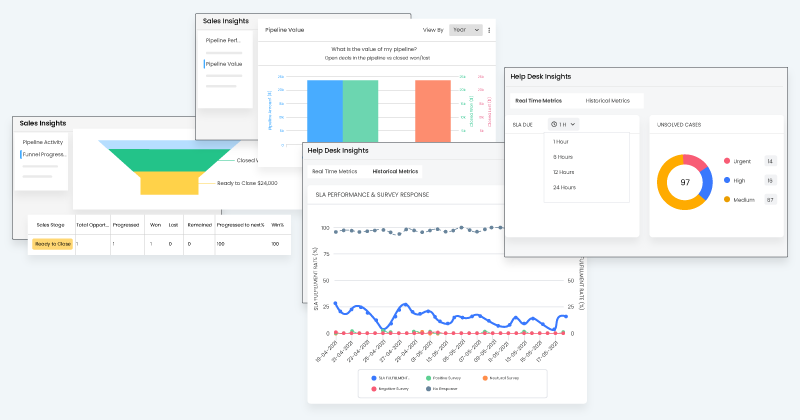
Click on the link to have a comprehensive idea about how Vtiger’s analytical tools work and streamline your business for better ROI.
Conclusion
Clarity in growth rarely comes from instinct alone. Patterns hide within everyday interactions, and that is exactly where CRM analytics starts to prove its value. Some customers expand faster, some quietly disengage, and crm business analytics helps you notice both early. Decisions begin shifting from reaction to preparation. Teams see what deserves attention, what needs fixing, and what deserves scaling, which ultimately strengthens stability, confidence, and direction.
Frequently Asked Questions (FAQs)
What is CRM analytics?
CRM analytics analyzes customer data collected inside CRM systems to understand behavior, improve decisions, predict outcomes, and optimize sales, marketing, service performance, and overall business growth strategies.
What are the 4 types of CRM Analytics?
Four types include descriptive analytics for past performance, diagnostic analytics for understanding causes, predictive analytics for forecasting outcomes, and prescriptive analytics for recommending next best actions.
What is level 3 CRM?
Level 3 CRM refers to advanced analytical CRM that uses AI, predictive models, and automation to forecast customer behavior, identify risks, and recommend strategic actions.
What is CRM analytics used for?
CRM analytics helps businesses track performance, forecast revenue, identify high value customers, predict churn, improve campaigns, personalize engagement, and support smarter, faster decision making.
How is CRM analytics different from CRM reporting?
CRM reporting shows past data in charts and summaries, while CRM analytics goes deeper by identifying patterns, predicting outcomes, and recommending actions for improvement.
What types of CRM analytics are most commonly used?
Descriptive analytics for performance review, predictive analytics for forecasting conversions or churn, and prescriptive analytics for recommending actions are most commonly used by businesses.
What key metrics are tracked in CRM analytics?
Common metrics include conversion rate, pipeline velocity, customer acquisition cost, customer lifetime value, churn rate, win loss ratio, response time, and customer satisfaction scores.
Which industries benefit the most from CRM analytics?
Industries like SaaS, banking, retail, healthcare, real estate, and manufacturing benefit greatly because they rely heavily on customer relationships, retention, and sales forecasting.
How can businesses get started with CRM analytics?
Businesses can start by implementing a CRM system, collecting clean customer data, defining key metrics, building dashboards, and using analytics tools to guide decisions.