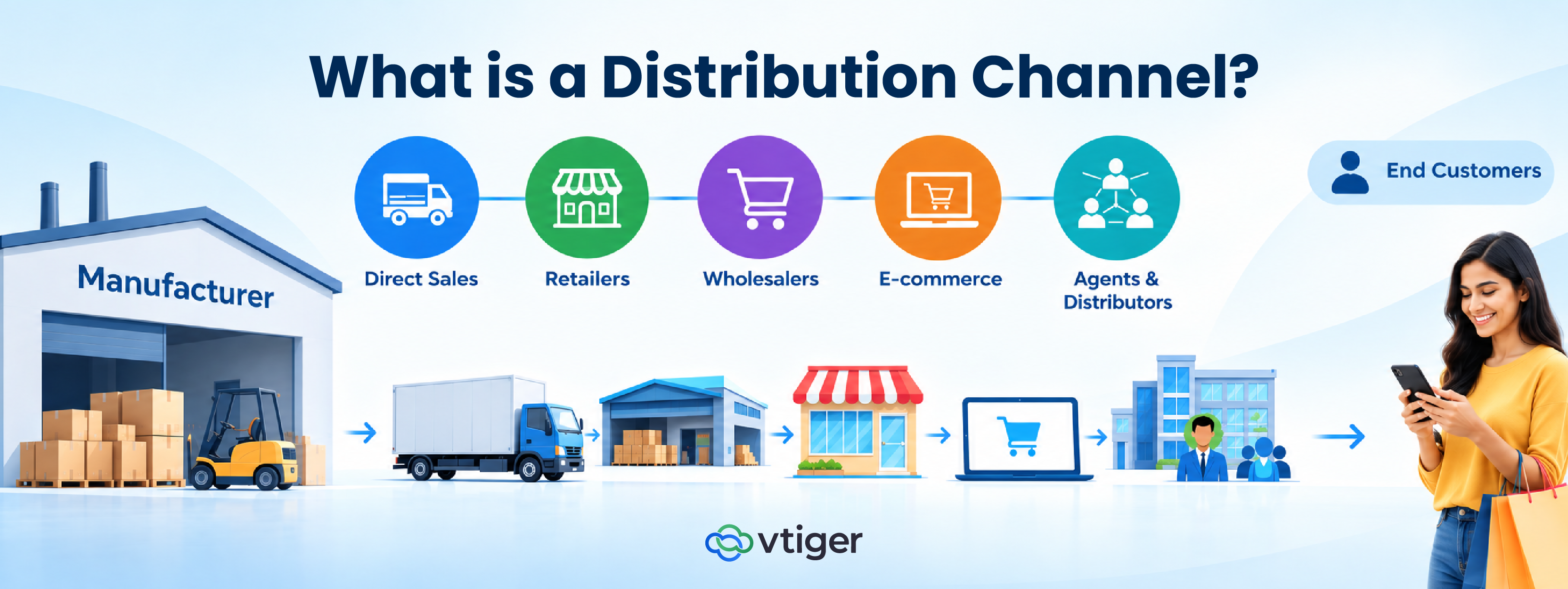
A distribution channel is the route a product or service takes from its manufacturer or provider to the end customer. Businesses can sell directly through their own websites and sales teams or use intermediaries such as wholesalers, distributors, and retailers.
The right channel depends on where customers buy, what the product requires, and how much the business can spend on sales and distribution. Each route involves a trade-off, as intermediaries can extend market reach and handle logistics, but they may also limit the manufacturer’s visibility into end customers and their purchasing behavior.
A business that sells through multiple partners needs to track more than the orders placed by each distributor. It must also understand which customers reorder, where demand is weakening, and which partners require support.
What Is a Distribution Channel?
A distribution channel connects the business that produces a product or provides a service with the customer who buys it. This structure operates either directly or through multiple businesses that sell, store, promote, and deliver the product.
Common intermediaries include:
- Wholesalers: Buy products in bulk from manufacturers and resell them in smaller quantities to retailers or other businesses.
- Distributors: Supply products to a defined market or customer segment, often providing storage, local delivery, and technical support.
- Retailers: Sell products directly to end consumers through physical stores or online shops.
- Agents and brokers: Connect sellers with potential buyers and negotiate transactions, usually without taking ownership of the goods.
A distribution channel is different from a distribution network. The channel describes the commercial route between the seller and buyer, including the intermediaries involved. The network refers to the supporting infrastructure, such as warehouses, transport routes, and partner locations.
| For example, a manufacturer may sell through regional distributors that supply independent retailers. The channel describes these selling relationships, while the network includes the facilities and transport systems used to move the products. |
How Does a Distribution Channel Work?
A distribution channel coordinates the movement of products, payments, and demand information between businesses and customers. Products generally move towards the buyer, while payments and sales information move back through the channel.
Intermediaries take on responsibilities that manufacturers would otherwise need to manage themselves.
- Bulk purchasing: Wholesalers and distributors consolidate orders, helping manufacturers sell larger quantities without serving every retailer individually.
- Inventory management: Partners hold stock closer to customers, shortening delivery times to local markets.
- Promotion and sales: Retailers and distributors introduce products to customers, explain their features, and recommend suitable options.
- Order processing and payment collection: Intermediaries manage transactions with their buyers, reducing the manufacturer’s need to handle every individual sale and payment.
Not every channel includes all these functions. A software company selling subscriptions through its website may handle sales and billing directly, while a food manufacturer may depend on wholesalers for storage and retailers for the final sale.
Types of Distribution Channels
The three main types of distribution channels are direct, indirect, and hybrid. They differ in how a business reaches customers and who manages the selling relationship.
- Direct Distribution Channel
A direct distribution channel allows a business to sell to customers without intermediaries. Common routes include an owned website, company-operated stores, and an in-house sales team.
The business retains greater control over pricing, customer interactions, and purchase data. However, it must also fund the sales, marketing, delivery, and customer service required to operate the channel.
For businesses with sales teams, a dedicated sales CRM helps organize leads, track deals, and maintain customer records throughout the sales process.
- Indirect Distribution Channel
An indirect distribution channel uses intermediaries such as wholesalers, distributors, and retailers to reach customers. These partners provide established relationships, local market knowledge, and distribution infrastructure that would take time and investment to build internally.
The scale of intermediary-led sales illustrates why this model remains important. According to the US Census Bureau, US merchant wholesalers recorded $11,382.3 billion in sales in 2022.
The trade-off is reduced direct access to end customers. Manufacturers may learn what distributors buy without knowing which products consumers ultimately purchase.
- Hybrid Distribution Channel
A hybrid distribution channel combines direct sales with one or more indirect routes. A brand might sell through its own website while using retail partners to reach customers who prefer to inspect products before buying.
Wholesalers can also combine online ordering with traditional sales relationships. US Census Bureau data put e-commerce at 33.3% of merchant wholesaler sales in 2019, illustrating the role online transactions can play alongside other sales routes.
Hybrid channels expand the ways customers can purchase, but they also create coordination requirements. Businesses need consistent pricing, reliable inventory information, and clear account ownership across their direct and partner-led sales.
Distribution Channel Levels
Distribution channel levels count the intermediaries between the manufacturer and the end customer. A zero-level channel has none, while one-, two-, and three-level channels introduce progressively more intermediaries.
| Level | Intermediaries | Example | Main trade-off |
| Zero | None | Direct software sales or a company-owned bakery | Greater control, higher direct operating responsibility |
| One | Retailer | Furniture manufacturer supplying a retail chain | Retail reach in exchange for shared margin |
| Two | Wholesaler and retailer | Packaged food sold through local shops | Wider reach, less direct customer visibility |
| Three | Agent, wholesaler and retailer | Manufacturer entering an unfamiliar export market | Access to established markets, greater dependence on partners |
A longer channel is not necessarily less effective. It can be more economical when a manufacturer needs to serve many small retailers that each purchase limited quantities.
| Zero-Level Distribution Channel In a zero-level channel, the manufacturer sells directly to the customer without an intermediary. Examples include a software company selling subscriptions through its website and a bakery selling from its own premises. The business receives customer feedback directly and controls the selling process. It must also manage the associated costs, including marketing, order processing, and customer support. |
| One-Level Distribution Channel A one-level channel has one intermediary, usually a retailer. For example, a furniture manufacturer may supply a chain of home stores that sell its products to consumers. The retailer provides access to an established customer base and handles the final sale. The manufacturer gives up part of the selling margin and may have limited visibility into individual purchases. |
| Two-Level Distribution Channel A two-level channel places a wholesaler and retailer between the manufacturer and customer. Packaged food is a common example, where wholesalers consolidate orders from numerous small retailers, making distribution more manageable for the manufacturer. This structure supports broad market coverage without requiring the manufacturer to supply every shop directly. |
| Three-Level Distribution Channel A three-level channel includes an agent or broker, a wholesaler, and a retailer. This structure can help manufacturers enter unfamiliar or fragmented markets where established intermediaries already have buyer relationships. The additional intermediary can simplify market entry, but it also creates more handoffs and makes end-customer information harder to collect. |
Distribution Channel Examples
Distribution channels vary by product, customer, and the resources required to complete a sale. These examples show how businesses balance market access with control over customer relationships.
| A skincare brand selling through its own website The brand uses a direct channel. It can track orders, customer preferences, and repeat purchases, but it must also attract visitors, process payments, and arrange delivery. |
| A kitchenware manufacturer supplying independent shops The manufacturer sells to distributors, who supply retailers. This two-level channel expands geographic reach, but the manufacturer’s sales figures may reflect distributor purchases rather than actual consumer demand. |
| A sports retailer selling through stores and online marketplaces The retailer uses a hybrid channel. Physical stores let customers inspect products, while marketplaces introduce the brand to additional buyers. The challenge is keeping prices, stock information, and return policies consistent across both routes. |
| An industrial equipment manufacturer working with regional distributors The manufacturer may generate inquiries through its website, trade shows, distributors, and in-house representatives. Each inquiry needs a clear owner and follow-up plan. Structured lead management helps sales teams assign responsibilities and track opportunities from different sources. |
Consider a packaging plant that contacts a regional distributor about industrial equipment. The manufacturer’s representative handles the consultation, the distributor supplies spare parts, and the plant later reorders through the manufacturer’s website.
Although the customer purchases through three routes, each interaction belongs to the same account. Shared records help the manufacturer and its partners coordinate service and sales without losing the customer’s history.
Why Are Distribution Channels Important?
Distribution channels determine where customers can buy a product, how much it costs to deliver, and how closely a business can manage the customer relationship. Their effectiveness influences sales growth, operating costs, and customer satisfaction.
- Market reach: Established partners help businesses enter regions and customer segments they cannot serve efficiently on their own.
- Product availability: Local inventory makes products easier to obtain and reduces the risk of customers switching to alternatives.
- Distribution costs: Intermediaries share responsibilities such as storage, transportation, and order processing in exchange for a margin.
- Customer segmentation: Different channels can serve different buyers, from large enterprise accounts to consumers who prefer convenient online purchasing.
- Customer convenience: Customers can buy through familiar stores, websites, or local suppliers rather than adapting to a single sales route.
- Sales growth: Additional channels create opportunities to reach new buyers, provided the business can support the resulting demand.
These benefits depend on how well you manage the channels. Expanding into more markets may increase sales, but limited visibility into customer purchases can make it difficult to identify changing demand or understand why revenue is declining.
How to Choose the Right Distribution Channel
Choose a distribution channel by evaluating where customers prefer to buy, what the product requires, how much each route costs, and whether potential partners can support the business.
- Understand Your Target Customers
Start with your customers’ purchasing habits and preferred suppliers. A hospital may need to purchase through approved vendors, while a home gardener may prefer a local garden center or online store.
Geography also matters. A direct sales model may work well in a densely populated city but prove expensive in rural markets where customers are spread across a larger area.
- Evaluate Product Requirements
Consider the handling, storage, and support your product needs between production and delivery. Perishable, fragile, or regulated goods may require specialized distribution partners.
Products that need installation, training, or repairs also benefit from channels with appropriate technical expertise and after-sales support.
- Compare Costs and Profit Margins
Compare the net margin each channel generates after accounting for its complete operating costs.
A distributor’s discount may appear expensive compared with the full price of a direct sale. However, direct sales also require spending on sales staff, marketing, fulfillment, and customer service.
Calculate the margin remaining after these costs rather than comparing the distributor’s discount with the direct selling price alone.
- Assess Channel Partner Capabilities
Evaluate potential partners based on their geographic coverage, customer relationships, reliability, and ability to support your product.
Ask which markets they serve, how they handle returns, what after-sales services they provide, and how frequently they report sales. Agree on customer ownership and define how both parties should handle inquiries from the same account.
- Monitor Channel Performance
Track revenue, costs, conversion rates, and market coverage separately for each channel. A route that generates more sales but requires increasingly high spending per order may be becoming less profitable.
Review sales performance metrics such as deal size and conversion rate each quarter to identify where additional investment is justified.
Before granting a distributor exclusive rights to a territory, establish minimum sales targets and a review date in the agreement. Without measurable performance requirements, an underperforming partner could prevent the business from appointing other distributors in that region.
Distribution Channel Management Challenges
Distribution channel management becomes more complex as businesses add partners and sales routes. Common problems include channel conflict, limited visibility into inventory and customer activity, inconsistent communication, and fragmented sales records.
Challenge 1:Direct and Partner Conflict
Channel conflict occurs when a direct sales team and a reseller compete for the same customer or quote different prices for the same product.
The customer may choose the cheaper offer, leaving the partner dissatisfied and creating disputes over account ownership or commission. Clear pricing policies, account-ownership rules, and shared activity records help reduce these conflicts.
Challenge 2:Limited Visibility and Availability
Manufacturers often depend on partners to report sales and inventory. When reports arrive late or use inconsistent formats, the manufacturer may not notice declining demand or empty shelves until customers have already run out.
Regular reporting requirements and shared inventory information help businesses identify supply issues earlier.
Challenge 3:Coordination and Communication Gaps
Customers may receive different information from a company’s website, direct sales representatives, and distribution partners. Inconsistent pricing, product specifications, or delivery commitments can undermine trust.
Gartner research published in June 2025 reported that 69% of surveyed B2B buyers encountered inconsistencies between information on a supplier’s website and what sales representatives told them.
Businesses can reduce these gaps by keeping product information accurate, communicating policy changes promptly, and giving customer-facing teams access to consistent records.
Challenge 4:Tracking Sales Across Multiple Channels
A customer who buys through a distributor, contacts a sales representative, and later orders through the company website can appear as three separate customers when each channel maintains its own records.
A CRM helps connect interactions to a single customer account. Understanding how CRM systems work can help businesses organize customer histories, inquiries, and sales opportunities across multiple routes.
| Four warning signs indicate that channel management needs attention:Different sales routes repeatedly quote the same customer without clear account ownership.Partner reports arrive progressively later, delaying visibility into demand.Repeat customers stop purchasing through one channel without being identified through another.Customer support receives complaints about prices or commitments that the direct sales team cannot verify. |
How CRM Supports Distribution Channel Management
A CRM supports distribution channel management by connecting partner records, customer accounts, sales opportunities, and communication histories. Teams can see which partner generated an inquiry, who owns the opportunity, and what to do next.
For example, when a distributor refers a potential customer, the sales team can record the referral source, assign a representative, and track the deal through each stage. If the customer later contacts the company directly, the team can review the existing account history before responding.
Shared records also improve partner reviews. Channel managers can identify which partners generate inquiries, which opportunities stall, and which customers purchase through multiple routes without manually combining separate spreadsheets.
Vtiger One supports inbound, outbound, and partner-led sales in one system, bringing sales, marketing, and support information together around a central customer record.
A CRM has a defined role in this process. It manages relationships, sales activity, and opportunities; it does not replace warehouse or logistics systems that track inventory, shipments, and deliveries. Businesses that need stock visibility can integrate those systems with the CRM or operate them alongside it.
When evaluating unified CRM software, check whether sales, channel management, and customer support can access the same account history. Start by recording the partner, region, and inquiry source against every opportunity.
Frequently Asked Questions
1. What is a distribution channel?
A distribution channel is the route a product or service takes from its provider to the customer. It may involve direct sales or intermediaries such as distributors and retailers. For services, a channel might include a direct sales team, referral partners, or a software marketplace.
2. What are the main types of distribution channels?
The three main types are direct, indirect, and hybrid. Direct channels sell without intermediaries, indirect channels use partners, and hybrid channels combine both approaches.
Businesses also classify distribution by market coverage. Intensive distribution aims to make a product available through as many suitable outlets as possible. Selective distribution uses a chosen group of sellers, while exclusive distribution grants specific selling rights to a limited partner or territory under agreed terms.
3. What is the difference between direct and indirect distribution?
Direct distribution means a business sells to customers without intermediaries. Indirect distribution uses partners such as wholesalers, distributors, or retailers.
The difference also affects customer visibility. Direct sellers generally receive customer and order information firsthand, while manufacturers using intermediaries depend on partners to share end-customer data and sales activity.
4. What are some examples of distribution channels?
Examples include a brand selling through its own website, a manufacturer supplying supermarkets through wholesalers, and a retailer selling through physical stores and online marketplaces.
Service businesses use distribution channels too. An accounting firm may acquire customers directly and through referral partners, while a software vendor may sell through resellers that also implement and support the product.
5. What are the four levels of distribution channels?
The four levels are zero, one, two, and three, based on the number of intermediaries between the manufacturer and customer.
A zero-level channel sells directly to customers. A one-level channel uses a retailer, a two-level channel uses a wholesaler and a retailer, and a three-level channel adds an agent or broker. Longer channels can be effective when they consolidate demand from many small buyers.
6. How do businesses choose a distribution channel?
Businesses compare customer purchasing preferences, product requirements, distribution costs, and partner capabilities. They should also evaluate the margin remaining after all channel expenses and assess how much customer information they can access.
Testing a new route in one market for a defined period provides evidence about profitability and customer response before the business expands it.
7. How does CRM help with distribution channel management?
A CRM connects partners, customer accounts, and sales opportunities so teams can view the same customer history across different channels.
It helps businesses track referrals, assign account ownership, monitor deal progress, and identify customers who interact through multiple routes. It is most useful when teams consistently record partner activity and update customer information after each interaction.