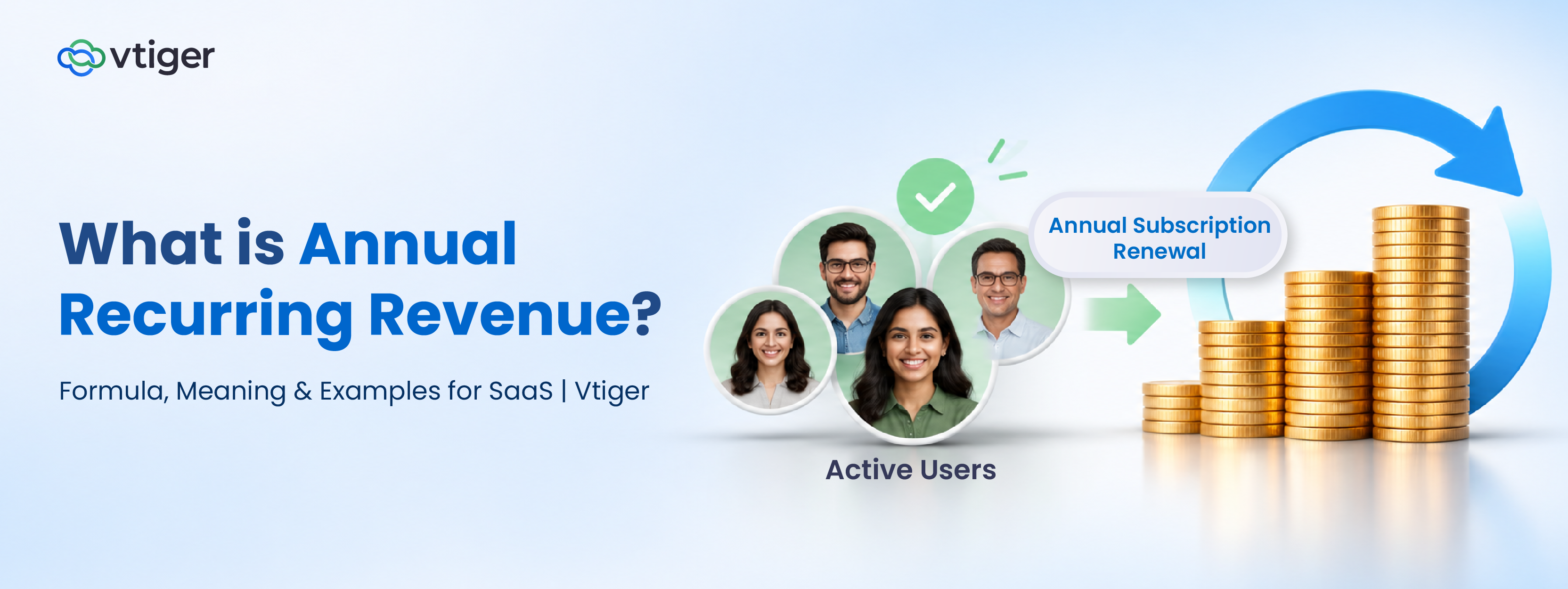
Annual recurring revenue (ARR) is the yearly value of the recurring subscription revenue a business expects from its active customers. SaaS companies use ARR to measure growth, forecast income, and track subscription performance. ARR includes recurring fees and leaves out one-time charges, so it shows how much revenue is likely to continue.
A founder tells an investor that the company made $2 million last year. The investor asks a better question—how much of that will still be there next year? Some of the money came from customers who pay every month or every year. Some came from one-off projects that will not repeat. Annual recurring revenue, or ARR, separates the two.
Software as a service (SaaS) companies sell access, not products. Customers keep paying as long as they keep getting value, so revenue arrives on a schedule. ARR turns that schedule into one yearly figure. Leaders use it to plan hiring and spending, to forecast income, and to track which subscriptions are renewing, growing, or ending. The formula is simple; the judgment is in deciding which revenue counts.
What Is Annual Recurring Revenue (ARR)?
Annual recurring revenue (ARR) is the yearly value of revenue that repeats because customers keep paying for ongoing access to a product. It applies to subscription businesses, including most SaaS companies. ARR counts only the recurring portion of what customers pay, so it measures stable, predictable income.
A simple test applies: revenue is recurring when a customer will keep paying for continued access unless they cancel. Revenue is one-time when it buys a single delivery and ends there. Only the first kind belongs in ARR.
In a SaaS model, customers may pay monthly, quarterly, or yearly. ARR puts every plan on the same yearly footing so that you can compare a monthly plan with an annual contract. That makes the figure easy to compare from one period to the next.
ARR is a popular performance metric because it changes whenever customers join, leave, upgrade, or downgrade. Investors and boards often ask for it for that reason. Because it is a management metric rather than an accounting standard, each company should define how it counts ARR and apply that definition consistently.
Accelerate Business Growth with Vtiger
15-day free trialNo credit card requiredFull product access
Almost there!
Redirecting you to your free trial…
Why Is ARR Important?
ARR matters because it also reveals how well a subscription business is growing on a stable base. It supports forecasting because recurring revenue is easier to predict than one-off sales. It also shows how well a company retains and expands its customer base, which often determines long-term growth.
- Measures recurring revenue growth:
Comparing ARR across quarters shows whether the recurring base is growing. A strong quarter of one-off sales can hide a shrinking base, but ARR will not. - Supports forecasting:
ARR reflects contracts already in place, so it gives a firm starting point for revenue plans. Teams then add expected renewals, new deals, and likely cancellations, and many pair the result with sales forecasting from live pipeline data. - Evaluates subscription performance:
ARR belongs beside churn, customer lifetime value, and acquisition cost. Reading these together, as CRM performance metrics, shows whether growth is efficient or merely fast. - Reveals retention and expansion:
ARR moves when customers cancel, downgrade, or upgrade. Tracking those movements separately shows whether the base is leaking or compounding.
Benchmarks help teams set realistic growth expectations. SaaS Capital’s 2025 survey of private B2B SaaS companies, published in September 2025, found a median growth rate of 24% for companies above $1 million in ARR; groups with net revenue retention of at least 110% grew faster than that median, and groups below 100% grew more slowly.
Net revenue retention (NRR) compares what last year’s customers pay today with what they paid a year earlier. The survey shows an association, not proof that retention causes growth, and it covers private B2B companies only.
How to Calculate ARR
To calculate ARR, add up the yearly value of every active recurring subscription.
| For steady monthly plans, multiply monthly recurring revenue (MRR) by 12. For annual contracts, use the annual contract value. Either way, count only recurring fees from customers who are active today. |
The arithmetic is easy, but the judgment lies in deciding what counts as recurring, which the following sections cover.
ARR Formula
The basic formula is
ARR = MRR × 12.
MRR is the total monthly fees from active subscriptions, excluding one-time charges.
Multiply by 12 when monthly revenue is stable, customers pay monthly, or you’ve converted annual plans to a monthly amount. It is less reliable when monthly revenue swings widely, because one unusual month gets multiplied by 12. Some companies average several recent months instead. Whichever method you choose, state it.
Annual contracts need a slightly different approach. Add together the annual contract value (ACV) of each live contract. A customer paying $6,000 for a one-year plan adds $6,000 to ARR, which equals $500 of MRR.
Subscription changes also move the figure. Upgrades, downgrades, cancellations, and price changes should update ARR when they take effect, so the number always describes the business as it stands.
ARR Calculation Example
Consider an invented SaaS company with three monthly plans. The table shows its customers at the end of two consecutive months.
| Plan | Monthly price | Customers, Month 1 | MRR, Month 1 | Customers, Month 2 | MRR, Month 2 |
|---|---|---|---|---|---|
| Starter | $50 | 40 | $2,000 | 38 | $1,900 |
| Growth | $200 | 25 | $5,000 | 22 | $4,400 |
| Business | $500 | 10 | $5,000 | 13 | $6,500 |
| Total | 75 | $12,000 | 73 | $12,800 | |
| ARR (MRR × 12) | $144,000 | $153,600 |
- Multiply price by customers:
In Month 1, Starter gives $2,000, Growth gives $5,000, and Business gives $5,000. - Add the plans:
The three amounts total $12,000 of MRR. - Multiply by 12:
The company’s ARR is $144,000.
In Month 2, two Starter customers cancel and three Growth customers move up to Business. Cancellations remove $100 of MRR, and the upgrades add $900, so MRR rises to $12,800 and ARR to $153,600.
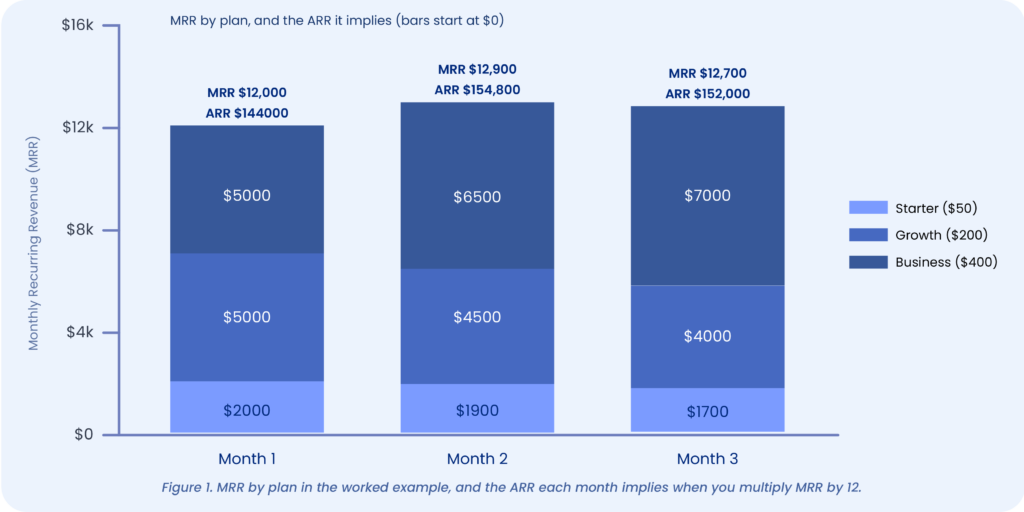
Figure 1. MRR by plan in the worked example, and the ARR each month implies when you multiply MRR by 12.
The $153,600 is not cash received so far. It is the yearly value of subscriptions active today, assuming those customers stay and keep paying current prices.
What Is Included in ARR?
ARR includes revenue that repeats under an active subscription or contract. That means recurring subscription fees, recurring contract revenue, and qualifying upgrades or expansion. It also changes whenever a contract changes, so renewals, downgrades, and cancellations should all be reflected as they take effect.
- Recurring subscription fees:
Fixed charges for continued access to the software count, whether they are billed monthly, quarterly, or yearly. Convert each to a yearly value. - Recurring contract revenue:
Support, maintenance, or license fees that renew under a signed contract count when the amount is fixed and repeats. - Qualifying upgrades and expansion:
Extra seats, higher tiers, and add-on modules count when customers pay for them regularly. - Contract changes:
A renewal at a higher price raises ARR, while a downgrade or cancellation lowers it. A contract that is signed but not yet live is usually reported as bookings rather than ARR, so reports should say which approach they use.
What Is Excluded From ARR?
ARR excludes revenue that does not repeat. That covers one-time setup and implementation fees, non-recurring services, and one-off purchases. Refunds, credits, and taxes are also removed. Keeping these out stops ARR from overstating how much revenue a business can rely on next year.
- One-time setup and implementation fees: Customers pay these once to get started, so they say little about next year.
- Non-recurring services: Training days, consulting, and custom development are billed per project, even when the same customer buys them again.
- One-off purchases: Hardware, a single license sale, or an event ticket does not repeat on a schedule.
- Other non-recurring income: Any other income that doesn’t repeat is excluded too. Variable usage charges need a clear rule, because only a committed minimum is predictable.
Because of these exclusions, ARR will usually differ from total yearly revenue.
ARR vs MRR: What Is the Difference?
ARR and MRR measure the same recurring revenue over different periods. MRR counts it per month, and ARR annualizes it, so ARR is MRR multiplied by 12. Businesses with monthly billing and short contracts tend to lead with MRR, while those with annual contracts and board reporting tend to lead with ARR.
| MRR | ARR | |
|---|---|---|
| Definition | Recurring revenue expected in one month | Recurring revenue expected over one year |
| Measurement period | Monthly | Annual |
| How it is calculated | Sum of monthly fees from active subscriptions, with annual plans divided by 12 | MRR multiplied by 12, or the sum of annual contract values |
| Common business uses | Tracking month-to-month change, spotting cancellations early, and managing monthly or short-term plans | Annual planning, board and investor reporting, and comparing companies that sell annual contracts |
Track MRR when customers can leave at short notice, because it reacts quickly to change. Track ARR when contracts run for a year or more, because monthly figures hide the size of a yearly commitment. Most companies track both, since MRR flags a problem early and ARR shows the yearly size.
ARR vs Annual Revenue
ARR is a forward-looking snapshot of recurring revenue, while annual revenue is the total a business earned over a past year. Annual revenue includes one-time income and counts customers only for the months they paid. The two figures therefore rarely match, and neither can replace the other.
ARR leaves out non-recurring income on purpose. It aims to show the base that should continue, not everything that happened to be billed.
Timing is the biggest reason the figures differ. Take one customer on a $12,000 annual plan that starts on 1 July. By the end of December, that customer had added $6,000 to annual revenue but $12,000 to ARR. One-time fees then widen the gap, because they raise revenue but never ARR.
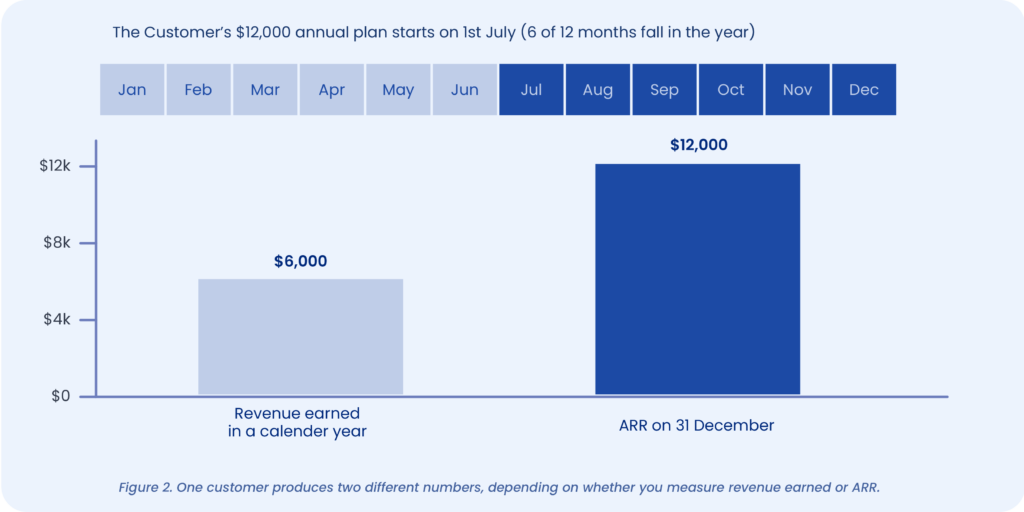
Figure 2. One customer produces two different numbers, depending on whether you measure revenue earned or ARR.
Common mistakes when reading ARR include:
- Treating ARR as cash or profit: ARR says nothing about cash received, costs, or margin.
- Counting one-time or unsigned revenue: One-off fees, pilots, and deals still in the pipeline are not ARR.
- Spreading a multi-year contract badly: A three-year contract worth $300,000 adds $100,000 a year to ARR, not $300,000.
- Assuming ARR is guaranteed: ARR is a snapshot of current contracts, and customers can still cancel or downgrade.
- Quoting ARR without a date or definition: Two companies can both report ARR and mean different things.
How Can Businesses Increase ARR?
Businesses increase ARR by adding recurring revenue faster than they lose it. The main levers are keeping customers longer, reducing cancellations, selling more to existing accounts, and raising the value of each subscription. Retention usually comes first because every customer protects revenue you’ve already earned.
Ending ARR equals starting ARR plus new and expansion revenue, minus contraction and churn. Each lever below improves one of those four terms.
- Improve customer retention: Streamline onboarding, engage clients prior to renewal, and accelerate issue resolution. Lifecycle mapping ensures teams intervene before accounts are at risk.
- Reduce customer churn: Watch for warning signs such as falling usage or rising support requests, and contact those accounts early. Even a small drop in cancellations compounds over a year.
- Upsell and cross-sell: An upsell moves a customer to a higher tier, and a cross-sell adds a different product. Both work best with customers who already see value.
- Increase subscription value and expand accounts: Review pricing and packaging, and grow usage inside existing customers, for example by adding teams or locations.
New customers add ARR as well. Consistent lead management helps a team follow up on every inquiry, although it is a separate discipline from the retention levers above.
How Can CRM Help Manage Recurring Revenue?
A CRM helps manage recurring revenue by keeping customer records, interactions, and renewal dates in one place. Teams can see who is due to renew, who is engaged, and who may buy more. A CRM supports the work that protects and grows ARR, but it does not replace billing or finance systems.
- Organize customer and account information:
One record per account stops teams from working from different versions of the facts. In Vtiger One, the One View feature brings conversation history, support tickets, contracts, and product usage into a single profile. - Track interactions and renewal opportunities:
Renewals are usually won or lost in the months before the due date, so logged conversations and reminders matter. CRM automation can create a follow-up task when set conditions are met, and C workflows follow the same trigger, conditions, and actions pattern. - Identify upsell and cross-sell opportunities:
Support history, usage, and past purchases show which customers are outgrowing their plan. In the One AI edition, Calculus AI recommends the next best action on each account, and the rep decides whether to take it. The decision stays with the person. - Support sales teams with customer and pipeline visibility:
Renewal and expansion deals need the same stage discipline as new business. In Vtiger One, Playbooks attach a set sequence of tasks to each deal stage, which supports consistent sales pipeline management.
A CRM also has clear limits. It does not calculate ARR by itself, because billing and finance systems hold the invoices and contract values that make the figure accurate, so the CRM view should be reconciled against them.
A CRM cannot make customers stay either, since product quality, service, and price decide that. Its data is only as good as what teams record. Used well, it makes good retention habits easier to follow, but it does not guarantee ARR growth.
| Where to Start With ARR The most useful first step is a reliable baseline. This week, export every active subscription from your billing system, convert each one to a yearly value, and remove one-time fees. Record the total with the date and the rules you used. Repeat it monthly, and ARR will start telling you something real. |
Frequently Asked Questions:
1. What does ARR stand for?
The same letters can also mean annualized run rate, which is a projection of all current revenue over a year, including one-off income. In subscription and software reporting, annual recurring revenue is the usual meaning, but it is sensible to confirm which definition a report uses before comparing figures.
2. How do you calculate ARR?
Add up the annual value of every active recurring subscription, or multiply steady monthly recurring revenue by 12. As a quick check, imagine a company with 500 customers on a $40 monthly plan. Its MRR is $20,000, and its ARR is $240,000.
3. What is the difference between ARR and MRR?
MRR is monthly recurring revenue, and ARR is the same revenue expressed annually. As a simple rule of thumb, track MRR to spot quick changes and use ARR to measure overall scale. A business with 200 customers on annual plans can report ARR cleanly, while one with monthly plans sees movement sooner in MRR.
4. Does ARR include one-time fees?
No, one-time fees for setup, implementation, or training are left out because they do not repeat. A fee paid in installments over a contract term is a common grey area, so finance should document how it is treated and apply that rule consistently.
5. Is ARR the same as annual revenue?
No, annual revenue is everything earned in a past year, including one-off income. ARR is a forward-looking figure that counts only recurring subscription revenue at a point in time. A fast-growing company often has ARR well above its annual revenue, because new customers count in full from the day their subscription starts.
6. What is a good ARR for a SaaS company?
There is no single good number, because the right level depends on price point, market, and stage. Judge ARR by its trend and quality—steady growth, low cancellations, and expansion from existing customers. Compare your growth with companies of similar size and contract value, not with headline figures from much larger firms.
7. How can a business increase ARR?
Start by protecting what you already have, because you must replace lost customers before ARR can grow. Then add revenue through upgrades, extra seats, and new products for existing customers, and through new customers. A monthly review that splits ARR movement into new, expansion, contraction, and churn shows which lever needs attention.