Most teams are not short on data. They are short on answers they trust.
Plans get revised because something changed, but no one can point to exactly when or why. A forecast looked solid last month and fragile this month. The numbers are still there, yet confidence is gone. That usually means the history behind those numbers has been lost.
Operational systems are built to move forward. They replace earlier values as work progresses. That keeps execution clean, but it erases the trail of assumptions, revisions, and tradeoffs that led to the outcome.
A CRM data warehouse keeps that trail intact. It stores customer decisions, changes, and consequences as they unfold. With that context, decisions stop being one-off reactions. They become adjustments informed by previous actions.
What Is a CRM Data Warehouse?
A CRM data warehouse is not an extension of a CRM screen. It exists because operational systems are designed to move work forward, not to explain its consequences.
CRMs store the current state. Who is the lead? What stage the deal is in. Which ticket is open? That information expires quickly. Once the deal closes or the ticket is resolved, the system moves on.
A CRM data warehouse exists to keep that information alive over time. It stores customer interactions alongside outcomes, delays, reversals, and follow-on effects. Sales intent, delivery performance, and support load sit in the same analytical space. This is what allows businesses to ask questions that span months instead of moments.
In practice, data warehousing in CRM turns activity logs into institutional memory.
How a CRM Data Warehouse Works
A CRM data warehouse works by separating decision capture from decision evaluation.
Step 1: Capture without interpretation
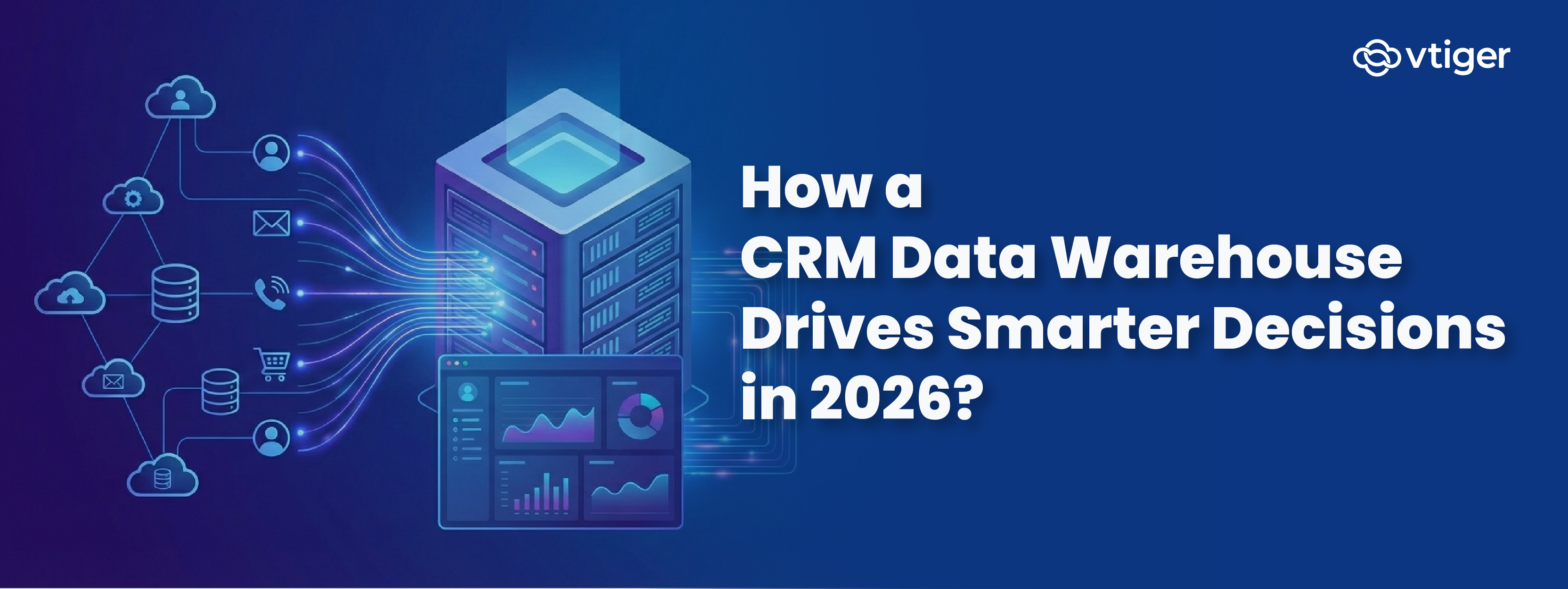
Data is continuously pulled from CRM systems, ERP platforms, inventory tools, marketing channels, and support systems. The goal is not to judge or aggregate yet. It is to capture events before they disappear.
Examples:
- Deal value revisions
- Delivery date changes
- Inventory reallocations
- Escalations and reversals
Step 2: Align timelines across systems
Different systems operate on different clocks. Sales works in conversations. Operations works in schedules. Finance works in periods.
The warehouse aligns these timelines so that cause and effect can be examined without guesswork.
Step 3: Store for analysis, not transactions
Data is stored in structures optimized for reading, comparison, and pattern detection. This is where crm in data warehouse setups differs from operational storage. Writes are rare. Reads are heavy. History is preserved.
Step 4: Expose patterns, not just numbers
The output feeds BI tools, forecasting models, and automation logic. The value is not dashboards. The value is understanding why plans break and where assumptions fail.
CRM Data Warehouse vs CRM Database
This comparison usually comes up only after something breaks. Reports start running slowly. Forecast numbers do not match reality. Teams argue over which dashboard is correct. At that point, organizations realize they are asking long-range questions from systems designed only to handle live transactions.
The confusion comes from using a CRM database for analytical work it was never designed to support, instead of separating operational storage from a CRM data warehouse built for historical insight.
CRM Database
A CRM database is designed to support live business activity. Its primary purpose is to ensure that sales, marketing, and support teams can record and update information quickly as work happens.
It is optimized for frequent inserts and updates. Lead statuses change, deal values are revised, tickets move between queues, and records are overwritten as new information becomes available. This design keeps operational systems responsive, but it also means historical context is gradually lost.
Because of this structure, a CRM database holds limited historical depth. It answers questions that are immediate and action-oriented, such as which leads need follow-up today, which tickets are overdue, or which opportunities are close to closing.
CRM Data Warehouse
A CRM data warehouse serves a different purpose. It exists to explain outcomes rather than to process transactions. Instead of focusing on what changed most recently, it preserves how customer data evolved over weeks, months, or years.
In data warehousing in CRM environments, systems are optimized for complex read operations rather than constant updates. Data is stored in analytical structures that allow large queries, comparisons across periods, and correlations between customer behavior and business results.
A CRM data warehouse stores years of historical context. It answers questions such as why similar deals close at different speeds, why certain customers churn despite strong early engagement, or how changes in sales behavior affect downstream fulfillment and support costs.
Key Components of a CRM Data Warehouse
A CRM data warehouse does not fail because the wrong platform was chosen. It fails when data discipline is treated as an afterthought. The components below matter not as a checklist, but because each one protects the meaning of data as it moves from activity to analysis.
Source systems
Source systems are where customer activity originates. This includes CRM platforms that record sales and service interactions, ERP systems that capture orders and invoices, inventory and logistics tools that reflect fulfillment reality, and marketing systems that track engagement. The role of source systems is not just to supply data, but to supply context. If customer actions, order confirmations, and delivery outcomes come from different systems without alignment, the warehouse inherits inconsistency from day one.
Ingestion pipelines
Ingestion pipelines control how data enters the warehouse. Some data arrives in batches, such as daily order summaries or monthly billing records. Other data arrives close to real time, such as lead updates, deal stage changes, or support escalations. Well-designed ingestion pipelines preserve timing and sequence. Poorly designed pipelines flatten events into snapshots, making it impossible to understand how decisions evolved. In data warehousing in CRM, ingestion quality directly determines analytical trust.
Transformation logic
Transformation logic exists to make data usable without distorting it. This includes standardizing formats, resolving duplicates, aligning customer identifiers across systems, and enriching records with reference data. The risk here is over-cleaning. When transformations remove too much variation, they erase the very signals analysts need. A mature CRM data warehouse balances consistency with traceability, allowing teams to see both cleaned metrics and underlying raw changes.
Analytical storage
Analytical storage is designed for comparison, not transactions. Data is organized to support long time ranges, multiple dimensions, and repeated querying without performance loss. This is where CRM and data warehouse design diverge from operational databases. Writes are infrequent. Reads are heavy. Historical depth is preserved even when business structures change.
Governance layer
Governance determines whether the data warehouse becomes trusted or ignored. Ownership defines who is responsible for each dataset. Access control ensures sensitive data is visible only to the right roles. Lineage explains where the data came from and how it was transformed. Most failed implementations focus on storage first and governance last. That order guarantees mistrust, because users cannot tell which numbers are reliable or how they were produced.
Consumption layer
The consumption layer is where value is realized. BI dashboards support analysis. Forecasting engines use historical patterns. AI models learn from consistent datasets. This layer should adapt as questions change. When it is tightly coupled to storage decisions, the warehouse becomes rigid instead of insightful.
Also read: Components of CRM here
4 Types of Data Stored in a CRM Data Warehouse
A CRM data warehouse becomes useful only when different kinds of data remain connected instead of being analyzed in isolation. Each type answers a different part of the decision problem.
Also Read: What is a CRM Database
1. Identity data
Identity data establishes who the customer is across systems. It includes accounts, contacts, organizational hierarchies, and relationship mappings. This data allows sales activity, orders, and support interactions to be tied back to the same customer entity even when systems use different identifiers.
2. Behavioral data
Behavioral data captures how customers interact over time. This includes engagement patterns, channel usage, response timing, and interaction frequency. Behavioral signals often appear before revenue changes. In CRM in data warehouse environments, this data helps explain early warning signs that transactional metrics miss.
3. Quantitative data
Quantitative data measures outcomes. Order values, purchase frequency, velocity of transactions, support ticket volume, and resolution times fall into this category. These metrics explain scale and impact, but not motivation. On their own, they show what happened, not why it happened.
4. Qualitative data
Qualitative data provides context. Customer feedback, escalation notes, survey responses, and sentiment indicators reveal intent, frustration, and satisfaction. When qualitative data is linked to quantitative trends, patterns become interpretable instead of speculative. Numbers explain what. Qualitative data explains why.
Benefits of Using a CRM Data Warehouse
The primary benefit of a CRM data warehouse is not broader visibility or faster reporting. It is the ability to make consistent decisions under pressure. By preserving historical context and linking customer behavior to downstream outcomes, the warehouse reduces reliance on assumptions during planning and execution.
Forecasts become testable
Sales forecasts are evaluated against multi-year behavioral patterns rather than pipeline confidence alone. Variance analysis identifies whether gaps come from demand shifts, execution delays, or qualification errors. Planning improves without forcing conservative assumptions.
Inventory buffers become measurable
Safety stock levels are calculated using observed demand volatility by customer segment, product category, and seasonality. Historical order movement, cancellations, and fulfillment performance stored in the CRM data warehouse replace blanket buffer rules with evidence-based sizing.
Automation becomes pattern-driven
Workflows trigger based on recurring signals. Historical event sequences enable automation to respond to trend thresholds, reducing false alerts and unnecessary escalations while improving timing accuracy.
Leadership debates assumptions
Shared historical context removes time spent reconciling reports. Reviews focus on testing planning assumptions such as demand elasticity, customer mix changes, and service capacity limits. Decisions accelerate because the data foundation is already aligned.
This is why modern evaluations of a Best CRM Platform increasingly include warehouse compatibility as a requirement rather than a bonus.
Read: Benefits of using marketing automation in CRM
Role of CRM Data Warehousing in Analytics
A CRM data warehouse changes analytics from pattern spotting to decision testing.
Instead of asking “what happened last quarter,” analytics can test assumptions such as:
- Which early sales behaviors consistently lead to delivery overruns
- Which customer segments look profitable initially but erode margin over time
- Which operational responses actually change customer behavior versus those that only shift timing
Because CRM data warehouse environments retain full decision sequences, analytics can isolate cause from coincidence. Models can be validated against past cycles rather than tuned on short windows. This is the point where analytics stops supporting reporting teams and starts supporting planning, pricing, and automation logic.
Without a CRM data warehouse, analytics remain limited to correlation. With it, analytics becomes a way to prove or disprove how the business believes it works.
Also Read: CRM Strategies to improve Business
CRM Data Warehouse Architecture Explained
A CRM data warehouse architecture is designed to prevent analytical questions from corrupting historical truth.
- Source systems remain untouched, so operational behavior is not distorted
- Ingestion layers preserve original events before business rules are applied
- Raw historical storage ensures past data is never reinterpreted when definitions change
- Curated models allow multiple analytical views without rewriting history
- Consumption layers change frequently without destabilizing upstream data
This separation allows CRM data warehouse systems to answer new questions years later without invalidating earlier conclusions. Architecture is not about performance alone. It is about protecting interpretability as the business evolves.
CRM Data Warehouse for Sales, Marketing, and Support
A CRM data warehouse removes plausible deniability between functions.
Sales
Sales performance can be evaluated against long-term outcomes, not just bookings.
Commitments are judged by fulfillment stability and retention impact, not pipeline confidence alone.
Marketing
Campaigns are evaluated by their downstream effects, not surface metrics.
Lead volume is weighed against sales effort, fulfillment pressure, and service load.
Support
Recurring issues are traced back to upstream decisions rather than handled as isolated incidents. Support becomes an early warning system, not just a resolution function.
By anchoring all three teams to the same historical record, the CRM data warehouse forces tradeoffs to surface early. Performance discussions shift from defending activity to owning consequences. This shared context matters deeply for CRM for Startups and Business Services CRM, where scale amplifies every mistake.
Data Integration and ETL in CRM Data Warehousing
Data integration determines whether the analysis reflects how the business actually operates. ETL decisions affect what can be measured later and what cannot be reconstructed.
Effective ETL must handle the following:
Event sequencing
ETL must capture changes as they occur. Deal value updates, delivery date changes, order reallocations, and escalations need to be stored as separate events. If only final values are stored, it becomes impossible to analyze how decisions evolved.
Cross-system identity resolution
Customers, products, and orders often use different identifiers across CRM, finance, logistics, and support systems. ETL must link these without collapsing detail. Incorrect matching leads to misleading customer-level and order-level analysis.
Schema change tolerance
Source systems change fields, add attributes, or modify structures. ETL pipelines must absorb these changes without rewriting historical data. This is essential for maintaining long-term usability of a CRM data warehouse.
When ETL is built mainly to make reports run faster, important detail gets flattened or lost. When it is built to support decisions, it keeps the variation and change that planners and analysts actually need.
CRM Data Warehouse Challenges
The main challenges surface after initial deployment, when the warehouse is used for planning and review rather than reporting. The common failure points include:
Data quality issues
Missing fields, delayed updates, and inconsistent values usually reflect process gaps in upstream systems. The warehouse exposes these issues rather than causing them.
Unclear ownership
When responsibility for datasets is not defined, disputes arise during reviews. Teams question numbers because no one is accountable for accuracy or definition.
Cost escalation
High query costs and slow performance often trace back to early design choices, such as storing highly aggregated data or duplicating datasets unnecessarily.
Low adoption
When users continue exporting data to spreadsheets, it indicates a lack of trust. This typically occurs when the warehouse answers reporting questions but does not support decision-making needs.
Warehouses fail when they are built to generate reports rather than to support planning and evaluation.
Best Practices for CRM Data Warehousing
Best practices focus on maintaining analytical usefulness as the business changes. The following are a few of the key practices that sustain long-term value:
Tie datasets to decisions
Every dataset should support a specific planning, prioritization, or evaluation decision. Data without a clear decision use case adds maintenance cost without value.
Define ownership early
Each dataset should have a clearly assigned owner responsible for definition, quality, and change management.
Preserve raw historical data
Raw data should remain unchanged. Adjustments and business logic should be applied in curated layers, not by altering historical records.
Design for evolving definitions
Customer segments, product categories, and performance metrics will change. The warehouse must support reclassification without altering past data.
Plan for adoption
Documentation, training, and review processes are required for teams to rely on the warehouse. Technical correctness alone does not ensure usage.
Many organizations revisit the Implementation of CRM after realizing that operational efficiency does not automatically result in analytical clarity.
How CRM Data Warehousing Supports AI and Automation
AI and automation depend on consistent historical data rather than isolated records.
What the CRM data warehouse enables
Sequential learning
Models can learn from ordered event histories rather than static snapshots. This improves accuracy in forecasting and classification tasks.
Stable relationships
Customer, account, and product relationships remain consistent across training cycles, reducing errors caused by changing identifiers or definitions.
Reproducible training datasets
Versioned datasets allow models to be retrained, tested, and compared using the same data conditions. This supports auditability and controlled improvement.
With this structure, automation rules can be based on observed patterns across time instead of single data points. In 2026, AI systems without CRM and data warehouse alignment remain limited to narrow use cases rather than supporting core planning and execution.
FAQs
Q1. What is a CRM data warehouse, and how does it work?
A CRM data warehouse is an analytical system that stores customer data over long periods instead of just current records. It works by pulling data from CRM, finance, operations, and support systems, then organizing it for analysis. This allows teams to study how customer activity, decisions, and outcomes connect over time, not just what is happening today.
Q2. How is a CRM data warehouse different from a CRM database?
A CRM database supports daily work like updating leads, closing deals, or resolving tickets. A CRM data warehouse supports analysis. It keeps historical data, tracks changes, and allows complex queries across months or years. The database helps teams act now, while the warehouse helps them understand why results differ and how future decisions should change.
Q3. Why do businesses need a CRM data warehouse in 2026?
Businesses deal with higher data volume, faster cycles, and greater pressure to predict outcomes. A CRM data warehouse is needed because operational systems alone cannot explain patterns across time. It supports forecasting, planning, and automation by linking customer behavior to delivery, revenue, and service impact instead of relying on short-term snapshots.
Q4. What type of data is stored in a CRM data warehouse?
A CRM data warehouse stores identity data such as accounts and contacts, behavioral data like engagement and response timing, quantitative data including orders and support volumes, and qualitative data such as feedback or escalation notes. Keeping these together allows teams to see not only what happened, but also why outcomes unfolded the way they did.
Q5. How does a CRM data warehouse support analytics and AI?
Analytics and AI depend on consistent historical data. A CRM data warehouse provides ordered event histories, stable relationships, and repeatable datasets. This allows models to learn from patterns instead of isolated records. As a result, forecasting, segmentation, and automation become more reliable and easier to improve over time without rebuilding logic from scratch.
Q6. What are the challenges of implementing a CRM data warehouse?
The main challenges are not tools but discipline. Common issues include poor data quality from upstream processes, unclear ownership of datasets, rising costs from weak architecture choices, and low adoption when teams do not trust the output. Successful implementations treat the warehouse as decision infrastructure, not just a reporting system.