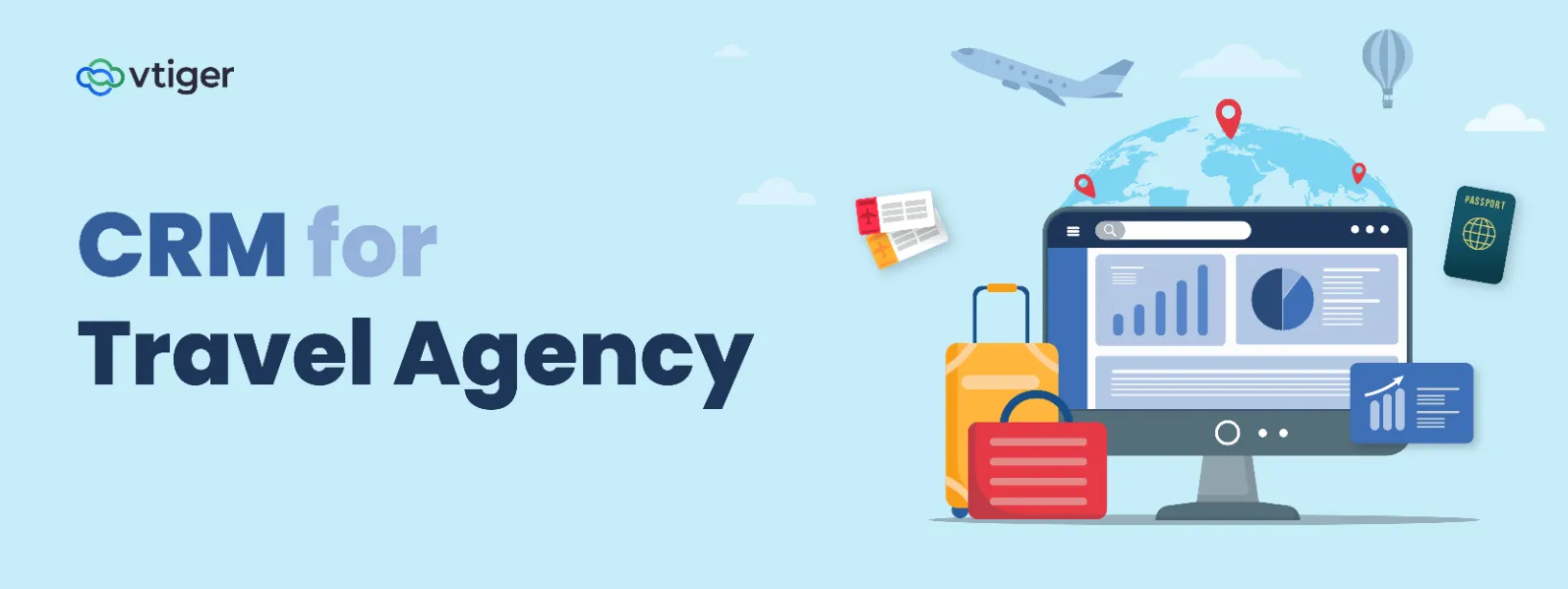
Travel isn’t just about destinations but about experiences that feel personal, effortless, and perfectly timed. But behind every great travel experience is a system that keeps everything running smoothly:; Travel CRM.
As the travel industry becomes more competitive and customer expectations rise, agencies can no longer rely on spreadsheets or manual follow-ups.
With tools like AI-based analytics, automated booking management, and real-time lead tracking, CRM for travel is helping travel businesses improve their efficiency, conversion rates, and customer satisfaction. In 2026, a Travel CRM is nothing less than your agency’s growth engine.
What is a Travel Agency CRM?
A Travel CRM is a specialized software solution designed to help travel agencies, tour operators, and agents manage every step of a customer’s journey. In fact, a travel agency CRM can manage it all, inquiries, arrangements and even post-trip engagement.
A travelling agency CRM brings together essential modules like lead management, itinerary building, booking coordination, invoicing, and multi-channel communication, all under one digital roof. With it, you can manage flight and hotel bookings, track follow-ups, automate emails, and access real-time analytics to improve client satisfaction.
Unlike generic CRM systems, a Travel CRM includes industry-specific modules tailored to the unique needs of tour operators and travel agents.
Why CRM is essential for modern travel agencies
The modern travel agency operates in a complex environment where it should manage numerous verticals simultaneously.
Automation doesn’t replace the travel agent but empowers them to focus on what humans do best; creating memorable journeys.
Here’s why CRM has become indispensable:
Managing Multiple Customer Journeys
Every traveler is at a different stage. Some are just browsing, others are ready to book, and many are repeat customers with specific preferences. A CRM tracks each journey individually, ensuring personalized attention without overwhelming your team. Multi-journey management reduces lead leakage through structured follow-ups and automated reminders.
Automating Repetitive Booking Tasks
Manual data entry, follow-up reminders, invoice generation, and voucher creation consume hours. Travel agency CRM automates these processes, freeing your staff to focus on high-value customer interactions and complex itinerary planning.
Improving Lead-to-Customer Conversion
Many travel leads are lost due to poor follow-up. With automated reminders, lead scoring, and real-time tracking, CRMs dramatically improve conversion rates by ensuring timely, relevant engagement with every prospect.
Enhancing Customer Satisfaction
When agents have instant access to customer preferences, past bookings, and special requests, they can deliver personalized service that builds loyalty and generates referrals.
Key features of CRM for travel agencies (2026)
The mark of a good CRM is mobility. This means that your travel CRM should move with you and evolve with your needs. ;
Centralized Lead and Contact Management
All your inquiries, customer profiles, and follow-ups are organized in one place. The CRM lets you track every touchpoint. With travel CRM, travel businesses can view complete customer histories, making personalization effortless.
Automated Booking & Itinerary Management
A Travel CRM automates your booking confirmations, vendor coordination, and itinerary generation. The built-in itinerary builder simplifies travel planning, ensuring every flight, transfer, and hotel is aligned. This saves both time and the risk of human error.
AI-Powered Insights and Predictive Analytics
Travel decisions run on data. CRMs now use AI to predict traveler preferences, seasonal trends, and upsell opportunities. Whether it’s identifying repeat travelers or recommending upgrades, predictive analytics helps agencies stay one step ahead.
Multi-Channel Communication Tools
A Travel CRM integrates emails, WhatsApp, calls, and even social media DMs. Every communication thread is logged automatically. This ensures that agents can deliver consistent service, no matter how a client reaches out.
Integration with Travel APIs and Accounting Systems
With Travel CRM, businesses can connect directly with Amadeus, Expedia, or GDS systems, and sync accounting tools for seamless financial tracking. Moreover. API integration reduces double entries, ensures data accuracy, and connects all your business tools into one cohesive ecosystem.
Important Note:
- Global Distribution System (GDS) is a centralized booking system for travel. It acts as a mediator between travel agents and online booking sites to search seat availability, compare prices, and more.
- Amadeus is a GDS primarily used by travel agents to search, book, and manage flights, hotels, cars, and more in real time.
- Expeida is an online travel agency that helps customers book travel directly and view packages.
Mobile CRM Access
The travel business never stops, and neither should your data. Mobile access lets your team respond, manage leads, and update itineraries from anywhere. No matter where you are, everything is just a tap away.
Customizable Dashboards and Reporting
Stay informed with dashboards that visualize bookings, cancellations, and revenue growth in real-time. Travel CRM allows each department to build its own dashboard for full visibility.
Benefits of using CRM for travel agencies
A great CRM can transform business outcomes and enhance efficiency. This enhanced efficiency will not just save time but scale success as well.
Higher Customer Retention Through Trip-History Intelligence
A CRM captures a traveller’s past itineraries, budgets, preferences, complaints, and booking behaviour. This allows your team to recommend relevant destinations, seasonal deals, and loyalty rewards, turning one-time travellers into repeat clients.
Faster Response Times Across All Enquiry Channels
Whether leads come from WhatsApp, website forms, referral partners, Instagram, or walk-ins, the CRM consolidates them. Automated reminders ensure no enquiry goes cold—critical during peak seasons when missed follow-ups cost real revenue.
Smoother Collaboration Between Sales, Operations & Ticketing
When itineraries, payment statuses, passport details, supplier confirmations, and client notes are all in one place, teams don’t waste time searching for information. Everyone works off a unified timeline; reducing errors like duplicate bookings or missed confirmations.
Better Decision-Making With Real Booking & Revenue Data
The CRM highlights which destinations are trending, which sales agents convert the fastest, where enquiry drop-offs happen, and which packages deliver the highest margin. Leadership gains clarity to adjust pricing, marketing, staffing, and supplier negotiations.
Reduced Manual Work in Daily Travel Agency Operations
Automations handle repetitive tasks such as:
– sending payment reminders
– follow-up nudges
– itinerary drafts
– ticket/visa status updates
– pre-trip checklists
This drastically reduces admin time and reduces team burnout during rush periods.
Personalized Travel Experiences
CRMs let you craft targeted itineraries and send offers based on traveller personas – solo explorers, corporate accounts, family travellers, etc. Personalization increases conversion rates and improves feedback scores.
Higher Conversions Through Lead Scoring & Upsell Signals
The system identifies high-intent enquiries (e.g., quick responses, repeated destination searches, premium budget ranges). It also surfaces upsell opportunities such as hotel upgrades, add-on tours, insurance, or airport transfers, boosting per-customer revenue.
How CRM helps in managing customer relationships
A CRM strengthens customer relationships by giving travel agencies a structured way to manage every interaction before, during, and after a trip. Instead of handling communication in scattered systems, the CRM keeps customer context, preferences, and engagement history organised. This helps teams deliver timely, relevant and consistent experiences that build trust over time.
Understanding Customer Needs More Accurately
A CRM records traveller profiles, inquiry details, budget ranges and trip preferences in a single system. When agents have an updated view of each customer, they can respond with better clarity and tailor their suggestions to match actual interests. This creates a smoother communication flow and sets the base for a long-term relationship.
Delivering Personalised and Context-Driven Offers
With organised customer insights, the CRM helps agencies share recommendations that align with past travel behaviour or upcoming plans. Whether it is a seasonal deal, a preferred destination or a relevant upgrade, personalised offers feel more intentional and increase customer engagement.
Maintaining Post-Trip Engagement
A CRM supports structured post-trip communication such as thank you messages, service follow-ups, and reminders for future planning. It also manages automated feedback collection, allowing agencies to capture customer insights without manual effort. When customers see that their feedback shapes future interactions, they feel valued and remain connected to the agency.
Role of AI and automation in Travel CRM (2026 Trends)
AI and automation are now central to how travel CRMs function. They help agencies work faster, personalise communication more effectively, and manage customer journeys with far greater accuracy than manual processes.
AI Chatbots for Instant Query Handling
AI chatbots answer common questions in real time.
Examples include:
• sharing package details
• checking availability
• guiding customers on documents and payments
This reduces response delays and frees agents to handle complex requests.
Automated Lead Scoring for Better Prioritisation
Travel CRMs analyse customer behaviour to score leads automatically. For instance, repeated destination searches or quick replies signal higher intent. This helps teams focus on ready-to-book customers instead of guessing who to follow up with.
Predictive Personalization for Relevant Recommendations
AI reviews data such as past trips, travel seasons, budgets and preferences. It then suggests ideal destinations, upgrades or add-ons. Agents can use these insights to send recommendations that match real customer interests and improve conversion rates.
Smart Task Scheduling for Operational Efficiency
Automation assigns tasks like follow-ups, reminders, vendor updates and payment alerts. Agents no longer need to track these manually, which reduces errors and ensures every customer receives timely communication.
Travel CRM vs. Traditional CRM: What’s the Difference?
One thing that can clearly explain the difference between travel CRM and traditional CRM is that: A traditional CRM tracks clients, and a travel CRM understands them:
| Feature | Traditional CRM | Travel CRM (CRMtravel™) |
| Lead Management | Generic lead tracking | Made for travel inquiries and follow-ups |
| Itinerary Builder | Not available | Built-in itinerary and booking module |
| API Integration | Limited | Connects with GDS, Amadeus, Expedia |
| Automation | Standard email workflows | Full booking and communication automation |
| Customer Data | Basic contact info | Travel preferences, history, and booking behavior |
| Reporting | General reports | Travel-specific KPIs and revenue tracking |
| Mobile Access | Optional | Real-time mobile dashboard access |
Choosing the right travel CRM software for your agency
A travel CRM must strengthen the way your agency serves clients, manages operational load, and collaborates with suppliers. The right system supports higher inquiry volumes, reduces manual tasks, improves accuracy across bookings, and gives your teams the clarity they need to respond to travellers quickly.
While many platforms look similar on the surface, the real difference lies in how well they align with the daily realities of running a travel business. The following factors help agencies evaluate a CRM based on measurable operational value rather than broad feature lists.
Scalability and Operational Fit
The CRM must support the actual volume and complexity of your operations. It should manage high-frequency quotation cycles, multi-component itineraries, repeated modifications, and group travel workflows without slowing down teams. This ensures sales, operations, and finance can work simultaneously without data conflicts or bottlenecks.
Cloud or On-Premise Deployment
Cloud deployment supports fast onboarding, remote team access, and automatic updates. It suits agencies with distributed teams, multiple branches, or dynamic seasonal demand. On premise systems are suitable only for agencies with dedicated in house IT resources and strict data control policies. Choose the approach that aligns with your long term security and infrastructure roadmap.
Integration with Booking and Supplier Systems
A high-quality travel CRM must connect with GDS, airline feeds, hotel inventory systems, DMC portals, and internal booking engines. This creates a unified view of availability, pricing, allotments, and cancellation rules. Strong integration removes repetitive data entry, reduces booking errors, and improves coordination with hotels, transport partners, and destination teams.
Financial Workflow Support
The CRM should streamline quotation creation, invoice generation, tax calculations, vendor payouts, and payment tracking. Automated reminders for pending customer payments and vendor settlements prevent leakage and improve cash flow visibility. Real-time financial reports support faster decision-making for managers and branch heads.
Agency Level Customisation
Look for a CRM that adapts to the way your agency runs. This includes custom sales pipelines for FIT and group travel, workflow automation for visa support, seasonal pricing rules, custom lead scoring, and approval flows for special rates. A system that molds to your internal processes ensures staff adoption and long-term productivity.
Support Quality and Total Cost of Ownership
Evaluate the availability of onboarding support, training, and response time commitments. Factor in subscription costs, integration expenses, custom development, and data storage charges. A CRM that looks inexpensive at the start may become costly if it requires constant manual workarounds.
Future of Travel CRMs: Trends to watch in 2026 and beyond
The next generation of travel CRMs is being shaped by clear advancements in AI, automation, data intelligence, and customer experience design.
Agencies can expect systems that not only reduce operational effort but also strengthen every stage of the traveler lifecycle. The future is moving toward CRMs that think ahead, respond faster, and give agencies deeper control over personalization, security, sustainability, and revenue opportunities.
The following trends capture what will define high-performing travel CRM platforms in the coming years.
Predictive Personalization
CRMs are moving toward machine learning driven traveler profiling. These systems study booking history, browsing patterns, spending ranges, seat and meal preferences, and loyalty activity to generate precise recommendations. Agencies will see targeted destination suggestions, fare predictions, alternate route visibility, and dynamic pricing support. Predictive engines also flag churn risk and identify upsell opportunities. Early adopters are already reporting higher campaign engagement and increased booking values.
Voice-Enabled CRM
Voice to CRM capabilities will remove most manual data entry for sales and support teams. Conversational AI will record calls, transcribe notes, update records, and create tasks directly within the CRM. Agents will retrieve itineraries, view pipelines, and schedule follow-ups using natural language commands. Voice biometrics, multilingual support, and secure payment capture will make this format suitable for remote teams and field sales.
Data Security Enhancements
Travel CRMs will strengthen security through AES grade encryption, secure communication protocols, and detailed access controls. Role-based permissions, multi-factor authentication, audit trails, and automated threat alerts will become standard. Compliance readiness for GDPR, CCPA, and the DPDP Act will ensure safe handling of passports, visas, payment information, and other personal data.
Sustainability Tracking
CRMs will begin to calculate emissions for flights, hotels, transfers, and activities. Integrated dashboards will help agencies report on Scope 1, 2, and 3 emissions and segment travelers based on sustainability preferences. These systems will also highlight eco-friendly suppliers, support carbon offset integration at booking, and track vendor sustainability performance across destinations.
Deeper AI Integration
AI will automate lead scoring, evaluate engagement patterns, and guide teams with next best action prompts. Chatbots will qualify leads, answer itinerary queries, and escalate complex cases with full context. Predictive forecasting, anomaly detection, and intelligent workflow triggers will refine sales and operations planning while ensuring consistent data across all touchpoints.
Conclusion: Why every travel agency needs CRM in 2026
A CRM gives travel agencies the structure and operational depth required to run a high-volume, service-driven business. It centralizes lead pipelines, booking workflows, vendor coordination, communication records, and customer intelligence so teams can work with clarity instead of chasing scattered information. When every inquiry, quote, payment, and post-trip action is tracked in one place, agencies deliver faster responses, fewer errors, and more consistent service.
The real value of a CRM shows up in long-term outcomes. Agencies see higher retention because customers receive timely, relevant communication based on accurate trip history. Revenue improves because agents can act on real data rather than assumptions. Internal teams collaborate better because sales, operations, accounts, and ticketing all operate from the same system.
For any agency focused on sustainable growth and repeat business, a CRM is now a strategic and operational requirement.
FAQs About CRM for Travel Agencies (2026)
Q1. What does CRM mean in the travel industry?
A CRM in the travel industry is a system that manages the full sales and operations lifecycle. It captures inquiries from websites, OTAs, WhatsApp, and ads, assigns tasks to sales teams, centralizes customer documents, tracks quotation revisions, and syncs bookings with airline and hotel suppliers. It ensures every stage from lead qualification to voucher issuance is controlled, traceable, and aligned with your agency’s service standards.
Q2. How can a travel CRM improve customer satisfaction?
A travel CRM improves satisfaction by ensuring agents never miss critical checkpoints such as visa updates, balance reminders, rooming list submissions, or supplier confirmations. It stores travel history, dietary notes, budget bands, cabin preferences, and family details so agents tailor every itinerary. Automated pre-trip alerts, real-time itinerary revisions, disruption notifications, and structured post-trip surveys create consistent communication that customers recognize as reliable, proactive, and high-value.
Q3. Is CRM suitable for small or mid-sized travel agencies?
Yes, small and mid-sized agencies benefit significantly because a CRM removes dependency on manual tracking across spreadsheets, WhatsApp chats, and email threads. It organizes FIT and group leads, allocates tasks across a small team, standardizes quotation and voucher formats, and prevents missed follow-ups during peak seasons. With cloud access, owners can monitor pipeline health, agent productivity, and supplier payments in real time without expanding operational overhead.
Q4. What are the most important features of travel CRM software?
Important features include automated lead routing, itinerary builders that support flights, hotels, transfers, and DMC inclusions, supplier rate management, and API connections to GDS and hotel channels. Integrated communication functions tie every email, WhatsApp message, and call log to the booking record. Real-time revenue dashboards, aging reports, payment tracking, and cancellation workflows help agencies maintain accuracy, reduce operational delays, and deliver a smoother end-to-end customer journey.
Q5. How does CRM help in lead management for travel agencies?
A travel CRM helps agencies handle high lead volumes by capturing every inquiry from campaigns, referrals, walk-ins, B2B partners, and comparison sites in one view. It categorizes leads by intent, travel window, destination, and budget so teams can assign them to the right specialists. Automated reminders maintain consistent outreach, while managers track response quality and handover speed to improve lead-to-itinerary conversion.
Q6. Can CRM integrate with booking engines and payment gateways?
Yes, travel CRMs connect with booking engines, airline consolidator portals, hotel inventory systems, and domestic or international payment processors. These integrations allow agents to pull live rates, confirm availability, generate invoices, and collect payments without switching platforms. This reduces processing errors, speeds up reservation handling, and ensures finance teams receive clean, itemized transaction records for auditing and reconciliation.
Q7. What is the role of AI in travel CRM systems?
AI supports travel operations by identifying customer patterns such as preferred trip length, budget tolerance, and response habits. It allocates leads to available agents based on workload, skill, or destination expertise. AI also suggests better timing for follow-ups, flags incomplete bookings, and prioritizes customers likely to convert. This helps agencies manage demand surges and maintain consistent service without overextending staff.