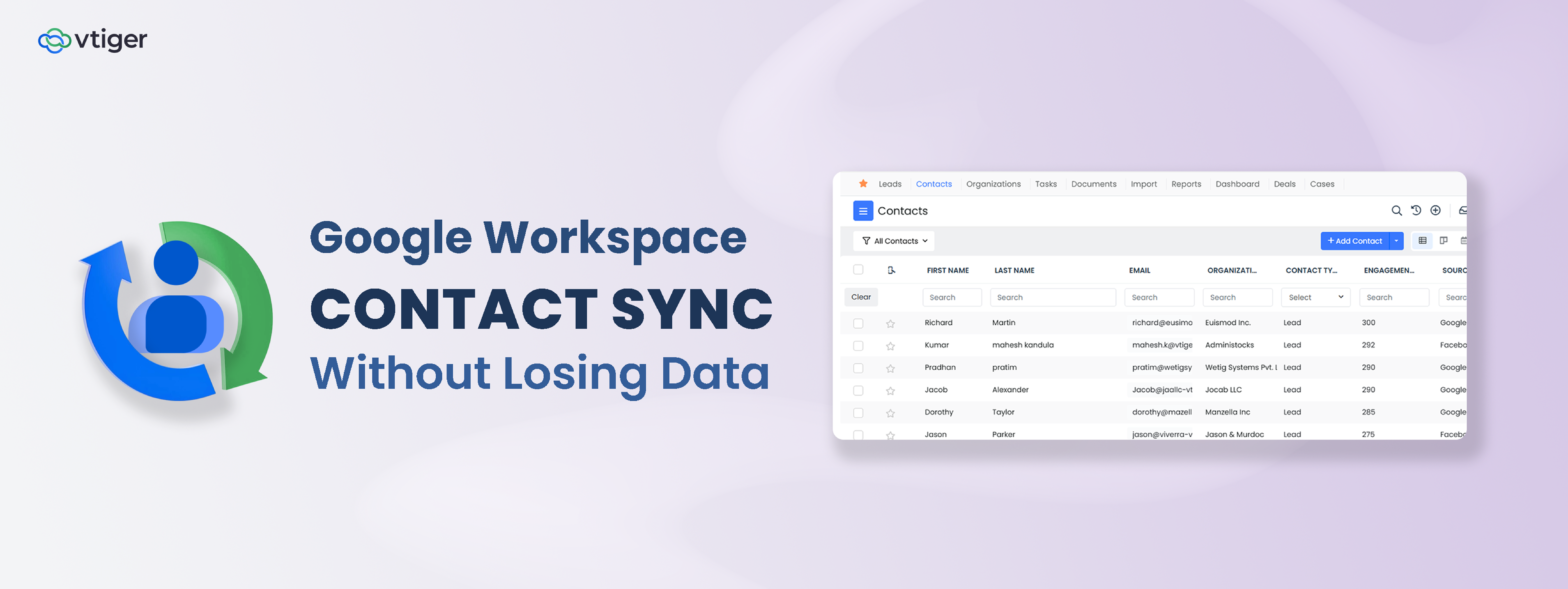
Google Workspace contact sync copies contacts between Google Contacts and a CRM on a schedule. Duplicates usually appear when the two systems fail to identify the same person using the configured match key. Data can also be lost when a conflict rule overwrites a newer value or a deletion propagates between systems. Google Contacts can undo changes from the past 30 days, making that the practical recovery window.
Contact sync rarely causes random data loss. Most problems come from three predictable points in the process: how records are matched, how conflicting edits are resolved, and whether deletions are allowed to propagate.
Many teams treat sync as a simple setup task. Connect Google Workspace, select the contact fields, choose a direction, and switch it on. The problems usually appear later, when someone discovers that a contact list has doubled or that a phone number corrected in the CRM has been replaced by an older value from Google Contacts.
Those outcomes are not necessarily software failures. They often result directly from how the sync rules were configured. The safer approach is to understand what the connector does during each sync cycle, identify which system should control important fields, and create a recovery point before the first bulk sync.
How Contact Sync Works
Google Workspace contact sync compares and updates records between two separate systems. It is usually scheduled rather than instantaneous, so each cycle checks what changed since the previous run and then applies the configured rules.
A sync cycle involves five steps:
- The connector checks for changes – It identifies contacts created, edited, or deleted since the previous cycle. Depending on the connector, these checks may happen every few minutes rather than immediately.
- It matches records – For each changed contact, the connector looks for the corresponding record in the other system. The field used for this comparison is the match key, and email address is a common choice.
- It maps fields – The connector determines which fields correspond between the two systems. Name, email, phone, company, and job title may have direct equivalents. Fields without a mapped destination are not transferred.
- It resolves conflicts – If the same contact was changed in both systems before the next sync, a conflict rule determines which value is retained.
- It writes the changes – The connector applies the resulting changes according to the selected sync direction and permissions.
The important point is that matching and conflict resolution are separate problems. Matching determines whether the connector thinks two records belong to the same person. Conflict resolution determines which value survives when it knows they are the same person.
| Important note: Sync copies data between two systems that each maintain their own records. That differs from a Google Workspace CRM Integration built around a shared customer record. If you are still choosing a CRM, this distinction matters because a shared record reduces the amount of contact data that needs to be reconciled between separate systems. |
What gets transferred?
A contact sync does not necessarily transfer every field from one system to another.
| Data type | Google Contacts | CRM | Typical sync result |
| Name | Yes | Yes | Usually mapped |
| Yes | Yes | Usually mapped and used for matching | |
| Phone | Yes | Yes | Usually mapped |
| Company | Yes | Yes | Usually mapped |
| Job title | Yes | Yes | Often mapped |
| Labels | Yes | Varies | May not transfer |
| Lead source | No | Yes | Usually remains in CRM |
| Deal history | No | Yes | Remains in CRM |
| Custom CRM fields | No | Yes | Usually remain in CRM |
An unmapped field is not necessarily deleted. It simply has no destination in the other system. The risk arises when teams assume that a field exists on both sides and then discover that it was never included in the mapping.
One-Way Versus Two-Way Sync
Sync direction determines which system is allowed to change the other. That decision should come before you worry about individual field mappings because it determines whether conflicting edits can occur at all.
| Criteria | One-way sync | Two-way sync |
| Direction of changes | Source to destination | Both systems |
| Conflicts | Not between both systems | Possible |
| Duplicate records | Still possible | Possible |
| Destination edits | Can be overwritten | Can propagate back |
| Setup complexity | Lower | Higher |
| Best suited to | One system acting as the master | Teams actively using both systems |
One-way sync is safer when one system is clearly the source of truth.
For example, if Google Contacts is simply being used to populate a CRM, there is little reason to allow CRM edits to flow back into Google.
Two-way sync makes sense when employees genuinely update contacts in both systems.
It also introduces a new requirement: you need rules for deciding what happens when both systems contain different versions of the same contact.
The key distinction is simple: one-way sync reduces conflict risk, but it does not eliminate duplicate risk. A record can still be duplicated if the connector fails to match it to an existing contact.w
Why Sync Creates Duplicates And Losses
Most contact sync problems come from three mechanisms: failed record matching, conflicting edits, and deletion propagation. Each requires a different fix, which is why simply merging duplicates after every sync does not solve the underlying problem.
The Match Key
The match key is the field the connector uses to decide whether two records represent the same person.
Email address is commonly used because it is relatively unique. The problem is that it is not always present or consistent.
Where the match fails
Consider a contact that exists in both systems:
- Google Contacts: [email protected]
- CRM: [email protected]
A person can immediately recognize that both records may belong to John Smith. A connector using exact email matching cannot make that assumption. It sees two different values and may create a second record.
The same problem occurs when:
- One record has no email address.
- A work email is used in one system and a personal email in another.
- Phone numbers use different formats.
- The connector matches on a field that users regularly edit.
- Duplicates already existed before sync was enabled.
Phone formatting can create particularly confusing results. For example, +44 20 7946 0958 and 02079460958 may represent the same number but will not match if the connector compares the stored strings exactly.
Fix the key before merging
Merging duplicates is useful only after you’ve corrected the matching problem.
If the match key is still inconsistent, the next sync can recreate the duplicate records you just removed. The correct sequence is:
Identify why the match failed → standardize the field → merge existing duplicates → run a controlled sync.
For larger databases, it is also worth checking how many records are missing the chosen match key before enabling two-way sync.
Conflict Resolution
A conflict occurs when the connector recognizes two records as the same contact but finds different values because both systems were edited before the next sync.
Common approaches include:
| Conflict rule | What happens | Main risk |
| Last write wins | Most recent edit is retained | A useful earlier correction can be overwritten |
| System of record | One system controls the field | Changes in the other system may not be retained |
| Field-level rules | Different fields follow different rules | More setup and maintenance required |
Last write wins are convenient but can cause silent changes. If someone corrects a phone number in the CRM at 9:00 and another employee edits the same contact in Google at 10:00 using an older phone number, the later edit may replace the correction.
For fields that affect sales or customer service, consider designating a system of record instead. Your CRM database structure may contain information that should not be overwritten by an address-book edit.
Deletion Propagation
Deletion deserves separate attention because it can remove information that is not visible in the contact itself.
In a two-way configuration, deleting a contact in Google can potentially delete its CRM counterpart. If that CRM record contains notes, activities, deal information, or links to customer records, the impact is larger than losing a name and phone number.
| Action | Potential result |
| Edit contact | Another system receives the new value |
| Create contact | Another system creates a corresponding record |
| Merge contacts | One record may be removed or changed |
| Delete contact | Deletion may propagate |
| Change both sides | Conflict rule determines the surviving value |
If your connector allows deletion propagation to be disabled, consider keeping it off unless your workflow specifically requires it.
Setting Up Sync Safely
The most effective controls are the ones applied before the first sync. Once thousands of contacts have been duplicated or overwritten, the cleanup becomes considerably harder because you have to distinguish original data from sync-generated changes.
Complete these checks before the first cycle
- Export both systems: Save a CSV export of Google Contacts and the CRM outside both systems. This gives you a recovery point if the first sync behaves unexpectedly.
- Remove existing duplicates: Syncing a database that already contains duplicates makes matching harder and can multiply the problem.
- Check match-key coverage: Find out how many contacts lack the field you plan to use for matching, particularly email address.
- Standardize phone numbers: Use one format across both systems so that formatting differences do not prevent matching.
- Start with one-way sync: Populate the CRM first and inspect the results before allowing changes to flow in both directions.
- Disable deletion propagation: Keep deletions from automatically moving between systems unless there is a clear operational reason to allow them.
- Test with a small group: Start with 20 contacts rather than your entire database. A test group is enough to expose incorrect field mappings and matching rules.
Check the result after the first cycle
Do not stop checking when the first sync reports “complete.” Some connectors run additional reconciliation cycles after the initial transfer. A database that looks correct immediately after the first run can change again when the next scheduled cycle processes records.
A safer test is:
First cycle → inspect records → wait for another cycle → inspect again → expand the sync group.
| Don’t skip this: If the test group produces duplicates, stop the sync before expanding it. Fixing the match key and field mappings at this stage is far easier than repairing the same issue across thousands of records. |
Recovering From A Bad Sync
If a sync has already overwritten or deleted contacts, stop the sync before attempting a cleanup. Otherwise, the connector can continue applying the same rule while you are trying to reverse its effects.
The recovery process should follow this order:
- Disable the sync.
- Export the current state of both systems.
- Identify when the unwanted changes began.
- Use the available recovery history or backup.
- Repair duplicates and incorrect records.
- Correct the sync configuration.
- Run another small test before reconnecting the full database.
What Google Can Restore
Google Contacts provides an Undo changes option that can restore contacts to an earlier state within the previous 30 days. Google states that the restoration can return the contact list to its state at a selected point during that period.
That 30-day window matters because it limits how long you have to reverse a large-scale contact change from Google’s side. Before restoring, export your current contacts because contacts added after the selected restoration point can be removed when you restore an older state.
Google also notes that contacts permanently removed from Trash cannot be recovered through this restoration process.
What the 30-Day Window Does Not Cover
The Google recovery window applies to Google Contacts. It does not automatically restore data that was overwritten or deleted in your CRM.
For example, if a sync changes a CRM phone number and the CRM has no version history for that field, Google’s undo function does not necessarily restore the CRM value.
The same applies to information attached to a CRM record. A contact’s name and email may be easy to reconstruct from an export, but the related notes, activities, opportunities, and customer interactions may not be recoverable unless the CRM retains them separately.
| Recovery source | What it can help recover | Limitation |
| Google Contacts Undo | Earlier Google contact state | Limited to 30 days |
| Google Contacts Trash | Recently deleted contacts | Permanently emptied Trash cannot be restored |
| CRM recycle bin | Deleted CRM records | Retention varies by CRM |
| CRM audit/history | Previous field values | Depends on the CRM and enabled tracking |
| CSV export | Snapshot of contact data | Only contains what was exported |
| If it has already gone wrong: Turn the sync off before merging duplicates or restoring records. Then export the current state, determine when the problem started, repair the data, correct the sync rules, and reconnect only after a controlled test. Otherwise, the same faulty configuration can recreate the problem while you are fixing it. |
Syncing Contacts With Vtiger One
Vtiger One connects Google Workspace data with CRM records so teams can work with contacts, email, calendars, files, and meetings without maintaining completely separate customer records.
The important distinction is what happens after a contact reaches the CRM. A CRM contact can be associated with sales opportunities, support cases, activities, notes, and customer interactions. That context is not equivalent to the basic contact information stored in an address book.
This is why contact sync needs to be treated as a data management process rather than simply a connection between two apps.
The customer relationship management record should remain useful even when the Google contact contains only a name, phone number, and email address. The lead management process adds the sales context that an address book does not contain.
Fewer Copies To Reconcile
The more systems that maintain their own copy of customer information, the more matching and conflict rules you have to maintain.
An all-in-one CRM platform can reduce that duplication by keeping sales, marketing, and support teams on the same customer record. Google Workspace can then remain the productivity layer while the CRM remains the system where customer history and business activity are maintained.
Practical setup checks
If you are configuring Google Workspace with Vtiger, review these areas before enabling a bulk sync:
- Review Google app sync options and enable only the services your team actually uses.
- Confirm the Google CRM integration direction before the first sync.
- Apply CRM security controls to the users who can manage or trigger integrations.
- Treat a large first-time import as a CRM migration planning exercise rather than a routine settings change.
- If Gmail is central to the team’s workflow, evaluate whether a CRM built for Google reduces the number of separate systems employees need to update.
The objective is not to eliminate every integration. It is to make clear which system owns each piece of customer information, which fields can move between systems, and what happens when two users edit the same record.
Frequently Asked Questions
Why does my CRM keep creating duplicate contacts?
Because the sync cannot match the incoming record to an existing contact. Matching commonly uses email addresses, so contacts without an email, contacts with different emails in each system, or contacts with inconsistent formatting may be treated as new records.
Does one-way sync prevent duplicates?
No. One-way sync prevents conflicts caused by both systems editing the same record, but it does not prevent failed matching. If the connector cannot identify an existing contact, it can still create a duplicate in the destination system.
Which system wins when a contact changes in both?
The result depends on the conflict rule configured for the connector. A common default is last-write-wins, where the most recent edit replaces the earlier value. If a particular field must be controlled by one system, configure that system as the source of truth for the field where the connector supports it.
Can I recover contacts after a bad sync?
Google Contacts can undo changes made within the previous 30 days. Contacts permanently removed from Trash cannot be recovered through Google’s undo function. Whether you can recover data overwritten or deleted in the CRM depends on that CRM’s recycle bin, audit history, version history, or available backups.
Should I turn off deletion sync?
For most teams, disabling deletion propagation is the safer choice unless the workflow specifically requires it. Otherwise, a deletion can move from Google into the CRM and remove the record and potentially its associated business history.
How do I prepare before turning on contact sync?
Export both systems, remove existing duplicates, check the coverage of your match key, standardize phone formats, start with one-way sync, disable deletion propagation, and test the first cycle with a small group before syncing the full database.
Why did duplicates appear after the sync initially looked correct?
Some connectors perform reconciliation on later scheduled cycles. The first run may therefore appear successful before a subsequent cycle processes additional records. Test the sync group again after another scheduled cycle before expanding it.
What is a match key in contact sync?
A match key is the field a connector uses to decide whether a record in one system represents the same person as a record in another. Email address is commonly used. If the field is missing or inconsistent, the connector may create a new contact instead of updating the existing one.